<Neilmacmaster3@Gmail.Com> Serge Chakhotin's the Rape of Th
Total Page:16
File Type:pdf, Size:1020Kb
Load more
Recommended publications
-

THE PHILIPPINES, 1942-1944 James Kelly Morningstar, Doctor of History
ABSTRACT Title of Dissertation: WAR AND RESISTANCE: THE PHILIPPINES, 1942-1944 James Kelly Morningstar, Doctor of History, 2018 Dissertation directed by: Professor Jon T. Sumida, History Department What happened in the Philippine Islands between the surrender of Allied forces in May 1942 and MacArthur’s return in October 1944? Existing historiography is fragmentary and incomplete. Memoirs suffer from limited points of view and personal biases. No academic study has examined the Filipino resistance with a critical and interdisciplinary approach. No comprehensive narrative has yet captured the fighting by 260,000 guerrillas in 277 units across the archipelago. This dissertation begins with the political, economic, social and cultural history of Philippine guerrilla warfare. The diverse Islands connected only through kinship networks. The Americans reluctantly held the Islands against rising Japanese imperial interests and Filipino desires for independence and social justice. World War II revealed the inadequacy of MacArthur’s plans to defend the Islands. The General tepidly prepared for guerrilla operations while Filipinos spontaneously rose in armed resistance. After his departure, the chaotic mix of guerrilla groups were left on their own to battle the Japanese and each other. While guerrilla leaders vied for local power, several obtained radios to contact MacArthur and his headquarters sent submarine-delivered agents with supplies and radios that tie these groups into a united framework. MacArthur’s promise to return kept the resistance alive and dependent on the United States. The repercussions for social revolution would be fatal but the Filipinos’ shared sacrifice revitalized national consciousness and created a sense of deserved nationhood. The guerrillas played a key role in enabling MacArthur’s return. -

State Denial, Local Controversies and Everyday Resistance Among the Santal in Bangladesh
The Issue of Identity: State Denial, Local Controversies and Everyday Resistance among the Santal in Bangladesh PhD Dissertation to attain the title of Doctor of Philosophy (PhD) Submitted to the Faculty of Philosophische Fakultät I: Sozialwissenschaften und historische Kulturwissenschaften Institut für Ethnologie und Philosophie Seminar für Ethnologie Martin-Luther-University Halle-Wittenberg This thesis presented and defended in public on 21 January 2020 at 13.00 hours By Farhat Jahan February 2020 Supervisor: Prof. Dr. Burkhard Schnepel Reviewers: Prof. Dr. Burkhard Schnepel Prof. Dr. Carmen Brandt Assessment Committee: Prof. Dr. Carmen Brandt Prof. Dr. Kirsten Endres Prof. Dr. Rahul Peter Das To my parents Noor Afshan Khatoon and Ghulam Hossain Siddiqui Who transitioned from this earth but taught me to find treasure in the trivial matters of life. Abstract The aim of this thesis is to trace transformations among the Santal of Bangladesh. To scrutinize these transformations, the hegemonic power exercised over the Santal and their struggle to construct a Santal identity are comprehensively examined in this thesis. The research locations were multi-sited and employed qualitative methodology based on fifteen months of ethnographic research in 2014 and 2015 among the Santal, one of the indigenous groups living in the plains of north-west Bangladesh. To speculate over the transitions among the Santal, this thesis investigates the impact of external forces upon them, which includes the epochal events of colonization and decolonization, and profound correlated effects from evangelization or proselytization. The later emergence of the nationalist state of Bangladesh contained a legacy of hegemony allowing the Santal to continue to be dominated. -

The Anarchist Collectives Workers’ Self-Management in the Spanish Revolution, 1936–1939
The Anarchist Collectives Workers’ Self-Management in the Spanish Revolution, 1936–1939 Sam Dolgoff (editor) 1974 Contents Preface 7 Acknowledgements 8 Introductory Essay by Murray Bookchin 9 Part One: Background 28 Chapter 1: The Spanish Revolution 30 The Two Revolutions by Sam Dolgoff ....................................... 30 The Bolshevik Revolution vs The Russian Social Revolution . 35 The Trend Towards Workers’ Self-Management by Sam Dolgoff ....................................... 36 Chapter 2: The Libertarian Tradition 41 Introduction ............................................ 41 The Rural Collectivist Tradition by Sam Dolgoff ....................................... 41 The Anarchist Influence by Sam Dolgoff ....................................... 44 The Political and Economic Organization of Society by Isaac Puente ....................................... 46 Chapter 3: Historical Notes 52 The Prologue to Revolution by Sam Dolgoff ....................................... 52 On Anarchist Communism ................................. 55 On Anarcho-Syndicalism .................................. 55 The Counter-Revolution and the Destruction of the Collectives by Sam Dolgoff ....................................... 56 Chapter 4: The Limitations of the Revolution 63 Introduction ............................................ 63 2 The Limitations of the Revolution by Gaston Leval ....................................... 63 Part Two: The Social Revolution 72 Chapter 5: The Economics of Revolution 74 Introduction ........................................... -

"The Crisis in the Communist Party," by James Casey
THE CRISIS in the..; COMMUNIST PARTY By James Casey Price IDc THREE ARROWS PRESS 21 East 17th Street New York City CHAPTER I THE PEOPlES FRONT AND MEl'tIBERSHIP The Communist Party has always prided itself on its «line." It has always boasted of being a "revolutionary work-class party with a Marxist Leninist line." Its members have been taught to believe that the party cannot be wrong at any time on any question. Nonetheless, today this Communist Party line has thrown the member ship of the Communist Party into a Niagara of Confusion. There are old members who insist that the line or program has not been changed. There are new members who assert just as emphatically that the line certainly has been changed and it is precisely because of this change that they have joined the party. Hence there is a clash of opinion which is steadily mov ing to the boiling point. Assuredly the newer members are correct in the first part of their contention that the basic program of the Communist Party has been changed. They are wrong when they hold that this change has been for the better. Today the Communist Party presents and seeks to carry out the "line" of a People's Front organization. And with its slogan of a People's Front, it has wiped out with one fell swoop, both in theory and in practice, the fundamental teachings of Karl Marx and Freidrick Engels. It, too, disowns in no lesser degree in deeds, if not yet in words, all the preachings and hopes of Nicolai Lenin, great interpretor of Marx and founder of the U. -
The Kpd and the Nsdap: a Sttjdy of the Relationship Between Political Extremes in Weimar Germany, 1923-1933 by Davis William
THE KPD AND THE NSDAP: A STTJDY OF THE RELATIONSHIP BETWEEN POLITICAL EXTREMES IN WEIMAR GERMANY, 1923-1933 BY DAVIS WILLIAM DAYCOCK A thesis submitted for the degree of Ph.D. The London School of Economics and Political Science, University of London 1980 1 ABSTRACT The German Communist Party's response to the rise of the Nazis was conditioned by its complicated political environment which included the influence of Soviet foreign policy requirements, the party's Marxist-Leninist outlook, its organizational structure and the democratic society of Weimar. Relying on the Communist press and theoretical journals, documentary collections drawn from several German archives, as well as interview material, and Nazi, Communist opposition and Social Democratic sources, this study traces the development of the KPD's tactical orientation towards the Nazis for the period 1923-1933. In so doing it complements the existing literature both by its extension of the chronological scope of enquiry and by its attention to the tactical requirements of the relationship as viewed from the perspective of the KPD. It concludes that for the whole of the period, KPD tactics were ambiguous and reflected the tensions between the various competing factors which shaped the party's policies. 3 TABLE OF CONTENTS PAGE abbreviations 4 INTRODUCTION 7 CHAPTER I THE CONSTRAINTS ON CONFLICT 24 CHAPTER II 1923: THE FORMATIVE YEAR 67 CHAPTER III VARIATIONS ON THE SCHLAGETER THEME: THE CONTINUITIES IN COMMUNIST POLICY 1924-1928 124 CHAPTER IV COMMUNIST TACTICS AND THE NAZI ADVANCE, 1928-1932: THE RESPONSE TO NEW THREATS 166 CHAPTER V COMMUNIST TACTICS, 1928-1932: THE RESPONSE TO NEW OPPORTUNITIES 223 CHAPTER VI FLUCTUATIONS IN COMMUNIST TACTICS DURING 1932: DOUBTS IN THE ELEVENTH HOUR 273 CONCLUSIONS 307 APPENDIX I VOTING ALIGNMENTS IN THE REICHSTAG 1924-1932 333 APPENDIX II INTERVIEWS 335 BIBLIOGRAPHY 341 4 ABBREVIATIONS 1. -

RAYMOND ABELLIO 4 Entretiens Avec Abellio Marie-Thérèse De BROSSES 8 I - Georges Soulès JP
ANCHORAGE BOSTON CHICAGO HOUSTON LOS ANGELES NEW YORK PHILADELPHIE SAN FRANCISCO WASHINGTON ir France vous offre le Aréseau le plus complet vers les Etats-Unis au départ de Paris. SOMMAIRE DOSSIER GEORGES SOULES - RAYMOND ABELLIO 4 Entretiens avec Abellio Marie-Thérèse de BROSSES 8 I - Georges Soulès JP. CALLOT (31) 13 II - Raymond Abellio JP. CA LLOT En couverture : 14 Abellio ou la géométrie du spirituel Le général DUFOUR Daniel VERNEY (58) (se reporter à l'article de Pierre STROH, page 37). 19 Un X peut en cacher un autre Charles HI RSCH 22 Abellio et l'ésotérisme 26 Abellio et l'astrologie La Jaune et la Rouge Daniel VERN EY (58) N° 433 - MARS 1988 27 Abellio et les femmes Revue mensuelle de la Société amicale des anciens élèves de l'École polytechnique 28 , Le romancier 5, rue Descartes, 75005 Paris Tél. 46.33.74.25 . 31 Abellio et l'X Directeur de la publication Henri Martre (4 7) 34 Abellio - Fin Rédacteur en chef . Jean-Pierre Ca llot (3 1) Secrétaire de rédaction · Michèle Lacroix 36 Courrier, Variétés Prix du numéro . 20 F Numéro spécial · 60 F LIBRES PROPOS Abonnement . France 190 F - étranger · 220 F Membres de l'association • 77 incluse 80 F - 37 Le général Guillaume-Henri Dufour (1807) 78 à 81 • 60 F - 82 à 84 40 F. Pierre STROH (31) Bureau des carrières . 12, rue de Poitiers, 75007 Paris. Té l. 45.48.41.94. IN MEMORIAM Autres annonces 5, rue Descartes, 75005 Paris, Tél. 46.33.74.25 . 45 René SAINT-GUILHEM (30) Éd iteur Société am ica le des anciens élèves de Raymond FISCHESSER (31) l'École polytechnique. -

Censorship and Holocaust Film in the Hollywood Studio System Nancy Copeland Halbgewachs
University of New Mexico UNM Digital Repository Sociology ETDs Electronic Theses and Dissertations 2-1-2012 Censorship and Holocaust Film in the Hollywood Studio System Nancy Copeland Halbgewachs Follow this and additional works at: https://digitalrepository.unm.edu/soc_etds Recommended Citation Halbgewachs, Nancy Copeland. "Censorship and Holocaust Film in the Hollywood Studio System." (2012). https://digitalrepository.unm.edu/soc_etds/18 This Dissertation is brought to you for free and open access by the Electronic Theses and Dissertations at UNM Digital Repository. It has been accepted for inclusion in Sociology ETDs by an authorized administrator of UNM Digital Repository. For more information, please contact disc@unm.edu. Nancy Copeland Halbgewachs Candidate Department of Sociology Department This dissertation is approved, and it is acceptable in quality and form for publication: Approved by the Dissertation Committee: Dr. George A. Huaco , Chairperson Dr. Richard Couglin Dr. Susan Tiano Dr. James D. Stone i CENSORSHIP AND HOLOCAUST FILM IN THE HOLLYWOOD STUDIO SYSTEM BY NANCY COPELAND HALBGEWACHS B.A., Sociology, University of Kansas, 1962 M.A., Sociology, University of Kansas, 1966 DISSERTATION Submitted in Partial Fulfillment of the Requirements for the Degree of Doctor of Philosophy Sociology The University of New Mexico Albuquerque, New Mexico December, 2011 ii DEDICATION In memory of My uncle, Leonard Preston Fox who served with General Dwight D. Eisenhower during World War II and his wife, my Aunt Bonnie, who visited us while he was overseas. My friend, Dorothy L. Miller who as a Red Cross worker was responsible for one of the camps that served those released from one of the death camps at the end of the war. -
Extreme Right Transnationalism: International Networking and Cross-Border Exchanges
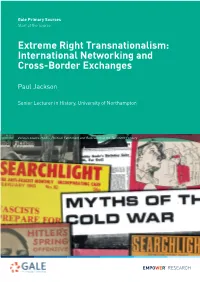
Gale Primary Sources Start at the source. Extreme Right Transnationalism: International Networking and Cross-Border Exchanges Paul Jackson Senior Lecturer in History, University of Northampton Various source media, Political Extremism and Radicalism in the Twentieth Century EMPOWER™ RESEARCH While many historians have devoted themselves to forms of anti-fascism: divisions within the left. The examining the dynamics of fascist movements and Italian Communist Party was also formed at this time, regimes, the topic of ‘anti-fascism’ has traditionally and while initially supportive of the Arditi del Popolo, been neglected. However, historians and other later it instructed its members to withdraw their academics are now starting to take greater interest in engagement. The Arditi del Popolo was shut down by the study of those who opposed nationalist and racist the Italian state by 1924, while the Italian Communist extremists, and are developing new approaches to Party was itself banned from 1926. Splits within the understanding these complex cultures. Some, such as left have often been a characteristic of anti-fascist Nigel Copsey, have been concerned with developing politics, and in Italy during the 1920s such anti- sober, empirical accounts, exploring left-wing, centre fascists were driven by competing ideas on how to and even right-wing forms of anti-fascism, presenting develop an anti-capitalist revolution. In this case, the it as a heterogeneous politicised identity. Others, such issue helped to foster discord between a more as Mark Bray, have been more concerned with eclectic and anarchist variant of anti-fascism and a developing unapologetically partisan readings of the more centralised Communist version. -

Né Une Première Fois À Toulouse Le 11 Novembre 1907 Sous Le Nom De Georges Soulès, Mort À Nice Le 26 Août 1986, Raymond Ab
RAYMOND ABELLIO Né une première fois à Toulouse le 11 novembre 1907 sous le nom de Georges Soulès, mort à Nice le 26 août 1986, Raymond Abellio a été successivement polytechni- cien, marxiste, membre de X-Crise, chargé de mission au ministère de l’Économie nationale en 1936 sous le gouver- nement de Léon Blum et représentant de l’opposition de gauche au comité directeur du Parti socialiste en 1937 et 1939. Il est mobilisé en août 1939, fait prisonnier en mai 1940 à Calais. En 1941, lors de son retour de capti- vité, il entre au MSR où, avec d’autres membres, il parti- cipe à une action fractionnelle clandestine. Il se met en rapport avec la Résistance et fonde en 1943 le groupe des « Unitaires » publiant le bulletin Force Libre. Il rencontre également Pierre de Combas, un guérisseur auvergnat qui lui transmet un enseignement ésotérique basé à la fois sur la Bible, la Kabbale et la Bhagavad-Gitâ. Pierre de Combas le fait sortir de l’action politique et l’oriente vers sa « seconde naissance » : celle d’un homme de connaissance. En 1948, confondu avec un homonyme gérant de biens juifs sous l’Occupation, il est condamné à dix ans de tra- vaux forcés, puis gracié en 1952 grâce à l’intervention de résistants. Il revient définitivement à Paris en 1953 où, ayant accepté sa mutation, il renonce définitivement à la politique pour se consacrer à l’écriture et à la philosophie. AVERTISSEMENT Un groupe d’amis m’ayant demandé en mai dernier de traiter devant lui de la situation actuelle de l’ésotérisme exprima ensuite le désir de voir mettre par écrit le texte de ces cinq exposés. -

Anti-Fascism in a Global Perspective
ANTI-FASCISM IN A GLOBAL PERSPECTIVE Transnational Networks, Exile Communities, and Radical Internationalism Edited by Kasper Braskén, Nigel Copsey and David Featherstone First published 2021 ISBN: 978-1-138-35218-6 (hbk) ISBN: 978-1-138-35219-3 (pbk) ISBN: 978-0-429-05835-6 (ebk) Chapter 5 ‘Make Scandinavia a bulwark against fascism!’: Hitler’s seizure of power and the transnational anti-fascist movement in the Nordic countries Kasper Braskén (CC BY-NC-ND 4.0) This OA chapter is funded by the Academy of Finland (project number 309624) 5 ‘MAKE SCANDINAVIA A BULWARK AGAINST FASCISM!’ Hitler’s seizure of power and the transnational anti-fascist movement in the Nordic countries Kasper Braskén On a global scale, Hitler’s seizure of power on 30 January 1933 provided urgent impetus for transnational anti-fascist conferences and rallies. One of the first Eur- opean, but almost completely overlooked major conferences was organised in Copenhagen in mid-April 1933 in the form of a Scandinavian Anti-Fascist Con- ference. This formed a transnational meeting point of European and especially Scandinavian workers and intellectuals that provided an important first response to developments in Germany. The chapter will use the Scandinavian conference as a prism to look back at anti-fascist activism in the Nordic countries during the preceding years, and to then follow its transformation after 1933. It will contribute to the global analysis of the transition period of communist-led anti-fascism from the sectarian class-against-class line to the inception of the popular front period in 1935. What were these largely overlooked, first anti-fascist articulations in Europe, and how were they connected to the rising transnational and global anti-fascist mobi- lisation coordinated in Paris and London? As we shall see, on the one hand Hitler’s seizure of power vitalised anti-fascism in Scandinavia but paradoxically, on the other, it further sharpened the communist critique of reformist social democracy and empowered social democratic anti-communism. -

When Neo-Nazis March and Anti-Fascists Demonstrate. PROTEAN COUNTERPUBLICS in the DIGITAL
When neo-Nazis march and anti-fascists demonstrate. PROTEAN COUNTERPUBLICS IN THE DIGITAL AGE Christina Neumayer A thesis submitted to the PhD school at the IT University of Copenhagen for the degree of Doctor of Philosophy, Copenhagen, January 2013. Abstract Demonstrations organised by neo-Nazis and the New Right, accompanied by large counter protests by anti-fascist groups, civil society networks, and citizens, have become important political events in Germany. Digital media technologies play an increasingly important role in the confrontation between the two ends of the political spectrum framed by historically rooted ideology. This study explores how different media technologies are appropriated by activists, who consider themselves marginalised and oppositional to the mainstream, on both sides of the conflict. The study aims to examine how digital media permeate counterpublics’ (Negt and Kluge 1972; Fraser 1992; Brouwer 2006; Warner 2002) strategies, tactics, and media practices in their struggles for visibility in these protest events. The counterpublics on both ends of the political spectrum take place and are analysed across three dimensions: [1] technical affordances and media environments; [2] strategies, tactics, and media practices; and [3] political positions and ideologies. The results are based on a data set of online communication, representation, and media coverage on different online media platforms related to marches planned by neo-Nazis in the former East Germany, which were accompanied by counter protests by anti-fascist groups, NGOs, and civil society. The data is analysed across these dimensions by using the methodological frameworks of discourse theory (Carpentier 2007; Dahlberg and Phelan 2011; Laclau and Mouffe 1985) and critical discourse analysis (Fairclough 2010; van Dijk 2001; van Dijk 1998b). -

Class, Culture and Conflict in Barcelona 1898–1937
Class, Culture and Conflict in Barcelona 1898–1937 This is a study of social protest and repression in one of the twentieth century’s most important revolutionary hotspots. It explains why Barcelona became the undisputed capital of the European anarchist movement and explores the sources of anarchist power in the city. It also places Barcelona at the centre of Spain’s economic, social, cultural and political life between 1898 and 1937. During this period, a range of social groups, movements and institutions competed with one another to impose their own political and urban projects on the city: the central authorities struggled to retain control of Spain’s most unruly city; nationalist groups hoped to create the capital of Catalonia; local industrialists attempted to erect a modern industrial city; the urban middle classes planned to democratise the city; and meanwhile, the anarchists sought to liberate the city’s workers from oppression and exploitation. This resulted in a myriad of frequently violent conflicts for control of the city, both before and during the civil war. This is a work of great importance in the field of contemporary Spanish history and fills a significant gap in the current literature. Chris Ealham is Senior Lecturer in the Department of History, Lancaster University. He is co-editor of The Splintering of Spain: Historical Perspectives on the Spanish Civil War. His work focuses on labour and social protest in Spain, and he is currently working on a history of urban conflict in 1930s Spain. Routledge/Cañada Blanch Studies