Publications of Los Alamos Research, 1985
Total Page:16
File Type:pdf, Size:1020Kb
Load more
Recommended publications
-

Mathématiques Et Espace
Atelier disciplinaire AD 5 Mathématiques et Espace Anne-Cécile DHERS, Education Nationale (mathématiques) Peggy THILLET, Education Nationale (mathématiques) Yann BARSAMIAN, Education Nationale (mathématiques) Olivier BONNETON, Sciences - U (mathématiques) Cahier d'activités Activité 1 : L'HORIZON TERRESTRE ET SPATIAL Activité 2 : DENOMBREMENT D'ETOILES DANS LE CIEL ET L'UNIVERS Activité 3 : D'HIPPARCOS A BENFORD Activité 4 : OBSERVATION STATISTIQUE DES CRATERES LUNAIRES Activité 5 : DIAMETRE DES CRATERES D'IMPACT Activité 6 : LOI DE TITIUS-BODE Activité 7 : MODELISER UNE CONSTELLATION EN 3D Crédits photo : NASA / CNES L'HORIZON TERRESTRE ET SPATIAL (3 ème / 2 nde ) __________________________________________________ OBJECTIF : Détermination de la ligne d'horizon à une altitude donnée. COMPETENCES : ● Utilisation du théorème de Pythagore ● Utilisation de Google Earth pour évaluer des distances à vol d'oiseau ● Recherche personnelle de données REALISATION : Il s'agit ici de mettre en application le théorème de Pythagore mais avec une vision terrestre dans un premier temps suite à un questionnement de l'élève puis dans un second temps de réutiliser la même démarche dans le cadre spatial de la visibilité d'un satellite. Fiche élève ____________________________________________________________________________ 1. Victor Hugo a écrit dans Les Châtiments : "Les horizons aux horizons succèdent […] : on avance toujours, on n’arrive jamais ". Face à la mer, vous voyez l'horizon à perte de vue. Mais "est-ce loin, l'horizon ?". D'après toi, jusqu'à quelle distance peux-tu voir si le temps est clair ? Réponse 1 : " Sans instrument, je peux voir jusqu'à .................. km " Réponse 2 : " Avec une paire de jumelles, je peux voir jusqu'à ............... km " 2. Nous allons maintenant calculer à l'aide du théorème de Pythagore la ligne d'horizon pour une hauteur H donnée. -
The Skyscraper 2009 04.Indd
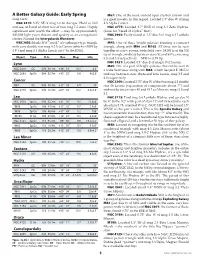
A Better Galaxy Guide: Early Spring M67: One of the most ancient open clusters known and Craig Cortis is a great novelty in this regard. Located 1.7° due W of mag NGC 2419: 3.25° SE of mag 6.2 66 Aurigae. Hard to find 4.3 Alpha Cancri. and see; at E end of short row of two mag 7.5 stars. Highly NGC 2775: Located 3.7° ENE of mag 3.1 Zeta Hydrae. significant and worth the effort —may be approximately (Look for “Head of Hydra” first.) 300,000 light years distant and qualify as an extragalactic NGC 2903: Easily found at 1.5° due S of mag 4.3 Lambda cluster. Named the Intergalactic Wanderer. Leonis. NGC 2683: Marks NW “crook” of coathanger-type triangle M95: One of three bright galaxies forming a compact with easy double star mag 4.2 Iota Cancri (which is SSW by triangle, along with M96 and M105. All three can be seen 4.8°) and mag 3.1 Alpha Lyncis (at 6° to the ENE). together in a low power, wide field view. M105 is at the NE tip of triangle, midway between stars 52 and 53 Leonis, mag Object Type R.A. Dec. Mag. Size 5.5 and 5.3 respectively —M95 is at W tip. Lynx NGC 3521: Located 0.5° due E of mag 6.0 62 Leonis. M65: One of a pair of bright galaxies that can be seen in NGC 2419 GC 07h 38.1m +38° 53’ 10.3 4.2’ a wide field view along with M66, which lies just E. -

The Brightest Stars Seite 1 Von 9
The Brightest Stars Seite 1 von 9 The Brightest Stars This is a list of the 300 brightest stars made using data from the Hipparcos catalogue. The stellar distances are only fairly accurate for stars well within 1000 light years. 1 2 3 4 5 6 7 8 9 10 11 12 13 No. Star Names Equatorial Galactic Spectral Vis Abs Prllx Err Dist Coordinates Coordinates Type Mag Mag ly RA Dec l° b° 1. Alpha Canis Majoris Sirius 06 45 -16.7 227.2 -8.9 A1V -1.44 1.45 379.21 1.58 9 2. Alpha Carinae Canopus 06 24 -52.7 261.2 -25.3 F0Ib -0.62 -5.53 10.43 0.53 310 3. Alpha Centauri Rigil Kentaurus 14 40 -60.8 315.8 -0.7 G2V+K1V -0.27 4.08 742.12 1.40 4 4. Alpha Boötis Arcturus 14 16 +19.2 15.2 +69.0 K2III -0.05 -0.31 88.85 0.74 37 5. Alpha Lyrae Vega 18 37 +38.8 67.5 +19.2 A0V 0.03 0.58 128.93 0.55 25 6. Alpha Aurigae Capella 05 17 +46.0 162.6 +4.6 G5III+G0III 0.08 -0.48 77.29 0.89 42 7. Beta Orionis Rigel 05 15 -8.2 209.3 -25.1 B8Ia 0.18 -6.69 4.22 0.81 770 8. Alpha Canis Minoris Procyon 07 39 +5.2 213.7 +13.0 F5IV-V 0.40 2.68 285.93 0.88 11 9. Alpha Eridani Achernar 01 38 -57.2 290.7 -58.8 B3V 0.45 -2.77 22.68 0.57 144 10. -

Removal of Plutonium from Plutonium Hexafluoride--Uranium Hexafluoride
United States Patent n?) [in 3,708,568 Golliher et al. [45] Jan. 2,1973 [54] REMOVAL OF PLUTONIUM FROM 2,843,453 7/1958 Connicketal. .23/332 PLUTONIUM HEXAFLUORIDE- 3,165,376 1/1965 Golliher.. .23/337 URANIUM HEXAFLUORIDE 3,178,258 4/1965 Cathersetal 23/337 MIXTURES 3,423,190 1/1969 Steindler et al .23/326 [75] Inventors: Waldo R. Golliher; Robert L. Har- Primary Examiner—Carl D. Quarforth ris; Reynold A. LeDoux, Jr., all ol Assistant Examiner—F. M. Gittes Paducah, Ky. Attorney—Roland A. Anderson [73] Assignee: The United States of America as represented by the United State: [57] ABSTRACT Atomic Energy Commission This invention relates to a method of selectively [22] Filed: Oct. 20,1970 removing plutonium values from a fluid mixture con- [21] Appl. No.: 82,508 taining plutonium hexafluoride and uranium hex- afluoride by passing the mixture through a bed of pel- [52] U.S. C! 423/6,423/19, 252/301.1 R letized cobaltous fluoride at a temperature in the [51] Int. CI COlg 56/00 range 134° to 1,000° F. to effect removal of plutonium [58] Field of Search 55/74; 252/301.1 R; 23/332, by the cobaltous fluoride. 23/326, 337, 344, 352; 423/19, 6, 11, 251, 258 [56] References Cited 3 Claims, No Drawings UNITED STATES PATENTS 3,615,267 10/1971 Golliher et al. 23/343 3,725,661 3 4 REMOVAL OF PLUTONIUM FROM PLUTONIUM recovered. The cobaltous fluoride can then be HEXAFLUORIDE-URANIUM HEXAFLUORIDE processed for reuse by contacting with gaseous MIXTURES hydrogen at a temperature in the range 400° to 500° F. -
System Studies of Fission-Fusion Hybrid Molten Salt Reactors
University of Tennessee, Knoxville TRACE: Tennessee Research and Creative Exchange Doctoral Dissertations Graduate School 12-2013 SYSTEM STUDIES OF FISSION-FUSION HYBRID MOLTEN SALT REACTORS Robert D. Woolley University of Tennessee - Knoxville, rwoolley@utk.edu Follow this and additional works at: https://trace.tennessee.edu/utk_graddiss Part of the Nuclear Engineering Commons Recommended Citation Woolley, Robert D., "SYSTEM STUDIES OF FISSION-FUSION HYBRID MOLTEN SALT REACTORS. " PhD diss., University of Tennessee, 2013. https://trace.tennessee.edu/utk_graddiss/2628 This Dissertation is brought to you for free and open access by the Graduate School at TRACE: Tennessee Research and Creative Exchange. It has been accepted for inclusion in Doctoral Dissertations by an authorized administrator of TRACE: Tennessee Research and Creative Exchange. For more information, please contact trace@utk.edu. To the Graduate Council: I am submitting herewith a dissertation written by Robert D. Woolley entitled "SYSTEM STUDIES OF FISSION-FUSION HYBRID MOLTEN SALT REACTORS." I have examined the final electronic copy of this dissertation for form and content and recommend that it be accepted in partial fulfillment of the equirr ements for the degree of Doctor of Philosophy, with a major in Nuclear Engineering. Laurence F. Miller, Major Professor We have read this dissertation and recommend its acceptance: Ronald E. Pevey, Arthur E. Ruggles, Robert M. Counce Accepted for the Council: Carolyn R. Hodges Vice Provost and Dean of the Graduate School (Original signatures are on file with official studentecor r ds.) SYSTEM STUDIES OF FISSION-FUSION HYBRID MOLTEN SALT REACTORS A Dissertation Presented for the Doctor of Philosophy Degree The University of Tennessee, Knoxville Robert D. -

Export Control Handbook for Chemicals
Export Control Handbook for Chemicals -Dual-use control list -Common Military List -Explosives precursors -Syria restrictive list -Psychotropics and narcotics precursors ARNES-NOVAU, X 2019 EUR 29879 This publication is a Technical report by the Joint Research Centre (JRC), the European Commission’s science and knowledge service. It aims to provide evidence-based scientific support to the European policymaking process. The scientific output expressed does not imply a policy position of the European Commission. Neither the European Commission nor any person acting on behalf of the Commission is responsible for the use that might be made of this publication. Contact information Xavier Arnés-Novau Joint Research Centre, Via Enrico Fermi 2749, 21027 Ispra (VA), Italy Xavier.ARNES-NOVAU@ec.europa.eu Tel.: +39 0332-785421 Filippo Sevini Joint Research Centre, Via Enrico Fermi 2749, 21027 Ispra (VA), Italy Filippo.SEVINI@ec.europa.eu Tel.: +39 0332-786793 EU Science Hub https://ec.europa.eu/jrc JRC 117839 EUR 29879 Print ISBN 978-92-76-11971-5 ISSN 1018-5593 doi:10.2760/844026 PDF ISBN 978-92-76-11970-8 ISSN 1831-9424 doi:10.2760/339232 Luxembourg: Publications Office of the European Union, 2019 © European Atomic Energy Community, 2019 The reuse policy of the European Commission is implemented by Commission Decision 2011/833/EU of 12 December 2011 on the reuse of Commission documents (OJ L 330, 14.12.2011, p. 39). Reuse is authorised, provided the source of the document is acknowledged and its original meaning or message is not distorted. The European Commission shall not be liable for any consequence stemming from the reuse. -

Chemical Names and CAS Numbers Final
Chemical Abstract Chemical Formula Chemical Name Service (CAS) Number C3H8O 1‐propanol C4H7BrO2 2‐bromobutyric acid 80‐58‐0 GeH3COOH 2‐germaacetic acid C4H10 2‐methylpropane 75‐28‐5 C3H8O 2‐propanol 67‐63‐0 C6H10O3 4‐acetylbutyric acid 448671 C4H7BrO2 4‐bromobutyric acid 2623‐87‐2 CH3CHO acetaldehyde CH3CONH2 acetamide C8H9NO2 acetaminophen 103‐90‐2 − C2H3O2 acetate ion − CH3COO acetate ion C2H4O2 acetic acid 64‐19‐7 CH3COOH acetic acid (CH3)2CO acetone CH3COCl acetyl chloride C2H2 acetylene 74‐86‐2 HCCH acetylene C9H8O4 acetylsalicylic acid 50‐78‐2 H2C(CH)CN acrylonitrile C3H7NO2 Ala C3H7NO2 alanine 56‐41‐7 NaAlSi3O3 albite AlSb aluminium antimonide 25152‐52‐7 AlAs aluminium arsenide 22831‐42‐1 AlBO2 aluminium borate 61279‐70‐7 AlBO aluminium boron oxide 12041‐48‐4 AlBr3 aluminium bromide 7727‐15‐3 AlBr3•6H2O aluminium bromide hexahydrate 2149397 AlCl4Cs aluminium caesium tetrachloride 17992‐03‐9 AlCl3 aluminium chloride (anhydrous) 7446‐70‐0 AlCl3•6H2O aluminium chloride hexahydrate 7784‐13‐6 AlClO aluminium chloride oxide 13596‐11‐7 AlB2 aluminium diboride 12041‐50‐8 AlF2 aluminium difluoride 13569‐23‐8 AlF2O aluminium difluoride oxide 38344‐66‐0 AlB12 aluminium dodecaboride 12041‐54‐2 Al2F6 aluminium fluoride 17949‐86‐9 AlF3 aluminium fluoride 7784‐18‐1 Al(CHO2)3 aluminium formate 7360‐53‐4 1 of 75 Chemical Abstract Chemical Formula Chemical Name Service (CAS) Number Al(OH)3 aluminium hydroxide 21645‐51‐2 Al2I6 aluminium iodide 18898‐35‐6 AlI3 aluminium iodide 7784‐23‐8 AlBr aluminium monobromide 22359‐97‐3 AlCl aluminium monochloride -

00419717.Pdf
APPROVED FOR PUBLIC RELEASE APPROVED FOR PUBLIC RELEASE APPROVED FOR PUBLIC RELEASE ~ ,—- UNWMFIED — PUBUCLYREI-EMABLF . ,$5 ~ .~16f3 This Document Consists of 18 Pages /“ @ LQS ALAMOS SCIENTIFIC LABORATORY Contribution from Chemistry-MetallurgyDivision E. R. Jette, Division Leader J. F, Lemons, Group Leader Plutonium~‘=Hexaf uor e: Preparation and Properties w A. E. Flor November 9, 1950 — ‘1” Chemistry-Tranwrs.nicElements “-+ - ,- —. 1 Y– -t APPROVED FOR PUBLIC RELEASE — APPROVED FOR PUBLIC RELEASE LA-I.M8 UNCLASSIFIED Los tiSDIOS 1-20 STANDARD DISTRIBUTION Argonne,I?ationslLaboratory 21-30 Atomic Energy Commission, Washington 31-32 Brookhaven National Laboratory 33-36 Carbide and Carbon Cheticals Division (K-25 Plant) 37-38 Carbide and Carbon Chemicsl.sDivision (Y-12 Plant) General.Electric Company, Richland Z-45 Hanford Operations Office 46 Iowa State College 47 Kellex Corporation 4.$ Knolls Atomic Power Laboratory g-;; Mound Laboratory Navel Radiological Defense Laboratory 56- NEPA Project 57 New York Operations Office 58-59 Oak Ridge National Laboratory 60-65 Patent Branch, Washington 66 Technical Information Division, ORE 6741 UCLA Medical Research Laboratory (Warren) University of California Radiatio nLaboratory %85 University of Rochester 86-87 2 APPROVED FOR PUBLIC RELEASE — APPROVED FOR PUBLIC RELEASE Introduction It is the purpose of this paper to present the results of experi- mental investigations on the chemistry of plutonium hernfluoride con- ducted at this laboratory subsequent to the preparation of report LAMS 1118(1). A more satisfactory apparatus for the preparation is des- cribed. More reliable values for the vapor pressure have been obtained and the related physical constants have been calculated. The rate of decomposition of the compound as a result of the associated alpha radiation has been determined and a preliminary observation on the thermal stability is reported. -
Fixed Stars Report
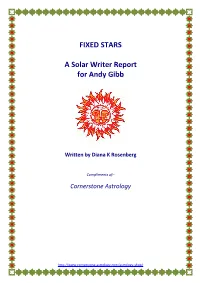
FIXED STARS A Solar Writer Report for Andy Gibb Written by Diana K Rosenberg Compliments of:- Cornerstone Astrology http://www.cornerstone-astrology.com/astrology-shop/ Table of Contents · Chart Wheel · Introduction · Fixed Stars · The Tropical And Sidereal Zodiacs · About this Report · Abbreviations · Sources · Your Starsets · Conclusion http://www.cornerstone-astrology.com/astrology-shop/ Page 1 Chart Wheel Andy Gibb 49' 44' 29°‡ Male 18°ˆ 00° 5 Mar 1958 22' À ‡ 6:30 am UT +0:00 ‰ ¾ ɽ 44' Manchester 05° 04°02° 24° 01° ‡ ‡ 53°N30' 46' ˆ ‡ 33'16' 002°W15' ‰ 56' Œ 10' Tropical ¼ Œ Œ 24° 21° 9 8 Placidus ‰ 10 » 13' 04° 11 Š ‘‘ 42' 7 ’ ¶ á ’ …07° 12 ” 05' ” ‘ 06° Ï 29° 29' … 29° Œ45' … 00° Á àà Š à „ 24' ‘ 24' 11' á 6 14°‹ á ¸ 28' Œ14' 15°‹ 1 “ „08° º 5 ¿ 4 2 3 Œ 46' 16' ƒ Ý 24° 02° 22' Ê ƒ 00° 05° Ý 44' 44' 18°‚ 29°Ý 49' http://www.cornerstone-astrology.com/astrology-shop/ Page 2 Astrological Summary Chart Point Positions: Andy Gibb Planet Sign Position House Comment The Moon Virgo 7°Vi05' 7th The Sun Pisces 14°Pi11' 1st Mercury Pisces 15°Pi28' 1st Venus Aquarius 4°Aq42' 12th Mars Capricorn 21°Cp13' 11th Jupiter Scorpio 1°Sc10' 8th Saturn Sagittarius 24°Sg56' 10th Uranus Leo 8°Le14' 6th Neptune Scorpio 4°Sc33' 8th Pluto Virgo 0°Vi45' 7th The North Node Scorpio 2°Sc16' 8th The South Node Taurus 2°Ta16' 2nd The Ascendant Aquarius 29°Aq24' 1st The Midheaven Sagittarius 18°Sg44' 10th The Part of Fortune Virgo 6°Vi29' 7th http://www.cornerstone-astrology.com/astrology-shop/ Page 3 Chart Point Aspects Planet Aspect Planet Orb App/Sep The Moon -

Technical Publications by JAERI Staff
~J JAERI 5011 S £ Vol. 6 E til Technical Publications by JAERI Staff from January 1971 to December 1972 March 1973 Japan Atomic Energy Research Institute JAERI Reports and the Availability Technical reports etc. are issued irregularly by JAERI. As to those in the pas'c, these are collectively given in yearly "A list of the JAERI Reports". Then, those currently issued are presented in monthly "JAERI Reports Abstracts" (current JAERI technical reports) with the summaries etc. of individual reports. Requests for the JAERI reports in any of those lists should be addressed to: Division of Technical Information, Japan Atomic Energy Research Institute, Tokai- mura, Ibaraki-ken, Japan. 晶組副I ~IIMil VV«eL' t 6 Technical Technical Technical PuPublicationblications s byb y JAERIJAER I SStaf同首f from from January January 1971 1971 to to Dec Decembeember r 1971972 2 E[Summary釦問問y] ] Technlca Technica同Jbl Publicationll 個 tlDn・ s byby JJAER必 RI I Staff Staff fr fro,開Jam Januarnuary y 1971 1971 toto D6C'Docsmba・崎町r 19721972 ApApproximatel戸司副皿a凶 y 770770 伊山首journaal l arti articlesc1 es. , pappaper闘 s .t at 園田討喝民間meetings, reportpor 岡田s and books books are are giv given,阻, , whicwhich h havehave be bee岨抑n publishe.bliahed d bbyμy personne四 onn e1 l of of IAERIJAER I froU 四mnII Januar曲四ry y 1971 1971 tto o DDecembe田 ember r 19721972. TheTh e ∞contentE 惚E 包s for for 岨eac.ch h 田町entry iincludnc1 ude e ththe e title. title, Ia時 languagU昭 e in in which which it it is is wriωnwritten,, author(a) authors) ,, andjoand journa世田1l namenam e or o r origin. origin. A list list of of the the papatents国民町, originatini岡田出g at IAERJ.JAERI , inc¥udi includin喝g bobot出h Japl Japanes祖国e 岨and 0othe出.er r patentspa 健a回'. -
A Guide to Hubble Space Telescope Objects
James L. Chen A Guide to Hubble Space Telescope Objects Their Selection, Location, and Signifi cance Graphics by Adam Chen The Patrick Moore The Patrick Moore Practical Astronomy Series More information about this series at http://www.springer.com/series/3192 A Guide to Hubble Space Telescope Objects Their Selection, Location, and Signifi cance James L. Chen Graphics by Adam Chen Author Graphics Designer James L. Chen Adam Chen Gore , VA , USA Baltimore , MD , USA ISSN 1431-9756 ISSN 2197-6562 (electronic) The Patrick Moore Practical Astronomy Series ISBN 978-3-319-18871-3 ISBN 978-3-319-18872-0 (eBook) DOI 10.1007/978-3-319-18872-0 Library of Congress Control Number: 2015940538 Springer Cham Heidelberg New York Dordrecht London © Springer International Publishing Switzerland 2015 This work is subject to copyright. All rights are reserved by the Publisher, whether the whole or part of the material is concerned, specifi cally the rights of translation, reprinting, reuse of illustrations, recitation, broadcasting, reproduction on microfi lms or in any other physical way, and transmission or information storage and retrieval, electronic adaptation, computer software, or by similar or dissimilar methodology now known or hereafter developed. The use of general descriptive names, registered names, trademarks, service marks, etc. in this publication does not imply, even in the absence of a specifi c statement, that such names are exempt from the relevant protective laws and regulations and therefore free for general use. The publisher, the authors and the editors are safe to assume that the advice and information in this book are believed to be true and accurate at the date of publication. -
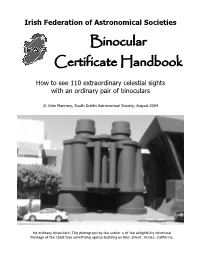
Binocular Certificate Handbook
Irish Federation of Astronomical Societies Binocular Certificate Handbook How to see 110 extraordinary celestial sights with an ordinary pair of binoculars © John Flannery, South Dublin Astronomical Society, August 2004 No ordinary binoculars! This photograph by the author is of the delightfully whimsical frontage of the Chiat/Day advertising agency building on Main Street, Venice, California. Binocular Certificate Handbook page 1 IFAS — www.irishastronomy.org Introduction HETHER NEW to the hobby or advanced am- Wateur astronomer you probably already own Binocular Certificate Handbook a pair of a binoculars, the ideal instrument to casu- ally explore the wonders of the Universe at any time. Name _____________________________ Address _____________________________ The handbook you hold in your hands is an intro- duction to the realm far beyond the Solar System — _____________________________ what amateur astronomers call the “deep sky”. This is the abode of galaxies, nebulae, and stars in many _____________________________ guises. It is here that we set sail from Earth and are Telephone _____________________________ transported across many light years of space to the wonderful and the exotic; dense glowing clouds of E-mail _____________________________ gas where new suns are being born, star-studded sec- tions of the Milky Way, and the ghostly light of far- Observing beginner/intermediate/advanced flung galaxies — all are within the grasp of an ordi- experience (please circle one of the above) nary pair of binoculars. Equipment __________________________________ True, the fixed magnification of (most) binocu- IFAS club __________________________________ lars will not allow you get the detail provided by telescopes but their wide field of view is perfect for NOTES: Details will be treated in strictest confidence.