El Género GEITODORIS BERGH, 1981 (Mollusca: Nudibranchia)
Total Page:16
File Type:pdf, Size:1020Kb
Load more
Recommended publications
-

New Records of Biuve Fulvipunctata (Baba, 1938) (Gastropoda
Biodiversity Journal, 2020, 11 (2): 587–591 https://doi.org/10.31396/Biodiv.Jour.2020.11.2.587.591 New records of Biuve fulvipunctata (Baba, 1938) (Gastropoda Cephalaspidea) and Taringa tritorquis Ortea, Perez et Llera, 1982 (Gastropoda Nudibranchia) in the Ionian coasts of Sicily, Mediterranean Sea Andrea Lombardo* & Giuliana Marletta Department of Biological, Geological and Environmental Sciences, Section of Animal Biology, University of Catania, via Androne 81, 95124 Catania, Italy *corresponding author, e-mail: andylombardo94@gmail.com. ABSTRACT In the present paper, two sea slug species, Biuve fulvipunctata (Baba, 1938) (Gastropoda Cepha- laspidea) and Taringa tritorquis Ortea, Perez & Llera, 1982 (Gastropoda Nudibranchia), are re- ported for the second time in the Ionian coasts of Sicily (Italy). Biuve fulvipunctata is an Indo-West Pacific cefalaspidean, previously reported for Italian territorial waters only in Faro Lake (Messina, Sicily). Taringa tritorquis is a species originally described for Canary Islands and hitherto found in Sicily and probably in Madeira. Both species are easily identifiable for their characteristic external morphology. Indeed, B. fulvipunctata shows a W-shaped pattern of white pigment on the head, while T. tritorquis presents rhinophore and gill sheaths with spiculous tubercles crown-shaped and an orange-yellowish body coloring. Since B. fulvipuctata has been previously reported in Faro Lake, probably, the specimen reported in this note could have been taken in veliger stage through the Strait of Messina currents. Otherwise, the veliger has been carried attached to the keel of boats. Instead, it is still unclear if T. tritorquis could be a native or non-indigenous species of the Mediterranean Sea. -

Diversity of Norwegian Sea Slugs (Nudibranchia): New Species to Norwegian Coastal Waters and New Data on Distribution of Rare Species
Fauna norvegica 2013 Vol. 32: 45-52. ISSN: 1502-4873 Diversity of Norwegian sea slugs (Nudibranchia): new species to Norwegian coastal waters and new data on distribution of rare species Jussi Evertsen1 and Torkild Bakken1 Evertsen J, Bakken T. 2013. Diversity of Norwegian sea slugs (Nudibranchia): new species to Norwegian coastal waters and new data on distribution of rare species. Fauna norvegica 32: 45-52. A total of 5 nudibranch species are reported from the Norwegian coast for the first time (Doridoxa ingolfiana, Goniodoris castanea, Onchidoris sparsa, Eubranchus rupium and Proctonotus mucro- niferus). In addition 10 species that can be considered rare in Norwegian waters are presented with new information (Lophodoris danielsseni, Onchidoris depressa, Palio nothus, Tritonia griegi, Tritonia lineata, Hero formosa, Janolus cristatus, Cumanotus beaumonti, Berghia norvegica and Calma glau- coides), in some cases with considerable changes to their distribution. These new results present an update to our previous extensive investigation of the nudibranch fauna of the Norwegian coast from 2005, which now totals 87 species. An increase in several new species to the Norwegian fauna and new records of rare species, some with considerable updates, in relatively few years results mainly from sampling effort and contributions by specialists on samples from poorly sampled areas. doi: 10.5324/fn.v31i0.1576. Received: 2012-12-02. Accepted: 2012-12-20. Published on paper and online: 2013-02-13. Keywords: Nudibranchia, Gastropoda, taxonomy, biogeography 1. Museum of Natural History and Archaeology, Norwegian University of Science and Technology, NO-7491 Trondheim, Norway Corresponding author: Jussi Evertsen E-mail: jussi.evertsen@ntnu.no IntRODUCTION the main aims. -

Phylum MOLLUSCA
285 MOLLUSCA: SOLENOGASTRES-POLYPLACOPHORA Phylum MOLLUSCA Class SOLENOGASTRES Family Lepidomeniidae NEMATOMENIA BANYULENSIS (Pruvot, 1891, p. 715, as Dondersia) Occasionally on Lafoea dumosa (R.A.T., S.P., E.J.A.): at 4 positions S.W. of Eddystone, 42-49 fm., on Lafoea dumosa (Crawshay, 1912, p. 368): Eddystone, 29 fm., 1920 (R.W.): 7, 3, 1 and 1 in 4 hauls N.E. of Eddystone, 1948 (V.F.) Breeding: gonads ripe in Aug. (R.A.T.) Family Neomeniidae NEOMENIA CARINATA Tullberg, 1875, p. 1 One specimen Rame-Eddystone Grounds, 29.12.49 (V.F.) Family Proneomeniidae PRONEOMENIA AGLAOPHENIAE Kovalevsky and Marion [Pruvot, 1891, p. 720] Common on Thecocarpus myriophyllum, generally coiled around the base of the stem of the hydroid (S.P., E.J.A.): at 4 positions S.W. of Eddystone, 43-49 fm. (Crawshay, 1912, p. 367): S. of Rame Head, 27 fm., 1920 (R.W.): N. of Eddystone, 29.3.33 (A.J.S.) Class POLYPLACOPHORA (=LORICATA) Family Lepidopleuridae LEPIDOPLEURUS ASELLUS (Gmelin) [Forbes and Hanley, 1849, II, p. 407, as Chiton; Matthews, 1953, p. 246] Abundant, 15-30 fm., especially on muddy gravel (S.P.): at 9 positions S.W. of Eddystone, 40-43 fm. (Crawshay, 1912, p. 368, as Craspedochilus onyx) SALCOMBE. Common in dredge material (Allen and Todd, 1900, p. 210) LEPIDOPLEURUS, CANCELLATUS (Sowerby) [Forbes and Hanley, 1849, II, p. 410, as Chiton; Matthews. 1953, p. 246] Wembury West Reef, three specimens at E.L.W.S.T. by J. Brady, 28.3.56 (G.M.S.) Family Lepidochitonidae TONICELLA RUBRA (L.) [Forbes and Hanley, 1849, II, p. -

Portadas 24 (1)
© Sociedad Española de Malacología Iberus , 24 (1): 5-12, 2006 Geitodoris pusae (Marcus, 1955) y Geitodoris bacalladoi Ortea, 1990, dos especies de Doridoidea (Mollusca: Nudibranchia) nuevas para el Mar Mediterráneo Geitodoris pusae (Marcus, 1955) and Geitodoris bacalladoi Ortea, 1990, two doridoidean species (Mollusca: Nudibranchia) new to the Mediterranean Sea Luis SÁNCHEZ TOCINO* , Amelia OCAÑA* y Juan Lucas CERVERA** Recibido el 9-III-2005. Aceptado el 20-X-2005 RESUMEN Se citan por primera vez en el Mediterráneo las especies Geitodoris pusae (Marcus, 1955) y Geitodoris bacalladoi Ortea, 1990 y se aportan nuevos datos sobre su anato - mía, comparándola con la de ejemplares recolectados en otras áreas geográficas. ABSTRACT Geitodoris pusae (Marcus, 1955) and Geitodoris bacalladoi Ortea, 1990 are recorded from the Mediterranean Sea for the first time. New anatomical data from these species are reported and compared with those from specimens from other geographical areas. PALABRAS CLAVE : Opisthobranchia, Nudibranchia, Geitodoris , Mediterráneo. KEY WORDS: Opisthobranchia, Nudibranchia, Geitodoris , Mediterranean. INTRODUCCIÓN El género Geitodoris Bergh, 1891 se costa atlántica francesa hasta Arcachon encuentra representado en el Medite - (BOUCHET Y TARDY , 1976 como Discodo - rráneo por cuatro especies válidas. Tres ris ), el Sur de la Península Ibérica ( CER - de ellas: Geitodoris joubini VERA , G ARCÍA Y GARCÍA , 1985) y Cana - (Vayssière, 1919 ), Geitodoris portmanni rias ( ORTEA , 1990). En el Mediterráneo (Schmekel, 1972) y Geitodoris bonosi Or - hay citas de Geitodoris planata en el Sur tea y Ballesteros, 1981 fueron descritas de la Península Ibérica ( SÁNCHEZ -T O- en el Mediterráneo y una cuarta, Geito - CINO , O CAÑA Y GARCÍA , 2000) y en las doris planata (Alder y Hancock, 1846), lo costa francesa ( PRUVOT -F OL , 1954), si fue en aguas escocesas. -

The Durham Heritage Coast Seasearch Site Surveys 1991-2016
The Durham Heritage Coast Seasearch Site Surveys 1991-2016 This report summarises the results of surveys along the Durham Heritage Coast carried out by Seasearch divers in the seven year period from 2009 to 2016, following on from the original Durham Coast survey in 19911 under the auspices of the Marine Nature Conservation Review (MNCR). The aim of the surveys was to add detailed records of the habitats and species found within this relatively un-dived and un-surveyed area. Particular attention was paid to priority species and habitats (as identified on various designation lists)2 and to the Habitat and Species FOCI identified in the Ecological Guidance on the designation of Marine Conservation Zones (MCZs)3 (which were reviewed in May 2016). Background The Durham Heritage Coast runs for approximately 18km in three sections from Sunderland in the north to Hartlepool in the south. It is managed by the Durham Heritage Coast Partnership4, consisting of various organisations (local authorities, statutory agencies, land owners and community bodies), which was formed in 2003 to build upon the achievements of the Turning The Tide project5. A once- heavily industrialised landscape (the last pit, Easington, closed in 1993), over a million tonnes of colliery spoil and associated debris has been successfully removed to re-generate the coastline for wildlife. The images depict Easington Colliery before (1992; below) and after (2010, the year in which the area won the UK Landscape Award6, right). Parts of the foreshore are designated as Special Protection Areas (SPAs) under the Birds Directive (Directive 79/409/EEC April 1979; Directive 2009/147/EC as amended 2009) – the Northumbria Coast SPA between Sunderland and Seaham, and the Teesmouth and Cleveland Coast SPA from Blackhall Colliery to Hartlepool. -

Gastropoda: Nudibranchia: Discodorididae) - a New Record for India from the Andaman Islands
Journal of Threatened Taxa | www.threatenedtaxa.org | 26 March 2016 | 8(3): 8626–8628 Note Discodorididae is one of the Halgerda dalanghita Fahey & Gosliner, most diverse families under 1999 (Gastropoda: Nudibranchia: Nudibranchia with a total of 305 Discodorididae) - a new record for India ISSN 0974-7907 (Online) species distributed among 32 from the Andaman Islands ISSN 0974-7893 (Print) genera from around the world (Bouchet 2015). Discodorids are Titus Immanuel 1, M.P. Goutham-Bharathi 2 & OPEN ACCESS generally distributed in the coastal R. Kiruba-Sankar 3 waters of the tropical regions particularly in reef environments. 1,2,3 Marine Research Laboratory, Division of Fisheries Science, ICAR- Halgerda Central Island Agricultural Research Institute, Post Box No. 181, The genus is represented Garacharma (Post), Port Blair, 744 101, by 35 species from around the world (Bouchet & Gofas Andaman and Nicobar Islands, India 2015) of which, India accounts for only five species 1 titusimmanuel@yahoo.co.in (corresponding author), 2 gouthamrussia@gmail.com, 3 rkirubasankar@gmail.com (14.2%) viz.: H. bacalusia Fahey & Gosliner, 1999, H. stricklandi Fahey & Gosliner, 1999, H. tessellata (Bergh, 1880), H. formosa Bergh, 1880 and H. punctata Farran, 1902 (Prasade et al. 2012). Among these, the former the distinguishing characters described of the holotype three are known from the Andaman and Nicobar in Fahey & Gosliner (1999). The specimen has been Islands (Ramakrishna et al. 2010; Sreeraj et al. 2010) deposited in the National Zoological Collection of while the latter two have been reported from the Tamil Andaman & Nicobar Regional Centre, Zoological Survey Nadu coast (O’donoghue 1932). H. -
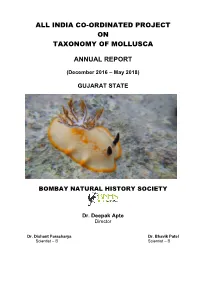
Table of Contents
ALL INDIA CO-ORDINATED PROJECT ON TAXONOMY OF MOLLUSCA ANNUAL REPORT (December 2016 – May 2018) GUJARAT STATE BOMBAY NATURAL HISTORY SOCIETY Dr. Deepak Apte Director Dr. Dishant Parasharya Dr. Bhavik Patel Scientist – B Scientist – B All India Coordinated Project on Taxonomy – Mollusca , Gujarat State Acknowledgements We are thankful to the Department of Forest and Environment, Government of Gujarat, Mr. G. K. Sinha, IFS HoFF and PCCF (Wildlife) for his guidance and cooperation in the work. We are thankful to then CCF Marine National Park and Sanctuary, Mr. Shyamal Tikader IFS, Mr. S. K. Mehta IFS and their team for the generous support, We take this opportunity to thank the entire team of Marine National Park and Sanctuary. We are thankful to all the colleagues of BNHS who directly or indirectly helped us in our work. We specially thank our field assistant, Rajesh Parmar who helped us in the field work. All India Coordinated Project on Taxonomy – Mollusca , Gujarat State 1. Introduction Gujarat has a long coastline of about 1650 km, which is mainly due to the presence of two gulfs viz. the Gulf of Khambhat (GoKh) and Gulf of Kachchh (GoK). The coastline has diverse habitats such as rocky, sandy, mangroves, coral reefs etc. The southern shore of the GoK in the western India, notified as Marine National Park and Sanctuary (MNP & S), harbours most of these major habitats. The reef areas of the GoK are rich in flora and fauna; Narara, Dwarka, Poshitra, Shivrajpur, Paga, Boria, Chank and Okha are some of these pristine areas of the GoK and its surrounding environs. -
An Annotated Checklist of the Marine Macroinvertebrates of Alaska David T
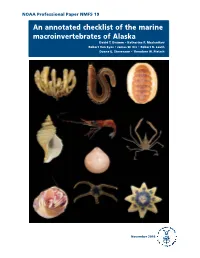
NOAA Professional Paper NMFS 19 An annotated checklist of the marine macroinvertebrates of Alaska David T. Drumm • Katherine P. Maslenikov Robert Van Syoc • James W. Orr • Robert R. Lauth Duane E. Stevenson • Theodore W. Pietsch November 2016 U.S. Department of Commerce NOAA Professional Penny Pritzker Secretary of Commerce National Oceanic Papers NMFS and Atmospheric Administration Kathryn D. Sullivan Scientific Editor* Administrator Richard Langton National Marine National Marine Fisheries Service Fisheries Service Northeast Fisheries Science Center Maine Field Station Eileen Sobeck 17 Godfrey Drive, Suite 1 Assistant Administrator Orono, Maine 04473 for Fisheries Associate Editor Kathryn Dennis National Marine Fisheries Service Office of Science and Technology Economics and Social Analysis Division 1845 Wasp Blvd., Bldg. 178 Honolulu, Hawaii 96818 Managing Editor Shelley Arenas National Marine Fisheries Service Scientific Publications Office 7600 Sand Point Way NE Seattle, Washington 98115 Editorial Committee Ann C. Matarese National Marine Fisheries Service James W. Orr National Marine Fisheries Service The NOAA Professional Paper NMFS (ISSN 1931-4590) series is pub- lished by the Scientific Publications Of- *Bruce Mundy (PIFSC) was Scientific Editor during the fice, National Marine Fisheries Service, scientific editing and preparation of this report. NOAA, 7600 Sand Point Way NE, Seattle, WA 98115. The Secretary of Commerce has The NOAA Professional Paper NMFS series carries peer-reviewed, lengthy original determined that the publication of research reports, taxonomic keys, species synopses, flora and fauna studies, and data- this series is necessary in the transac- intensive reports on investigations in fishery science, engineering, and economics. tion of the public business required by law of this Department. -

(Mollusca: Euthyneura) Biodiversity in Mauritius Lisa Ah-Shee-Tee1
An assessment of nudibranchs (Mollusca: Euthyneura) biodiversity in Mauritius Lisa Ah-Shee-Tee1 (chin.29.ah@gmail.com ), Daneshwar Puchooa1 (sudeshp@uom.ac.mu ), Vishwakalyan Bhoyroo1 (v.bhoyroo@uom.ac.mu ), Chandani Appadoo2 (chandani@uom.ac.mu ) 1Department of Agricultural & Food Science, Faculty of Agriculture, University of Mauritius, Mauritius 2Department of Biosciences & Ocean Studies, Faculty of Science, University of Mauritius, Mauritius Presenting author is a PhD student: Lisa Ah Shee Tee. Species form the basic unit of biodiversity. They provide economic, pharmacological and public health importance while some can be used as bio-indicators of either environmental quality or climate change. Cataloguing a list of species is also an element of biodiversity. Without prior knowledge of the different species present in the same environment, it is difficult to move towards a sustainable management. Nudibranchs constitute one of the most diverse group of opisthobranchs. They are also known as “butterflies of the sea” as a result of their spectacular coloration. Nudibranchs are recognised to possess important pharmacological potency such as cytotoxicity to a number of tumor cell lines. They can also be used to detect and monitor fine-scale climate change along the coast. They are able to forecast ups and downs in the populations of other species with long pelagic larval periods. Reports of nudibranchs occurrence from Mauritius Island date back from 1832 arising from expedition and systematic records. The most recent review of the biodiversity of opisthobranchs in Mauritius date back to 1991 whereby 23 nudibranchs species belonging to eight families were identified. The present study aims to provide an inventory of nudibranchs species from the lagoon of Mauritius. -
Last Reprint Indexed Is 004480
17 September 2009 Nudibranch Systematic Index page - 1 NUDIBRANCH SYSTEMATIC INDEX Second Online Edition compiled by Gary McDonald 17 September 2009 Gary McDonald, Long Marine Lab, 100 Shaffer Rd., Santa Cruz, Cal. 95060 17 September 2009 Nudibranch Systematic Index page - 2 This is an index of the more than 7,000 nudibranch reprints and books in my collection. I have indexed them only for information concerning systematics, taxonomy, nomenclature, & description of taxa (as these are my areas of interest, and to have tried to index for areas such as physiology, behavior, ecology, neurophysiology, anatomy, etc. would have made the job too large and I would have given up long ago). This is a working list and as such may contain errors, but it should allow you to quickly find information concerning the description, taxonomy, or systematics of almost any species of nudibranch. The phylogenetic hierarchy used is based on Traite de Zoologie, with a few additions and changes (since this is intended to be an index, and not a definitive classification, I have not attempted to update the hierarchy to reflect recent changes). The full citation for any of the authors and dates listed may be found in the nudibranch bibliography at http://repositories.cdlib.org/ims/Bibliographia_Nudibranchia_second_edition/. Names in square brackets and preceded by an equal sign are synonyms which were listed as such in at least one of the cited papers. If only a generic name is listed in square brackets after a species name, it indicates that the generic allocation of the species has changed, but the specific epithet is the same. -

Spongivory by Nudibranchs on the Coast of Rio De Janeiro State, Southeastern Brazil
©Zoologische Staatssammlung München/Verlag Friedrich Pfeil; download www.pfeil-verlag.de SPIXIANA 38 2 187-195 München, Dezember 2015 ISSN 0341-8391 Spongivory by nudibranchs on the coast of Rio de Janeiro state, southeastern Brazil (Mollusca, Gastropoda) Thalita Belmonte, Juliana Alvim, Vinicius Padula & Guilherme Muricy Belmonte, T., Alvim, J., Padula, V. & Muricy, G. 2015. Spongivory by nudibranchs on the coast of Rio de Janeiro state, southeastern Brazil (Mollusca, Gastropoda). Spixiana 38 (2): 187-195. Nudibranch gastropods are carnivores and most dorid nudibranchs are spongi- vores, preying on a single or a few species of sponges. The feeding biology has important biological, ecological and evolutionary implications, and many charac- teristics of nudibranchs likely arose from co-evolution with diet organisms. Data on spongivory by dorid nudibranchs are available for many species from the Indo- Pacific, eastern Pacific and the Mediterranean Sea, but such information is scarce for the southwestern Atlantic. In this study we provide qualitative data on spongi- vory by dorid nudibranchs along the coast of Rio de Janeiro State, southeastern Brazil, including the identification of the species involved. A total of 94 spongi- vory events were observed between 12 nudibranch and 13 sponge species, greatly expanding our knowledge of predator-prey interactions. Among the sponges preyed upon, one species belongs to the class Homoscleromorpha (Plakina sp.) and 12 species to the class Demospongiae. Our observations show that spongivorous nudibranchs have a more diverse diet than previously thought. Additional observa- tions on a higher number of species from different biogeographic regions are needed for a better understanding of the feeding preferences of the diverse and ecologically important spongivorous dorid nudibranchs. -

Distribution, Genetic Differentiation, and Assortative Mating
DISTRIBUTION, GENETIC DIFFERENTIATION, AND ASSORTATIVE MATING OF DISTINCT MORPHOTYPES OF DIAULULA SANDIEGENSIS, A NUDIBRANCH WITH HIGH DISPERSAL POTENTIAL By Julie Anne Kelly A Thesis Presented to The Faculty of Humboldt State University In Partial Fulfillment of the Requirements for the Degree Master of Science in Biology Committee Membership Dr. Sean F. Craig, Committee Chair Dr. Edward C. Metz, Committee Member Dr. Erik S. Jules, Committee Member Dr. John O. Reiss, Committee Member Dr. Michael R. Mesler, Graduate Coordinator May 2013 ABSTRACT DISTRIBUTION, GENETIC DIFFERENTIATION, AND REPRODUCTIVE ISOLATION OF DISTINCT MORPHOTYPES OF DIAULULA SANDIEGENSIS, A NUDIBRANCH WITH HIGH DISPERSAL POTENTIAL Julie A. Kelly Diaulula sandiegensis (Cooper, 1862), a northern Pacific nudibranch, has considerable phenotypic variation in dorsal spotting pattern throughout its range. Experiments were conducted to test the possibility that D. sandiegensis is a complex of unrecognized species, even though it has a planktonic larva with a high dispersal potential. Field and laboratory common garden experiments were conducted to investigate whether length of the individual or diet influence spotting pattern. These investigations found individual D. sandiegensis maintained dorsal spotting morphology, indicating that their dorsal spotting pattern was genetically determined. Field investigations from California to British Columbia and a survey of D. sandiegensis images from the World Wide Web were conducted to describe the variation in spotting pattern of D. sandiegensis and to correlate this variation in dorsal spotting pattern with latitude, depth, and prey. Characteristics from 337 D. sandiegensis were categorized and found to separate individuals into two distinct morphotypic populations, the “many-spotted” (MS) and “few-spotted” (FS) morph, reliably distinguished by presence or absence of mantle-skirt spots, respectively.