(Ericales) with Special Emphasis on the Genus Purdiaea Planch
Total Page:16
File Type:pdf, Size:1020Kb
Load more
Recommended publications
-

Biosphere Consulting 14908 Tilden Road ‐ Winter Garden FL 34787 (407) 656 8277
Biosphere Consulting 14908 Tilden Road ‐ Winter Garden FL 34787 (407) 656 8277 www.BiosphereNursery.com The following list of plants include only native wetland and transitional species used primarily in aquascaping, lakefront and wetland restoration. Biosphere also carries a large number of upland species and BIOSCAPE species, as well as wildflower seeds and plants. The nursery is open to the public on Tuesday through Saturday only from 9:00 A.M. until 5:00 P.M. Prices are F.O.B. the nursery. * Bare root plants must be ordered at least two (2) days prior to pick-up. PRICE LIST NATIVE WETLAND AND TRANSITIONAL SPECIES HERBACEOUS SPECIES *Bare Root 1 Gal. 3 Gal. Arrowhead (Sagittaria latifolia) .50 2.50 --- Bulrush (Scirpus californicus & S.validus) .50 --- 8.00 Burrmarigold (Bidens leavis) --- 2.00 --- Canna (Canna flaccida) .60 2.00 --- Crinum (Crinum americanum) 1.50 3.00 10.00 Duck Potato (Sagittaria lancifolia) .60 2.00 --- Fragrant Water Lily (Nymphaea odorata) 5.00 --- 12.00 Hibiscus (Hibiscus coccinea) --- 3.00 8.00 Horsetail (Equisetum sp.) .80 2.00 --- Iris (Iris savannarum) .60 2.00 --- Knotgrass (Paspalum distichum) .50 2.00 --- Lemon Bacopa (Bacopa caroliniana) --- 3.50 --- Lizards Tail (Saururus cernuus) .60 2.50 --- Maidencane (Panicum hemitomon) .50 2.00 --- Pickerelweed (Pontederia cordata) .50 2.00 --- Redroot (Lachnanthes carolinana) .60 2.00 --- Sand Cord Grass (Spartina bakeri) .50 3.50 --- Sawgrass (Cladium jamaicense) .60 3.00 --- Softrush (Juncus effusus) .50 2.00 --- Spikerush (Eleocharis cellulosa) .70 2.00 --- -

Vascular Flora of the Possum Walk Trail at the Infinity Science Center, Hancock County, Mississippi
The University of Southern Mississippi The Aquila Digital Community Honors Theses Honors College Spring 5-2016 Vascular Flora of the Possum Walk Trail at the Infinity Science Center, Hancock County, Mississippi Hanna M. Miller University of Southern Mississippi Follow this and additional works at: https://aquila.usm.edu/honors_theses Part of the Biodiversity Commons, and the Botany Commons Recommended Citation Miller, Hanna M., "Vascular Flora of the Possum Walk Trail at the Infinity Science Center, Hancock County, Mississippi" (2016). Honors Theses. 389. https://aquila.usm.edu/honors_theses/389 This Honors College Thesis is brought to you for free and open access by the Honors College at The Aquila Digital Community. It has been accepted for inclusion in Honors Theses by an authorized administrator of The Aquila Digital Community. For more information, please contact Joshua.Cromwell@usm.edu. The University of Southern Mississippi Vascular Flora of the Possum Walk Trail at the Infinity Science Center, Hancock County, Mississippi by Hanna Miller A Thesis Submitted to the Honors College of The University of Southern Mississippi in Partial Fulfillment of the Requirement for the Degree of Bachelor of Science in the Department of Biological Sciences May 2016 ii Approved by _________________________________ Mac H. Alford, Ph.D., Thesis Adviser Professor of Biological Sciences _________________________________ Shiao Y. Wang, Ph.D., Chair Department of Biological Sciences _________________________________ Ellen Weinauer, Ph.D., Dean Honors College iii Abstract The North American Coastal Plain contains some of the highest plant diversity in the temperate world. However, most of the region has remained unstudied, resulting in a lack of knowledge about the unique plant communities present there. -
Outline of Angiosperm Phylogeny
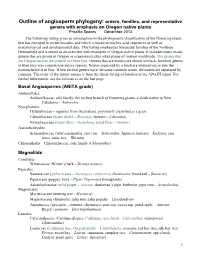
Outline of angiosperm phylogeny: orders, families, and representative genera with emphasis on Oregon native plants Priscilla Spears December 2013 The following listing gives an introduction to the phylogenetic classification of the flowering plants that has emerged in recent decades, and which is based on nucleic acid sequences as well as morphological and developmental data. This listing emphasizes temperate families of the Northern Hemisphere and is meant as an overview with examples of Oregon native plants. It includes many exotic genera that are grown in Oregon as ornamentals plus other plants of interest worldwide. The genera that are Oregon natives are printed in a blue font. Genera that are exotics are shown in black, however genera in blue may also contain non-native species. Names separated by a slash are alternatives or else the nomenclature is in flux. When several genera have the same common name, the names are separated by commas. The order of the family names is from the linear listing of families in the APG III report. For further information, see the references on the last page. Basal Angiosperms (ANITA grade) Amborellales Amborellaceae, sole family, the earliest branch of flowering plants, a shrub native to New Caledonia – Amborella Nymphaeales Hydatellaceae – aquatics from Australasia, previously classified as a grass Cabombaceae (water shield – Brasenia, fanwort – Cabomba) Nymphaeaceae (water lilies – Nymphaea; pond lilies – Nuphar) Austrobaileyales Schisandraceae (wild sarsaparilla, star vine – Schisandra; Japanese -

Alphabetical Lists of the Vascular Plant Families with Their Phylogenetic
Colligo 2 (1) : 3-10 BOTANIQUE Alphabetical lists of the vascular plant families with their phylogenetic classification numbers Listes alphabétiques des familles de plantes vasculaires avec leurs numéros de classement phylogénétique FRÉDÉRIC DANET* *Mairie de Lyon, Espaces verts, Jardin botanique, Herbier, 69205 Lyon cedex 01, France - frederic.danet@mairie-lyon.fr Citation : Danet F., 2019. Alphabetical lists of the vascular plant families with their phylogenetic classification numbers. Colligo, 2(1) : 3- 10. https://perma.cc/2WFD-A2A7 KEY-WORDS Angiosperms family arrangement Summary: This paper provides, for herbarium cura- Gymnosperms Classification tors, the alphabetical lists of the recognized families Pteridophytes APG system in pteridophytes, gymnosperms and angiosperms Ferns PPG system with their phylogenetic classification numbers. Lycophytes phylogeny Herbarium MOTS-CLÉS Angiospermes rangement des familles Résumé : Cet article produit, pour les conservateurs Gymnospermes Classification d’herbier, les listes alphabétiques des familles recon- Ptéridophytes système APG nues pour les ptéridophytes, les gymnospermes et Fougères système PPG les angiospermes avec leurs numéros de classement Lycophytes phylogénie phylogénétique. Herbier Introduction These alphabetical lists have been established for the systems of A.-L de Jussieu, A.-P. de Can- The organization of herbarium collections con- dolle, Bentham & Hooker, etc. that are still used sists in arranging the specimens logically to in the management of historical herbaria find and reclassify them easily in the appro- whose original classification is voluntarily pre- priate storage units. In the vascular plant col- served. lections, commonly used methods are systema- Recent classification systems based on molecu- tic classification, alphabetical classification, or lar phylogenies have developed, and herbaria combinations of both. -

Streamhead Canebrakes Are Treeless Or Sparsely Treed Vegetation Dominated by Arundinaria Tecta in Seepage-Fed Drainages
STREAMHEAD CANEBRAKE Concept: Streamhead Canebrakes are treeless or sparsely treed vegetation dominated by Arundinaria tecta in seepage-fed drainages. Tree plus broadleaf shrub cover is generally less than 25 percent in good examples but may be higher if fire frequency has been reduced. Most of this rare community type is in the Sandhills Region, but it might occur in sand dune areas elsewhere in the Coastal Plain. Distinguishing Features: Streamhead Canebrakes are distinguished from other communities of seepage-fed streamheads by the dominance of Arundinaria tecta combined with low cover of trees and other shrubs (less than 25 percent). They are distinguished from Peatland Canebrakes by occurring in streamheads rather than in flat or domed peatlands, Carolina bays, or shallow outer Coastal Plain swales. Synonyms: Arundinaria gigantea ssp. tecta Shrubland (CEGL003843) (not distinguished from Peatland Canebrake in NVC). Atlantic Coastal Plain Streamhead Seepage Swamp, Pocosin and Baygall (CES203.252). Sites: Streamhead Canebrakes occur along mucky headwater and small stream bottoms in dissected sandhill areas, where soils are kept saturated by seepage. Soils: Soils are mucky mineral soils, most often mapped as Johnston (Cumulic Humaquept). Hydrology: Hydrology is typical of the theme as a whole, with long-term saturation by nutrient- poor water but with little or no stream flooding or standing water. Vegetation: Vegetation consists of a dense thicket of Arundinaria tecta and limited cover of broadleaf shrubs. Pinus serotina, Liriodendron tulipifera, Pinus taeda, Nyssa biflora, and Magnolia virginiana may form a sparse canopy. Any of the species of Streamhead Pocosin may be present in moderate numbers. Lyonia lucida is the most abundant other shrub in CVS plot data. -
Plant Succession on Burned Areas in Okefenokee Swamp Following the Fires of 1954 and 1955 EUGENE CYPERT Okefenokee National Wildlife Refuge U.S
Plant Succession on Burned Areas in Okefenokee Swamp Following the Fires of 1954 and 1955 EUGENE CYPERT Okefenokee National Wildlife Refuge U.S. Bureau of Sport Fisheries and 'Wildlife Waycross, GA 31501 INTRODUCTION IN 1954 and 1955, during an extreme drought, five major fires occurred in Okefenokee Swamp. These fires swept over approximately 318,000 acres of the swamp and 140,000 acres of the adjacent upland. In some areas in the swamp, the burning was severe enough to kill most of the timber and the understory vegetation and burn out pockets in the peat bed. Burns of this severity were usually small and spotty. Over most of the swamp, the burns were surface fires which generally killed most of the underbrush but rarely burned deep enough into the peat bed to kill the larger trees. In many places the swamp fires swept over lightly, burning surface duff and killing only the smaller underbrush. Some areas were missed entirely. On the upland adjacent to the swamp, the fires were very de structive, killing most of the pine timber on the 140,000 acres burned over. The destruction of pine forests on the upland and the severe 199 EUGENE CYPERT burns in the swamp caused considerable concern among conservation ists and neighboring land owners. It was believed desirable to learn something of the succession of vegetation on some of the more severely burned areas. Such knowl edge would add to an understanding of the ecology and history of the swamp and to an understanding of the relation that fires may have to swamp wildlife. -

Perú: Cordillera Escalera-Loreto Perú: Cordillera Escalera-Loreto Escalera-Loreto Cordillera Perú: Instituciones Participantes/ Participating Institutions
.................................................................................................................................................................................................................................................................................................................................................................................................................................................................................................................... .............................................................................................................................................................................................................................................................................................................................................................................................no. 26 ....................................................................................................................... 26 Perú: Cordillera Escalera-Loreto Perú: Cordillera Escalera-Loreto Instituciones participantes/ Participating Institutions The Field Museum Nature and Culture International (NCI) Federación de Comunidades Nativas Chayahuita (FECONACHA) Organización Shawi del Yanayacu y Alto Paranapura (OSHAYAAP) Municipalidad Distrital de Balsapuerto Instituto de Investigaciones de la Amazonía Peruana (IIAP) Herbario Amazonense de la Universidad Nacional de la Amazonía Peruana (AMAZ) Museo de Historia Natural de la Universidad Nacional Mayor de San Marcos Centro -

Sweetpepper Bush Clethra Alnifolia L
W&M ScholarWorks Reports 11-1-1999 Sweetpepper Bush Clethra alnifolia L. Gene Silberhorn Virginia Institute of Marine Science Follow this and additional works at: https://scholarworks.wm.edu/reports Part of the Plant Sciences Commons Recommended Citation Silberhorn, G. (1999) Sweetpepper Bush Clethra alnifolia L.. Wetland Flora Technical Reports, Wetlands Program, Virginia Institute of Marine Science. Virginia Institute of Marine Science, College of William and Mary. http://dx.doi.org/doi:10.21220/m2-ep1m-de63 This Report is brought to you for free and open access by W&M ScholarWorks. It has been accepted for inclusion in Reports by an authorized administrator of W&M ScholarWorks. For more information, please contact scholarworks@wm.edu. Wetlands Technical Report Program Wetland Flora No. 99-11 / November 1999 Gene Silberhorn Sweetpepper Bush Clethra alnifolia L. Growth Habit and Diagnostic Characteristics Habitat Sweetpepper bush is a coastal freshwater shrub with Sweetpepper bush is most likely found in wooded simple, deciduous, alternate leaves (3 to 6 inches wetlands in coastal Virginia, but can grow elsewhere long) and serrated margins. It often grows in dense in non-wetland areas. It is the dominant shrub in the thickets from 3 to 10 feet tall. In mid-summer, the Great Dismal Swamp in Virginia and North Carolina. shrub produces a terminal inflorescence (raceme) of Dense thickets exist there that are difficult to penetrate small, white fragrant flowers. By late summer or early during the growing season. In the Swamp, it is often fall, green, globular capsules (1/8- 1/4 in. wide) associated with fetterbush (Lyonia lucida) and coastal appear (as illustrated) and turn gray by late autumn/ sweetbells (Leucothoe axillaris). -

Carnivorous Plant Newsletter V42 N3 September 2013
Technical Refereed Contribution Phylogeny and biogeography of the Sarraceniaceae JOHN BRITTNACHER • Ashland, Oregon • USA • john@carnivorousplants.org Keywords: History: Sarraceniaceae evolution The carnivorous plant family Sarraceniaceae in the order Ericales consists of three genera: Dar- lingtonia, Heliamphora, and Sarracenia. Darlingtonia is represented by one species that is found in northern California and western Oregon. The genus Heliamphora currently has 23 recognized species all of which are native to the Guiana Highlands primarily in Venezuela with some spillover across the borders into Brazil and Guyana. Sarracenia has 15 species and subspecies, all but one of which are located in the southeastern USA. The range of Sarracenia purpurea extends into the northern USA and Canada. Closely related families in the plant order Ericales include the Roridu- laceae consisting of two sticky-leaved carnivorous plant species, Actinidiaceae, the Chinese goose- berry family, Cyrillaceae, which includes the common wetland plant Cyrilla racemiflora, and the family Clethraceae, which also has wetland plants including Clethra alnifolia. The rather charismatic plants of the Sarraceniaceae have drawn attention since the mid 19th century from botanists trying to understand how they came into being, how the genera are related to each other, and how they came to have such disjunct distributions. Before the advent of DNA sequencing it was very difficult to determine their relationships. Macfarlane (1889, 1893) proposed a phylogeny of the Sarraceniaceae based on his judgment of the overlap in features of the adult pitchers and his assumption that Nepenthes is a member of the family (Fig. 1a). He based his phy- logeny on the idea that the pitchers are produced from the fusion of two to five leaflets. -

U.S. National Vegetation Classification: Advancing The
U.S. National Vegetation Classification: Advancing the Description and Management of the Nation’s Ecosystems Use of the NVC hierarchy to scale the GAP/LANDFIRE National Ecosystems Map Legend Don Long (U.S. Forest Service), Anne Davidson (GAP, BSU) Todd Earnhardt (GAP , NSCU) Alexa McKerrow (U.S. Geological Survey) . Background Methods Results A national inventory of the existing vegetation across the There are 551 natural vegetation classes represented in the 6 Classes 13 Subclasses 22 Formations U.S. has been central to the missions of both the GAP/LANDFIRE National Terrestrial Ecosystems Map for the a Landscape Fire and Resource Management Planning Tools conterminous U.S. The crosswalk allows for the Project (LANDFIRE) and the National Gap Analysis Program aggregation of the mapped classes into the hierarchical b (GAP). Over the past several years these two programs structure of the USNVC; specifically, the ecological systems a. Forest & Woodland a. Temperate & Boreal Forest & Woodland a. Temperate Flooded & Swamp Forest b. Desert & Semi-Desert b. Warm Desert & Semi-Desert Woodland, b. Warm Desert & Semi-Desert Scrub & have come together to collaborate on the next generation are crosswalked to the middle and upper levels of the Scrub & Grassland Grassland highly detailed existing vegetation maps for the U.S. This USNVC. Relationships between the two classification 51 Divisions 112 Macrogroups 240 Groups collaboration leverages the mapping and inventory to systems developed by NatureServe ecologists were used to meet needs for both fire and fuels management, as well link the mapped Ecological Systems to the Group level of as for wildlife habitat conservation planning. the USNVC. -

The Natural Communities of South Carolina
THE NATURAL COMMUNITIES OF SOUTH CAROLINA BY JOHN B. NELSON SOUTH CAROLINA WILDLIFE & MARINE RESOURCES DEPARTMENT FEBRUARY 1986 INTRODUCTION The maintenance of an accurate inventory of a region's natural resources must involve a system for classifying its natural communities. These communities themselves represent identifiable units which, like individual plant and animal species of concern, contribute to the overall natural diversity characterizing a given region. This classification has developed from a need to define more accurately the range of natural habitats within South Carolina. From the standpoint of the South Carolina Nongame and Heritage Trust Program, the conceptual range of natural diversity in the state does indeed depend on knowledge of individual community types. Additionally, it is recognized that the various plant and animal species of concern (which make up a significant remainder of our state's natural diversity) are often restricted to single natural communities or to a number of separate, related ones. In some cases, the occurrence of a given natural community allows us to predict, with some confidence, the presence of specialized or endemic resident species. It follows that a reasonable and convenient method of handling the diversity of species within South Carolina is through the concept of these species as residents of a range of natural communities. Ideally, a nationwide classification system could be developed and then used by all the states. Since adjacent states usually share a number of community types, and yet may each harbor some that are unique, any classification scheme on a national scale would be forced to recognize the variation in a given community from state to state (or region to region) and at the same time to maintain unique communities as distinctive. -

Evolutionary History of Floral Key Innovations in Angiosperms Elisabeth Reyes
Evolutionary history of floral key innovations in angiosperms Elisabeth Reyes To cite this version: Elisabeth Reyes. Evolutionary history of floral key innovations in angiosperms. Botanics. Université Paris Saclay (COmUE), 2016. English. NNT : 2016SACLS489. tel-01443353 HAL Id: tel-01443353 https://tel.archives-ouvertes.fr/tel-01443353 Submitted on 23 Jan 2017 HAL is a multi-disciplinary open access L’archive ouverte pluridisciplinaire HAL, est archive for the deposit and dissemination of sci- destinée au dépôt et à la diffusion de documents entific research documents, whether they are pub- scientifiques de niveau recherche, publiés ou non, lished or not. The documents may come from émanant des établissements d’enseignement et de teaching and research institutions in France or recherche français ou étrangers, des laboratoires abroad, or from public or private research centers. publics ou privés. NNT : 2016SACLS489 THESE DE DOCTORAT DE L’UNIVERSITE PARIS-SACLAY, préparée à l’Université Paris-Sud ÉCOLE DOCTORALE N° 567 Sciences du Végétal : du Gène à l’Ecosystème Spécialité de Doctorat : Biologie Par Mme Elisabeth Reyes Evolutionary history of floral key innovations in angiosperms Thèse présentée et soutenue à Orsay, le 13 décembre 2016 : Composition du Jury : M. Ronse de Craene, Louis Directeur de recherche aux Jardins Rapporteur Botaniques Royaux d’Édimbourg M. Forest, Félix Directeur de recherche aux Jardins Rapporteur Botaniques Royaux de Kew Mme. Damerval, Catherine Directrice de recherche au Moulon Président du jury M. Lowry, Porter Curateur en chef aux Jardins Examinateur Botaniques du Missouri M. Haevermans, Thomas Maître de conférences au MNHN Examinateur Mme. Nadot, Sophie Professeur à l’Université Paris-Sud Directeur de thèse M.