LISTIFIED! Britannica’S 300 Lists That Will Blow Your Mind
Total Page:16
File Type:pdf, Size:1020Kb
Load more
Recommended publications
-
Origin and Beyond
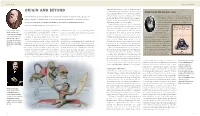
EVOLUTION ORIGIN ANDBEYOND Gould, who alerted him to the fact the Galapagos finches ORIGIN AND BEYOND were distinct but closely related species. Darwin investigated ALFRED RUSSEL WALLACE (1823–1913) the breeding and artificial selection of domesticated animals, and learned about species, time, and the fossil record from despite the inspiration and wealth of data he had gathered during his years aboard the Alfred Russel Wallace was a school teacher and naturalist who gave up teaching the anatomist Richard Owen, who had worked on many of to earn his living as a professional collector of exotic plants and animals from beagle, darwin took many years to formulate his theory and ready it for publication – Darwin’s vertebrate specimens and, in 1842, had “invented” the tropics. He collected extensively in South America, and from 1854 in the so long, in fact, that he was almost beaten to publication. nevertheless, when it dinosaurs as a separate category of reptiles. islands of the Malay archipelago. From these experiences, Wallace realized By 1842, Darwin’s evolutionary ideas were sufficiently emerged, darwin’s work had a profound effect. that species exist in variant advanced for him to produce a 35-page sketch and, by forms and that changes in 1844, a 250-page synthesis, a copy of which he sent in 1847 the environment could lead During a long life, Charles After his five-year round the world voyage, Darwin arrived Darwin saw himself largely as a geologist, and published to the botanist, Joseph Dalton Hooker. This trusted friend to the loss of any ill-adapted Darwin wrote numerous back at the family home in Shrewsbury on 5 October 1836. -

Gorgonopsia: Rubidgeinae) with Implications for the Identity of This Species
Rediscovery of the holotype of Clelandina major Broom, 1948 (Gorgonopsia: Rubidgeinae) with implications for the identity of this species Christian F. Kammerer North Carolina Museum of Natural Sciences, 11 W. Jones Street, Raleigh, North Carolina 27604, U.S.A., and Evolutionary Studies Institute, University of the Witwatersrand, Private Bag 3, WITS, Johannesburg, 2050 South Africa E-mail: christian.kammerer@naturalsciences.org Received 7 November 2017. Accepted 8 December 2017 No specimen number was given for the holotype of the rubidgeine gorgonopsian species Clelandina major Broom, 1948 in its original description. Historically, a specimen in the Rubidge Collection (RC 94) was considered to represent Broom’s type specimen for C. major. However, recent study has revealed that the holotype of C. major is in fact a different specimen in the McGregor Museum in Kimberley (MMK 5031). The morphology of this specimen is consistent with the genus Clelandina, contra work based on RC 94 that considered C. major referable to Aelurognathus. Clelandina major is here considered synonymous with the type species Clelandina rubidgei. MMK 5031 represents only the fifth known specimen of this rare and unusual gorgonopsian. Keywords: Synapsida, Therapsida, Gorgonopsia, Permian, holotype, taxonomy. Palaeontologia africana 2017. ©2017 Christian F.Kammerer. This is an open-access article published under the Creative Commons Attribution 4.0 Unported License (CC BY4.0). To view a copy of the license, please visit http://creativecommons.org/licenses/by/4.0/. This license permits unrestricted use, distribution, and reproduction in any medium, provided the original author and source are credited. The article is permanently archived at: http://wiredspace.wits.ac.za/handle/10539/23480 INTRODUCTION provided no specimen numbers for the holotypes of Clelandina is one of the rarest and most unusual C. -

The Big Picture Book
BOOK PUBLISHERS Teachers Notes (Middle Years) by Dr John Long The Big Picture Book by Dr John Long, illustrated by Brian Choo ISBN 9781741143287 Recommended for ages 8-14 These notes may be reproduced free of charge for use and study within schools but they may not be reproduced (either in whole or in part) and offered for commercial sale. Introduction ............................................ 2 Science studies........................................ 2 Time........................................... 2 Astronomy .................................. 3 Geology ...................................... 3 Biology ....................................... 4 Science and the future .................. 6 Cultural studies ....................................... 6 Language................................................ 7 Meanings of some of the names featured in the book ........... 7 About the writer and illustrator .................. 7 Appendix: A ‘Bestiary’ of living things featured in the illustrations........................ 10 83 Alexander Street PO Box 8500 Crows Nest, Sydney St Leonards NSW 2065 NSW 1590 ph: (61 2) 8425 0100 info@allenandunwin.com Allen & Unwin PTY LTD Australia Australia fax: (61 2) 9906 2218 www.allenandunwin.com ABN 79 003 994 278 INTRODUCTION This book was written to introduce to upper primary and lower secondary level children an outline of the three main themes that contribute towards our understanding of evolution: time, physical processes, and biological change. The book can be used to augment studies in general science (astronomy, geology, biology), but also to contribute to an understanding of the birth of human culture and to promote discussion of environmental issues confronting the world today. The writing is a simple, almost lyrical style to facilitate an easy level of reading, with pronunciation guide and glossary at the back of the book to help children say and understand the meaning of most of the technical words used in the text. -

Physical and Environmental Drivers of Paleozoic Tetrapod Dispersal Across Pangaea
ARTICLE https://doi.org/10.1038/s41467-018-07623-x OPEN Physical and environmental drivers of Paleozoic tetrapod dispersal across Pangaea Neil Brocklehurst1,2, Emma M. Dunne3, Daniel D. Cashmore3 &Jӧrg Frӧbisch2,4 The Carboniferous and Permian were crucial intervals in the establishment of terrestrial ecosystems, which occurred alongside substantial environmental and climate changes throughout the globe, as well as the final assembly of the supercontinent of Pangaea. The fl 1234567890():,; in uence of these changes on tetrapod biogeography is highly contentious, with some authors suggesting a cosmopolitan fauna resulting from a lack of barriers, and some iden- tifying provincialism. Here we carry out a detailed historical biogeographic analysis of late Paleozoic tetrapods to study the patterns of dispersal and vicariance. A likelihood-based approach to infer ancestral areas is combined with stochastic mapping to assess rates of vicariance and dispersal. Both the late Carboniferous and the end-Guadalupian are char- acterised by a decrease in dispersal and a vicariance peak in amniotes and amphibians. The first of these shifts is attributed to orogenic activity, the second to increasing climate heterogeneity. 1 Department of Earth Sciences, University of Oxford, South Parks Road, Oxford OX1 3AN, UK. 2 Museum für Naturkunde, Leibniz-Institut für Evolutions- und Biodiversitätsforschung, Invalidenstraße 43, 10115 Berlin, Germany. 3 School of Geography, Earth and Environmental Sciences, University of Birmingham, Birmingham B15 2TT, UK. 4 Institut -

Stratigraphic Data of the Middle – Late Permian on Russian Platform Données Stratigraphiques Sur Le Permien Moyen Et Supérieur De La Plate-Forme Russe
Geobios 36 (2003) 533–558 www.elsevier.com/locate/geobio Stratigraphic data of the Middle – Late Permian on Russian Platform Données stratigraphiques sur le Permien moyen et supérieur de la Plate-forme russe Vladimir P. Gorsky a, Ekaterina A. Gusseva a,†, Sylvie Crasquin-Soleau b,*, Jean Broutin c a All-Russian Geological Research Institute (VSEGEI), Sredny pr. 74, St. Petersburg, 199106, Russia b CNRS, FRE2400, université Pierre-et-Marie-Curie, département de géologie sédimentaire, T.15–25, E.4, case 104, 75252 Paris cedex 05, France c Université Pierre-et-Marie-Curie, laboratoire de paléobotanique et paléoécologie, IFR101–CNRS, 12, rue Cuvier, 75005 Paris, France Received 12 November 2001; accepted 2 December 2002 Abstract This paper presents the litho– and biostratigraphic data and correlations of the Middle and Late Permian (Ufimian, Kazanian and Tatarian) on the Russian Platform. The lithological descriptions and the paleontological content (foraminifera, bivalves, ostracods, brachiopods, vertebrates, plants and acritarchs) of the different units are exposed from the Barents Sea up to the Caspian Sea. © 2003 E´ ditions scientifiques et médicales Elsevier SAS. All rights reserved. Résumé Cet article présente les descriptions et les corrélations litho– et biostratigraphiques du Permien moyen et supérieur (Ufimien, Kazanien, Tatarien) de la Plate-forme russe depuis la mer de Barents jusqu’à la mer Caspienne. Les descriptions lithologiques et le contenu paléontologique (foraminifères, bivalves, ostracodes, brachiopodes, vertébrés, plantes et acritarches) des différentes unités sont exposés. © 2003 E´ ditions scientifiques et médicales Elsevier SAS. All rights reserved. Keywords: Stratigraphic data; Correlations; Middle and Late Permian; Russian Platform; Ostracods; Plants Mots clés : Données stratigraphiques ; Corrélations ; Permien moyen et supérieur ; Plate-forme russe ; Ostracodes ; Plantes 1. -

Pelycosauria Y Therapsida
Pelycosauria y Therapsida Los amniotos pueden dividirse en dos líneas principales: Los synapsidos (de quienes provienen los mamíferos) y los Sauropsidos (de quienes provienen “rep;les” y aves). Los Synápsidos poseen una apertura (fenestra) en el cráneo, detrás del ojo, debajo de la unión entre los huesos postorbital y escamoso. Comparten un ancestro en común más reciente con un mamífero que con una lagar;ja. Filogené;camente, no pertenecen a rep;lia, pero a la mayoría se les conoce como “rep;les semejantes a mamíferos” Anapsida Synapsida Diapsida “Parapsida” o “Euryapsida” (Diapsida modificados) SYNAPSIDA: -COMPARTEN UN ACMR CON MAMÍFEROS QUE CON REPTILES -FENESTRA TEMPORAL, BAJO POSTORBITAL-ESCAMOSO -REGION OCCIPITAL POSTERIORMENTE INCLINADA (NO VERTICAL) -SUPRATEMPORAL SE CONECTA AL POSTORBITAL PETROLACOSAURUS ARCHAEOTHYRIS (synapsida) -CENTRALE MEDIAL (MC) BIEN DESARROLLADO EN EL TARSO -PRESENCIA DE DOS HUESOS CORONOIDES (LADO MEDIAL MANDÍBULA) Tradicionalmente se discuten cuatro “tipos fundamnetales” de synapsidos, que en efecto son grupos sucesivamente sucesivamente anidados “Pelycosaurios” (parafilético, se usa para hablar de synapsidos basales) Carbonífero Superior- Terápsidos. Pérmico-Triásico Pérmico. Muy “reptilianos” aún Modificaciones craneales y posturales importantes Cynodontes. Pérmico superior, Triásico Mamíferos. Triásico Muy similares a mamíferos Oído interno tres huesos Dinastías synapsidas Meg Dynasty 1: Pelicosaurios del Pérmico inferior Meg Dynasty 2: Terápsidos del Pérmico superior-Triásico inferior Meg Dynasty 3: Mamíferos del Cenozoico Los primeros synápsidos (basales) se conocen colectivamente como un grupo “parafilético”, los Pelycosaurios (P en la figura) que excluyen a sus descendientes Terápsidos. Los pelycosaurios presentan abundantes dientes en el paladar. Reconstruc;on of Pangaea showing anteosaurid dinocephalians and platyoposaurid temnospondyles during the Middle Permian. Probable dispersal routes are indicated by red arrows. -

ARSTANOSAURUS Species Undescribed AVIMIMUS Portentosus
Dinosaur Casts Specimen List ARSTANOSAURUS species undescribed Meaning of Name: Reptile from Arstan Well Classification: ORNITHOPODA; Hadrosauridae, Hadrosaurinae Age: Late Cretaceous (Santonian) Bayn Shireh Formation, 85 million years ago Locality: Gobi Desert, Peoples' Republic of Mongolia Size: l5cm in length AVIMIMUS portentosus Partial skeleton. In position as if found in field Meaning of Name: Bird Mimic Classification: THEROPODA; relationships uncertain Age: Late Cretaceous (Campanian) Djadokhta Formation, 75 million years ago Locality: Gobi Desert, Peoples' Republic of Mongolia Size: l00cm in length reconstructed Skeleton www.gondwanastudios.com BAGACERATOPS rozhdestvenskyi Meaning of Name: Small horned face Classification: CERATOPSIA; Neoceratopsia; Protoceratopsidae Age: Late Cretaceous (Campanian), Barun Goyot Formation, 75 million years ago Locality: Gobi Desert, Southern Khermin Tsav, Mongolia Size: 3.5cm in length BIARMOSUCHUS tener Meaning of Name: Crocodile from Biarmia, an ancient country in the Perm region. Classification: THERAPSIDA; Eotheriodontia; Family Biarmosuchidae Age: Late Permian, Zone I, 225 million years ago Locality: Ocher, Perm Region, Russia Size: 75cm in length Half skeleton encased in sediment, as found in the field. BULLOCKORNIS planei (Demon Duck of Doom) Meaning of Name: Bird from Bullock Creek Classification: Flightless Bird Age: 12 million years Locality: Northern Territory, Australia Size: 250cm in height www.gondwanastudios.com CATOPSALIS djadochtatherium Meaning of Name: Beast from Djadokhta -
(2020). Morphological Convergence Obscures Functional Diversity in Sabre-Toothed Carnivores
Lautenschlager, S., Figueirido, B., Cashmore, D., Bendel, E-M., & Stubbs, T. L. (2020). Morphological convergence obscures functional diversity in sabre-toothed carnivores. Proceedings of the Royal Society of London B: Biological Sciences, 287(1935). https://doi.org/10.1098/rspb.2020.1818 Peer reviewed version Link to published version (if available): 10.1098/rspb.2020.1818 Link to publication record in Explore Bristol Research PDF-document This is the author accepted manuscript (AAM). The final published version (version of record) is available online via The Royal Society at https://doi.org/10.1098/rspb.2020.1818. Please refer to any applicable terms of use of the publisher. University of Bristol - Explore Bristol Research General rights This document is made available in accordance with publisher policies. Please cite only the published version using the reference above. Full terms of use are available: http://www.bristol.ac.uk/red/research-policy/pure/user-guides/ebr-terms/ Submitted to Proceedings of the Royal Society B: For Review Only Morphological convergence obscures functional diversity in sabre-toothed carnivores Journal: Proceedings B Manuscript ID RSPB-2020-1818.R1 Article Type: Research Date Submitted by the 03-Sep-2020 Author: Complete List of Authors: Lautenschlager, Stephan; University of Birmingham, Figueirido, Borja; Universidad de Málaga Cashmore, Daniel; University of Birmingham Bendel, Eva-Maria; Museum für Naturkunde - Leibniz-Institut für Evolutions- und Biodiversitätsforschung; Humboldt-Universität zu Berlin Stubbs, Thomas; University of Bristol, School of Earth Sciences Subject: Palaeontology < BIOLOGY, Evolution < BIOLOGY Convergent evolution, functional morphology, computational analysis, Keywords: Smilodon, ecology Proceedings B category: Palaeobiology http://mc.manuscriptcentral.com/prsb Page 1 of 26 Submitted to Proceedings of the Royal Society B: For Review Only Author-supplied statements Relevant information will appear here if provided. -
Gorgonopsians, an Attempt Based on a Re-Examination of the Cranial Anatomy of the Type Material and a Comparison of All the Specimens Available 2
ON THE CLASSIFICATION OF THE GORGONOPSIA by D. Sigogneau 1 The work here summarized represents an attempt to review the South African Gorgonopsians, an attempt based on a re-examination of the cranial anatomy of the type material and a comparison of all the specimens available 2. The possible origin of the group from the Russian eotheriodonts is discussed in conclusion. When one realizes what a tremendous amount of material Broom had to deal with, one cannot help but be impressed by the synthesis at which he was able to arrive and which remains to-day largely valid. He masterfully recognized the major taxonomic boundaries and their significance, perceiving within each group the affinities uniting the different constituents. However, his inner feeling that it was his duty to make known each and every specimen examined by him led him to neglect somewhat their preparation and to establish types insufficiently described or justified. Quite apart from that, the number of specimens accumulated for over a hundred years naturally de manded a re-organization of the different infra-orders; I was offered by Dr. A. S. Brink, fonner Assistant Director of the Bernard Price Institute for Palaeontological Research of Johannesburg, the opportunity to disentangle the Gorgonopsians. After four years of reflection I emerged in 1967 with a provisional classification, the sole pretention of which being to present some new morphological data. The material consists of about 150 specimens, formerly distributed in 67 genera and 108 species. Except for the North American material, every specimen has been re-examined, often further prepared, and drawn and photographed. -
Lab 10-Carboniferous+Perm-Online
Lab 10: Carboniferous/Permian Observations How This Lab Will Work 1. Open a Word doc or similar on your computer 2. At various points I will ask you to answer a question based on the activities in this lab. 3. I will indicate these points by this symbol: Please answer these questions in your Word doc. 4. After you have assembled the answers into your Word doc, go to the course Canvas page. 5. On the module for this week there is a link to TurnItIn. 6. Please upload your document using the TurnInIt. 7. That completes the lab assignment. :) Reminder on Observation Project Please remember that as we go through these, you should be using these fossils to construct your lab observation project, which was detailed last time. Easy to put off, hard to catch up. ;) Topics Today: 1. Introduction to Carboniferous-Permian 2. Phylum Rhizaria: Fusulinida 3. Phylum Bryozoa: Archimedes 4. Phylum Plantae: Glossopteris 5. Phylum Plantae: Lepidodendron 6. Phylum Plantae: Calamites 7. Phylum Arthropoda: Meganeuropsis 8. Phylum Arthropoda: Arthropleura 9. Phylum Chordata: Helicoprion 10. Phylum Chordata: Eryops 11. Phylum Chordata: Dimetrodon 12. Phylum Chordata: Lystrosaurus 13. Phylum Chordata: Gorgonopsia Geology 121 Lab 10: Carboniferous-Permian, page 1 of 7 Introduction to Carboniferous-Permian In today’s lab we’ll look at specimens from the Carboniferous and the Permian. The Carboniferous was period of high O2 and high CO2. It is typically divided in North America into the Mississippian and the Pennsylvanian, so a sketch of today’s time periods looks like this: Permian Pennsylvanian Carboniferous Mississippian These time periods saw developments of some things we haven’t seen before—namely, land animals, foraminifera, and forests of land plants. -

Permian Monsters: Life Before the Dinosaurs’
Life Before the Dinosaurs Introducing the Permian, its bizarre creatures and the greatest extinction Earth ever experienced. A Travelling Exhibition Blending Art and Science Exhibition Overview Step back in time 290 million years when bizarre-looking animals dominated life on land and sea, and find out about the greatest extinction the world has ever seen in ‘Permian Monsters: Life before the Dinosaurs’. This unique exhibition brings the past back to life with fossilized skeletons and full size life models of the animals that ruled the world millions of years before the age of dinosaurs, in a time known as the Permian. The Permian period ended with the largest extinction Earth ever experienced, which wiped out 90% of all species on the planet. The cause of the end-Permian extinction had baffled scientists for the past 20 years but a recent discovery shed new light on the cause of this catastrophe: global warming. Find out how this familiar phenomenon, started by a huge volcanic eruption, set off a chain of events that led to the greatest extinction on Earth. The exhibition blends art and science with a collection of new artwork which offers a glimpse back in time through the eyes of award winning paleo-artist Julius Csotonyi. View fossilised skeletons and reconstructed models of these amazing but bizarre creatures that dominated land and sea; and dig and identify fossils in the interactive dig pits throughout the exhibition. ‘Permian Monsters’ showcases an amazing collection of fossils and models from this relatively unknown time period, from giant insects, bizarre looking sharks to strange reptiles with mammal-like characteristics. -
Reptile Family Tree Peters 2021 1909 Taxa, 235 Characters
Turinia Enoplus Chondrichtyes Jagorina Gemuendina Manta Chordata Loganellia Ginglymostoma Rhincodon Branchiostoma Tristychius Pikaia Tetronarce = Torpedo Palaeospondylus Craniata Aquilolamna Tamiobatis Myxine Sphyrna Metaspriggina Squalus Arandaspis Pristis Poraspis Rhinobatos Drepanaspis Cladoselache Pteromyzon adult Promissum Chlamydoselachus Pteromyzon hatchling Aetobatus Jamoytius Squatina Birkenia Heterodontus Euphanerops Iniopteryx Drepanolepis Helodus Callorhinchus Haikouichthys Scaporhynchus Belantsea Squaloraja Hemicyclaspis Chimaera Dunyu CMNH 9280 Mitsukurina Rhinochimaera Tanyrhinichthys Isurus Debeerius Thelodus GLAHM–V8304 Polyodon hatchling Cetorhinus Acipenser Yanosteus Oxynotus Bandringa PF8442 Pseudoscaphirhynchus Isistius Polyodon adult Daliatus Bandringa PF5686 Gnathostomata Megachasma Xenacanthus Dracopristis Akmonistion Ferromirum Strongylosteus Ozarcus Falcatus Reptile Family Tree Chondrosteus Hybodus fraasi Hybodus basanus Pucapampella Osteichthyes Orodus Peters 2021 1943 taxa, 235 characters Gregorius Harpagofututor Leptolepis Edestus Prohalecites Gymnothorax funebris Doliodus Gymnothorax afer Malacosteus Eurypharynx Amblyopsis Lepidogalaxias Typhlichthys Anableps Kryptoglanis Phractolaemus Homalacanthus Acanthodes Electrophorus Cromeria Triazeugacanthus Gymnotus Gorgasia Pholidophorus Calamopleurus Chauliodus Bonnerichthys Dactylopterus Chiasmodon Osteoglossum Sauropsis Synodus Ohmdenia Amia Trachinocephalus BRSLI M1332 Watsonulus Anoplogaster Pachycormus Parasemionotus Aenigmachanna Protosphyraena Channa Aspidorhynchus