Ichinoseki Hiraizumi Area Tourism Guidebook
Total Page:16
File Type:pdf, Size:1020Kb
Load more
Recommended publications
-

Hiraizumi (Japan) No 1277Rev
The World Heritage Committee, Hiraizumi 1. Having examined Documents WHC-08/32.COM/8B (Japan) and WHC-08/32.COM/INF.8B1, 2. Defers the examination of the nomination of No 1277rev Hiraizumi – Cultural Landscape Associated with Pure Land Buddhist Cosmology, Japan, to the World Heritage List in order to allow the State Party to: a) provide further comparative analysis, particularly for the gardens, including comparators in China Official name as proposed by the State Party and Korea; Hiraizumi – Temples, Gardens and Archaeological b) consider revising the boundary of the nominated Sites Representing the Buddhist Pure Land property to include the elements of the landscape value; Location 3. Recommends that any further nomination would Iwate Prefecture need to be accompanied by a fully functioning Japan management plan and an adequate suite of indicators, including those to monitor visual connections and Brief description knowledge of associations with the property; Hiraizumi was the political and administrative centre of 4. Considers that any revised nomination with revised the northern realm of Japan in the 11th and 12th century boundaries, would need to be considered by a mission and rivalled Kyoto, politically and commercially. Built by to the site. the Ôshû Fujiwara family, the northern branch of the 5. Recommends that the World Heritage Centre assist ruling clan, its layout is seen as reflecting the by all means possible the State Party in the revision of cosmology of Pure Land Buddhism. This had been the nominated property. introduced to Japan from China and Korea in the th th 6 century and by the 12 century had developed into a On 10 January 2010 the State Party submitted a revised strong, local distinctive doctrine. -
JR EAST GROUP CSR REPORT 2015 Safety
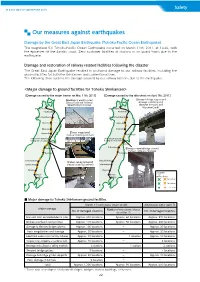
JR EAST GROUP CSR REPORT 2015 Safety Our measures against earthquakes Damage by the Great East Japan Earthquake (Tohoku-Pacific Ocean Earthquake) The magnitude 9.0 Tohoku-Pacific Ocean Earthquake occurred on March 11th, 2011, at 14:46, with the epicenter off the Sanriku coast. Zero customer fatalities at stations or on board trains due to the earthquake. Damage and restoration of railway related facilities following the disaster The Great East Japan Earthquake resulted in profound damage to our railway facilities, including the ground facilities for both the Shinkansen and conventional lines. The following chart outlines the damage incurred by our railway facilities due to the earthquake. <Major damage to ground facilities for Tohoku Shinkansen> 【Damage caused by the major tremor on Mar. 11th, 2011】 【Damage caused by the aftershock on April 7th, 2011】 【Breakage of electric poles】 【Damage to bridge supports and (Between Sendai and Shinkansen breakage of electric poles】 General Rolling Stock Center) (Between Ichinoseki and Mizusawa-Esashi) Shin-Aomori Shin-Aomori Hachinohe Hachinohe Iwate-Numakunai Iwate-Numakunai Morioka Morioka Kitakami Kitakami Ichinoseki 【Track irregularity】 (Sendai Station premises) Ichinoseki Shinkansen General Shinkansen General Rolling Stock Center Rolling Stock Center Sendai Sendai Fukushima Fukushima 【Damage to elevated bridge columns】 (Between Sendai and Furukawa) Kōriyama Kōriyama Nasushiobara Nasushiobara 【Fallen ceiling material】 Utsunomiya (Sendai Station platform) Utsunomiya Oyama Oyama 【Legend】 Ōmiya Ōmiya Civil engineering Tōkyō Tōkyō Electricity 50 locations 10 locations 1 location ■ Major damage to Tohoku Shinkansen ground facilities March 11 earthquake (main shock) Aftershocks (after April 7) Major damage Number of not restored places No. of damaged locations No. -

Full Download
VOLUME 1: BORDERS 2018 Published by National Institute of Japanese Literature Tokyo EDITORIAL BOARD Chief Editor IMANISHI Yūichirō Professor Emeritus of the National Institute of Japanese 今西祐一郎 Literature; Representative Researcher Editors KOBAYASHI Kenji Professor at the National Institute of Japanese Literature 小林 健二 SAITō Maori Professor at the National Institute of Japanese Literature 齋藤真麻理 UNNO Keisuke Associate Professor at the National Institute of Japanese 海野 圭介 Literature KOIDA Tomoko Associate Professor at the National Institute of Japanese 恋田 知子 Literature Didier DAVIN Associate Professor at the National Institute of Japanese ディディエ・ダヴァン Literature Kristopher REEVES Associate Professor at the National Institute of Japanese クリストファー・リーブズ Literature ADVISORY BOARD Jean-Noël ROBERT Professor at Collège de France ジャン=ノエル・ロベール X. Jie YANG Professor at University of Calgary 楊 暁捷 SHIMAZAKI Satoko Associate Professor at University of Southern California 嶋崎 聡子 Michael WATSON Professor at Meiji Gakuin University マイケル・ワトソン ARAKI Hiroshi Professor at International Research Center for Japanese 荒木 浩 Studies Center for Collaborative Research on Pre-modern Texts, National Institute of Japanese Literature (NIJL) National Institutes for the Humanities 10-3 Midori-chō, Tachikawa City, Tokyo 190-0014, Japan Telephone: 81-50-5533-2900 Fax: 81-42-526-8883 e-mail: journal@nijl.ac.jp Website: https//www.nijl.ac.jp Copyright 2018 by National Institute of Japanese Literature, all rights reserved. PRINTED IN JAPAN KOMIYAMA PRINTING CO., TOKYO CONTENTS -

ILD Experimental Hall Design
ILD Integration - Internal and External A Review Karsten Buesser 24.09.2013 ILD Workshop Cracow Introduction • An integrated detector model for ILD has been developed for the DBD/TDR • No site-specific issues have been taken into account • Now we have a site in northern Japan • At the same time ILD is undergoing the next round of optimisation • improvements, cost efficiency, sharpening of physics case • Subdetector collaborations get more experience with realistic full-system and full- scale prototypes • More realistic designs of mechanics, cabling, cooling • Time to review the current design w.r.t. realistic boundary conditions • Internal integration: the ILD engineering model • External integration: integration with the machine and SiD ILD in its Natural Environment... ILD Mechanical Design R. Stromhagen Update on model later today Yoke NB: Endcap Design for ILD@CLIC is different R. Stromhagen Calorimeter Integration Analogue HCAL K. Gadow K. Gadow Semi-Digital HCAL J.C. Ianigro • 5 Rings: • Structure mass: 440 t • Detector mass: 184 t • Total mass 624 t ECAL Installation Si/W ECAL Ecal integration steps ( Assembly hall) : A full ( mechanical ) stave structure is mounted on a frame ( yellow) making a beam The beam is then placed on its transport and storage cradle( orange) Adaptation of this tooling to the ILD considerations and to the moutain site constraints C. Clerc The stave is then ready to be equipped with slabs , cabled and tested C. Clerc ILD MDI session, Kyushu University 21 May 2012 To be done 8 times ILD MDI session, Kyushu University 21 May 2012 TPC Integration V. Prahl FEA studies Inner Region • Integration procedure : Using the same TPC insertion tool, adapt on it an apparatus to support and insert the inner parts. -

Powerful Warriors and Influential Clergy Interaction and Conflict Between the Kamakura Bakufu and Religious Institutions
UNIVERSITY OF HAWAllllBRARI Powerful Warriors and Influential Clergy Interaction and Conflict between the Kamakura Bakufu and Religious Institutions A DISSERTATION SUBMITTED TO THE GRADUATE DIVISION OF THE UNIVERSITY OF HAWAI'I IN PARTIAL FULFILLMENT OF THE REQUIREMENTS FOR THE DEGREE OF DOCTOR OF PHILOSOPHY IN HISTORY MAY 2003 By Roy Ron Dissertation Committee: H. Paul Varley, Chairperson George J. Tanabe, Jr. Edward Davis Sharon A. Minichiello Robert Huey ACKNOWLEDGMENTS Writing a doctoral dissertation is quite an endeavor. What makes this endeavor possible is advice and support we get from teachers, friends, and family. The five members of my doctoral committee deserve many thanks for their patience and support. Special thanks go to Professor George Tanabe for stimulating discussions on Kamakura Buddhism, and at times, on human nature. But as every doctoral candidate knows, it is the doctoral advisor who is most influential. In that respect, I was truly fortunate to have Professor Paul Varley as my advisor. His sharp scholarly criticism was wonderfully balanced by his kindness and continuous support. I can only wish others have such an advisor. Professors Fred Notehelfer and Will Bodiford at UCLA, and Jeffrey Mass at Stanford, greatly influenced my development as a scholar. Professor Mass, who first introduced me to the complex world of medieval documents and Kamakura institutions, continued to encourage me until shortly before his untimely death. I would like to extend my deepest gratitude to them. In Japan, I would like to extend my appreciation and gratitude to Professors Imai Masaharu and Hayashi Yuzuru for their time, patience, and most valuable guidance. -

Expanding the Scope of Online Train Seating Reservation Services For
August 28, 2018 East Japan Railway Company Expanding the scope of online train seating reservation services for travelers visiting from abroad - Adding more services to the Joyful Trains lineup, very popular overseas! - East Japan Railway Company (Head office: Shibuya-ku, Tokyo; President and CEO: Yuji Fukasawa; below, "JR East") is working to make it easier for passengers from overseas to enjoy rail travel. We plan to add 13 new “Joyful Train” services to the JR-EAST Train Reservation online designated seat reservations service for foreign travelers visiting Japan. We will keep striving to expand our services and improve the convenience of our products to ensure that passengers from overseas are able to enjoy pleasant and convenient rail travel. 1. Newly added “Joyful Trains” services In addition to its existing five train services, which include the much-loved Resort Shirakami, the JR-EAST Train Reservation online seating reservation service for overseas travelers visiting Japan is planning to add 13 appealing new train services to its lineup. These will include SL steam locomotives, which are very popular with foreign travelers visiting Japan, as well as the Koshino Shu*Kura train and other rail services for travelers to enjoy. This service allows travelers to reserve designated seating in advance of their visit to Japan, making it extremely convenient and easy to plan a trip. Additions to the Joyful Trains lineup 1 Resort Umineko (Hachinohe Line) 2 Resort Asunaro Shimokita (Ominato Line) 3 SL Ginga (Kamaishi Line) 4 POKÉMON with YOU Train (Ofunato Line) 5 Zipangu Hiraizumi (Tohoku Main Line) 6 Resort Minori (Riku-East Line) Koshino Shu*Kura (Shinetsu Main Line) 7 SL Minakami (Joetsu Line) Renamed “SL Gunma Minakami” from October 2018 8 SL Usui (Shinetsu Main Line) Renamed “SL Gunma Yokokawa” from October 2018 9 Koshino Shu*Kura (Shinetsu Main Line) 10 SL Banetsu Monogatari (Ban-etsu-West Line) 11 Kirakira Uetsu (Uetsu Line) 12 Oykot (Iiyama Line) 13 Resort View Furusato (Shinonoi & Oito Lines) SL Ginga (Kamaishi Line) 2. -

Iwate Aomori Iwate Experience 8 Cuisine 10 Festival 11
ENGLISH EDITION TOHOKU TOURIST INFORMATION CENTER NETWORK TOHOKU Round Trip Guide Majestic Nature Historic Landmark Excellent Cuisine Indigenous Festival TOHOKU TOURIST INFORMATION CENTER NETWORK The 42 tourist information centers in the Tohoku region are all connected with an online video chat service. We provide information to you in real time. Shiroishi River and 1000 Cherry Trees, Miyagi Tohoku Regional Collaboraion Promotion Office,Culture and Tourism Bureau, City of Sendai Hokkaido TOHOKU TOURIST INFORMATION CENTER NETWORK INDEX Tohoku, an area surrounded by beautiful nature with four seasons. Aomori Architectures with rich Japanese history, Experience 4 various local cuisine, unique indigenous festivals. Cuisine 6 Experiences only possible in Tohoku await. Festival 7 Iwate Aomori Iwate Experience 8 Cuisine 10 Festival 11 Miyagi Experience 12 Cuisine 14 Aomori Festival 15 Akita Experience 16 Cuisine 18 Tanesashi Coast Jodogahama Beach Festival 19 Miyagi Akita Yamagata Experience 20 Akita Cuisine 22 Iwate Festival 23 Fukushima Experience 24 Cuisine 26 Festival 27 Tourist Information Center 28 Railway 34 Yamagata Miyagi Matsushima Godzilla Rock Yamagata Fukushima Fukushima Mt. Haguro Higashiyama Onsen (Hot Spring) 2 3 Experience Superb View of 2,600 Cherry Trees (Sakura) Aomori and a White-walled Castle Hirosaki Castle Hirosaki Castle in Hirosaki Park, built in the Edo period, has the northernmost castle tower*1 in Japan and is designated as an important national cultural property. Its extensive castle walls in their original form being opened as a park is rare in Japan. There Aomori are about 2,600 Sakura in the park, and many people come for Aomori the blossoms in the spring. -

By Municipality) (As of March 31, 2020)
The fiber optic broadband service coverage rate in Japan as of March 2020 (by municipality) (As of March 31, 2020) Municipal Coverage rate of fiber optic Prefecture Municipality broadband service code for households (%) 11011 Hokkaido Chuo Ward, Sapporo City 100.00 11029 Hokkaido Kita Ward, Sapporo City 100.00 11037 Hokkaido Higashi Ward, Sapporo City 100.00 11045 Hokkaido Shiraishi Ward, Sapporo City 100.00 11053 Hokkaido Toyohira Ward, Sapporo City 100.00 11061 Hokkaido Minami Ward, Sapporo City 99.94 11070 Hokkaido Nishi Ward, Sapporo City 100.00 11088 Hokkaido Atsubetsu Ward, Sapporo City 100.00 11096 Hokkaido Teine Ward, Sapporo City 100.00 11100 Hokkaido Kiyota Ward, Sapporo City 100.00 12025 Hokkaido Hakodate City 99.62 12033 Hokkaido Otaru City 100.00 12041 Hokkaido Asahikawa City 99.96 12050 Hokkaido Muroran City 100.00 12068 Hokkaido Kushiro City 99.31 12076 Hokkaido Obihiro City 99.47 12084 Hokkaido Kitami City 98.84 12092 Hokkaido Yubari City 90.24 12106 Hokkaido Iwamizawa City 93.24 12114 Hokkaido Abashiri City 97.29 12122 Hokkaido Rumoi City 97.57 12131 Hokkaido Tomakomai City 100.00 12149 Hokkaido Wakkanai City 99.99 12157 Hokkaido Bibai City 97.86 12165 Hokkaido Ashibetsu City 91.41 12173 Hokkaido Ebetsu City 100.00 12181 Hokkaido Akabira City 97.97 12190 Hokkaido Monbetsu City 94.60 12203 Hokkaido Shibetsu City 90.22 12211 Hokkaido Nayoro City 95.76 12220 Hokkaido Mikasa City 97.08 12238 Hokkaido Nemuro City 100.00 12246 Hokkaido Chitose City 99.32 12254 Hokkaido Takikawa City 100.00 12262 Hokkaido Sunagawa City 99.13 -

A Record of the Reconstruction from March 2011 to March 2019 a Er the Great East Japan Earthquake and Tsunami
IWATE Moving toward Reconstruction A record of the reconstruction from March 2011 to March 2019 aer the Great East Japan Earthquake and Tsunami Sanriku Railway Rias Line All parts of the Tohoku East-West Expressway, Kamaishi Akita Line are open. Miyako-Muroran Ferry August 2019 Iwate Kamaishi Unosumai Memorial Stadium Contents Introduction Introduction 1 1 Disaster Damage and the Reconstruction Plan 2 When the Great East Japan Earthquake and Tsunami infrastructures that we could not finish during the initial struck the Tohoku region on the Pacific coast side on March recovery period. We will also promote efforts to Build Back 11, 2011, 5,140 lives were lost in Iwate, primarily on the coast. Better in the Sanriku area, by also taking into account its 2 Status of the Reconstruction 4 I would like to express my sincere condolences to those that future, through supporting mental and emotional care of lost their loved ones, in addition to the families of the 1,114 disaster survivors, providing assistance to form new commu- 3 Support from Abroad 6 people that are still missing. nities, and revitalizing commercial activities in the forestry, With the love and feelings the victims had towards their marine, and agricultural sectors. 4 Main Initiatives So Far hometown firmly in our mind, it became our mission to In addition, as a disaster-affected prefecture, ensure the livelihood as well as the ability to learn and work we can contribute to the improvement of disaster for those affected by the disaster. It also became essential for risk reduction both in Japan and the entire world. -

Japanese Folk Tale
The Yanagita Kunio Guide to the Japanese Folk Tale Copublished with Asian Folklore Studies YANAGITA KUNIO (1875 -1962) The Yanagita Kunio Guide to the Japanese Folk Tale Translated and Edited by FANNY HAGIN MAYER INDIANA UNIVERSITY PRESS Bloomington This volume is a translation of Nihon mukashibanashi meii, compiled under the supervision of Yanagita Kunio and edited by Nihon Hoso Kyokai. Tokyo: Nihon Hoso Shuppan Kyokai, 1948. This book has been produced from camera-ready copy provided by ASIAN FOLKLORE STUDIES, Nanzan University, Nagoya, japan. © All rights reserved No part of this book may be reproduced or utilized in any form or by any means, electronic or mechanical, including photocopying and recording, or by any information storage and retrieval system, without permission in writing from the publisher. The Association of American University Presses' Resolution on Permissions constitutes the only exception to this prohibition. Manufactured in the United States of America Library of Congress Cataloging-in-Publication Data Nihon mukashibanashi meii. English. The Yanagita Kunio guide to the japanese folk tale. "Translation of Nihon mukashibanashi meii, compiled under the supervision of Yanagita Kunio and edited by Nihon Hoso Kyokai." T.p. verso. "This book has been produced from camera-ready copy provided by Asian Folklore Studies, Nanzan University, Nagoya,japan."-T.p. verso. Bibliography: p. Includes index. 1. Tales-japan-History and criticism. I. Yanagita, Kunio, 1875-1962. II. Mayer, Fanny Hagin, 1899- III. Nihon Hoso Kyokai. IV. Title. GR340.N52213 1986 398.2'0952 85-45291 ISBN 0-253-36812-X 2 3 4 5 90 89 88 87 86 Contents Preface vii Translator's Notes xiv Acknowledgements xvii About Folk Tales by Yanagita Kunio xix PART ONE Folk Tales in Complete Form Chapter 1. -

A Record of the Reconstruction from March 2011 to March 2019 a Er the Great East Japan Earthquake and Tsunami
IWATE Moving toward Reconstruction A record of the reconstruction from March 2011 to March 2019 aer the Great East Japan Earthquake and Tsunami Sanriku Railway Rias Line All parts of the Tohoku East-West Expressway, Kamaishi Akita Line are open. Miyako-Muroran Ferry August 2019 Iwate Kamaishi Unosumai Memorial Stadium Contents Introduction Introduction 1 1 Disaster Damage and the Reconstruction Plan 2 When the Great East Japan Earthquake and Tsunami infrastructures that we could not finish during the initial struck the Tohoku region on the Pacific coast side on March recovery period. We will also promote efforts to Build Back 11, 2011, 5,140 lives were lost in Iwate, primarily on the coast. Better in the Sanriku area, by also taking into account its 2 Status of the Reconstruction 4 I would like to express my sincere condolences to those that future, through supporting mental and emotional care of lost their loved ones, in addition to the families of the 1,114 disaster survivors, providing assistance to form new commu- 3 Support from Abroad 6 people that are still missing. nities, and revitalizing commercial activities in the forestry, With the love and feelings the victims had towards their marine, and agricultural sectors. 4 Main Initiatives So Far hometown firmly in our mind, it became our mission to In addition, as a disaster-affected prefecture, ensure the livelihood as well as the ability to learn and work we can contribute to the improvement of disaster for those affected by the disaster. It also became essential for risk reduction both in Japan and the entire world. -
An Analysis on Traffic Accidents on Undivided Expressway in Cold and Snow Area
Journal of the Eastern Asia Society for Transportation Studies, Vol. 8, 2010 An Analysis on Traffic Accidents on Undivided Expressway in Cold and Snow Area Kazushi SANO Touru INAGAKI Associate Professor Graduate Student Civil and Environmental Engineering Civil and Environmental Engineering Nagaoka University of Technology Nagaoka University of Technology Kamitomioka1603-1, Nagaoka Niigata Kamitomioka1603-1, Nagaoka Niigata 940-2188, Japan 940-2188, Japan Fax: +81-258-47-9650 Fax: +81-258-47-9650 E-mail: sano@nagaokaut.ac.jp E-mail: easts_isc@trip.t.u-tokyo.ac.jp Jouji NAKANO Nguyen Cao Y Senior Deputy Director Graduate Student Planning Division, Road Bureau Civil and Environmental Engineering Ministry of Land, Infrastructure, Transport and Nagaoka University of Technology Tourism Kamitomioka1603-1, Nagaoka, Niigata, 2-1-3,Kasumigaseki,Chiyodaku,Tokyo 940-2188, Japan 100-8918 Japan Fax: +81-258-47-9650 Fax :+81-3-5253-1618 E-mail: nguyeny@stn.nagaokaut.ac.jp E-mail : nakano-j22g @mlit.go.jp Abstract: Some fatal accidents occur on two lanes expressway in cold and snow area in Japan and no rigid median strip causes more damage to passenger in cars. It is very important to find effective countermeasures that reduce the number of these tragic traffic accidents. However, general characteristics and factors of traffic accidents on undivided expressway have not been clarified sufficiently yet. We apply a discriminant analysis to traffic accidents data for five years in order to find some crucial factors for traffic accidents especially in snow cold region. Two categories, fatal or serious and slight injury, are used as a dependent variable.