From Aglaia Lawii (White)
Total Page:16
File Type:pdf, Size:1020Kb
Load more
Recommended publications
-

Silvestrol Induces Early Autophagy and Apoptosis in Human Melanoma Cells Wei-Lun Chen1, Li Pan2, A
Chen et al. BMC Cancer (2016) 16:17 DOI 10.1186/s12885-015-1988-0 RESEARCH ARTICLE Open Access Silvestrol induces early autophagy and apoptosis in human melanoma cells Wei-Lun Chen1, Li Pan2, A. Douglas Kinghorn2, Steven M. Swanson1,3 and Joanna E. Burdette1* Abstract Background: Silvestrol is a cyclopenta[b]benzofuran that was isolated from the fruits and twigs of Aglaia foveolata, a plant indigenous to Borneo in Southeast Asia. The purpose of the current study was to determine if inhibition of protein synthesis caused by silvestrol triggers autophagy and apoptosis in cultured human cancer cells derived from solid tumors. Methods: In vitro cell viability, flow cytometry, fluorescence microscopy, qPCR and immunoblot was used to study the mechanism of action of silvestrol in MDA-MB-435 melanoma cells. Results: By 24 h, a decrease in cyclin B and cyclin D expression was observed in silvestrol-treated cells relative to control. In addition, silvestrol blocked progression through the cell cycle at the G2-phase. In silvestrol-treated cells, DAPI staining of nuclear chromatin displayed nucleosomal fragments. Annexin V staining demonstrated an increase in apoptotic cells after silvestrol treatment. Silvestrol induced caspase-3 activation and apoptotic cell death in a time- and dose-dependent manner. Furthermore, both silvestrol and SAHA enhanced autophagosome formation in MDA-MB-435 cells. MDA-MB-435 cells responded to silvestrol treatment with accumulation of LC3-II and time-dependent p62 degradation. Bafilomycin A, an autophagy inhibitor, resulted in the accumulation of LC3 in cells treated with silvestrol. Silvestrol-mediated cell death was attenuated in ATG7-null mouse embryonic fibroblasts (MEFs) lacking a functional autophagy protein. -
The Framework Species Approach to Forest Restoration: Using Functional Traits As Predictors of Species Performance
- 1 - The Framework Species Approach to forest restoration: using functional traits as predictors of species performance. Thesis submitted in accordance with the requirements of the University of Liverpool for the degree of Doctor in Philosophy by Hannah Betts July 2013 - 2 - - 3 - Abstract Due to forest degradation and loss, the use of ecological restoration techniques has become of particular interest in recent years. One such method is the Framework Species Approach (FSA), which was developed in Queensland, Australia. The Framework Species Approach involves a single planting (approximately 30 species) of both early and late successional species. Species planted must survive in the harsh conditions of an open site as well as fulfilling the functions of; (a) fast growth of a broad dense canopy to shade out weeds and reduce the chance of forest fire, (b) early production of flowers or fleshy fruits to attract seed dispersers and kick start animal-mediated seed distribution to the degraded site. The Framework Species Approach has recently been used as part of a restoration project in Doi Suthep-Pui National Park in northern Thailand by the Forest Restoration Research Unit (FORRU) of Chiang Mai University. FORRU have undertaken a number of trials on species performance in the nursery and the field to select appropriate species. However, this has been time-consuming and labour- intensive. It has been suggested that the need for such trials may be reduced by the pre-selection of species using their functional traits as predictors of future performance. Here, seed, leaf and wood functional traits were analysed against predictions from ecological models such as the CSR Triangle and the pioneer concept to assess the extent to which such models described the ecological strategies exhibited by woody species in the seasonally-dry tropical forests of northern Thailand. -

Honorary Editors: in 1962 a MSS. on the Indonesian Species of Lansium
KEINWARDTIA HERBARIUM BOGORlENSE Published by Herbarium Bogoriense, Bogor, Indonesia Volume 7, Part 3, p.p. 221—282 (1966) Head: ANWARI DILMY, Dip. For., Lecturer in Botany. A MONOGRAPH OF AGLAIA, sect. LANSIUM Kosterm. (MELIACEAE) Staff: W. SOEGENG REKSODIHARDJO, Ph.D., Botanist. A. J. G. H. KOSTERMANS *) E. SOEPADMO, Ph.D., „ SUMMARY E. KUSWATA EAETAWINATA, B.SC, ASS. Botanist. 1. The history of the genus and the arguments for merging it with Aglaia,, are MIEN A. RIPAI, M.SC, ASS. Mycologist. expounded. DJAJA DJENBOEL SOEJARTO, M.SC, ASS. Botanist. 2. The section Lansium of Aglaia is characterized by simple hairs and contains 15 N. WlRAWAN, B.Sc, „ species. I. SOEJATMI, B.Sc, » 8. Aglaia kinabaluensis, A. intricatoreticulata, A. membrartacea and A. chartacea are new to science. 4. New combinations: Aglaia anamallayana, aquea, breviracemosa, dubia, koster- Honorary editors: mansii, pedicellata, sepalina. New names: A. steenisii (base: L. pedicellatum C. G. G. J. VAN STEENIS, D.SC, Flora Malesiana Kosterm.), A. pseudolansium (base: L.cinereum Hiern). Foundation. 5. The genus Reinwardtiodendron Koorders is merged with Aglaia (sect Lansium) ; A. J. G. H. KOSTERMANS, D.Sc, Forest Research new name: A. reinwardtiana (base R. celebicum Kds.). Institute. 6. Excluded are: Lansium decandrum Roxb. and L. hum.ile Hassk., which are referred to Aphanamixis (A. decandra and A. humile, comb, nov.). 7. Aglaia jdnowskyi Harms is referred to Amoora as A. janowskyi (Harms) Kosterm., comb. nov. 8. The three well-known, commercial fruit trees: Duku, Langsat and Pisitan are considered to represent three distict species. They have been treated exhaustively. 9. Melia parasitica Osbeck is referred to Dysoxylum as D. -
Check List of Wild Angiosperms of Bhagwan Mahavir (Molem
Check List 9(2): 186–207, 2013 © 2013 Check List and Authors Chec List ISSN 1809-127X (available at www.checklist.org.br) Journal of species lists and distribution Check List of Wild Angiosperms of Bhagwan Mahavir PECIES S OF Mandar Nilkanth Datar 1* and P. Lakshminarasimhan 2 ISTS L (Molem) National Park, Goa, India *1 CorrespondingAgharkar Research author Institute, E-mail: G. datarmandar@gmail.com G. Agarkar Road, Pune - 411 004. Maharashtra, India. 2 Central National Herbarium, Botanical Survey of India, P. O. Botanic Garden, Howrah - 711 103. West Bengal, India. Abstract: Bhagwan Mahavir (Molem) National Park, the only National park in Goa, was evaluated for it’s diversity of Angiosperms. A total number of 721 wild species belonging to 119 families were documented from this protected area of which 126 are endemics. A checklist of these species is provided here. Introduction in the National Park are Laterite and Deccan trap Basalt Protected areas are most important in many ways for (Naik, 1995). Soil in most places of the National Park area conservation of biodiversity. Worldwide there are 102,102 is laterite of high and low level type formed by natural Protected Areas covering 18.8 million km2 metamorphosis and degradation of undulation rocks. network of 660 Protected Areas including 99 National Minerals like bauxite, iron and manganese are obtained Parks, 514 Wildlife Sanctuaries, 43 Conservation. India Reserves has a from these soils. The general climate of the area is tropical and 4 Community Reserves covering a total of 158,373 km2 with high percentage of humidity throughout the year. -

Phayre's Langur in Satchari National Park, Bangladesh
10 Asian Primates Journal 9(1), 2021 STATUS OF PHAYRE’S LANGUR Trachypithecus phayrei IN SATCHARI NATIONAL PARK, BANGLADESH Hassan Al-Razi1 and Habibon Naher2* Department of Zoology, Jagannath University, 9-11 Chittaranjan Avenue, Dhaka-1100, Bangladesh.1Email: chayan1999@ yahoo.com, 2Email: likhi.habibon@gmail.com. *Corresponding author ABSTRACT We studied the population status of Phayre’s Langur in Satchari National Park, Bangladesh, and threats to this population, from January to December 2016. We recorded 23 individuals in three groups. Group size ranged from four to 12 (mean 7.7±4.0) individuals; all groups contained a single adult male, 1–4 females and 2–7 immature individuals (subadults, juveniles and infants). Habitat encroachment for expansion of lemon orchards by the Tipra ethnic community and habitat degradation due to logging and firewood collection are the main threats to the primates. Road mortality, electrocution and tourist activities were additional causes of stress and mortality. Participatory work and awareness programmes with the Tipra community or generation of alternative income sources may reduce the dependency of local people on forest resources. Strict implementation of the rules and regulations of the Bangladesh Wildlife (Security and Conservation) Act 2012 can limit habitat encroachment and illegal logging, which should help in the conservation of this species. Key Words: Group composition, habitat encroachment, Satchari National Park. INTRODUCTION Phayre’s Langur (Phayre’s Leaf Monkey, Spectacled (1986) recorded 15 Phayre’s Langur groups comprising Langur) Trachypithecus phayrei (Blyth) occurs in 205 individuals in the north-east and south-east of Bangladesh, China, India and Myanmar (Bleisch et al., Bangladesh. -

Cytotoxic Sesquiterpenoid from the Stembark of Aglaia Argentea
Research Journal of Chemistry and Environment_______________________________Vol. 22(Special Issue II) August (2018) Res. J. Chem. Environ. Cytotoxic Sesquiterpenoid from the Stembark of Aglaia argentea (Meliaceae) Harneti Desi1, Farabi Kindi1, Nurlelasari1, Maharani Rani1, Supratman Unang1* and Shiono Yoshihito2 1. Department of Chemistry, Faculty of Mathematics and Natural Sciences, Universitas Padjadajaran, Jatinangor 45363, INDONESIA 2. Department of Food, Life and Environmental Science, Faculty of Agriculture, Yamagata University, Tsuruoka, Yamagata 997-8555, JAPAN *unang.supratman@unpad.ac.id Abstract reducing fever and for treating contused wound, coughs and Aglaia argentea also known as langsat hutan in skin diaseases16-18. Previous phytochemical studies of A. Indonesia is a higher plant traditionally used for argentea have revealed the presence of compounds with moisturizing the lungs, reducing fever and treating cytotoxic activity including cycloartane-type triterpenoids against KB cells19 and 3,4-secoapotirucallane-type contused wound, coughs and skin diseases. The triterpenoids against KB cells20, but there are no reports of stembark of A. argentea was successively extracted sesquiterpenes of this species before. with methanol. The methanolic extract then partitioned by n-hexane, ethyl acetate and n-butanol. The n-hexane Herein we isolated, determined the chemical structure and extract was chromatographed over a vacuum-liquid tested at P388 murine leukemia cells of one sesquiterpenoid chromatographed (VLC) column packed with silica gel compound from n-hexane extract of A. argentea. 60 by gradient elution. Material and Methods The VLC fractions were repeatedly subjected to General: The IR spectra were recorded on a Perkin-Elmer normal-phase column chromatography and spectrum-100 FT-IR in KBr. Mass spectra were obtained with a Synapt G2 mass spectrometer instrument. -

Botanical Survey in Thirteen Montane Forests of Bawean Island Nature Reserve, East Java Indonesia: Flora Diversity, Conservation Status, and Bioprospecting
BIODIVERSITAS ISSN: 1412-033X Volume 17, Number 2, October 2016 E-ISSN: 2085-4722 Pages: 832-846 DOI: 10.13057/biodiv/d170261 Botanical survey in thirteen montane forests of Bawean Island Nature Reserve, East Java Indonesia: Flora diversity, conservation status, and bioprospecting TRIMANTO♥, LIA HAPSARI♥♥ Purwodadi Botanic Garden, Indonesian Institute of Sciences. Jl. Surabaya – Malang Km 65, Pasuruan 67163, East Java, Indonesia. Tel./Fax. +62-343- 615033, ♥email: triman.bios08@gmail.com, trimanto@lipi.go.id; ♥♥ hapsari.lia@gmail.com, lia.hapsari@lipi.go.id Manuscript received: 31 March 2016. Revision accepted: 19 October 2016. Abstract. Trimanto, Hapsari L. 2016. Botanical survey in thirteen montane forests of Bawean Island Nature Reserve, East Java Indonesia: Conservation status, bioprospecting and potential tourism. Biodiversitas 17: 832-846. Bawean Island which located between Borneo and Java islands possessed unique and distinctive abiotic and biotic resources. Botanical survey has been conducted in Bawean Island Nature Reserve. This paper reported the results of inventory study of plant bioresources in 13 montane forests of Bawean Island, discussed their conservation status, bioprospecting on some wild plant species and potential development subjected to some conservation areas. Inventory results in montane forests showed that it was registered about 432 plant species under 286 genera and 103 families; comprised of 14 growth habits in which tree plants were the most dominant with about 237 species. Conservation status evaluation showed that there are at least 33 species of plants included in IUCN list comprised of 30 species categorized as least concern and 3 species considered at higher risk of extinction i.e. -

Terrestrial Biodiversity Field Assessment in the May River and Upper Sepik River Catchments SDP-6-G-00-01-T-003-018
Frieda River Limited Sepik Development Project Environmental Impact Statement Appendix 8b – Terrestrial Biodiversity Field Assessment in the May River and Upper Sepik River Catchments SDP-6-G-00-01-T-003-018 Terrestrial Biodiversity Field Assessment in the May River and Upper Sepik River Catchments Sepik Development Project (Infrastructure Corridor) August 2018 SDP-6-G-00-01-T-003-018 page i CONTRIBUTORS Wayne Takeuchi Wayne is a retired tropical forest research biologist from the Harvard University Herbaria and Arnold Arboretum. He is one of the leading floristicians in Papuasian botany and is widely known in professional circles for wide-ranging publications in vascular plant taxonomy and conservation. His 25-year career as a resident scientist in Papua New Guinea began in 1988 at the Wau Ecology Institute (subsequently transferring to the PNG National Herbarium in 1992) and included numerous affiliations as a research associate or consultant with academic institutions, non-governmental organisations (NGOs) and corporate entities. Despite taking early retirement at age 57, botanical work has continued to the present on a selective basis. He has served as the lead botanist on at least 38 multidisciplinary surveys and has 97 peer-reviewed publications on the Malesian flora. Kyle Armstrong, Specialised Zoological Pty. Ltd – Mammals Dr Kyle Armstrong is a consultant Zoologist, trading as ‘Specialised Zoological’, providing a variety of services related to bats, primarily on acoustic identification of bat species from echolocation call recordings, design and implementation of targeted surveys and long term monitoring programmes for bats of conservation significance, and the provision of management advice on bats. He is also currently Adjunct Lecturer at The University of Adelaide, an Honorary Research Associate of the South Australian Museum, and had four years as President of the Australasian Bat Society, Inc. -

Chemical Constituents from the Leaves of Aglaia Odorata
Chemical Constituents from the Leaves of Aglaia odorata Dong-Xiao Wanga and Shu-Min Yangb,* a Department of Pharmaceutical Care, General Hospital of Chinese PLA, Beijing, 100853, P. R. China b School of Chemical Biology and Pharmaceutical Sciences, Capital Medical University, Beijing, 100069, P. R. China. Fax: +86 01 83911533. E-mail: smyang@ccmu.edu.cn * Author for correspondence and reprint requests Z. Naturforsch. 68 c, 82 − 86 (2013); received March 26/October 19, 2012 A new dammarane triterpene, 3-acetoxy aglinin C (1), and a new aglain, 10-oxo-aglaxif- lorin D (2), along with fi ve known compounds, 3 – 7, were isolated from the leaves of Aglaia odorata using chromatographic methods. The structures of 1 and 2 were determined on the basis of spectroscopic analyses. Bioactivities of 1 – 7 against AGZY 83-a (human lung cancer cell line) and SMMC-7721 (human liver cancer cell line) cells were determined. Key words: Aglaia odorata, 3-Acetoxy Aglinin C, 10-Oxo-aglaxifl orin D Introduction by HR-ESI-MS (m/z 541.3859 [M+Na]+). The 13C NMR (DEPT) spectrum of 1 displayed signals The genus Aglaia (Meliaceae) comprises nearly for 32 carbon atoms, eight tertiary methyl groups 120 species and is distributed mainly in the tropi- (δC 24.9, 24.5, 27.9, 21.4, 16.0, 24.2/24.0, 16.6/16.5, cal forest of Southeast Asia (Pannell, 1992). Previ- 15.5 ppm), ten methylene groups (δC 34.3, 22.9, ous phytochemical investigation has revealed the 18.1, 35.2, 21.4/21.2, 25.9/25.2, 31.6, 27.3/26.9, presence of unique secondary metabolities such 36.8/34.6, 31.5/31.1 ppm), fi ve methane groups (δC as bisamides, lignans, and triterpenes (Fuzzati et 78.4, 50.6, 50.9, 43.3/42.8, 50.6/50.4 ppm), seven al., 1996; Xie et al., 2007; Kim et al., 2006). -
Threatened Ecosystems of Myanmar
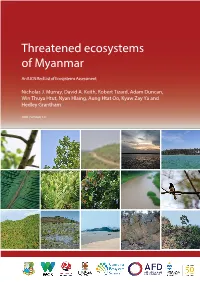
Threatened ecosystems of Myanmar An IUCN Red List of Ecosystems Assessment Nicholas J. Murray, David A. Keith, Robert Tizard, Adam Duncan, Win Thuya Htut, Nyan Hlaing, Aung Htat Oo, Kyaw Zay Ya and Hedley Grantham 2020 | Version 1.0 Threatened Ecosystems of Myanmar. An IUCN Red List of Ecosystems Assessment. Version 1.0. Murray, N.J., Keith, D.A., Tizard, R., Duncan, A., Htut, W.T., Hlaing, N., Oo, A.H., Ya, K.Z., Grantham, H. License This document is an open access publication licensed under a Creative Commons Attribution-Non- commercial-No Derivatives 4.0 International (CC BY-NC-ND 4.0). Authors: Nicholas J. Murray University of New South Wales and James Cook University, Australia David A. Keith University of New South Wales, Australia Robert Tizard Wildlife Conservation Society, Myanmar Adam Duncan Wildlife Conservation Society, Canada Nyan Hlaing Wildlife Conservation Society, Myanmar Win Thuya Htut Wildlife Conservation Society, Myanmar Aung Htat Oo Wildlife Conservation Society, Myanmar Kyaw Zay Ya Wildlife Conservation Society, Myanmar Hedley Grantham Wildlife Conservation Society, Australia Citation: Murray, N.J., Keith, D.A., Tizard, R., Duncan, A., Htut, W.T., Hlaing, N., Oo, A.H., Ya, K.Z., Grantham, H. (2020) Threatened Ecosystems of Myanmar. An IUCN Red List of Ecosystems Assessment. Version 1.0. Wildlife Conservation Society. ISBN: 978-0-9903852-5-7 DOI 10.19121/2019.Report.37457 ISBN 978-0-9903852-5-7 Cover photos: © Nicholas J. Murray, Hedley Grantham, Robert Tizard Numerous experts from around the world participated in the development of the IUCN Red List of Ecosystems of Myanmar. The complete list of contributors is located in Appendix 1. -

Biogeography and Ecology in a Pantropical Family, the Meliaceae
Gardens’ Bulletin Singapore 71(Suppl. 2):335-461. 2019 335 doi: 10.26492/gbs71(suppl. 2).2019-22 Biogeography and ecology in a pantropical family, the Meliaceae M. Heads Buffalo Museum of Science, 1020 Humboldt Parkway, Buffalo, NY 14211-1293, USA. m.j.heads@gmail.com ABSTRACT. This paper reviews the biogeography and ecology of the family Meliaceae and maps many of the clades. Recently published molecular phylogenies are used as a framework to interpret distributional and ecological data. The sections on distribution concentrate on allopatry, on areas of overlap among clades, and on centres of diversity. The sections on ecology focus on populations of the family that are not in typical, dry-ground, lowland rain forest, for example, in and around mangrove forest, in peat swamp and other kinds of freshwater swamp forest, on limestone, and in open vegetation such as savanna woodland. Information on the altitudinal range of the genera is presented, and brief notes on architecture are also given. The paper considers the relationship between the distribution and ecology of the taxa, and the interpretation of the fossil record of the family, along with its significance for biogeographic studies. Finally, the paper discusses whether the evolution of Meliaceae can be attributed to ‘radiations’ from restricted centres of origin into new morphological, geographical and ecological space, or whether it is better explained by phases of vicariance in widespread ancestors, alternating with phases of range expansion. Keywords. Altitude, limestone, mangrove, rain forest, savanna, swamp forest, tropics, vicariance Introduction The family Meliaceae is well known for its high-quality timbers, especially mahogany (Swietenia Jacq.). -

Phylogenetic Community and Nearest Neighbor Structure of Disturbed Tropical Rain Forests Encroached by Streblus Macrophyllus
Article Phylogenetic Community and Nearest Neighbor Structure of Disturbed Tropical Rain Forests Encroached by Streblus macrophyllus Nguyen Hong Hai 1 , Yousef Erfanifard 2 , Tran Quang Bao 3, Any Mary Petritan 4, Trinh Hien Mai 5 and Ion Catalin Petritan 6,* 1 Department of Forest inventory and Planning, Faculty of Silviculture, Vietnam Forestry University, Hanoi 100000, Vietnam; hainh@vnuf.edu.vn 2 Department of Remote Sensing and GIS, University of Tehran, Tehran 1417466191, Iran; erfanifard@ut.ac.ir 3 Faculty of Forest Resources and Environmental Management, Vietnam Forestry University, Hanoi 100000, Vietnam; baofuv@vnuf.edu.vn 4 National Institute for Research-Development in Forestry ‘Marin Dracea’, Eroilor 128, 077190 Voluntari, Romania; apetritan@gmail.com 5 College of Wood Industry and Interior Design, Vietnam Forestry University, Hanoi 100000, Vietnam; maith@vnuf.edu.vn 6 Faculty of Silviculture and Forest Engineering, Transilvania University, Sirul Beethoven 1, ROU-500123 Brasov, Romania * Correspondence: petritan@unitbv.ro Received: 13 May 2020; Accepted: 25 June 2020; Published: 30 June 2020 Abstract: Although woody plant encroachment of tropical forest ecosystems has been related to altered disturbance regimes, its impacts on the nearest neighborhood structures and community phylogenetics are still poorly understood. Streblus macrophyllus is a light-demanding species during its early life stages and is shade-tolerant as a mature tree. S. macrophyllus can be found in tropical karst evergreen forests in northern Vietnam. It often regenerates at high densities in anthropogenic disturbed forest stands. To understand the structural patterns of disturbed forests encroached by S. macrophyllus at different abundance levels, three fully mapped 1-ha plots were established in Cuc Phuong National Park.