The Cone Collector N°18
Total Page:16
File Type:pdf, Size:1020Kb
Load more
Recommended publications
-
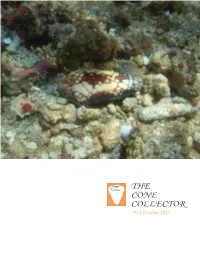
The Cone Collector N°23
THE CONE COLLECTOR #23 October 2013 THE Note from CONE the Editor COLLECTOR Dear friends, Editor The Cone scene is moving fast, with new papers being pub- António Monteiro lished on a regular basis, many of them containing descrip- tions of new species or studies of complex groups of species that Layout have baffled us for many years. A couple of books are also in André Poremski the making and they should prove of great interest to anyone Contributors interested in Cones. David P. Berschauer Pierre Escoubas Our bulletin aims at keeping everybody informed of the latest William J. Fenzan developments in the area, keeping a record of newly published R. Michael Filmer taxa and presenting our readers a wide range of articles with Michel Jolivet much and often exciting information. As always, I thank our Bernardino Monteiro many friends who contribute with texts, photos, information, Leo G. Ros comments, etc., helping us to make each new number so inter- Benito José Muñoz Sánchez David Touitou esting and valuable. Allan Vargas Jordy Wendriks The 3rd International Cone Meeting is also on the move. Do Alessandro Zanzi remember to mark it in your diaries for September 2014 (defi- nite date still to be announced) and to plan your trip to Ma- drid. This new event will undoubtedly be a huge success, just like the two former meetings in Stuttgart and La Rochelle. You will enjoy it and of course your presence is indispensable! For now, enjoy the new issue of TCC and be sure to let us have your opinions, views, comments, criticism… and even praise, if you feel so inclined. -
BAST1986050004005.Pdf
BASTERIA, 50: 93-150, 1986 Alphabetical revision of the (sub)species in recent Conidae. 9. ebraeus to extraordinarius with the description of Conus elegans ramalhoi, nov. subspecies H.E. Coomans R.G. Moolenbeek& E. Wils Institute of Taxonomic Zoology (Zoological Museum) University of Amsterdam INTRODUCTION In this ninth part of the revision all names of recent Conus taxa beginning with the letter e are discussed. Amongst these are several nominal species of tent-cones with a C.of close-set lines, the shell a darker pattern consisting very giving appearance (e.g. C. C. The elisae, euetrios, eumitus). phenomenon was also mentioned for C. castaneo- fasciatus, C. cholmondeleyi and C. dactylosus in former issues. This occurs in populations where with normal also that consider them specimens a tent-pattern are found, so we as colour formae. The effect is known shells in which of white opposite too, areas are present, leaving 'islands' with the tent-pattern (e.g. C. bitleri, C. castrensis, C. concatenatus and C. episco- These colour formae. patus). are also art. Because of a change in the rules of the ICZN (3rd edition, 1985: 73-74), there has risen a disagreement about the concept of the "type series". In cases where a museum type-lot consists of more than one specimen, although the original author(s) did not indicate that more than one shell was used for the description, we will designate the single originally mentioned and/or figured specimen as the "lectotype". Never- theless a number of taxonomists will consider that "lectotype" as the holotype, and disregard the remaining shells in the lot as type material. -

Taxonomic Revision of West African Cone Snails (Gastropoda: Conidae) Based Upon Mitogenomic Studies: Implications for Conservation
European Journal of Taxonomy 663: 1–89 ISSN 2118-9773 https://doi.org/10.5852/ejt.2020.663 www.europeanjournaloftaxonomy.eu 2020 · Tenorio M.J. et al. This work is licensed under a Creative Commons Attribution License (CC BY 4.0). Monograph urn:lsid:zoobank.org:pub:78E7049C-F592-4D01-9D15-C7715119B584 Taxonomic revision of West African cone snails (Gastropoda: Conidae) based upon mitogenomic studies: implications for conservation Manuel J. TENORIO 1,*, Samuel ABALDE 2, José R. PARDOS-BLAS 3 & Rafael ZARDOYA 4 1 Departamento CMIM y Química Inorgánica – Instituto de Biomoléculas (INBIO), Facultad de Ciencias, Torre Norte, 1ª Planta, Universidad de Cadiz, 11510 Puerto Real, Cadiz, Spain. 2,3,4 Museo Nacional de Ciencias Naturales (MNCN-CSIC), José Gutiérrez Abascal 2, 28006 Madrid, Spain. * Corresponding author: manuel.tenorio@uca.es 2 Email: saabalde@gmail.com 3 Email: joserrapblas@gmail.com 4 Email: rafaz@mncn.csic.es 1 urn:lsid:zoobank.org:author:24B3DC9A-3E34-4165-A450-A8E86B0D1231 2 urn:lsid:zoobank.org:author:C72D4F45-19A1-4554-9504-42D1705C85A3 3 urn:lsid:zoobank.org:author:1CAB2718-4C97-47EE-8239-0582C472C40E 4 urn:lsid:zoobank.org:author:C55129E8-7FF7-41B2-A77C-4097E61DDD2E Abstract. In the last few years, a sharp increase in the number of descriptions of new species of West African cone snails, particularly from the Cabo Verde Archipelago, has taken place. In previous studies, we used mitogenome sequences for reconstructing robust phylogenies, which comprised in total 120 individuals representing the majority of species (69.7%) described from this biogeographical region (except Angolan endemics) and grouped into seven genera within the family Conidae. -

The Recent Molluscan Marine Fauna of the Islas Galápagos
THE FESTIVUS ISSN 0738-9388 A publication of the San Diego Shell Club Volume XXIX December 4, 1997 Supplement The Recent Molluscan Marine Fauna of the Islas Galapagos Kirstie L. Kaiser Vol. XXIX: Supplement THE FESTIVUS Page i THE RECENT MOLLUSCAN MARINE FAUNA OF THE ISLAS GALApAGOS KIRSTIE L. KAISER Museum Associate, Los Angeles County Museum of Natural History, Los Angeles, California 90007, USA 4 December 1997 SiL jo Cover: Adapted from a painting by John Chancellor - H.M.S. Beagle in the Galapagos. “This reproduction is gifi from a Fine Art Limited Edition published by Alexander Gallery Publications Limited, Bristol, England.” Anon, QU Lf a - ‘S” / ^ ^ 1 Vol. XXIX Supplement THE FESTIVUS Page iii TABLE OF CONTENTS INTRODUCTION 1 MATERIALS AND METHODS 1 DISCUSSION 2 RESULTS 2 Table 1: Deep-Water Species 3 Table 2: Additions to the verified species list of Finet (1994b) 4 Table 3: Species listed as endemic by Finet (1994b) which are no longer restricted to the Galapagos .... 6 Table 4: Summary of annotated checklist of Galapagan mollusks 6 ACKNOWLEDGMENTS 6 LITERATURE CITED 7 APPENDIX 1: ANNOTATED CHECKLIST OF GALAPAGAN MOLLUSKS 17 APPENDIX 2: REJECTED SPECIES 47 INDEX TO TAXA 57 Vol. XXIX: Supplement THE FESTIVUS Page 1 THE RECENT MOLLUSCAN MARINE EAUNA OE THE ISLAS GALAPAGOS KIRSTIE L. KAISER' Museum Associate, Los Angeles County Museum of Natural History, Los Angeles, California 90007, USA Introduction marine mollusks (Appendix 2). The first list includes The marine mollusks of the Galapagos are of additional earlier citations, recent reported citings, interest to those who study eastern Pacific mollusks, taxonomic changes and confirmations of 31 species particularly because the Archipelago is far enough from previously listed as doubtful. -

22 April 2013 the Note from CONE the Editor COLLECTOR Dear Friends
THE CONE COLLECTOR #22 April 2013 THE Note from CONE the Editor COLLECTOR Dear friends, Editor The project “The Cone Collector” is still under seven years old António Monteiro and yet when I look at all we have achieved so far I cannot help thinking that we have probably exceeded expectations. Layout André Poremski We started modestly – as becomes any serious project – back in Contributors October 2006, with our newsletter aimed at all those who are Carlos Afonso interested in studying or collecting Cones, from professional Jim Cootes biologists to amateur collectors. Today we can proudly display Remy Devorsine a total of twenty-four numbers of TCC, two hugely successful Sébastien Dutertre international meetings and a website that brings together an Günther Herndl unparalleled wealth of information on Cones. Joaquin M. Inchaustegui Bruce Livett As a matter of fact, after the uploading in our website (at www. Philippe Quiquandon Christopher Roux theconecollector.com ) of the important and vastly updated Manuel Jiménez Tenorio and augmented work by Mike Filmer’s involving taxonomy and Will van Damme nomenclature, we now have at the same address Paul Kersten’s Alessandro Zanzi extremely useful and well-known Checklist, enriched with new images and much more detailed information than before. This is the work of a team – the names of Manuel Jimenez Tenorio, Bill Fenzan, John Tucker, Gavin Malcolm, Mike Filmer, Paul Kersten and André Poremski readily come to my mind as front row collaborators of TCC, but all others who have contributed with articles, photos, opinions, suggestions and unfailing support deserve equal credit! The project belongs to all and can only survive with the continued support of all. -
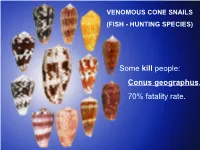
Conus Geographus, 70% Fatality Rate
VENOMOUS CONE SNAILS (FISH - HUNTING SPECIES) Some kill people: Conus geographus, 70% fatality rate. 3 F2 4 different clades of fish-hunting cone snails harpoon tooth proboscis tip Lightning-strike cabal -Conotoxin - INCREASES Na channel conductance k-Conotoxin - Blocks K channels Others - ? k-PVIIA CRIONQKCFQHLDDCCSRKCNRFNKCV -PVIA EACYAOGTFCGIKOGLCCSEFCLPGVCFG Prey Capture Excitotoxic Neuromuscular 1 Shock 2 Block Very rapid, fish stunned Irreversible paralysis Lightning-strike cabal Lightning strike constellation -Conotoxin - INCREASES Na channel conductance k-Conotoxin - Blocks K channels -Conotoxin - Activates Na Channels Con-ikot-ikot - Inhibits Glu receptor desensitization Motor cabal Motor constellation w-Conotoxin - Blocks Ca channels a-Conotoxin - Competitive nicotinic receptor inhibitor y-Conotoxin - Nicotinic receptor channel blocker? m-Conotoxin - BLOCKS Na channel conductance Conus geographus • The Deadliest Snail in the Ocean Net Strategy Sensory Deadening Neuromuscular Block (Nirvana Cabal) (Motor Cabal) Nirvana Cabal Sedated, quiescent state Motor Cabal Neuromuscular transmission block Nirvana cabal Targeted to sensory circuitry: s-Conotoxin - 5HT3 receptor blocker * Conantokin - NMDA receptor blocker * “Sluggish” peptide “Sleeper” peptides “Weaponized” insulin Mature venom insulin is post-translationally modified Con-Ins G1 Highly expressed in venom gland Highly abundant in C. geographus venom Helena Hemami-Safavi Activity testing Adam Douglass SafaviSantosh-Hemami Karanth et al. 2015, Amnon PNAS Schlegel Venom insulin: proposed mechanism of action Adminstration of insulin causes glucose uptake from the blood into liver and muscle tissue Insulin overdose: rapid depletion of blood glucose leads to insufficient glucose supply for the brain: dizziness, nausea, coma and death Insulin shock, hypoglycemic shock Insulin as a murder weapon, the Sunny von Bülow case: American heiress and socialite. Her husband, Claus von Bülow, was convicted of attempting her murder by insulin overdose C. -

The Hawaiian Species of Conus (Mollusca: Gastropoda)1
The Hawaiian Species of Conus (Mollusca: Gastropoda) 1 ALAN J. KOHN2 IN THECOURSE OF a comparative ecological currents are factors which could plausibly study of gastropod mollus ks of the genus effect the isolation necessary for geographic Conus in Hawaii (Ko hn, 1959), some 2,400 speciation . specimens of 25 species were examined. Un Of the 33 species of Conus considered in certainty ofthe correct names to be applied to this paper to be valid constituents of the some of these species prompted the taxo Hawaiian fauna, about 20 occur in shallow nomic study reported here. Many workers water on marine benches and coral reefs and have contributed to the systematics of the in bays. Of these, only one species, C. ab genus Conus; nevertheless, both nomencla breviatusReeve, is considered to be endemic to torial and biological questions have persisted the Hawaiian archipelago . Less is known of concerning the correct names of a number of the species more characteristic of deeper water species that occur in the Hawaiian archi habitats. Some, known at present only from pelago, here considered to extend from Kure dredging? about the Hawaiian Islands, may (Ocean) Island (28.25° N. , 178.26° W.) to the in the future prove to occur elsewhere as island of Hawaii (20.00° N. , 155.30° W.). well, when adequate sampling methods are extended to other parts of the Indo-West FAUNAL AFFINITY Pacific region. As is characteristic of the marine fauna of ECOLOGY the Hawaiian Islands, the affinities of Conus are with the Indo-Pacific center of distribu Since the ecology of Conus has been dis tion . -

Assemblierung, Annotation Und Vergleichende Genomik Komplexer Invertebratengenome Am Beispiel Von Radix (Mollusca, Gastropoda)
Assemblierung, Annotation und vergleichende Genomik komplexer Invertebratengenome am Beispiel von Radix (Mollusca, Gastropoda) Dissertation zur Erlangung des Doktorgrades der Naturwissenschaften vorgelegt beim Fachbereich Biowissenschaften der Johann Wolfgang Goethe-Universität in Frankfurt am Main von Tilman Schell aus Plauen Frankfurt am Main 2018 (D30) vom Fachbereich Biowissenschaften der Johann Wolfgang Goethe-Universität als Dissertation angenommen. Dekan: Prof. Dr. Sven Klimpel Institut für Ökologie, Evolution und Diversität Integrative Parasitologie und Tierphysiologie Johann Wolfgang Goethe-Universität D-60438 Frankfurt am Main Gutachter: Prof. Dr. Markus Pfenninger Institut für Organismische und Molekulare Evolutionsbiologie Johannes Gutenberg-Universität Mainz D-55128 Mainz Prof. Dr. Ingo Ebersberger Institut für Zellbiologie und Neurowissenschaften Johann Wolfgang Goethe-Universität D-60438 Frankfurt am Main Datum der Disputation: “. [A] knowledge of sequences could contribute much to our understanding of living matter.” Sanger (1980) Vorbemerkung Die vorliegende Arbeit befasst sich mit Themen der Bioinformatik, deren englische Fach- termini nachfolgend kursiv vom deutschen Fließtext abgehoben sind, falls sie nicht in zusammengesetzten Wörtern auftreten. Zusätzlich werden die Namen verwendeter Soft- ware, Versionsnummern, Parameter, Dateiformate und URLs in Schreibmaschinen- schrift gesetzt. Stammt eine Aufzälung von Informationen aus einer Quelle, wird die entsprechende Referenz direkt vor der Aufzälung genannt und gilt für alle Punkte, falls nicht anderweitig zitiert wird. I II Zusammenfassung Die Analyse von DNA-Sequenzen steht spätestens seit der Feststellung ihrer tragen- den Rolle in der Vererbung organismischer Eigenschaften im Fokus biologischer Fra- gestellungen. Seit Kurzem wird mit modernsten Methoden der sogenannten „nächsten Generation“ (next-generation sequencing) die Untersuchung von kompletten Genomen ermöglicht. Dies eröffnet den Zugang zu genomweiten Informationen gegenüber begrenzt aussagekräftigen markerbasierten Analysen. -

Dicembre 2010
PRO NATURA NOVARA ONLUS GRUPPO MALACOLOGICO NOVARESE Gianfranco Vischi (minuto@libero.it) n- 9 - Dicembre 2010 LA CONCHIGLIA CHIMERA CHIMAERIA INCOMPARABILIS ( Falsa Cypraea? Rarissimo Ovulide? Fossile vivente?) a cura di Paolo Cesana In biologia, Chimera è un organismo che ''ha caratteri di molti altri'' (vedi nella mitologia il favoloso essere mostruoso. Le prime notizie della Chimera sono nel libro dell' Iliade). Qui di mostruoso non vi è nulla, ma anzi di meraviglioso, di una bellezza che abbaglia gli occhi (del malacologo e non). Parliamo della stupenda quanto misteriosa,enigmatica e rarissima CHIMAERIA INCOMPARABILIS (la Chimera incomparabile - BRIANO B. 1993). Chimera è il nome appropriato, perché questa splendida conchiglia (se ne conoscono, dati al 2009 solo 6 esemplari nelle collezioni di tutto il mondo) è un po’ un enigma per gli studiosi, chi la classifica nella grande Famiglia delle Cypraee - eocypraeinae - sottofam. Cypraeovulinae ? Chi nella Fam. Ovulidae - ovulinae. Anche il genere è contrastato, alcuni la classificano col genere SPHAEROCYPRAEA (con specie fossili molto simili l'attuale, risalenti all' Eocene, vedi fig. allegata ). EOCYPRAEIDAE è una piccola famiglia di Sphaerocypraea tardivelae grandi lumache di mare, consiste come detto principalmente di specie fossili (dall' Eocene inf. circa 55 milioni di anni) fino ai giorni nostri, vedere schema illustrativo. Qualche altro afferma che la conchiglia in questione possa appartenere a un gruppo a sé stante. VENIAMO ALLA DESCRIZIONE: La Chimaeria incomparabilis (o Sphaerocypraea) -

Download Preprint
1 Mobilising molluscan models and genomes in biology 2 Angus Davison1 and Maurine Neiman2 3 1. School of Life Sciences, University Park, University of Nottingham, NG7 2RD, UK 4 2. Department of Biology, University of Iowa, Iowa City, IA, USA and Department of Gender, 5 Women's, and Sexuality Studies, University of Iowa, Iowa, City, IA, USA 6 Abstract 7 Molluscs are amongst the most ancient, diverse, and important of all animal taxa. Even so, 8 no individual mollusc species has emerged as a broadly applied model system in biology. 9 We here make the case that both perceptual and methodological barriers have played a role 10 in the relative neglect of molluscs as research organisms. We then summarize the current 11 application and potential of molluscs and their genomes to address important questions in 12 animal biology, and the state of the field when it comes to the availability of resources such 13 as genome assemblies, cell lines, and other key elements necessary to mobilising the 14 development of molluscan model systems. We conclude by contending that a cohesive 15 research community that works together to elevate multiple molluscan systems to ‘model’ 16 status will create new opportunities in addressing basic and applied biological problems, 17 including general features of animal evolution. 18 Introduction 19 Molluscs are globally important as sources of food, calcium and pearls, and as vectors of 20 human disease. From an evolutionary perspective, molluscs are notable for their remarkable 21 diversity: originating over 500 million years ago, there are over 70,000 extant mollusc 22 species [1], with molluscs present in virtually every ecosystem. -

(Approx) Mixed Micro Shells (22G Bags) Philippines € 10,00 £8,64 $11,69 Each 22G Bag Provides Hours of Fun; Some Interesting Foraminifera Also Included
Special Price £ US$ Family Genus, species Country Quality Size Remarks w/o Photo Date added Category characteristic (€) (approx) (approx) Mixed micro shells (22g bags) Philippines € 10,00 £8,64 $11,69 Each 22g bag provides hours of fun; some interesting Foraminifera also included. 17/06/21 Mixed micro shells Ischnochitonidae Callistochiton pulchrior Panama F+++ 89mm € 1,80 £1,55 $2,10 21/12/16 Polyplacophora Ischnochitonidae Chaetopleura lurida Panama F+++ 2022mm € 3,00 £2,59 $3,51 Hairy girdles, beautifully preserved. Web 24/12/16 Polyplacophora Ischnochitonidae Ischnochiton textilis South Africa F+++ 30mm+ € 4,00 £3,45 $4,68 30/04/21 Polyplacophora Ischnochitonidae Ischnochiton textilis South Africa F+++ 27.9mm € 2,80 £2,42 $3,27 30/04/21 Polyplacophora Ischnochitonidae Stenoplax limaciformis Panama F+++ 16mm+ € 6,50 £5,61 $7,60 Uncommon. 24/12/16 Polyplacophora Chitonidae Acanthopleura gemmata Philippines F+++ 25mm+ € 2,50 £2,16 $2,92 Hairy margins, beautifully preserved. 04/08/17 Polyplacophora Chitonidae Acanthopleura gemmata Australia F+++ 25mm+ € 2,60 £2,25 $3,04 02/06/18 Polyplacophora Chitonidae Acanthopleura granulata Panama F+++ 41mm+ € 4,00 £3,45 $4,68 West Indian 'fuzzy' chiton. Web 24/12/16 Polyplacophora Chitonidae Acanthopleura granulata Panama F+++ 32mm+ € 3,00 £2,59 $3,51 West Indian 'fuzzy' chiton. 24/12/16 Polyplacophora Chitonidae Chiton tuberculatus Panama F+++ 44mm+ € 5,00 £4,32 $5,85 Caribbean. 24/12/16 Polyplacophora Chitonidae Chiton tuberculatus Panama F++ 35mm € 2,50 £2,16 $2,92 Caribbean. 24/12/16 Polyplacophora Chitonidae Chiton tuberculatus Panama F+++ 29mm+ € 3,00 £2,59 $3,51 Caribbean. -

Gastropoda, Mollusca)
bioRxiv preprint doi: https://doi.org/10.1101/087254; this version posted November 11, 2016. The copyright holder for this preprint (which was not certified by peer review) is the author/funder, who has granted bioRxiv a license to display the preprint in perpetuity. It is made available under aCC-BY-NC-ND 4.0 International license. An annotated draft genome for Radix auricularia (Gastropoda, Mollusca) Tilman Schell 1,2 *, Barbara Feldmeyer 2, Hanno Schmidt 2, Bastian Greshake 3, Oliver Tills 4, Manuela Truebano 4, Simon D. Rundle 4, Juraj Paule 5, Ingo Ebersberger 3,2, Markus Pfenninger 1,2 1 Molecular Ecology Group, Institute for Ecology, Evolution and Diversity, Goethe-University, Frankfurt am Main, Germany 2 Adaptation and Climate, Senckenberg Biodiversity and Climate Research Centre, Frankfurt am Main, Germany 3 Department for Applied Bioinformatics, Institute for Cell Biology and Neuroscience, Goethe- University, Frankfurt am Main, Germany 4 Marine Biology and Ecology Research Centre, Marine Institute, School of Marine Science and Engineering, Plymouth University, Plymouth, United Kingdom 5 Department of Botany and Molecular Evolution, Senckenberg Research Institute, Frankfurt am Main, Germany * Author for Correspondence: Senckenberg Biodiversity and Climate Research Centre, Senckenberganlage 25, 60325 Frankfurt am Main, Germany. Tel.: +49 (0)69 75 42 18 30, E-mail: Tilman.Schell@senckenberg.de Data deposition: BioProject: PRJNA350764, SRA: SRP092167 1 bioRxiv preprint doi: https://doi.org/10.1101/087254; this version posted November 11, 2016. The copyright holder for this preprint (which was not certified by peer review) is the author/funder, who has granted bioRxiv a license to display the preprint in perpetuity.