The Vegetation of the Netherlands Antilles
Total Page:16
File Type:pdf, Size:1020Kb
Load more
Recommended publications
-
Nature Policy Plan
Ministry of Public Housing, Spatial Planning, Environment And Infrastructure Ministerie van Volkshuisvesting, Ruimtelijke Ordening, Milieu en Infrastructuur Nature Policy Plan 2021 – 2025 Established/Approved: Date: By: i Nature Policy Plan Sint Maarten 2021 – 2025 “We the people of Sint Maarten: RESOLVED to provide for the continuing preservation of nature and the environment”. Constitution of Sint Maarten ii Nature Policy Plan Sint Maarten 2021 – 2025 Nature Policy Plan Sint Maarten 2021 – 2025 Ministry of Public Housing, Spatial Planning, Environment and Infrastructure (Ministry of VROMI) Address: Government of Sint Maarten Ministry of VROMI Soualiga Road #1 Pond Island, Great Bay Sint Maarten Contact: Louis.Brown@sintmaartengov.org Ildiko.Gilders@sintmaartengov.org iii Nature Policy Plan Sint Maarten 2021 – 2025 Lignum Vitae (Guaiacum officinale) iv Photo by: Mark Yokoyama Nature Policy Plan Sint Maarten 2021 – 2025 Acknowledgments In writing the Nature Policy Plan Sint Maarten 2021 – 2025, the Ministry of VROMI consulted several government ministries, and external stakeholders including private sector entities and NGO’s. Some were engaged in the preparation of the policy from the onset; others were part of a review of the policy and stakeholder meetings. The Ministry of VROMI acknowledges and appreciates the time and effort of the stakeholders who contributed to the formulation of this Nature Policy Plan, which provides insights into the current state of affairs of nature on Sint Maarten and the proposed way forward on nature conservation -

Non-Timber Forest Products
Agrodok 39 Non-timber forest products the value of wild plants Tinde van Andel This publication is sponsored by: ICCO, SNV and Tropenbos International © Agromisa Foundation and CTA, Wageningen, 2006. All rights reserved. No part of this book may be reproduced in any form, by print, photocopy, microfilm or any other means, without written permission from the publisher. First edition: 2006 Author: Tinde van Andel Illustrator: Bertha Valois V. Design: Eva Kok Translation: Ninette de Zylva (editing) Printed by: Digigrafi, Wageningen, the Netherlands ISBN Agromisa: 90-8573-027-9 ISBN CTA: 92-9081-327-X Foreword Non-timber forest products (NTFPs) are wild plant and animal pro- ducts harvested from forests, such as wild fruits, vegetables, nuts, edi- ble roots, honey, palm leaves, medicinal plants, poisons and bush meat. Millions of people – especially those living in rural areas in de- veloping countries – collect these products daily, and many regard selling them as a means of earning a living. This Agrodok presents an overview of the major commercial wild plant products from Africa, the Caribbean and the Pacific. It explains their significance in traditional health care, social and ritual values, and forest conservation. It is designed to serve as a useful source of basic information for local forest dependent communities, especially those who harvest, process and market these products. We also hope that this Agrodok will help arouse the awareness of the potential of NTFPs among development organisations, local NGOs, government officials at local and regional level, and extension workers assisting local communities. Case studies from Cameroon, Ethiopia, Central and South Africa, the Pacific, Colombia and Suriname have been used to help illustrate the various important aspects of commercial NTFP harvesting. -
Evolution of Unusual Morphologies in Lentibulariaceae (Bladderworts and Allies) And
Annals of Botany 117: 811–832, 2016 doi:10.1093/aob/mcv172, available online at www.aob.oxfordjournals.org REVIEW: PART OF A SPECIAL ISSUE ON DEVELOPMENTAL ROBUSTNESS AND SPECIES DIVERSITY Evolution of unusual morphologies in Lentibulariaceae (bladderworts and allies) and Podostemaceae (river-weeds): a pictorial report at the interface of developmental biology and morphological diversification Rolf Rutishauser* Institute of Systematic Botany, University of Zurich, Zurich, Switzerland * For correspondence. E-mail rutishau@systbot.uzh.ch Received: 30 July 2015 Returned for revision: 19 August 2015 Accepted: 25 September 2015 Published electronically: 20 November 2015 Background Various groups of flowering plants reveal profound (‘saltational’) changes of their bauplans (archi- tectural rules) as compared with related taxa. These plants are known as morphological misfits that appear as rather Downloaded from large morphological deviations from the norm. Some of them emerged as morphological key innovations (perhaps ‘hopeful monsters’) that gave rise to new evolutionary lines of organisms, based on (major) genetic changes. Scope This pictorial report places emphasis on released bauplans as typical for bladderworts (Utricularia,approx. 230 secies, Lentibulariaceae) and river-weeds (Podostemaceae, three subfamilies, approx. 54 genera, approx. 310 species). Bladderworts (Utricularia) are carnivorous, possessing sucking traps. They live as submerged aquatics (except for their flowers), as humid terrestrials or as epiphytes. Most Podostemaceae are restricted to rocks in tropi- http://aob.oxfordjournals.org/ cal river-rapids and waterfalls. They survive as submerged haptophytes in these extreme habitats during the rainy season, emerging with their flowers afterwards. The recent scientific progress in developmental biology and evolu- tionary history of both Lentibulariaceae and Podostemaceae is summarized. -

Lopez-Gonzales-Mariela-Andrea.Pdf
UNIVERSIDAD NACIONAL AGRARIA LA MOLINA Presentado por: TESIS PARA OPTAR EL TÍTULO DE INGENIERO FORESTAL Lima - Perú 2018 ACTA DE SUSTENTACIÓN DE TESIS Los Miembros del Jurado que suscriben, reunidos para calificar la sustentación del Trabajo de Tesis, presentado por la ex-alumna de la Facultad de Ciencias Forestales, Bach. MARIELA ANDREA LÓPEZ GONZALES , intitulado “ CARACTERIZACIÓN HISTOLÓGICA Y EVALUACIÓN DE PROPIEDADES FÍSICO MECÁNICAS DE LA FIBRA DE CASHAVARA (DESMONCUS POLYACANTHOS MARTIUS) PROVENIENTE DE UNA PLANTACIÓN DEL DISTRITO JENARO HERRERA, LORETO- PERÚ ”. Oídas las respuestas a las observaciones formuladas, lo declaramos: ………………………………… con el calificativo de ………………………………… En consecuencia queda en condición de ser considerada APTA y recibir el título de INGENIERO FORESTAL. La Molina, 27 de diciembre de 2016 PhD. Carlos Reynel Rodríguez Presidente Ing. Martín Araujo Flores Ing. Neptalí Bustamante Guillén Miembro Miembro PhD. Héctor Gonzales Mora Asesor Mg. Sc. Manuel Chavesta Custodio Coasesor ii DEDICATORIA Con mucho cariño dedico este trabajo: A mis padres, Víctor y Gilma, por creer en mí en todo momento, ser mi apoyo incondicional y haberme inculcado desde pequeña valores de perseverancia con amor. A mis hermanas Rocío, Valeria y Claudia por brindarme siempre su respaldo y cariño. A Frangi, mi compañero eterno, el que me motiva día a día a seguir mis metas con su entusiasmo, bondad y su hermosa manera de ver la vida. iii AGRADECIMIENTOS Quiero expresar mi más sincero agradecimiento A la Universidad Nacional Agraria La Molina, mi casa de estudios, y financista principal de la presente investigación. Al Instituto de Investigación de la Amazonía Peruana, IIAP, por fomentar estudios sobre “cashavara”. -
Molecular and Morphological Support for a Florida Origin of the Cuban
Journal of Biogeography (J. Biogeogr.) (2011) SPECIAL Molecular and morphological support ISSUE for a Florida origin of the Cuban oak Paul F. Gugger* and Jeannine Cavender-Bares Department of Ecology, Evolution and ABSTRACT Behavior, University of Minnesota, 100 Ecology Aim The origins of the Cuban biota are of long-standing interest in Building, 1987 Upper Buford Circle, Saint Paul, MN, USA biogeography, and the source of a small live oak (Quercus series Virentes) population on Cuba remains unresolved. Based on morphological evidence, previous authors have hypothesized a Florida origin from either Q. geminata or Q. virginiana or both; a Mexican origin from Q. oleoides; or a hybrid origin from both sources. We use molecular data and taxonomically informative leaf morphology to identify the source species and timing of colonization. Location Cuba, Central America, Mexico and the south-eastern United States. Methods We collected representative samples of Cuban oaks and each putative source species and genotyped each sample at 12 nuclear microsatellites and two chloroplast DNA sequences. We estimated population structure using a Bayesian clustering analysis and F-statistics, pairwise migration rates among taxa, and divergence time using an isolation-with-migration model. We measured seven leaf traits and conducted an analysis of similarity (ANOSIM) to determine which putative source species was most similar to Cuban oaks. Results Cuban oak contains one chloroplast DNA haplotype, which is common in southern Florida. Bayesian clustering analysis of microsatellites revealed that the Cuban oak forms a distinct and pure population cluster, and F-statistics showed that Cuban oaks are differentiated least from Q. virginiana and most from Q. -

Origen I Evolució Dels Endemismes Vegetals De Les Illes Del Carib
Òscar Castillo Agudo Final Degree Project Origin and evolution of the Biology (2020) Caribbean Islands endemic plants The Islands Geological History The Caribbean Islands, also known Greater Antilles: originated as a submerged volcanic arc (Proto-Greater as the West Indies, are conformed Antilles) between North and South America (130 Ma.) The last time the by three archipelago. These islands islands emerged as a landmass was 49 Ma and later Cuba, the have been categorized as one of Hispaniola and Puerto Rico split (25-20 Ma). the world’s biodiversity hotspots Lesser Antilles: originated in two times as oceanic islands. with conservation priority as the Bahames: got the current configuration in the Eocene but the land ecosystem is threatened by loss of surface and connections changed drastically due to the fluctuations in habitat from anthropogenic origin. the sea level. Figure 1. Source 8. GAARlandia: an hypothetical land bridge connecting the Biodiversity: some numbers north of South America and the Greater Antilles for 3 million 12.847 taxa of seed plants, 10.948 years at Eocene-Oligocene are native and 7.868 are endemic transition (c. 33 Ma). (72% out of the native). 1.447 native genera with 181 endemic and 10 nearly endemic, Biogeography Figure 3. Source 9. 47,5% of the endemic are monotypic. 2 ways of colonization of the islands from the continent: The Greater Antilles hosts most of Vicariance: the endemic genera. First interpretations considered the Proto-Antilles to be connected with Figure 2. Source 1. the continent but now we know they were submerged. Now it is Isolation atribuited to GAARAlandia acting as a low-land connection for the biota. -

27 Skunk Vine
27 SKUNK VINE R. W. Pemberton and P. D. Pratt U.S. Department of Agriculture, Agricultural Research Service, Invasive Plant Research Laboratory, Fort Lauderdale, Florida, USA tion of livestock, however, are unknown (Gann and PEST STATUS OF WEED Gordon, 1998). In urban landscapes, this vine en- Skunk vine, Paederia foetida L. (Fig. 1), is a recently twines branches of woody ornamental plants and also recognized weedy vine of natural areas in Florida that spreads horizontally through lawns, rooting at the is spreading into other parts of the southern United nodes (Martin, 1995). In westcentral Florida, P. States. The weed, which is native to Asia, appears to foetida is considered the most troublesome weed have the potential to spread well beyond the South along roadside right-of-ways (W. Moriaty, pers. to the northeastern states. Control of the plant by comm.), and it also entangles power lines and associ- chemical or mechanical means damages valued veg- ated structures (Martin, 1995). etation supporting the vine. Skunk vine is a Category On the island of Hawaii, P. foetida is a very se- I Florida Exotic Pest Plant Council weed (Langeland rious weed in nurseries producing ornamental foli- and Craddock Burks, 1998), a listing that groups the age plants (Pemberton, pers. obs.). The weed infests plant with the most invasive weed species in Florida. field plantings used for propagation. Control of the weed is very difficult because stock plants are easily injured if herbicides are applied. At times, growers have had to abandon or destroy stock plants that have become overgrown by skunk vine. -

Bay Native Plant Garden
WELCOME TO THE FISH BAY NATIVE PLANT GARDEN Tyre Palm This garden shows the types of plants and trees that grow best and naturally in Fish Bay. Before you excavate, use this garden area as a guide to what could grow on your land or may already be there. Tag trees on your building site for saving and only excavate the area covering the footprint of the home you are building. This garden is in greenspace owned by the Island Resources Foundation which permitted this education use. The Estate Fish Bay Owners’ Association was awarded a grant from the VI Department of Agriculture, Urban & Community Forestry Program to fund this project. Members of the community volunteered many hours to prepare the site, plant, and install the garden path and Eleanor Gibney, St John’s own botanist, guided us and was instrumental in creating this brochure. Thank you to all. Bay rum - Pimenta racemosa This beautiful native tree is the source of aromatic oil that is mixed with alcohol or rum to make the cologne or lotion known as bay rum which was extremely popular around the world in the period between 1880 and 1940. St. John was a major producer of bay oil. Locally, leaves are also used in home remedies and cooking. A medium sized evergreen tree, with smooth bark and very dark green spicy-scented foliage. Bay Rum Birchberry or Privet eugenia - Eugenia ligustrina A pretty shrub or small tree that makes an excellent hedge. The berries are edible, with a sweet, juicy, and slightly aromatic flesh. Black calabash - Amphetheca latifolia A native relative of the commoner calabash or gobi tree, black calabash is restricted to the larger guts and areas that receive a lot of freshwater runoff. -
Safeguarding Through Science
UnitedUnited States States DepartmentDepartment of of Safeguarding AgricultureAgriculture AnimalAnimal and and Through Science PlantPlant Health Health InspectionInspection Center for Plant Health Science and Technology ServiceService APHIS 81-10-003 2012 Accomplishments C1 Center for Plant Health Science and Technology Mission The Center for Plant Health Science and Technology (CPHST) supports the regulatory decisions and operations of the Animal and Plant Health Inspection Service’s (APHIS) Plant Protection and Quarantine (PPQ) program through methods development, scientific investigation, analyses, and technology. Strategic Goals • Enhance PPQ’s efforts in pest detection and management • Provide timely scientific and technical support required for emergency response and management • Enhance support for APHIS trade-related plant health issues • Provide current, relevant scientific and technical information to PPQ decisionmakers • Enhance PPQ’s capacity to anticipate and respond to emerging scientific, technical, and regulatory issues through partnership Contact Information CPHST Headquarters Fort Collins Laboratory Phoenix Laboratory 1730 Varsity Drive, Suite 400 2301 Research Boulevard, Suite 108 3645 East Wier Avenue Raleigh, NC 27606 Fort Collins, CO 80526 Phoenix, AZ 85040 (919) 855-7400 (970) 490-4464 (602) 431-3230 AQI Laboratory Mission Laboratory Plant Epidemiology and Risk 13601 Old Cutler Road Moore AB Building S-6414 Analysis Laboratory Miami, FL 33158 22675 North Moorefield Road 1730 Varsity Drive, Suite 300 (786) 573-7089 Edinburg, TX 78541 Raleigh, NC 27606 (956) 205-7667 (919) 855-7500 Beltsville Laboratory BARC-East, Building 580 Otis Laboratory Powder Mill Road Otis Air National Guard Base Beltsville, MD 20705 1398 West Truck Road (301) 504-7100 Buzzards Bay, MA 02542 (508) 563-9303 CPHST Web site: www.aphis.usda.gov/plant_health/cphst Cover Photo: Pink bollworm larvae emerging from a cotton boll (USDA/ARS, Peggy Greb). -
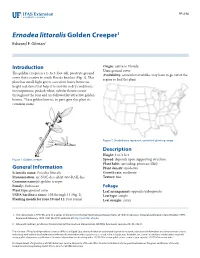
Ernodea Littoralis Golden Creeper1 Edward F
FPS196 Ernodea littoralis Golden Creeper1 Edward F. Gilman2 Introduction Origin: native to Florida Uses: ground cover The golden creeper is a 1- to 3-foot-tall, prostrate ground Availability: somewhat available, may have to go out of the cover that is native to south Florida beaches (Fig. 1). This region to find the plant plant has small, light green, succulent leaves borne on bright red stems that help it to survive in dry conditions. Inconspicuous, pinkish white, tubular flowers occur throughout the year and are followed by attractive golden berries. These golden berries, in part, give this plant its common name. Figure 2. Shaded area represents potential planting range. Description Height: 1 to 3 feet Figure 1. Golden creeper. Spread: depends upon supporting structure Plant habit: spreading; prostrate (flat) General Information Plant density: moderate Scientific name: Ernodea littoralis Growth rate: moderate Pronunciation: air-NOE-dee-uh lit-taw-RAIL-liss Texture: fine Common name(s): golden creeper Family: Rubiaceae Foliage Plant type: ground cover Leaf arrangement: opposite/subopposite USDA hardiness zones: 10B through 11 (Fig. 2) Leaf type: simple Planting month for zone 10 and 11: year round Leaf margin: entire 1. This document is FPS196, one of a series of the Environmental Horticulture Department, UF/IFAS Extension. Original publication date October 1999. Reviewed February 2014. Visit the EDIS website at http://edis.ifas.ufl.edu. 2. Edward F. Gilman, professor, Environmental Horticulture Department, UF/IFAS Extension, Gainesville, FL 32611. The Institute of Food and Agricultural Sciences (IFAS) is an Equal Opportunity Institution authorized to provide research, educational information and other services only to individuals and institutions that function with non-discrimination with respect to race, creed, color, religion, age, disability, sex, sexual orientation, marital status, national origin, political opinions or affiliations. -

CARIBBEAN REGION - NWPL 2014 FINAL RATINGS User Notes: 1) Plant Species Not Listed Are Considered UPL for Wetland Delineation Purposes
CARIBBEAN REGION - NWPL 2014 FINAL RATINGS User Notes: 1) Plant species not listed are considered UPL for wetland delineation purposes. 2) A few UPL species are listed because they are rated FACU or wetter in at least one Corps region. -

Appendix A. Plant Species Known to Occur at Canaveral National Seashore
National Park Service U.S. Department of the Interior Natural Resource Stewardship and Science Vegetation Community Monitoring at Canaveral National Seashore, 2009 Natural Resource Data Series NPS/SECN/NRDS—2012/256 ON THE COVER Pitted stripeseed (Piriqueta cistoides ssp. caroliniana) Photograph by Sarah L. Corbett. Vegetation Community Monitoring at Canaveral National Seashore, 2009 Natural Resource Report NPS/SECN/NRDS—2012/256 Michael W. Byrne and Sarah L. Corbett USDI National Park Service Southeast Coast Inventory and Monitoring Network Cumberland Island National Seashore 101 Wheeler Street Saint Marys, Georgia, 31558 and Joseph C. DeVivo USDI National Park Service Southeast Coast Inventory and Monitoring Network University of Georgia 160 Phoenix Road, Phillips Lab Athens, Georgia, 30605 March 2012 U.S. Department of the Interior National Park Service Natural Resource Stewardship and Science Fort Collins, Colorado The National Park Service, Natural Resource Stewardship and Science office in Fort Collins, Colorado publishes a range of reports that address natural resource topics of interest and applicability to a broad audience in the National Park Service and others in natural resource management, including scientists, conservation and environmental constituencies, and the public. The Natural Resource Data Series is intended for the timely release of basic data sets and data summaries. Care has been taken to assure accuracy of raw data values, but a thorough analysis and interpretation of the data has not been completed. Consequently, the initial analyses of data in this report are provisional and subject to change. All manuscripts in the series receive the appropriate level of peer review to ensure that the information is scientifically credible, technically accurate, appropriately written for the intended audience, and designed and published in a professional manner.