Ecological Separation by Ecomorphology and Swimming Performance Between Two Congeneric Fish Species
Total Page:16
File Type:pdf, Size:1020Kb
Load more
Recommended publications
-

Curriculum Vitae
MAIRIN FRANCESCA ARAGONES BALISI La Brea Tar Pits and Museum, 5801 Wilshire Blvd, Los Angeles, CA 90036 mbalisi@tarpits.org | mairinbalisi.com EDUCATION 2018 Ph.D., Ecology and Evolutionary Biology University of California, Los Angeles Dissertation: “Carnivory in the Oligo-Miocene: Resource specialization, competition, and coexistence among North American fossil canids” Advisor: Blaire Van Valkenburgh 2011 M.S., Ecology and Evolutionary Biology University of Michigan, Ann Arbor Thesis: “Dietary behavior and resource partitioning among the carnivorans of Late Pleistocene Rancho La Brea” 2008 B.A., Integrative Biology and Comparative Literature University of California, Berkeley PROFESSIONAL APPOINTMENTS 2019–present Research Affiliate University of Southern California / Natural History Museum of LA County 2018–present National Science Foundation Postdoctoral Research Fellow in Biology La Brea Tar Pits and Museum; University of California, Merced 2014–2018 Graduate Student in Residence, Vertebrate Paleontology Natural History Museum of Los Angeles County PUBLICATIONS ^equal contribution *undergraduate co-author 2020 Balisi MA and B Van Valkenburgh. Iterative evolution of large-bodied hypercarnivory in canids benefits species but not clades. Communications Biology 3:461. (doi:10.1038/s42003-020-01193-9) 2020 Tong, HW, X Chen, B Zhang, B Rothschild, SC White, MA Balisi, and X Wang. Hypercarnivorous teeth and healed injuries in Canis chihliensis from the early Pleistocene Nihewan beds, China, support social hunting for ancestral wolves. PeerJ 8:e9858. (doi:10.7717/peerj.9858) 2020 Dávalos, LM^, RM Austin^, MA Balisi^, RL Begay^, CA Hofman^, ME Kemp^, JR Lund^, C Monroe^, AM Mychajliw^, EA Nelson^, MA Nieves- Colón^, SA Redondo^, S Sabin^, KS Tsosie^, and JM Yracheta^. -
Phylogenetic Relationships Within the Speciose Family Characidae
Oliveira et al. BMC Evolutionary Biology 2011, 11:275 http://www.biomedcentral.com/1471-2148/11/275 RESEARCH ARTICLE Open Access Phylogenetic relationships within the speciose family Characidae (Teleostei: Ostariophysi: Characiformes) based on multilocus analysis and extensive ingroup sampling Claudio Oliveira1*, Gleisy S Avelino1, Kelly T Abe1, Tatiane C Mariguela1, Ricardo C Benine1, Guillermo Ortí2, Richard P Vari3 and Ricardo M Corrêa e Castro4 Abstract Background: With nearly 1,100 species, the fish family Characidae represents more than half of the species of Characiformes, and is a key component of Neotropical freshwater ecosystems. The composition, phylogeny, and classification of Characidae is currently uncertain, despite significant efforts based on analysis of morphological and molecular data. No consensus about the monophyly of this group or its position within the order Characiformes has been reached, challenged by the fact that many key studies to date have non-overlapping taxonomic representation and focus only on subsets of this diversity. Results: In the present study we propose a new definition of the family Characidae and a hypothesis of relationships for the Characiformes based on phylogenetic analysis of DNA sequences of two mitochondrial and three nuclear genes (4,680 base pairs). The sequences were obtained from 211 samples representing 166 genera distributed among all 18 recognized families in the order Characiformes, all 14 recognized subfamilies in the Characidae, plus 56 of the genera so far considered incertae sedis in the Characidae. The phylogeny obtained is robust, with most lineages significantly supported by posterior probabilities in Bayesian analysis, and high bootstrap values from maximum likelihood and parsimony analyses. -
Estimating Migratory Fish Distribution from Altitude and Basin Area: a Case
Freshwater Biology (2012) 57, 2297–2305 doi:10.1111/fwb.12003 Estimating migratory fish distribution from altitude and basin area: a case study in a large Neotropical river JOSE´ RICARDO S. BARRADAS*, LUCAS G. SILVA*, BRET C. HARVEY† AND NELSON F. FONTOURA* *Departamento de Biodiversidade e Ecologia, Pontifı´cia Universidade Cato´lica do Rio Grande do Sul (PUCRS), Porto Alegre, RS, Brazil †USDA Forest Service, Pacific Southwest Research Station, Arcata, CA, U.S.A. SUMMARY 1. The objective of this study was to identify longitudinal distribution patterns of large migratory fish species in the Uruguay River basin, southern Brazil, and construct statistical distribution models for Salminus brasiliensis, Prochilodus lineatus, Leporinus obtusidens and Pseudoplatystoma corruscans. 2. The sampling programme resulted in 202 interviews with old residents and fishermen at 167 different sampling sites in the major rivers of the basin. Interviewees were asked whether these fish species were present in the nearby river segment, recently or in the past. The average age of respondents was 56 years, and the great majority had resided for more than 30 years in the area where they were interviewed. 3. Fish distribution patterns were modelled using altitude and basin area as environmental descriptors. Distributional patterns were estimated using logistic equations (LOGIT): À1 P ¼ eða0þa1 lnðAlÞþa2 lnðBAÞÞð1 þ eða0þa1 lnðAlÞþa2 lnðBAÞÞÞ , where Al is the altitude and BA is the basin area. 4. Accuracies of the distribution models were between 77 and 85%. These accuracies are similar to those of published distribution models for other fishes based on larger numbers of environmental descriptors. 5. The historical distributional ranges make clear that all operating or planned large hydropower dams in the Uruguay River basin, with one exception, limit or will limit the distribution of migratory fishes. -
A New Computing Environment for Modeling Species Distribution
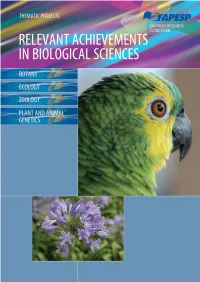
EXPLORATORY RESEARCH RECOGNIZED WORLDWIDE Botany, ecology, zoology, plant and animal genetics. In these and other sub-areas of Biological Sciences, Brazilian scientists contributed with results recognized worldwide. FAPESP,São Paulo Research Foundation, is one of the main Brazilian agencies for the promotion of research.The foundation supports the training of human resources and the consolidation and expansion of research in the state of São Paulo. Thematic Projects are research projects that aim at world class results, usually gathering multidisciplinary teams around a major theme. Because of their exploratory nature, the projects can have a duration of up to five years. SCIENTIFIC OPPORTUNITIES IN SÃO PAULO,BRAZIL Brazil is one of the four main emerging nations. More than ten thousand doctorate level scientists are formed yearly and the country ranks 13th in the number of scientific papers published. The State of São Paulo, with 40 million people and 34% of Brazil’s GNP responds for 52% of the science created in Brazil.The state hosts important universities like the University of São Paulo (USP) and the State University of Campinas (Unicamp), the growing São Paulo State University (UNESP), Federal University of São Paulo (UNIFESP), Federal University of ABC (ABC is a metropolitan region in São Paulo), Federal University of São Carlos, the Aeronautics Technology Institute (ITA) and the National Space Research Institute (INPE). Universities in the state of São Paulo have strong graduate programs: the University of São Paulo forms two thousand doctorates every year, the State University of Campinas forms eight hundred and the University of the State of São Paulo six hundred. -
Appendix A. Supplementary Material
Appendix A. Supplementary material Comprehensive taxon sampling and vetted fossils help clarify the time tree of shorebirds (Aves, Charadriiformes) David Cernˇ y´ 1,* & Rossy Natale2 1Department of the Geophysical Sciences, University of Chicago, Chicago 60637, USA 2Department of Organismal Biology & Anatomy, University of Chicago, Chicago 60637, USA *Corresponding Author. Email: david.cerny1@gmail.com Contents 1 Fossil Calibrations 2 1.1 Calibrations used . .2 1.2 Rejected calibrations . 22 2 Outgroup sequences 30 2.1 Neornithine outgroups . 33 2.2 Non-neornithine outgroups . 39 3 Supplementary Methods 72 4 Supplementary Figures and Tables 74 5 Image Credits 91 References 99 1 1 Fossil Calibrations 1.1 Calibrations used Calibration 1 Node calibrated. MRCA of Uria aalge and Uria lomvia. Fossil taxon. Uria lomvia (Linnaeus, 1758). Specimen. CASG 71892 (referred specimen; Olson, 2013), California Academy of Sciences, San Francisco, CA, USA. Lower bound. 2.58 Ma. Phylogenetic justification. As in Smith (2015). Age justification. The status of CASG 71892 as the oldest known record of either of the two spp. of Uria was recently confirmed by the review of Watanabe et al. (2016). The younger of the two marine transgressions at the Tolstoi Point corresponds to the Bigbendian transgression (Olson, 2013), which contains the Gauss-Matuyama magnetostratigraphic boundary (Kaufman and Brigham-Grette, 1993). Attempts to date this reversal have been recently reviewed by Ohno et al. (2012); Singer (2014), and Head (2019). In particular, Deino et al. (2006) were able to tightly bracket the age of the reversal using high-precision 40Ar/39Ar dating of two tuffs in normally and reversely magnetized lacustrine sediments from Kenya, obtaining a value of 2.589 ± 0.003 Ma. -

Ontogenetic Shifts in the Digestive Tube and Diet of Bryconamericus
Ontogenetic shifts in the digestive tube and diet of Bryconamericus stramineus Eigenmann, 1908 (Osteichthyes, Characidae) Mudanças ontogenéticas no tubo digestório e na dieta de Bryconamericus stramineus Eigenmann, 1908 (Osteichthyes, Characidae) Suiberto, MR.1, Galuch, AV.2, Bialetzki, A.3 and Nakatani, K.3† 1Programa de Pós-graduação em Zoologia, Instituto de Biociências, Universidade Estadual Paulista – UNESP, Campus de Botucatu, Distrito de Rubião Jr., s/n, CEP 18618-000, Botucatu, SP, Brazil e-mail: mrs@ibb.unesp.br 2Programa de Pós-graduação em Biologia de Água Doce e Pesca Interior, Instituto Nacional de Pesquisas da Amazônia – INPA, Av. André Araújo, 2936, CEP 69083-000, Manaus, AM, Brazil e-mail: galuch@gmail.com 3Programa de Pós-Graduação em Ecologia de Ambientes Aquáticos Continentais – PEA, Núcleo de Pesquisas em Limnologia, Ictiologia e Aqüicultura – Nupélia, Departamento de Biologia – DBI, Biological Limnology Universidade Estadual de Maringá – UEM, Av. Colombo, 5790, bloco G-90, CEP 87020-900, Maringá, PR, Brazil e-mail: bialetzki@nupelia.uem.br Abstract: Aim: Studies on feeding of early life stages are very important to the understanding of the biology and trophic ecology of fish species. Therefore, the aim of this work is to describe the development of the digestive tube, and to characterize the diet of larvae and juveniles of Bryconamericus stramineus Eigenmann, 1908 of the upper Paraná River floodplain; Methods: Larvae were obtained from, monthly samples during nychthemeral cycles with four-hour interval between samplings from February/91 to February/92, utilizing a conical-cylindrical plankton net; Results: At the preflexion stage, larvae at approximately 4.00 mm SL, showed a morphologically undifferentiated straight tube, with the anterior region more dilated. -
Niche Enlargement As a Consequence of Co-Existence
Niche enlargement as a consequence of co-existence: a case study Mazzoni, R.a*, Marques, PS.a, Rezende, CF.a,c and Iglesias-Rios, R.b aDepartamento de Ecologia, Instituto de Biologia Roberto Alcantara Gomes, Universidade do Estado do Rio de Janeiro – UERJ, Rua São Francisco Xavier, 524, CEP 20550-013, Rio de Janeiro, RJ, Brazil bDepartamento de Ecologia, Instituto de Biologia, Universidade Federal do Rio de Janeiro – UFRJ, CP 68020, Rio de Janeiro, RJ, Brazil cDepartamento de Biologia, Universidade Federal do Ceará – UFC, CEP 60455-970, Fortaleza, CE, Brazil *e-mail: mazzoni@uerj.br Received March 22, 2011 – Accepted July 04, 2011 – Distributed May 31, 2012 (With 4 figures) Abstract Spatio-temporal changes in the diet, niche breadth and niche overlap of two species of Characidium from three different sites along a Neotropical coastal stream were studied during a dry and rainy season. Seasonal changes were restricted to the occurrence of plant items in the stomach contents. The relative importance of food items in the diet of both species varied across sites, but Diptera, Ephemeroptera, Simuliidae, Trichoptera and Coleoptera larvae were always the main prey items. Contrary to the expected pattern, values of the niche breadth were higher at the site where Characidium species co-existed and niche overlapped at this site indicated 52% (p = 0.52) of feeding overlap. Keywords: neotropical characidae, coastal stream, close related species. Ampliação do nicho como consequência da co-existência: um estudo de caso Resumo Variações espaço-temporal na dieta, na amplitude e na sobreposição de nicho foram estudadas para duas espécies de Characidium de três localidades distintas de um riacho costeiro da região Neotropical, considerando-se as estações seca e chuvosa. -

Karyotypic Characterization of Prochilodus Mariae, Semaprochilodus Kneri Ands. Laticeps (Teleostei: Prochilodontidae) from Caica
Neotropical Ichthyology, 1(1):47-52, 2003 Copyright © 2003 Sociedade Brasileira de Ictiologia Karyotypic characterization of Prochilodus mariae, Semaprochilodus kneri and S. laticeps (Teleostei: Prochilodontidae) from Caicara del Orinoco, Venezuela Claudio Oliveira*, Mauro Nirchio**, Ángel Granado*** and Sara Levy** Fish of the family Prochilodontidae are considered one of the most important components of commercial and subsistence fishery in freshwater environments in South America. This family consists of 21 species and three genera. In the present study, the karyotypes of Prochilodus mariae, Semaprochilodus kneri, and S. laticeps from Caicara del Orinoco, Bolivar State, Venezuela were studied. The species P. mariae, S. kneri and S. laticeps exhibited 2n=54 chromosomes (40 metacentric and 14 submetacentric), a single chromosome pair with nucleolus organizer regions, and a large amount of heterochromatin found at centromeric and pericentromeric positions in almost all chromosomes. The P. mariae specimens studied displayed 0 to 3 supernumerary microchromosomes. The data obtained here confirm the conservative nature of the chromosome number and morphology of Prochilodontidae and reinforce the hypothesis that small structural chromosome rearrangements were the main cause of the karyotypic diversification seen in this group. Os peixes da família Prochilodontidae são considerados um dos componentes mais importantes da pesca comercial e de subsistência em ambientes de água doce na América do Sul. Essa família compreende 21 espécies e três gêneros. No presente estudo foram analisados os cariótipos de Prochilodus mariae, Semaprochilodus kneri e S. laticeps provenientes de Caicara del Orinoco, Estado Bolivar, Venezuela. As espécies P. mariae, S. kneri e S. laticeps apresentaram 2n=54 cromossomos (40 metacêntricos e 14 submetacêntricos), um único par de cromossomos com regiões organizadoras de nucléolo e uma grande quantidade de heterocromatina em posição centromérica e pericentromérica de quase todos os cromossomos. -

Diversidade De Ictiofauna Em Lagoas Costeiras Na Costa Atlântica Da América Do Sul: Fatores Históricos, Contemporâneos E Mudanças Climáticas
UNIVERSIDADE FEDERAL DO RIO GRANDE DO SUL INSTITUTO DE BIOCIÊNCIAS PROGRAMA DE PÓS-GRADUAÇÃO EM ECOLOGIA Tese de Doutorado Diversidade de ictiofauna em lagoas costeiras na costa atlântica da América do Sul: fatores históricos, contemporâneos e mudanças climáticas Taís de Fátima Ramos Guimarães Porto Alegre, novembro de 2019 i CIP - Catalogação na Publicação Guimarães, Taís de Fátima Ramos Diversidade de ictiofauna em lagoas costeiras na costa atlântica da América do Sul: fatores históricos, contemporâneos e mudanças climáticas / Taís de Fátima Ramos Guimarães. -- 2019. 143 f. Orientadora: Sandra Maria Hartz. Coorientadora: Ana Cristina Petry. Tese (Doutorado) -- Universidade Federal do Rio Grande do Sul, Instituto de Biociências, Programa de Pós-Graduação em Ecologia, Porto Alegre, BR-RS, 2019. 1. Ictiofauna de lagoas costeiras. 2. Efeitos históricos e contemporâneos sobre a ictiofauna. 3. Impacto da elevação do nível do mar sobre a ictiofauna de lagoas. I. Hartz, Sandra Maria, orient. II. Petry, Ana Cristina, coorient. III. Título. Elaborada pelo Sistema de Geração Automática de Ficha Catalográfica da UFRGS com os dados fornecidos pelo(a) autor(a). Diversidade de ictiofauna em lagoas costeiras na costa atlântica da América do Sul: fatores históricos, contemporâneos e mudanças climáticas Taís de Fátima Ramos Guimarães Tese de Doutorado apresentada ao Programa de Pós-Graduação em Ecologia, do Instituto de Biociências da Universidade Federal do Rio Grande do Sul, como parte dos requisitos para obtenção do título de Doutor em Ciências com ênfase em Ecologia. Orientador: Prof. Dra. Sandra Maria Hartz - UFRGS Corientador: Prof. Dra. Ana Cristina Petry - UFRJ Comissão examinadora: Prof. Dra. Sandra C. Müller - UFRGS Prof. Dra. -
Siluriformes: Callichthyidae)
Neotropical Ichthyology, 9(4): 689-695, 2011 Copyright © 2011 Sociedade Brasileira de Ictiologia Differentiating cave Aspidoras catfish from a karst area of Central Brazil, upper rio Tocantins basin (Siluriformes: Callichthyidae) Sandro Secutti1, Roberto E. Reis2 and Eleonora Trajano1 Two cave populations of Aspidoras albater catfish with reduced eyes and pigmentation were recently found near the city of Posse, São Domingos karst area, Goiás State, representing the first known case of a troglomorphic callichthyid catfish. Cave specimens are described and compared to epigean specimens of A. albater, but morphometric differences between the epigean and the cave populations are not adequate to delimit as distinct species. Duas populações de Aspidoras albater com olhos e pigmentação reduzidos foram descobertas recentemente em cavernas do município de Posse, área cárstica de São Domingos, Goiás, representando o primeiro caso conhecido de Callichthyidae troglomórfico. Os espécimes cavernícolas são descritos e comparados com espécimes epígeos de A. albater, mas as diferenças morfométricas entre eles não são suficientes para delimitá-los como espécies distintas. Key words: Aspidoras albater, Cave fish, Goiás State, Neotropical, Population differentiation. Introduction eye and pigmentation reduction show a distribution tending to normal within the populations (Trajano & Bichuette, 2010). At least 37 species of subterranean fishes showing some These observations are evidence for a gradual degree of troglomorphism (basically reduction of eyes and differentiation of eyes, pigmentation, and other pigmentation) have been found in continental South America, troglomorphisms in populations confined to subterranean representing almost one quarter of the total number of species habitats and thus supposed to be genetically isolated. recorded worldwide (164 - Proudlove, 2010). -

A Rapid Biological Assessment of the Upper Palumeu River Watershed (Grensgebergte and Kasikasima) of Southeastern Suriname
Rapid Assessment Program A Rapid Biological Assessment of the Upper Palumeu River Watershed (Grensgebergte and Kasikasima) of Southeastern Suriname Editors: Leeanne E. Alonso and Trond H. Larsen 67 CONSERVATION INTERNATIONAL - SURINAME CONSERVATION INTERNATIONAL GLOBAL WILDLIFE CONSERVATION ANTON DE KOM UNIVERSITY OF SURINAME THE SURINAME FOREST SERVICE (LBB) NATURE CONSERVATION DIVISION (NB) FOUNDATION FOR FOREST MANAGEMENT AND PRODUCTION CONTROL (SBB) SURINAME CONSERVATION FOUNDATION THE HARBERS FAMILY FOUNDATION Rapid Assessment Program A Rapid Biological Assessment of the Upper Palumeu River Watershed RAP (Grensgebergte and Kasikasima) of Southeastern Suriname Bulletin of Biological Assessment 67 Editors: Leeanne E. Alonso and Trond H. Larsen CONSERVATION INTERNATIONAL - SURINAME CONSERVATION INTERNATIONAL GLOBAL WILDLIFE CONSERVATION ANTON DE KOM UNIVERSITY OF SURINAME THE SURINAME FOREST SERVICE (LBB) NATURE CONSERVATION DIVISION (NB) FOUNDATION FOR FOREST MANAGEMENT AND PRODUCTION CONTROL (SBB) SURINAME CONSERVATION FOUNDATION THE HARBERS FAMILY FOUNDATION The RAP Bulletin of Biological Assessment is published by: Conservation International 2011 Crystal Drive, Suite 500 Arlington, VA USA 22202 Tel : +1 703-341-2400 www.conservation.org Cover photos: The RAP team surveyed the Grensgebergte Mountains and Upper Palumeu Watershed, as well as the Middle Palumeu River and Kasikasima Mountains visible here. Freshwater resources originating here are vital for all of Suriname. (T. Larsen) Glass frogs (Hyalinobatrachium cf. taylori) lay their -

Ecomorphology of Feeding in Coral Reef Fishes
Ecomorphology of Feeding in Coral Reef Fishes Peter C. Wainwright David R. Bellwood Center for Population Biology Centre for Coral Reef Biodiversity University of California at Davis School of Marine Biology and Aquaculture Davis, California 95616 James Cook University Townsville, Queensland 4811, Australia I. Introduction fish biology. We have attempted to identify generalities, II. How Does Morphology Influence Ecology? the major patterns that seem to cut across phylogenetic III. The Biomechanical Basis of Feeding Performance and geographic boundaries. We begin by constructing IV. Ecological Consequences of Functional a rationale for how functional morphology can be used Morphology to enhance our insight into some long-standing eco- V. Prospectus logical questions. We then review the fundamental me- chanical issues associated with feeding in fishes, and the basic design features of the head that are involved in prey capture and prey processing. This sets the stage I. Introduction for a discussion of how the mechanical properties of fish feeding systems have been modified during reef fish di- nce an observer gets past the stunning coloration, versification. With this background, we consider some O surely no feature inspires wonder in coral reef of the major conclusions that have been drawn from fishes so much as their morphological diversity. From studies of reef fish feeding ecomorphology. Because of large-mouthed groupers, to beaked parrotfish, barbeled space constraints we discuss only briefly the role of goatfish, long-snouted trumpet fish, snaggle-toothed sensory modalities--vision, olfaction, electroreception, tusk fish, tube-mouthed planktivores, and fat-lipped and hearingmbut these are also significant and diverse sweet lips, coral reef fishes display a dazzling array elements of the feeding arsenal of coral reef fishes and of feeding structures.