1860 Nelson Province Superintendent's Inwards
Total Page:16
File Type:pdf, Size:1020Kb
Load more
Recommended publications
-

Motupipi-Takaka Terraces and Plains Ecosystem Plant Lists
MOTUPIPI – TAKAKA TERRACES & PLAINS ECOSYSTEM NATIVE PLANT RESTORATION LIST Flats east of the Takaka and Motupipi River floodplains, extending from Pohara inland up the Takaka valley to Uruwhenua and backed in the east by limestone and marble Locality: hill country. Outliers west of Takaka River include terraces of Go-Ahead Creek and those north of One-Spec Creek. Plains and terraces, in the north reaching 40m above sea level and gently dipping to Topography: the north-west, and inland rising up to 80m above sea level. Low-lying towards Motupipi Inlet and coast. Alluvial, sandy and silty loams of moderate fertility derived from a range of sedimentary rocks, marble, granites and schist. Overlying unweathered glacial outwash gravels. Soils and Geology: Mostly well-drained except along low-gradient, meandering water courses and behind strip of sandy coast at Motupipi-Clifton where there are swamp deposits. Not drought- prone. High sunshine hours; frosts mild to moderate; mild annual temperatures. Climate: Rainfall 1600mm on the coast to 2600mm inland. Coastal Influence: Between Motupipi Estuary and Pohara up to ½ km inland. Mixed podocarp-broadleaf forest, especially tōtara, mataī, tītoki and northern rātā on Original Vegetation: the drier sites and kāhikatea and pukatea on the less well-drained sites. Wetlands in low-lying areas. No original vegetation remaining. A few small and isolated secondary forest and Human Modification: treeland remnants persist as well as numerous scattered individual trees, particularly tōtara. [Refer to the Ecosystem Restoration map showing the colour-coded area covered by this list.] KEY TYPE OF FOOD PROVIDED FOR PLANTING RATIO PLANT PREFERENCES BIRDS AND LIZARDS Early Stage plants are able to Wet, Moist, Dry, Sun, Shade, Frost, Saline establish in open sites and can act as F = Fruit/seeds a nursery for later stage plants by 1 = prefers or tolerates providing initial cover. -

Moutere Gravels
LAND USE ON THE MOUTERE GRAVELS, I\TELSON, AND THE DilPORTANOE OF PHYSIC.AL AND EOONMIC FACTORS IN DEVJt~LOPHTG THE F'T:?ESE:NT PATTERN. THESIS FOR THE DEGREE OF MASTER OF ARTS ( Honours ) GEOGRAPHY UNIVERSITY OF NEW ZEALAND 1953 H. B. BOURNE-WEBB.- - TABLE OF CONTENTS. CRAFTER 1. INTRODUCTION. Page i. Terminology. Location. Maps. General Description. CH.AFTER 11. HISTORY OF LAND USE. Page 1. Natural Vegetation 1840. Land use in 1860. Land use in 1905. Land use in 1915. Land use in 1930. CHA.PrER 111. PRESENT DAY LAND USE. Page 17. Intensively farmed areas. Forestry in the region. Reversion in the region. CHA.PrER l V. A NOTE ON TEE GEOLOGY OF THE REGION Page 48. Geological History. Composition of the gravels. Structure and surface forms. Slope. Effect on land use. CHA.mm v. CLIMATE OF THE REGION. Page 55. Effect on land use. CRAFTER Vl. SOILS ON Tlffi: MGm'ERE GRAVELS. Page 59. Soil.tYJDes. Effect on land use. CHAPrER Vll. ECONOMIC FACTORS WrIICH HAVE INFLUENCED TEE LAND USE PATTERN. Page 66. ILLUSTRATIONS AND MAPS. ~- After page. l. Location. ii. 2. Natu.ral Vegetation. i2. 3. Land use in 1905. 6. Land use regions and generalized land use. 5. Terraces and sub-regions at Motupiko. 27a. 6. Slope Map. Folder at back. 7. Rainfall Distribution. 55. 8. Soils. 59. PLATES. Page. 1. Lower Moutere 20. 2. Tapawera. 29. 3. View of Orcharding Arf;;a. 34a. 4. Contoured Orchard. 37. 5. Reversion and Orchards. 38a. 6. Golden Downs State Forest. 39a. 7. Japanese Larch. 40a. B. -

MUSIC MAN Community 3-7
October 2017 Inside this issue: MUSIC MAN Community 3-7 Recreation 9-11 Arts and Crafts 13 Moutere Youth 15 Food 17 Animals 19-21 Gardening 22 Health & Wellbeing 23 Trade & Services 26 directory Recycled materials are a perfect basis for Lawrie Feely’s stringed instruments Special points of interest: and stored for 30 years, and I’ve used it in a lot of my L O C A L L I V E S instruments. Each wood has a different sound.” His favourite is the strum stick—a portable version of Every Friday Sharing table the dulcimer that can be played like a guitar instead of MHCC Eight-string island ukuleles, strum sticks and mountain on a table. “Backpackers love them,” he says. Also dulcimers are everywhere to be seen in Lawrie Feely’s popular is a stringed instrument that can be played by workshop. Created from recycled venetian blinds, fruit anyone who’s capable of a single finger tune on the 14 October: The Andrew bowls, tabletops and bedheads, each one looks and piano. “You can make music out of anything,” says London Trio—page 11 sounds unique. Lawrie, pulling out a ‘tin-canjo’ with a decorative biscuit- Lawrie has been making instruments since going to a tin body to prove his point. 70th birthday party down South and playing along with a 20 October: Musical When he’s not making instruments, Lawrie can be found group of ladies from the marae on the ukulele. “Next repairing horse gear, such as covers, bridles and saddle bingo—page 10 day, I took some photos and measurements and made strapping. -
Abel Tasman Sailing Adventures
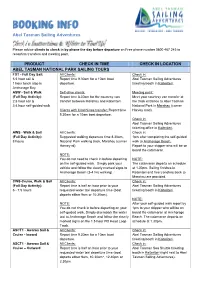
Abel Tasman Sailing Adventures Please advise clients to check in by phone the day before departure on Free phone number 0800 467 245 to reconfirm transfers and meeting point. PRODUCT CHECK IN TIME CHECK IN LOCATION ABEL TASMAN NATIONAL PARK SAILING TOURS FDT - Full Day Sail: All Clients: Check in: 5.5 hour sail & Report time 9.30am for a 10am boat Abel Tasman Sailing Adventures 1 hour lunch stop in departure. ticketing booth in Kaiteriteri. Anchorage Bay ASW - Sail & Walk Self-drive clients: Meeting point: (Full Day Activity): Report time 8.30am for the courtesy van Meet your courtesy van transfer at 2.5 hour sail & transfer between Marahau and Kaiteriteri the track entrance to Abel Tasman 3-4 hour self-guided walk National Park in Marahau (corner Clients with Coachlines transfer: Report time Harvey road). 9.30am for a 10am boat departure. Check in: Abel Tasman Sailing Adventures ticketing office in Kaiteriteri. AWS - Walk & Sail All Clients: Check in: (Full Day Activity): Suggested walking departure time 8.30am, 1pm after completing the self-guided 8 hours National Park walking track, Marahau (corner walk to Anchorage Beach. Harvey rd). Report to your skipper who will be on board the catamaran. NOTE: You do not need to check in before departing NOTE: on the self-guided walk. Simply park your The catamaran departs on schedule vehicle and follow the clearly marked signs to at 1.30pm. Sailing finishes in Anchorage Beach (3-4 hrs walking). Kaiteriteri and free transfers back to Marahau are provided. CWS-Cruise, Walk & Sail All Clients: Check in: (Full Day Activity): Report time is half an hour prior to your Abel Tasman Sailing Adventures 6 - 7.5 hours requested water taxi departure time (boat ticketing booth in Kaiteriteri. -

Moutere Catchment Stream Restoration Framework
REPORT Moutere Catchment Stream Restoration Framework Prepared for Tasman District Council Prepared by Tonkin & Taylor Ltd Date October 2020 Job Number 1012499.v2 Tonkin & Taylor Ltd October 2020 Moutere Catchment - Stream Restoration Framework Job No: 1012499.v2 Tasman District Council Document Control Title: Moutere Catchment Date Version Description Prepared by: Reviewed by: Authorised by: 18/09/20 1 Draft for client comment S. Conn B. Quilter N. Laverack 30/10/20 2 Final S. Conn N. Laverack N. Laverack Distribution: Tasman District Council 1 electronic copy Tonkin & Taylor Ltd (FILE) 1 electronic copy Table of contents 1 Introduction 1 1.1 Background 1 1.2 Objectives 2 1.3 Limitations 3 2 Catchment description 4 2.1 Climate and flow dynamics 5 2.2 Geology and soil 7 2.3 Sediment regime 9 2.4 Landuse history 10 2.5 River management history 12 3 Stream types 14 3.1 Artificially straightened, partly/unconfined gravel bed 18 3.2 Confined gravel bed stream 21 3.3 Partly confined gravel bed stream 24 3.4 Valley fill 27 3.5 Unconfined meandering gravel bed 30 3.6 Unconfined cut and fill sand bed derived from Separation Point Granite’s (SPS) 33 3.7 Unconfined artificially straightened fine-grained stream derived from Separation Point Granites (SPS) 36 3.8 Confined mixed-bed stream derived from Separation Point Granites (SPS) 39 3.9 Recovery potential and stream type prioritisation 42 4 Restoration framework 44 5 Restoration tool-box 46 6 Recommendations/next steps 48 7 Applicability 49 8 References 50 Appendix A : Restoration framework descriptions Appendix B : Restoration tool descriptions Appendix C : Glossary Tonkin & Taylor Ltd October 2020 Moutere Catchment - Stream Restoration Framework Job No: 1012499.v2 Tasman District Council 1 1 Introduction Tasman District Council (TDC) engaged Tonkin & Taylor Ltd (T+T) to develop a restoration framework for the Moutere Catchment. -

The Hills 60 16 Almost All Family-Owned
Kaiteriteri Nelson is home to 21 cellar doors, The Hills 60 16 almost all family-owned. This Riwaka High St High means that when you visit the cellar door, you’ll often meet the Motueka winemaker and experience their passion first hand. 10. RIMU GROVE WINERY 13. KINA BEACH VINEYARD 16. RIWAKA RIVER ESTATE 19. DUNBAR ESTATES Motueka Valley Highway r ive 60 Motueka R Come enjoy our handcrafted Pinot Noir, Bronte Road East Boutique vineyard in stunning coastal setting, 21 Dee Road, Kina, Tasman Artisan vineyard producing ‘Resurgence’ wines 60 Takaka Hill Highway, Dunbar Estates’ Accommodation, Cellar Door, Café Dunbar Estates 13 14 Kina Peninsula 15 Chardonnay, Pinot Gris, Gewürztraminer and (off Coastal Highway), producing single vineyard multiple award Tel: 03 526 6252 – individual, well-crafted wines of unique and Riwaka & Vineyard adjacent to the picturesque Motueka 1469 Motueka Valley Highway 19 Kina Beach Rd Riesling wines overlooking the scenic Waimea Inlet. RD1, Upper Moutere winning wines. or 027 521 5321 distinctive character from limestone soils. Our extra- Tel: 03 528 8819 river. Taste and purchase wines from our Nelson and RD1, Ngatimoti Open: Tel: 03 540 2345 Accommodation: lou@kinabeach.co.nz virgin olive oil is also available at our cellar door. Mob: 021 277 2553 Central Otago Vineyards. Stay or relax in the beautiful Motueka 7196 The Hills Summer: 11.00am – 5.00pm daily. rimugrove@xtra.co.nz Charming guest cottages set amongst the vines, www.kinabeach.co.nz Delightful vineyard accommodation is now available. sayhello@riwakariverestate.com countryside while enjoying wine, food and Tel: 03 526 8598 Winter: By appointment. -

Tasman's Great Taste Trail
FOLD FOLD FOLD FOLD Motueka to Riwaka Riwaka to Kaiteriteri Riwaka to Woodstock Woodstock to Kohatu Kohatu to Wakefield Wakefield to Richmond Grade 2 | 0.5 to 1 hour | 11 km Grade 2-3 | 0.5 to 1 hour | 7 km On-road, ungraded | 1.5 to 3 hours | 32 km On-road, ungraded | 1.5 to 3 hours | 26 km Grade 2 | 1.5 to 3 hours | 26 km Grade 1 | 1 to 2 hours | 19 km Start: 1km south of central Motueka on Old Wharf Road. Start: Riwaka Domain. Start: Factory Road. Follow the signs to West Bank Road. Prepare: This section is on the Motueka Valley Highway, Prepare: Spooners Tunnel is dark and chilly, so bring lights and Taste: St John’s Church; Native bush and rolling farmland; Lord Taste: Spectacular coastal scenery, estuary and sea birds Taste: Apple and kiwifruit orchards; hop gardens; Riwaka Prepare: We recommend taking your refreshments with you following the Motueka River. Traffic can be busy, especially an extra layer. Rutherford Memorial; Brightwater village for cafes, local pottery including the majestic Kotuku; Raumanuka Reserve; Riwaka River suspension bridge; spectacular coastal views; Kaiteriteri for this mainly rural section. in summer. Please take care and keep left at all times. Taste: Norris Gully Reserve; Spooners Tunnel; Belgrove and the and crafts; Waimea River and suspension bridge; vineyards and wineries; Richmond township. This section has several wineries village for cafes; Hop Federation brewery is a few hundred Mountain Bike Park (Easy Rider); Kaiteriteri beach, recreation Taste: Beautiful scenery, orchards, hop gardens, farmland Taste: Hill climbs; Country views; Hop farms; Tapawera village historic railway windmill, Wai-iti River and native bush; Ewings near the trail. -

WOW August 2018
ISSUE 70 August 2018 Wakefield School’s New Obstacle Course Clears the Final Hurdle by Peter Verstappen In recent years Wakefield School has completed several major improvements to its grounds and play areas, inspired by a 2015 project called The Great Outdoors Review. The review took a long, hard look at how our outdoor spaces support learning. We worked from the idea that children learn everywhere and at all times, so how could we make our environment a place that supports learning in many ways? The Great Outdoors Review inspired Loose Ends (a shipping container full of creative junk), an artificial turf games zone with shade sails, winding pathways and bark play areas, tyre swings, a willow tunnel, bicycle pump track and log circle. We sprayed green lines around trees we encourage children to climb (‘green line climb, orange line stop’ is one of our mantras). An orchard and vege gardens emerged from our new mindset. And… children began pestering us to create an obstacle course. Feeling a bit overwhelmed at the idea we batted it back to the kids: ‘you design it’, we said. And they did, bombarding us with Grand Designs to rival a Gold Coast theme park. Patiently they wore down our reluctance, reminding us of our commitment to child-led learning and a well-balanced curriculum. After many designs and re-designs, many conversations with parents, sponsors and supporters, many meetings with professional designers and engineers, and a big helping of community spirit, our obstacle course is finally complete and fully operational. At 80m in length the course is designed as a strength and fitness trail, featuring eight obstacles that together offer a complete workout. -
Motueka Plains and Valleys Plant Lists
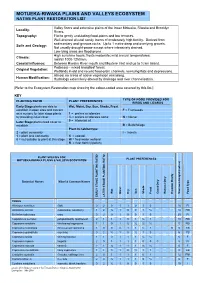
MOTUEKA-RIWAKA PLAINS AND VALLEYS ECOSYSTEM NATIVE PLANT RESTORATION LIST Valley floors and extensive plains of the lower Motueka, Riwaka and Brooklyn Locality: Rivers. Topography: Flat to gently undulating flood-plains and low terraces. Well-drained alluvial sandy loams of moderately high fertility. Derived from sedimentary and igneous rocks. Up to 1 metre deep and overlying gravels. Soils and Geology: Not usually drought-prone except where intensively drained. Low-lying areas are flood-prone. High sunshine hours; frosts moderate; mild annual temperatures; Climate: rainfall 1000-1250mm. Coastal influence: Between Riwaka River mouth and Moutere Inlet and up to ½ km inland. Podocarp - mixed broadleaf forest. Original Vegetation: Wetlands in old and recent flood-plain channels, low-lying flats and depressions. Almost no areas of native vegetation remaining. Human Modification: Hydrology extensively altered by drainage and river channelisation. [Refer to the Ecosystem Restoration map showing the colour-coded area covered by this list.] KEY TYPE OF FOOD PROVIDED FOR PLANTING RATIO PLANT PREFERENCES BIRDS AND LIZARDS Early Stage plants are able to Wet, Moist, Dry, Sun, Shade, Frost establish in open sites and can act F = Fruit/seeds as a nursery for later stage plants 1 = prefers or tolerates by providing initial cover. ½ = prefers or tolerates some N = Nectar 0 = intolerant of Later Stage plants need cover to establish. B = Buds/foliage Plant in habitat type: 2 = plant commonly I = Insects 1 = plant less commonly C = coastal 0 = not suitable -

ANNUAL REPORT 2019 CONTENTS Rārangi Upoko
Te Rāhui Rēhia o Kaiteretere Pūrongo ā-Tau 2019 ANNUAL REPORT 2019 CONTENTS Rārangi Upoko Performance 4 Chair / CEO Report 6 Vision, Mission, Values 11 Annual Plan 12 Guest Services – improved systems management and increased occupancy 15 Operations – attention to detail in maintenance and housekeeping 19 Kaiteriteri Store – delivering value to visitors and community 23 Food and Beverage – establishing the new product 27 Kaiteriteri Mountain Bike Park – managing the risks from fire 31 Whakapakoko 35 Community and Environment 37 Governance 44 Financial Report 46 Directory 62 © LB Photography PERFORMANCE Te Hua Mahi Kaiteriteri Store Kai & GoneBurgers $2.14m $2.16m REVENUE REVENUE Concessions & Sundry Camp & Apartments $2.45m $113k REVENUE REVENUE 4 PERFORMANCE 46 Full-time 108 Peak season EMPLOYEES EMPLOYEES Cleaning products, Events, community & waste & consumables marketing promotions $218k $140k EXPENDITURE INVESTMENT Kaiteriteri Maintenance of beach, Mountain Bike Park grounds & assets $49k $205k INVESTMENT INVESTMENT PERFORMANCE 5 CHAIR / CEO REPORT Te Pūrongo a te Heamana me te Tumu Whakarae 6 CHAIR / CEO REPORT 2019 was a very good year for the With capital projects and major refurbishing of Kaiteriteri Recreation Reserve, both the restaurant completed in the previous year, FY financially and through the successful 2018 – 19 focused on systems, staff training, service, execution of many exciting initiatives that partnerships, environmental operations and marketing, are a feature of the Reserve’s relatively with all being initiated, implemented, monitored and measured. These were areas of business that had unique social enterprise model. been identified as holding potential for improvement Although our summer was very busy, shoulder and the overall execution of the Reserve’s strategic seasons have been extended and we are now heading planning contributed to the excellent result. -
Classification of New Zealand's Coastal Hydrosystems
A classification of New Zealand's coastal hydrosystems Prepared for Ministry of the Environment October 2016 Prepared by: T. Hume (Hume Consulting Ltd) P. Gerbeaux (Department of Conservation) D. Hart (University of Canterbury) H. Kettles (Department of Conservation) D. Neale (Department of Conservation) For any information regarding this report please contact: Iain MacDonald Scientist Coastal and Estuarine Processes +64-7-859 1818 iain.macdonald@niwa.co.nz National Institute of Water & Atmospheric Research Ltd PO Box 11115 Hamilton 3251 Phone +64 7 856 7026 NIWA CLIENT REPORT No: HAM2016-062 Report date: October 2016 NIWA Project: MFE15204 Quality Assurance Statement Reviewed by: Dr Murray Hicks Formatting checked by: Alison Bartley Approved for release by: Dr David Roper © All rights reserved. This publication may not be reproduced or copied in any form without the permission of the copyright owner(s). Such permission is only to be given in accordance with the terms of the client’s contract with NIWA. This copyright extends to all forms of copying and any storage of material in any kind of information retrieval system. Whilst NIWA has used all reasonable endeavours to ensure that the information contained in this document is accurate, NIWA does not give any express or implied warranty as to the completeness of the information contained herein, or that it will be suitable for any purpose(s) other than those specifically contemplated during the Project or agreed by NIWA and the Client. Contents Executive Summary .......................................................................................................................5 -

Project Janszoon Annual Report 2020—Secure Contents
ANNUAL REPORT 2020 Mihi Takahia mai ra Te tupuna whenua o Aorere Ka rere taku reo tongi Mai i Mārahau ki Wainui Whakatau mai Whakatau mai Traversing the ancestral lands My voice soars and declares From Mārahau to Wainui Welcome, welcome. Pāteke/brown teal. Ruth Bollongino, www.fernphotos.com Cover: Released kākā at Wairima/Bark Bay. Ruth Bollongino, www.fernphotos.com Project Janszoon Annual Report 2020—Secure Contents Milestones 2 Director and Chair Message 5 Secure 7 40 thousand trapping milestone reached 9 Beech mast challenging 9 Northern A24 network to be intensified 11 Stoat trapping network extended 11 New finds in mistletoe survey 13 Rare banded rail benefiting from predator control 13 Winning against wilding pines 15 Weed control focusing on known locations 15 Invasive pampas grass concerning 17 Protecting the halo 17 Protecting the south 17 Goat control on target 19 Golden Bay painter helping protect spotted shags 19 Tata islands have a rich history 21 Restore 23 Largest ever kākā release 25 Pāteke hit by a “perfect storm” 27 More whio likely to be released 27 Acoustic monitoring showing promising results 29 One more year for gannet trial 31 Weka impacting native snails 31 Hadfield Clearing restoration faces challenges 35 Volunteer mahi sees Firesmart programme expand 35 Black beech survival rates pleasing 37 Northern rātā doing well 37 Southern planting project underway 37 Nursery helping planting projects around the region 39 Helen Lindsay receives prestigious award 39 Peppercress defying the odds 39 Persistence pays off for