Social Media in Egypt
Total Page:16
File Type:pdf, Size:1020Kb
Load more
Recommended publications
-

In May 2011, Freedom House Issued a Press Release Announcing the Findings of a Survey Recording the State of Media Freedom Worldwide
Media in North Africa: the Case of Egypt 10 Lourdes Pullicino In May 2011, Freedom House issued a press release announcing the findings of a survey recording the state of media freedom worldwide. It reported that the number of people worldwide with access to free and independent media had declined to its lowest level in over a decade.1 The survey recorded a substantial deterioration in the Middle East and North Africa region. In this region, Egypt suffered the greatest set-back, slipping into the Not Free category in 2010 as a result of a severe crackdown preceding the November 2010 parliamentary elections. In Tunisia, traditional media were also censored and tightly controlled by government while internet restriction increased extensively in 2009 and 2010 as Tunisians sought to use it as an alternative field for public debate.2 Furthermore Libya was included in the report as one of the world’s worst ten countries where independent media are considered either non-existent or barely able to operate and where dissent is crushed through imprisonment, torture and other forms of repression.3 The United Nations Development Programme’s (UNDP) Arab Knowledge Report published in 2009 corroborates these findings and view the prospects of a dynamic, free space for freedom of thought and expression in Arab states as particularly dismal. 1 Freedom House, (2011): World Freedom Report, Press Release dated May 2, 2011. The report assessed 196 countries and territories during 2010 and found that only one in six people live in countries with a press that is designated Free. The Freedom of the Press index assesses the degree of print, broadcast and internet freedom in every country, analyzing the events and developments of each calendar year. -

1 During the Opening Months of 2011, the World Witnessed a Series Of
FREEDOM HOUSE Freedom on the Net 2012 1 EGYPT 2011 2012 Partly Partly POPULATION: 82 million INTERNET FREEDOM STATUS Free Free INTERNET PENETRATION 2011: 36 percent Obstacles to Access (0-25) 12 14 WEB 2.0 APPLICATIONS BLOCKED: Yes NOTABLE POLITICAL CENSORSHIP: No Limits on Content (0-35) 14 12 BLOGGERS/ ICT USERS ARRESTED: Yes Violations of User Rights (0-40) 28 33 PRESS FREEDOM STATUS: Partly Free Total (0-100) 54 59 * 0=most free, 100=least free NTRODUCTION I During the opening months of 2011, the world witnessed a series of demonstrations that soon toppled Hosni Mubarak’s 30-year presidency. The Egyptian revolution received widespread media coverage during the Arab Spring not only because of Egypt’s position as a main political hub in the Middle East and North Africa, but also because activists were using different forms of media to communicate the events of the movement to the world. While the Egyptian government employed numerous tactics to suppress the uprising’s roots online—including by shutting down internet connectivity, cutting off mobile communications, imprisoning dissenters, blocking media websites, confiscating newspapers, and disrupting satellite signals in a desperate measure to limit media coverage—online dissidents were able to evade government pressure and spread their cause through social- networking websites. This led many to label the Egyptian revolution the Facebook or Twitter Revolution. Since the introduction of the internet in 1993, the Egyptian government has invested in internet infrastructure as part of its strategy to boost the economy and create job opportunities. The Telecommunication Act was passed in 2003 to liberalize the private sector while keeping government supervision and control over information and communication technologies (ICTs) in place. -

Palgrave Studies in Young People and Politics
Palgrave Studies in Young People and Politics Series Editors James Sloam Department of Politics and International Relations Royal Holloway, University of London Egham, UK Constance Flanagan School of Human Ecology University of Wisconsin–Madison Madison, WI, USA Bronwyn Hayward School of Social and Political Sciences University of Canterbury Christchurch, New Zealand Over the past few decades, many democracies have experienced low or falling voter turnout and a sharp decline in the members of mainstream political parties. These trends are most striking amongst young people, who have become alienated from mainstream electoral politics in many countries across the world. Young people are today faced by a particu- larly tough environment. From worsening levels of child poverty, to large increases in youth unemployment, to cuts in youth services and educa- tion budgets, public policy responses to the fnancial crisis have placed a disproportionate burden on the young. This book series will provide an in-depth investigation of the changing nature of youth civic and political engagement. We particularly welcome contributions looking at: • Youth political participation: for example, voting, demonstrations, and consumer politics • The engagement of young people in civic and political institutions, such as political parties, NGOs and new social movements • The infuence of technology, the news media and social media on young people’s politics • How democratic innovations, such as social institutions, electoral reform, civic education, can rejuvenate democracy • The civic and political development of young people during their transition from childhood to adulthood (political socialisation) • Young people’s diverse civic and political identities, as defned by issues of gender, class and ethnicity • Key themes in public policy affecting younger citizens—e.g. -

Banks of Downgraded S&P Rating Extends to Pharmaceuticals
AILY EWS MONDAY, MAY 13, 2013 N D ISSUE NO. 2190 NEWSTAND PRICE LE 4.00 EGYPT www.thedailynewsegypt.com Egypt’s Only Daily Independent Newspaper In English MENA COORDINATOR IN CAIRO A PASSIVE POWER RUNNIN’ ‘rOUND IN CAIRO White House coordinator for the Defence Minister Al-Sisi says the Cairo Runners’s half marathon Middle East, North Africa and the Armed Forces will not intervene in proved to be impressively Gulf Region Philip Gordon comes political affairs or begin policing organised, even while they ran in to Cairo 2 the streets 3 Egypt’s traffic-lawless streets 8 Central Bank receives $3bn Court to rule on Shura Council next month Qatari deposit for bonds The court said the verdict regarding the legality of the BONDS TO MATURE IN THREE YEARS WITH 3.5% INTEREST RATE Shura Council and Constituent Assembly, a case that began last year, will be announced on 2 June By Hend Kortam ing, forcing the court to suspend its activity. The Supreme Constitutional Court By the time the court reconvened will announce the verdict regarding the the new constitution had passed. status of the Shura Council on 2 June. The new constitution transfers full The case regarding the upper legislative authority to the Shura house of parliament had been re- Council until a new lower house, ferred to the State Commissioners renamed the House of Representa- Authority, an advisory panel of ex- tives, is elected. perts, to give its recommendations The constitution also bestows new since the status of the legislature has legislative powers on the council in changed after the adoption of the general, in addition to the ones it held constitution. -

Egypt: a Repression Made in France Executive Summary
Egypt: A Repression Made in France Exports of Weapons and Surveillance Technologies June 2018 / N° 716a Cover photo: Sherpa MIDS, photographed in Cairo on April 15, 2016. Table of contents Executive Summary 5 Introduction: The Establishment of a “partenariat privilégié” (Special Partnership) with the Egyptian Security Forces 8 Chapter 1: the consolidation in Egypt of a dictatorship of the security forces since 2013 imposed through unprecedented repression and grave human rights violations 11 1. The establishment of a highly repressive security apparatus that proliferates human rights violations 11 1.1. Strengthened military power 11 1.2. Increasingly powerful intelligence services 12 1.3 Repression of the opposition, civil society and all dissident voices 13 1.4. Repression giving rise to ongoing grave human rights violations 15 Use of lethal force against demonstrators 15 Mass arbitrary arrests 17 Enforced disappearances 17 Torture, abuse and death in prisons 17 Extrajudicial executions 18 Resurgence of the death penalty 18 The countless abuses of the antiterrorist campaign in the Sinai 18 2. At the heart of the repressive measures: widespread surveillance of the population 19 2.1. Digital arms race 19 2.2. From targeted surveillance to mass interception of communications 20 2.3. A totalitarian plan to monitor digital activities 21 2.4. Collecting personal data 23 2.5. Monitoring social networks 23 2.6. Intruding into personal data and monitoring private communications 24 2.7. Surveillance at the origin of grave and repeated human rights violations 25 Fabrication of evidence for use against suspected dissidents 25 Targets of surveillance: opponents, human rights defenders, and LGBTI people 25 Chapter 2: The enormous increase in French exports of surveillance technologies to Egypt: an unconditional partnership in the name of the «fight against terrorism» 27 1. -
Prohibited List (Updated List October 25, 2016) Mohamed Hosny Elsayed
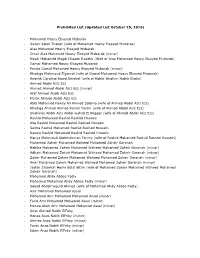
Prohibited List (Updated List October 25, 2016) Mohamed Hosny Elsayed Mubarak Suzan Saleh Thabet (wife of Mohamed Hosny Elsayed Mubarak) Alaa Mohamed Hosny Elsayed Mubarak Omar Alaa Mohamed Hosny Elsayed Mubarak (minor) Haydi Mohamed Magdi Hussen Rasekh (Wife of Alaa Mohamed Hosny Elsayed Mubarak) Gamal Mohamed Hosny Elsayed Mubarak Farida Gamal Mohamed Hosny Elsayed Mubarak (minor) Khadiga Mahmoud Elgamal (wife of Gamal Mohamed Hosny Elsayed Mubarak) Anoshk Caroline Rowd Serabel (wife of Habib Ibrahim Habib Eladly) Ahmed Abdel Aziz Ezz Ahmed Ahmed Abdel Aziz Ezz (minor) Afaf Ahmed Abdel Aziz Ezz Malak Ahmed Abdel Aziz Ezz Abla Mohamed Fawzy Ali Ahmed Salama (wife of Ahmed Abdel Aziz Ezz) Khadiga Ahmed Ahmed Kamel Yassin (wife of Ahmed Abdel Aziz Ezz) Shahinez Abdel Aziz Abdel wahab ELNaggar (wife of Ahmed Abdel Aziz Ezz) Rashid Mohamed Rashid Rashed Hussein Alia Rashid Mohamed Rashid Rashed Hussein Salma Rashid Mohamed Rashid Rashed Hussein Rawya Rashid Mohamed Rashid Rashed Hussein Hanya Mahmoud Abdelrahman Fahmy (wife of Rashid Mohamed Rashid Rashed Hussein) Mohamed Zoheir Mohamed Waheed Mohamed Zoheir Garanah Habiba Mohamed Zoheir Mohamed Waheed Mohamed Zoheir Garanah (minor) Adham Mohamed Zoheir Mohamed Waheed Mohamed Zoheir Garanah (minor) Zoher Mohamed Zoheir Mohamed Waheed Mohamed Zoheir Garanah (minor) Amir Mohamed Zoheir Mohamed Waheed Mohamed Zoheir Garanah (minor) Jaylan Shawkat Hosni Galal ElDin (wife of Mohamed Zoheir Mohamed Waheed Mohamed Zoheir Garanah) Mohamed Ahdy Abbas Fadly Mohamed Mohamed -
Terrorism and the Rise of ISIS in Egypt
BearWorks MSU Graduate Theses Fall 2015 Terrorism and the Rise of ISIS in Egypt Jantzen William Garnett As with any intellectual project, the content and views expressed in this thesis may be considered objectionable by some readers. However, this student-scholar’s work has been judged to have academic value by the student’s thesis committee members trained in the discipline. The content and views expressed in this thesis are those of the student-scholar and are not endorsed by Missouri State University, its Graduate College, or its employees. Follow this and additional works at: https://bearworks.missouristate.edu/theses Part of the Defense and Security Studies Commons Recommended Citation Garnett, Jantzen William, "Terrorism and the Rise of ISIS in Egypt" (2015). MSU Graduate Theses. 2551. https://bearworks.missouristate.edu/theses/2551 This article or document was made available through BearWorks, the institutional repository of Missouri State University. The work contained in it may be protected by copyright and require permission of the copyright holder for reuse or redistribution. For more information, please contact BearWorks@library.missouristate.edu. TERRORISM AND THE RISE OF ISIS IN EGYPT A Masters Thesis Presented to The Graduate College of Missouri State University TEMPLATE In Partial Fulfillment Of the Requirements for the Degree Master of Science, Defense and Strategic Studies By Jantzen W. Garnett December 2015 Copyright 2015 by Jantzen William Marlow Garnett ii TERRORISM AND THE RISE OF ISIS IN EGYPT Defense and Strategic Studies Missouri State University, December 2015 Master of Science Jantzen W. Garnett ABSTRACT Using mostly primary source materials this thesis seeks to understand the evolution of and linkages between different terrorist organization that have operated in Egypt and the Sinai, in particular. -
A Youtube Call to Action in the Egyptian Revolution
International Journal of Communication 5 (2011), Feature 1333–1343 1932–8036/2011FEA1333 “I’ll Be Waiting for You Guys”: A YouTube Call to Action in the Egyptian Revolution MELISSSA WALL California State University, Northridge SAHAR EL ZAHED Claremont University In this essay, we consider the ways the YouTube videos of Egyptian youth activist, Asmaa Mafouz, may be contributing to the development of a new political language for Egypt, providing a space to create an individual public political self, and modeling a new form of citizenship and activism for Egyptians. “If you stay home, you deserve all that’s being done to you, and you will be guilty before your nation and your people. Go down to the street, send SMSes, post it on the ‘Net, make people aware.” ~YouTube video of Asmaa Mahfouz, a leader in Egypt’s April 6, 2011 Youth Movement On January 18, 2011, a week before the massive street protests in Cairo’s Tahrir Square, Asmaa Mahfouz, a 26-year-old business graduate of Cairo University, recorded a 4-minute, 36-second video of herself and placed it on her Facebook page, from where it was quickly reposted to YouTube. In classic vlog style, the only image is a close-up of her face, in this case veiled, as she looks directly into the camera, passionately calling in Arabic for her fellow Egyptians to join her in protesting against the government. Despite the Egyptian government’s control of most of the country’s news media, Mahfouz’s video quickly spread among Egypt’s youth, many of whom had turned to social-networking sites as the only consistent arena for free political expression open to them. -

Edinburgh Research Explorer
Edinburgh Research Explorer Counterrevolution as international phenomenon Citation for published version: Allinson, J 2019, 'Counterrevolution as international phenomenon: The case of Egypt', Review of International Studies, vol. 45, no. 2, pp. 320-344. https://doi.org/10.1017/S0260210518000529 Digital Object Identifier (DOI): 10.1017/S0260210518000529 Link: Link to publication record in Edinburgh Research Explorer Document Version: Peer reviewed version Published In: Review of International Studies Publisher Rights Statement: This article has been published in a revised form in Review of International Studies. This version is free to view and download for private research and study only. Not for re-distribution, re-sale or use in derivative works. © copyright holder. General rights Copyright for the publications made accessible via the Edinburgh Research Explorer is retained by the author(s) and / or other copyright owners and it is a condition of accessing these publications that users recognise and abide by the legal requirements associated with these rights. Take down policy The University of Edinburgh has made every reasonable effort to ensure that Edinburgh Research Explorer content complies with UK legislation. If you believe that the public display of this file breaches copyright please contact openaccess@ed.ac.uk providing details, and we will remove access to the work immediately and investigate your claim. Download date: 25. Sep. 2021 COUNTER-REVOLUTION AS INTERNATIONAL PHENOMENON: THE CASE OF EGYPT Corresponding author: Jamie Allinson Lecturer in Politics and International Relations, University of Edinburgh Chrystal Macmillan Building, George Square, Edinburgh j.allinson@ed.ac.uk Abstract This article argues that the case of the Egyptian 2011 revolution forces us to rethink accounts of counter-revolution in International Relations. -

Five Years of Egypt's War on Terror
FIVE YEARS OF EGYPT’S WAR ON TERROR The Tahrir Institute for Middle East Policy (TIMEP) is dedicated to influencing policy toward the Middle East and North Africa through rigorous research and targeted advocacy efforts that promote local voices. TIMEP is fully registered and acknowledged under Section501(c)(3) in the District of Columbia. For more information about TIMEP’s mission, programming, or upcoming events, please visit timep.org. This report is the product of the collaborative efforts of TIMEP's staff and fellows. Cover image: A security checkpoint in the Egyptian Western Desert and the Bahariya Oasis in Siwa, Egypt, May 15, 2015 (photo by Amr Abdallah Dalsh for Reuters) CONTENTS INTRODUCTION 4 EXECUTIVE SUMMARY 5 TERRORISM 5 COUNTER-TERRORISM 10 LEGAL AND POLITICAL CONTEXT 14 FINDINGS 15 TERRORISM 17 ACROSS EGYPT: Intensification and evolution in terror attacks after 2013 17 NORTH SINAI: Violence has become an entrenched insurgency 19 MAINLAND: Low-scale violence gives way to sporadic, deadly attacks 26 COUNTER-TERRORISM 35 ACROSS EGYPT: Tens of thousands of citizens ensnared in the war on terror 35 NORTH SINAI: Continuous military occupation 36 MAINLAND: Sweeping and broad crackdown 39 LEGAL AND POLITICAL CONTEXT 43 LEGAL AND JUDICIAL CONTEXT: The war on terror trumps rule of law 43 DOMESTIC POLITICAL CONTEXT: The war on terror as pretext for political consolidation 46 GEOPOLITICAL CONTEXT: Continued global support 49 FINDINGS 52 METHODOLOGY 54 Egypt Security Watch 3 Five Years of Egypt’s War on Terror INTRODUCTION On July 24, 2013, then-Defense Minister Abdel-Fattah El Sisi asked for a popular mandate to fight terrorism, marking the declaration of the “war on terror” that has lasted five years. -

11. Doyle Proof
118 • Platform: Journal of Media and Communication Volume 6 (2015): 118-129. Deregulating the struggle: Network organisation and party organisation Kim Doyle – University of Melbourne doyle.k@unimelb.edu.au Since the global revolts of 2011, there has been a wave of tweeting, blogging and theorising regarding the “net- work effect” on revolutionary movements. This article will critique Manuel Castells’ claim that horizontal net- worked forms of organisation were responsible for the Egyptian revolution in 2011, and that autonomous mass self-communication, facilitated by social media, represents a new model of individual freedom, focusing upon the Egyptian revolution, given its pivotal role in the Arab revolutions. The article argues that the timing of the Egyptian revolution can only be fully understood through a political economy analysis of neoliberalism and capi- talist crisis. Equally, the role of traditional social actors and political parties cannot be ignored. Rather than be- ing made redundant by the “network society”, traditional collectivist organisation, such as political parties and trade unions, have been essential characters in the Egyptian revolution. Likewise, traditional print media has also played a role in the revolutionary process in Egypt. This article attempts to reorient theoretical discussion to the communicative tools best suited at a particular juncture in the social struggle, rather than fetishizing partic- ular technologies or social formations. The past thirty years have been marked by a neoliberal economic discourse. This article will employ David Harvey’s definition of neoliberalism as an ideology proposing that human wellbeing can best be achieved by empowering individual entrepreneurial freedoms through institutional frameworks that guarantee strong private property rights, free markets and free trade (Harvey, 2005, p. -

Egypt Looks to Monitor Popular Social Media Users 28 June 2018, by Bassem Aboualabass and Aziz El Massassi
Egypt looks to monitor popular social media users 28 June 2018, by Bassem Aboualabass And Aziz El Massassi and television programmes accused of violating public morals, would oversee "every personal website, blog or electronic account of any person with 5,000 followers or more". It would also have the right to suspend or block such accounts if they "publish or broadcast false news" or information inciting "breaking the law, violence or hatred". "Every citizen will think 1,000 times before they can write a post in which they criticise the action of the government or the regime," said Mohamed Abdelsalam, director of research at AFTE. Under the bill, internet users with at least 5,000 followers He urged social media companies to "reject the would be placed under the supervision of Egypt's Supreme Council for Media Regulation practices of the Egyptian government and stand on the side of the rights (of citizens) and civil society organisations". Freedom of expression may shrink further in Egypt Waves of arrests where lawmakers have approved the first reading of a bill that would monitor popular social media In another move in early June, lawmakers passed a users in the name of combating "false news". law on cyber-crime that allows authorities to block any website or account that threatens Egypt's Platforms such as Twitter and Facebook have national security or economy. become one of the last forums for public debate in Egypt since a November 2013 ban on all but police- Those who administer such websites face jail time approved gatherings. or fines.