The Eastern (Rite) Catholic Church
Total Page:16
File Type:pdf, Size:1020Kb
Load more
Recommended publications
-

Biblical Trinity Doctrine and Christology Translation of L
Ludwig Neidhart: Biblical Trinity Doctrine and Christology translation of L. Neidhart, Biblische Trinitätslehre und Christologie, published on http://catholic-church.org/ao/ps/Trinitaet.html, 2017, translated by the author, published online on http://catholic-church.org/ao/ps/downloads/TrinityChristology.pdf, 2017, © Dr. Ludwig Neidhart, Hannover 1990 (original German Version), © Dr. Ludwig Neidhart, Augsburg 2017 (extended German Version and English translation, both issued on September 15, 2017) Contents: 1. Unity in Essence and Personal Distinction between Father and Son.......................................................3 2. The Unity in Essence between the Father and the Son: Ten Biblical Arguments...................................8 3. The Holy Spirit or Holy Ghost...................................................................................................................18 4. The Triune God...........................................................................................................................................21 5. Trinity and Incarnation..............................................................................................................................29 6. Development of the Doctrine of Trinity and Incarnation.......................................................................31 7. Summary and Graphic Presentation of the Concepts of Trinity and Incarnation...............................48 8. Discussion: Is the Son subordinated to the Father?................................................................................50 -

UNIVERSITY of CALIFORNIA Los Angeles Byzantine Liturgy and The
UNIVERSITY OF CALIFORNIA Los Angeles Byzantine Liturgy and the Primary Chronicle A dissertation submitted in partial satisfaction of the requirements for the degree Doctor of Philosophy in Slavic Languages and Literatures by Sean Delaine Griffin 2014 ABSTRACT OF THE DISSERTATION Byzantine Liturgy and the Primary Chronicle by Sean Delaine Griffin Doctor of Philosophy in Slavic Languages and Literatures University of California, Los Angeles, 2014 Professor Gail Lenhoff, Chair The monastic chroniclers of medieval Rus’ lived in a liturgical world. Morning, evening and night they prayed the “divine services” of the Byzantine Church, and this study is the first to examine how these rituals shaped the way they wrote and compiled the Povest’ vremennykh let (Primary Chronicle, ca. 12th century), the earliest surviving East Slavic historical record. My principal argument is that several foundational accounts of East Slavic history—including the tales of the baptism of Princess Ol’ga and her burial, Prince Vladimir’s conversion, the mass baptism of Rus’, and the martyrdom of Princes Boris and Gleb—have their source in the feasts of the liturgical year. The liturgy of the Eastern Church proclaimed a distinctively Byzantine myth of Christian origins: a sacred narrative about the conversion of the Roman Empire, the glorification of the emperor Constantine and empress Helen, and the victory of Christianity over paganism. In the decades following the conversion of Rus’, the chroniclers in Kiev learned these narratives from the church services and patterned their own tales of Christianization after them. The ii result was a myth of Christian origins for Rus’—a myth promulgated even today by the Russian Orthodox Church—that reproduced the myth of Christian origins for the Eastern Roman Empire articulated in the Byzantine rite. -
Some Symbols of Identity of Byzantine Catholics I Robert J
Some Symbols of Identity of Byzantine Catholics I Robert J. Skovira Introduction This essay is a descript�on of some of an ethnic group's symbols of identity2; itsa im is to explore the meanings of the following statement: [Byzantine Catholics] are no longer an immigrant and ethnic group. Byzantine Catholics are American in every sense of the word, that the rite itself is American as opposed to fo reign, and that both the rite and its adherents have become part and parcel of the American scene.;l This straight-forward statement claims that there ha been a rei nterpretation an d reexpression of identity within a new political and sociocultural envrionment.� It is common ense, for example, to think that individuals as a group do, re-do, rearrange, and change the expressions of values and beliefs in new situations. But, in order to ensure continuity in the midst of change, people will usually use already ex isting symbols-or whatever is at hand and fa miliar. Byzan tine Catholic identity is a case of new bottles with old wine. Ethnic groups and their members rely upon any number of factors to symbolize the values and beliefs with which they identify and by which they are identified. Such symbol of identity are manipulated, exploited, reinterpreted or changed, over time, according to the requirements of the context. In any event, people always use whatever is present to them for maintaining some continuity of identity while, at the same time, adjusting to new state -of-affairs. Herskovits shows, for exampl ,that We are dealing with a basi proce s in the adjustment of individual behavior and of institutional structures to be found in all situations where people having different ways of life come into con tact. -
Liturgical Architecture: the Layout of a Byzantine Church Building
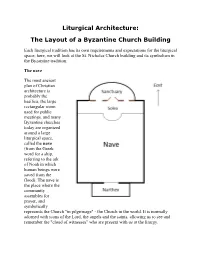
Liturgical Architecture: The Layout of a Byzantine Church Building Each liturgical tradition has its own requirements and expectations for the liturgical space; here, we will look at the St. Nicholas Church building and its symbolism in the Byzantine tradition. The nave The most ancient plan of Christian architecture is probably the basilica, the large rectangular room used for public meetings, and many Byzantine churches today are organized around a large liturgical space, called the nave (from the Greek word for a ship, referring to the ark of Noah in which human beings were saved from the flood). The nave is the place where the community assembles for prayer, and symbolically represents the Church "in pilgrimage" - the Church in the world. It is normally adorned with icons of the Lord, the angels and the saints, allowing us to see and remember the "cloud of witnesses" who are present with us at the liturgy. At St. Nicholas, the nave opens upward to a dome with stained glass of the Eucharist chalice and the Holy Spirit above the congregation. The nave is also provided with lights that at specific times the church interior can be brightly lit, especially at moments of great joy in the services, or dimly lit, like during parts of the Liturgy of Presanctified Gifts. The nave, where the congregation resides during the Divine Liturgy, at St. Nicholas is round, representing the endlessness of eternity. The principal church building of the Byzantine Rite, the Church of Holy Wisdom (Hagia Sophia) in Constantinople, employed a round plan for the nave, and this has been imitated in many Byzantine church buildings. -

Eastern Rite Catholicism
Eastern Rite Catholicism Religious Practices Religious Items Requirements for Membership Medical Prohibitions Dietary Standards Burial Rituals Sacred Writings Organizational Structure History Theology RELIGIOUS PRACTICES Required Daily Observances. None. However, daily personal prayer is highly recommended. Required Weekly Observances. Participation in the Divine Liturgy (Mass) is required. If the Divine Liturgy is not available, participation in the Latin Rite Mass fulfills the requirement. Required Occasional Observances. The Eastern Rites follow a liturgical calendar, as does the Latin Rite. However, there are significant differences. The Eastern Rites still follow the Julian Calendar, which now has a difference of about 13 days – thus, major feasts fall about 13 days after they do in the West. This could be a point of contention for Eastern Rite inmates practicing Western Rite liturgies. Sensitivity should be maintained by possibly incorporating special prayer on Eastern Rite Holy days into the Mass. Each liturgical season has a focus; i.e., Christmas (Incarnation), Lent (Human Mortality), Easter (Salvation). Be mindful that some very important seasons do not match Western practices; i.e., Christmas and Holy Week. Holy Days. There are about 28 holy days in the Eastern Rites. However, only some require attendance at the Divine Liturgy. In the Byzantine Rite, those requiring attendance are: Epiphany, Ascension, St. Peter and Paul, Assumption of the Blessed Virgin Mary, and Christmas. Of the other 15 solemn and seven simple holy days, attendance is not mandatory but recommended. (1 of 5) In the Ukrainian Rites, the following are obligatory feasts: Circumcision, Easter, Dormition of Mary, Epiphany, Ascension, Immaculate Conception, Annunciation, Pentecost, and Christmas. -
Valid-Invalid Baptisms Valid
Archdiocese of Los Angeles- Office of Divine Worship- Valid -Invalid Baptism VALID-INVALID BAPTISMS VALID: The following is a list of baptisms which are considered valid, as both water (pouring, sprinkling, or immersing the one baptized) and the Trinitarian formula (“I baptize you in the name of the Father, and of the Son, and of the Holy Spirit”) are used. Also, the minister must intend to do what the Church does when baptizing. • All Eastern non-Catholics (including all Orthodox churches) • Adventist Valid Baptism • African Methodist Episcopal • Amish/Mennonite • Anglican / Church of England • Assembly of God • Baptists • Chinese Catholic Baptism/Confirmation recognized • Chinese Christian • Christian and Missionary Alliance • Christian Fellowship • Church of the Brethren • Church of Christ • Church of God • Church of the Nazarene • Community of Pope Pius X (Lefebvre) Baptism/Confirmation recognized • Congregational • Disciples of Christ • Dutch Reformed • Eastern Non-Catholics (Orthodox) Baptism/Confirmation recognized • Episcopal • Evangelical • Evangelical Church of Covenant • Evangelical United Brethren • International Council of Community • Liberal Catholic • Lutheran • Methodist • Mennonite • Missionary Hill • Moravian July 2021 Archdiocese of Los Angeles- Office of Divine Worship- Valid -Invalid Baptism • New Apostolic Church • Church of the Nazarene • Old Catholic • Old Roman Catholic • Orthodox (see Eastern above) Baptism/Confirmation recognized • Polish National • Presbyterian • Reformed • Seventh Day Adventist • United Church • United Church of Canada • United Church of Christ • United Reformed • United Church of Australia • Waldensian • Zion DOUBTFUL: The following communities have baptismal practices which are not uniform and are considered to be doubtful, requiring an investigation into each case. Some of their communities have valid baptism, others do not. Mennonite Moravian Pentecostal Seventh Day Adventist INVALID: The following is a list (albeit incomplete) of baptisms considered to be invalid, due to a number of reasons. -

Byzantine Liturgical Hymnography: a Stumbling Stone for the Jewish-Orthodox Christian Dialogue? Alexandru Ioniță*
Byzantine Liturgical Hymnography: a Stumbling Stone for the Jewish-Orthodox Christian Dialogue? Alexandru Ioniță* This article discusses the role of Byzantine liturgical hymnography within the Jewish- Orthodox Christian dialogue. It seems that problematic anti-Jewish hymns of the Orthodox liturgy were often put forward by the Jewish side, but Orthodox theologians couldn’t offer a satisfactory answer, so that the dialogue itself profoundly suffered. The author of this study argues that liturgical hymnography cannot be a stumbling stone for the dialogue. Bringing new witnesses from several Orthodox theologians, the author underlines the need for a change of perspective. Then, beyond the intrinsic plea for the revision of the anti-Jewish texts, this article actually emphasizes the need to rediscover the Jewishness of the Byzantine liturgy and to approach the hymnography as an exegesis or even Midrash on the biblical texts and motives. As such, the anti-Jewish elements of the liturgy can be considered an impulse to a deeper analysis of Byzantine hymnography, which could be very fruitful for the Jewish-Christian Dialogue. Keywords: Jewish-Orthodox Christian Dialogue; Byzantine Hymnography; anti-Judaism; Orthodox Liturgy. Introduction The dialogue between Christian Orthodox theologians and Jewish repre- sentatives is by far one of the least documented and studied inter-religious interchanges. However, in recent years several general approaches to this topic have been issued1 and a complex study of it by Pier Giorgio Tane- burgo has even been published.2 Yet, because not all the reports presented at different Christian-Jewish joint meetings have been published and also, * Alexandru Ioniță, research fellow at the Institute for Ecumenical Research, Lucian Blaga University of Sibiu. -

The Eastern Mission of the Pontifical Commission for Russia, Origins to 1933
University of Wisconsin Milwaukee UWM Digital Commons Theses and Dissertations August 2017 Lux Occidentale: The aE stern Mission of the Pontifical Commission for Russia, Origins to 1933 Michael Anthony Guzik University of Wisconsin-Milwaukee Follow this and additional works at: https://dc.uwm.edu/etd Part of the European History Commons, History of Religion Commons, and the Other History Commons Recommended Citation Guzik, Michael Anthony, "Lux Occidentale: The Eastern Mission of the Pontifical ommiC ssion for Russia, Origins to 1933" (2017). Theses and Dissertations. 1632. https://dc.uwm.edu/etd/1632 This Dissertation is brought to you for free and open access by UWM Digital Commons. It has been accepted for inclusion in Theses and Dissertations by an authorized administrator of UWM Digital Commons. For more information, please contact open-access@uwm.edu. LUX OCCIDENTALE: THE EASTERN MISSION OF THE PONTIFICAL COMMISSION FOR RUSSIA, ORIGINS TO 1933 by Michael A. Guzik A Dissertation Submitted in Partial Fulfillment of the Requirements for the Degree of Doctor of Philosophy in History at The University of Wisconsin-Milwaukee August 2017 ABSTRACT LUX OCCIDENTALE: THE EASTERN MISSION OF THE PONTIFICAL COMMISSION FOR RUSSIA, ORIGINS TO 1933 by Michael A. Guzik The University of Wisconsin-Milwaukee, 2017 Under the Supervision of Professor Neal Pease Although it was first a sub-commission within the Congregation for the Eastern Churches (CEO), the Pontifical Commission for Russia (PCpR) emerged as an independent commission under the presidency of the noted Vatican Russian expert, Michel d’Herbigny, S.J. in 1925, and remained so until 1933 when it was re-integrated into CEO. -

Liturgical Press Style Guide
STYLE GUIDE LITURGICAL PRESS Collegeville, Minnesota www.litpress.org STYLE GUIDE Seventh Edition Prepared by the Editorial and Production Staff of Liturgical Press LITURGICAL PRESS Collegeville, Minnesota www.litpress.org Scripture texts in this work are taken from the New Revised Standard Version Bible: Catholic Edition © 1989, 1993, Division of Christian Education of the National Council of the Churches of Christ in the United States of America. Used by permission. All rights reserved. Cover design by Ann Blattner © 1980, 1983, 1990, 1997, 2001, 2004, 2008 by Order of Saint Benedict, Collegeville, Minnesota. Printed in the United States of America. Contents Introduction 5 To the Author 5 Statement of Aims 5 1. Submitting a Manuscript 7 2. Formatting an Accepted Manuscript 8 3. Style 9 Quotations 10 Bibliography and Notes 11 Capitalization 14 Pronouns 22 Titles in English 22 Foreign-language Titles 22 Titles of Persons 24 Titles of Places and Structures 24 Citing Scripture References 25 Citing the Rule of Benedict 26 Citing Vatican Documents 27 Using Catechetical Material 27 Citing Papal, Curial, Conciliar, and Episcopal Documents 27 Citing the Summa Theologiae 28 Numbers 28 Plurals and Possessives 28 Bias-free Language 28 4. Process of Publication 30 Copyediting and Designing 30 Typesetting and Proofreading 30 Marketing and Advertising 33 3 5. Parts of the Work: Author Responsibilities 33 Front Matter 33 In the Text 35 Back Matter 36 Summary of Author Responsibilities 36 6. Notes for Translators 37 Additions to the Text 37 Rearrangement of the Text 37 Restoring Bibliographical References 37 Sample Permission Letter 38 Sample Release Form 39 4 Introduction To the Author Thank you for choosing Liturgical Press as the possible publisher of your manuscript. -
The Baptismal Anointings According to the Anonymous Expositio Officiorum†
Hugoye: Journal of Syriac Studies, Vol. 1.1, 5–17 © 1998 [2010] by Beth Mardutho: The Syriac Institute and Gorgias Press THE BAPTISMAL ANOINTINGS ACCORDING TO THE ANONYMOUS † EXPOSITIO OFFICIORUM SEBASTIAN BROCK UNIVERSITY OF OXFORD ORIENTAL INSTITUTE PUSEY LANE, OXFORD OX1 2LE INTRODUCTION [1] The extensive anonymous commentary, wrongly ascribed by Assemani to George of Arbela, is one of the most important sources of information on the development of the East Syriac liturgical tradition and seems to date sometime between the seventh and ninth century.1 At many points the author directly quotes the liturgical reformer Isho’yahb III himself. † Originally published in G. Karukaparampil (ed.), Tuvaik: Studies in Honour of Rev. Jacob Vellian (Syrian Churches Series 16; Kottayam, 1995) 27–37, and reproduced here by kind permission of the editor. (The volume is available from Madnaha Theological Institute, Thellakam P.O., Kottayam 16, Kerala.) 1 Ed. R.H. Connolly, Anonymi auctoris expositio officiorum ecclesiae Georgio Arbelensi vulgo ascripta, I–II (CSCO 64, 71, 72, 76; Scr. Syri 25, 28, 29, 32; 1911–15). Memra V on baptism features in volume II, pp. 105–9 (text); this section is reproduced, with an accompanying Arabic translation, by J. Isaac, in Bayn an-Nahrayn 11 (1983): 329–80. The Commentary on the baptismal rite by Timothy II draws on the Anonymous Commentator at a few points; see the edition and translation 5 6 Sebastian Brock [2] Book V is devoted to the baptismal liturgy, and the fifth chapter of this specifically concerns the anointings. In this chapter the author offers a very interesting—and at the same time idiosyncratic—interpretation of the significance of the four different points at which oil was originally used in the East Syriac baptismal rite,2 namely at the ¾Ćãü, or ‘marking, signing’, at the ¿ÍÐÙýâ, or ‘anointing’, the pouring of oil on the baptismal water at its consecration, and the post-baptismal ¾ĆâÍÏ, or ‘sealing’. -

On a Delicate Mission: Pope John Paul 11 in Ukraine*
Religion, State & Society, Vol. 29, No. 3, 2001 On a Delicate Mission: Pope John Paul 11 in Ukraine* GERD STRICKER From 23 to 27 June 2001 Pope John Paul 11 made what he described as a pastoral journey and pilgrimage to Ukraine. The Ukrainian president, Leonid Kuchma, who is under intense internal political pressure, had issued an invitation to the pope with the support of the churches in Ukraine which owe allegiance to Rome. Patriarch Aleksi 11 of Moscow and All Russia protested vehemently against the papal visit, claiming that the Catholic Church was involved in 'proselytism' and 'massive mission' on the canonical territory of the Russian Orthodox Church (the former Soviet Union). Despite this, the pope was convinced that his visit to Ukraine would bring an improvement in interreligious relations, in particular in the relations between the Orthodox and Roman Catholic Churches. It has to be doubted whether he has succeeded in this delicate mission. Any hopes that Patriarch Aleksi would change his mind at the last minute were dashed: the patriarch took the opportunity to make a well-publicised 'state visit' to Belarus' and the representative of the Ukrainian Orthodox Church-Moscow Patriarchate (UOC-MP), Metropolitan Volodymyr (Sabodan, born 1935) of Kiev and All Ukraine, travelled to the Czech Republic 'for medical reasons', in order to avoid meeting the pope. In the course of his 94 visits abroad, Pope John Paul has previously visited other traditionally Orthodox countries (Georgia and Romania in 1999 and Greece earlier in 2001). As in Ukraine, he was invited by the heads of state, but also by the heads of the Orthodox Churches. -

Narratives of Ethnic Identity and Language Among Young Pannonian Ruthenians in Serbia
DOI: 10.11649/a.1983 Marina Sakač, an undergraduate at the University of Belgrade, Article No.: 1983 Serbia, Faculty of Philosophy, Department of Ethnology and Anthropology. Junior Associate at Petnica Science Center, Depart- ment of Anthropology. ORCID: https://orcid.org/0000-0001-6441-3371 nr 14/2019 r. e-mail: marina.sakac19@gmail.com Marina Sakač Narratives of ethnic identity and language among young Pannonian Ruthenians in Serbia “[…] there is not, there has never been anywhere, any people without narrative; all classes, all human groups, have their stories […]” Roland Barthes Introduction his article offers a study of personal experiences and understandings of Ruthenian ethnic minority identity in Serbia. The narrative approach was selected as the most Tappropriate method to gain insight into its intersubjective perception. The narratives under consideration are viewed as personal story-telling and are presented in the context of the political and social discourse of ethnic identities and minorities in particular. The bilingual upbringing of all Ruthenians in Serbia poses as one of the key factors behind a political position which enabled them to avoid assimilation with the majority. This study can be taken as an example of how minorities (ethnic, linguistic or otherwise) can obtain their rights within nation-states through strategic positioning aiming to withstand the cultural and linguistic hegemony of the majority. The migration of Ruthenians form the region of Transcarpathia in the north-east of the historical Kingdom of Hungary (Kraljevina Ugarska) to the south of the realm, today’s Vojvodina (Srem, Banat, Bačka), Serbia, began in the mid-eighteenth century The study was conducted at the author’s own expense.