AT0 M Los Alamos Scientific Laboratory July 16,1965
Total Page:16
File Type:pdf, Size:1020Kb
Load more
Recommended publications
-
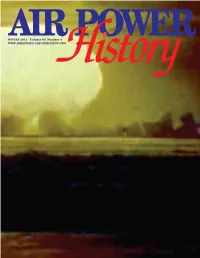
WINTER 2013 - Volume 60, Number 4 the Air Force Historical Foundation Founded on May 27, 1953 by Gen Carl A
WINTER 2013 - Volume 60, Number 4 WWW.AFHISTORICALFOUNDATION.ORG The Air Force Historical Foundation Founded on May 27, 1953 by Gen Carl A. “Tooey” Spaatz MEMBERSHIP BENEFITS and other air power pioneers, the Air Force Historical All members receive our exciting and informative Foundation (AFHF) is a nonprofi t tax exempt organization. Air Power History Journal, either electronically or It is dedicated to the preservation, perpetuation and on paper, covering: all aspects of aerospace history appropriate publication of the history and traditions of American aviation, with emphasis on the U.S. Air Force, its • Chronicles the great campaigns and predecessor organizations, and the men and women whose the great leaders lives and dreams were devoted to fl ight. The Foundation • Eyewitness accounts and historical articles serves all components of the United States Air Force— Active, Reserve and Air National Guard. • In depth resources to museums and activities, to keep members connected to the latest and AFHF strives to make available to the public and greatest events. today’s government planners and decision makers information that is relevant and informative about Preserve the legacy, stay connected: all aspects of air and space power. By doing so, the • Membership helps preserve the legacy of current Foundation hopes to assure the nation profi ts from past and future US air force personnel. experiences as it helps keep the U.S. Air Force the most modern and effective military force in the world. • Provides reliable and accurate accounts of historical events. The Foundation’s four primary activities include a quarterly journal Air Power History, a book program, a • Establish connections between generations. -

The Making of an Atomic Bomb
(Image: Courtesy of United States Government, public domain.) INTRODUCTORY ESSAY "DESTROYER OF WORLDS": THE MAKING OF AN ATOMIC BOMB At 5:29 a.m. (MST), the world’s first atomic bomb detonated in the New Mexican desert, releasing a level of destructive power unknown in the existence of humanity. Emitting as much energy as 21,000 tons of TNT and creating a fireball that measured roughly 2,000 feet in diameter, the first successful test of an atomic bomb, known as the Trinity Test, forever changed the history of the world. The road to Trinity may have begun before the start of World War II, but the war brought the creation of atomic weaponry to fruition. The harnessing of atomic energy may have come as a result of World War II, but it also helped bring the conflict to an end. How did humanity come to construct and wield such a devastating weapon? 1 | THE MANHATTAN PROJECT Models of Fat Man and Little Boy on display at the Bradbury Science Museum. (Image: Courtesy of Los Alamos National Laboratory.) WE WAITED UNTIL THE BLAST HAD PASSED, WALKED OUT OF THE SHELTER AND THEN IT WAS ENTIRELY SOLEMN. WE KNEW THE WORLD WOULD NOT BE THE SAME. A FEW PEOPLE LAUGHED, A FEW PEOPLE CRIED. MOST PEOPLE WERE SILENT. J. ROBERT OPPENHEIMER EARLY NUCLEAR RESEARCH GERMAN DISCOVERY OF FISSION Achieving the monumental goal of splitting the nucleus The 1930s saw further development in the field. Hungarian- of an atom, known as nuclear fission, came through the German physicist Leo Szilard conceived the possibility of self- development of scientific discoveries that stretched over several sustaining nuclear fission reactions, or a nuclear chain reaction, centuries. -
Secrets Jeremy Bernstein
INFERENCE / Vol. 6, No. 1 Secrets Jeremy Bernstein Restricted Data: The History of Nuclear Secrecy in the decided to found a rival weapons laboratory. Even if Teller United States had offered me a job, I doubt that I would have accepted.3 by Alex Wellerstein After obtaining my degree, I was offered a job that University of Chicago Press, 528 pp., $35.00. would keep me in Cambridge for at least another year. One year became two and at the end of my second year I was uclear weapons have been shrouded in secrecy accepted at the Institute for Advanced Study in Princeton. from the very beginning. After plutonium was It was around this time that the chairman of the physics discovered at the University of California in department at Harvard, Kenneth Bainbridge, came to me NDecember 1940, researchers led by Glenn Seaborg submit- with an offer. Bainbridge had been an important figure at ted a pair of letters to the Physical Review. The details of Los Alamos during the war. Robert Oppenheimer had put their discovery were withheld from publication until after him in charge of the site in New Mexico where the Trinity the war.1 Once the project to make a nuclear weapon got test had taken place.4 Bainbridge told me that the labora- underway, secrecy became a very serious matter indeed. tory was offering summer jobs to young PhDs and asked The story of these efforts and how they evolved after the if I was interested. I was very interested. Los Alamos had war is the subject of Alex Wellerstein’s Restricted Data: an almost mystical significance for me due to its history The History of Nuclear Secrecy in the United States. -
The Development of Military Nuclear Strategy And
The Development of Military Nuclear Strategy and Anglo-American Relations, 1939 – 1958 Submitted by: Geoffrey Charles Mallett Skinner to the University of Exeter as a thesis for the degree of Doctor of Philosophy in History, July 2018 This thesis is available for Library use on the understanding that it is copyright material and that no quotation from the thesis may be published without proper acknowledgement. I certify that all material in this thesis which is not my own work has been identified and that no material has previously been submitted and approved for the award of a degree by this or any other University. (Signature) ……………………………………………………………………………… 1 Abstract There was no special governmental partnership between Britain and America during the Second World War in atomic affairs. A recalibration is required that updates and amends the existing historiography in this respect. The wartime atomic relations of those countries were cooperative at the level of science and resources, but rarely that of the state. As soon as it became apparent that fission weaponry would be the main basis of future military power, America decided to gain exclusive control over the weapon. Britain could not replicate American resources and no assistance was offered to it by its conventional ally. America then created its own, closed, nuclear system and well before the 1946 Atomic Energy Act, the event which is typically seen by historians as the explanation of the fracturing of wartime atomic relations. Immediately after 1945 there was insufficient systemic force to create change in the consistent American policy of atomic monopoly. As fusion bombs introduced a new magnitude of risk, and as the nuclear world expanded and deepened, the systemic pressures grew. -

Trinity Scientific Firsts
TRINITY SCIENTIFIC FIRSTS THE TRINITY TEST was perhaps the greatest scientifi c experiment ever. Seventy-fi ve years ago, Los Alamos scientists and engineers from the U.S., Britain, and Canada changed the world. July 16, 1945 marks the entry into the Atomic Age. PLUTONIUM: THE BETHE-FEYNMAN FORMULA: Scientists confi rmed the newly discovered 239Pu has attractive nuclear Nobel Laureates Hans Bethe and Richard Feynman developed the physics fi ssion properties for an atomic weapon. They were able to discern which equation used to estimate the yield of a fi ssion weapon, building on earlier production path would be most effective based on nuclear chemistry, and work by Otto Frisch and Rudolf Peierls. The equation elegantly encapsulates separated plutonium from Hanford reactor fuel. essential physics involved in the nuclear explosion process. PRECISION HIGH-EXPLOSIVE IMPLOSION FOUNDATIONAL RADIOCHEMICAL TO CREATE A SUPER-CRITICAL ASSEMBLY: YIELD ANALYSIS: Project Y scientists developed simultaneously-exploding bridgewire detonators Wartime radiochemistry techniques developed and used at Trinity with a pioneering high-explosive lens system to create a symmetrically provide the foundation for subsequent analyses of nuclear detonations, convergent detonation wave to compress the core. both foreign and domestic. ADVANCED IMAGING TECHNIQUES: NEW FRONTIERS IN COMPUTING: Complementary diagnostics were developed to optimize the implosion Human computers and IBM punched-card machines together calculated design, including fl ash x-radiography, the RaLa method, -

Copyright by Paul Harold Rubinson 2008
Copyright by Paul Harold Rubinson 2008 The Dissertation Committee for Paul Harold Rubinson certifies that this is the approved version of the following dissertation: Containing Science: The U.S. National Security State and Scientists’ Challenge to Nuclear Weapons during the Cold War Committee: —————————————————— Mark A. Lawrence, Supervisor —————————————————— Francis J. Gavin —————————————————— Bruce J. Hunt —————————————————— David M. Oshinsky —————————————————— Michael B. Stoff Containing Science: The U.S. National Security State and Scientists’ Challenge to Nuclear Weapons during the Cold War by Paul Harold Rubinson, B.A.; M.A. Dissertation Presented to the Faculty of the Graduate School of The University of Texas at Austin in Partial Fulfillment of the Requirements for the Degree of Doctor of Philosophy The University of Texas at Austin August 2008 Acknowledgements Thanks first and foremost to Mark Lawrence for his guidance, support, and enthusiasm throughout this project. It would be impossible to overstate how essential his insight and mentoring have been to this dissertation and my career in general. Just as important has been his camaraderie, which made the researching and writing of this dissertation infinitely more rewarding. Thanks as well to Bruce Hunt for his support. Especially helpful was his incisive feedback, which both encouraged me to think through my ideas more thoroughly, and reined me in when my writing overshot my argument. I offer my sincerest gratitude to the Smith Richardson Foundation and Yale University International Security Studies for the Predoctoral Fellowship that allowed me to do the bulk of the writing of this dissertation. Thanks also to the Brady-Johnson Program in Grand Strategy at Yale University, and John Gaddis and the incomparable Ann Carter-Drier at ISS. -
Annual Report 2013.Pdf
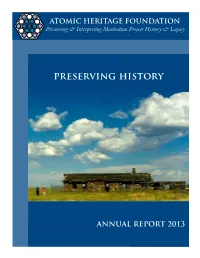
ATOMIC HERITAGE FOUNDATION Preserving & Interpreting Manhattan Project History & Legacy preserving history ANNUAL REPORT 2013 WHY WE SHOULD PRESERVE THE MANHATTAN PROJECT “The factories and bombs that Manhattan Project scientists, engineers, and workers built were physical objects that depended for their operation on physics, chemistry, metallurgy, and other nat- ural sciences, but their social reality - their meaning, if you will - was human, social, political....We preserve what we value of the physical past because it specifically embodies our social past....When we lose parts of our physical past, we lose parts of our common social past as well.” “The new knowledge of nuclear energy has undoubtedly limited national sovereignty and scaled down the destructiveness of war. If that’s not a good enough reason to work for and contribute to the Manhattan Project’s historic preservation, what would be? It’s certainly good enough for me.” ~Richard Rhodes, “Why We Should Preserve the Manhattan Project,” Bulletin of the Atomic Scientists, May/June 2006 Photographs clockwise from top: J. Robert Oppenheimer, General Leslie R. Groves pinning an award on Enrico Fermi, Leona Woods Marshall, the Alpha Racetrack at the Y-12 Plant, and the Bethe House on Bathtub Row. Front cover: A Bruggeman Ranch property. Back cover: Bronze statues by Susanne Vertel of J. Robert Oppenheimer and General Leslie Groves at Los Alamos. Table of Contents BOARD MEMBERS & ADVISORY COMMITTEE........3 Cindy Kelly, Dorothy and Clay Per- Letter from the President..........................................4 -

Footnotes for ATOMIC ADVENTURES
Footnotes for ATOMIC ADVENTURES Secret Islands, Forgotten N-Rays, and Isotopic Murder - A Journey into the Wild World of Nuclear Science By James Mahaffey While writing ATOMIC ADVENTURES, I tried to be careful not to venture off into subplots, however interesting they seemed to me, and keep the story flowing and progressing at the right tempo. Some subjects were too fascinating to leave alone, and there were bits of further information that I just could not abandon. The result is many footnotes at the bottom of pages, available to the reader to absorb at his or her discretion. To get the full load of information from this book, one needs to read the footnotes. Some may seem trivia, but some are clarifying and instructive. This scheme works adequately for a printed book, but not so well with an otherwise expertly read audio version. Some footnotes are short enough to be inserted into the audio stream, but some are a rambling half page of dense information. I was very pleased when Blackstone Audio agreed wholeheartedly that we needed to include all of my footnotes in this version of ATOMIC ADVENTURES, and we came up with this added feature: All 231 footnotes in this included text, plus all the photos and explanatory diagrams that were included in the text. I hope you enjoy reading some footnotes while listening to Keith Sellon-Wright tell the stories in ATOMIC ADVENTURES. James Mahaffey April 2017 2 Author’s Note Stories Told at Night around the Glow of the Reactor Always striving to beat the Atlanta Theater over on Edgewood Avenue, the Forsyth Theater was pleased to snag a one-week engagement of the world famous Harry Houdini, extraordinary magician and escape artist, starting April 19, 1915.1 It was issued an operating license, no. -

Cold War Requisitions, Scientific Manpower, and the Production of American Physicists After World War II
DAVID KAISER* Cold War requisitions, scientific manpower, and the production of American physicists after World War II 1. RAYMOND BIRGE’S “MAIN OBJECTIVE” “THE MAIN OBJECTIVE of this department of physics,” Raymond Birge wrote in late May 1955, “is to train Ph.D.’s in physics.” Birge— iconic, somber, a displaced Yankee who traced his New England ancestry nine generations back—had been chair of Berkeley’s physics department for twenty-two years; by the mid-1950s, it was the nation’s largest. At the time he explained his department’s “main objec- tive,” Birge was the retiring president of the American Physical Society (APS). Birge and his colleagues in Berkeley’s physics department had emphasized the importance of its graduate program many times before in annual budget requests to the university administration and in funding reports to private industries; it would be easy to read such remarks as thinly-veiled requests for more funding, since training physics Ph.D.s became expensive after World War II. This time, however, Birge articulated his department’s mission in a letter to a local citizen, far outside of the university bureaucracy, who had no funds to offer and who had requested no such pronouncement. 1 *Program in Science, Technology, and Society, and Department of Physics, Building E51- 185, MIT, Cambridge, MA 02139; dikaiser@mit.edu. My thanks to Shane Hamilton for his research assistance, and to Alexis De Greiff, Kenji Ito, John Krige, Elizabeth Paris, and John Rudolph for their helpful comments on an earlier draft. The following abbreviations are used: AIP-EMD, American Institute of Physics, Edu- cation and Manpower Division Records, Niels Bohr Library, American Institute of Physics, College Park, MD; BAS, Bulletin of the atomic scientists; BDP , University of California, Berkeley, Department of Physics Records, Bancroft Library, Berkeley, CA; HDP, Harvard University Department of Physics Records, Pusey Library, Cambridge, MA; PDP, Princeton University Department of Physics Records, Seeley G. -

THE MEETING Meridel Rubenstein 1995
THE MEETING Meridel Rubenstein 1995 Palladium prints, steel, single-channel video Video assistance by Steina Video run time 4:00 minutes Tia Collection The Meeting consists of twenty portraits of people from San Ildefonso Pueblo and Manhattan Project physicists—who met at the home of Edith Warner during the making of the first atomic bomb—and twenty photographs of carefully selected objects of significance to each group. In this grouping are people from San Ildefonso Pueblo and the objects they selected from the collections of the Museum of Indian Arts and Culture to represent their culture. 1A ROSE HUGHES 2A TALL-NECKED JAR 3A BLUE CORN 4A SLEIGH BELLS 5A FLORENCE NARANJO Rose Hughes holding a photograph of WITH AVANYU One of the most accomplished and (Museum of Indian Arts and Culture) Married to Louis Naranjo; her father, Tony Peña, who organized (plumed serpent) made by Julian and recognized of the San Ildefonso Sleigh bells are commonly used in granddaughter of Ignacio and Susana the building of Edith Warner’s second Maria Martinez, ca. 1930 (Museum of potters. Like many women from the ceremonial dances to attract rain. Aguilar; daughter of Joe Aguilar, who house. Hughes worked at Edith Indian Arts and Culture) Edith Warner pueblos, she worked as a maid for the Tilano Montoya returned with bells like helped Edith Warner remodel the Warner’s with Florence Naranjo one was shown a pot like this one in 1922 Oppenheimers. these from Europe, where he went on tearoom. Edith called her Florencita. summer. She recalls that Edith once on her first visit to San Ildefonso, in the tour with a group of Pueblo dancers. -

Alfred O. C. Nier
CHEMICAL HERITAGE FOUNDATION ALFRED O. C. NIER Transcript of Interviews Conducted by Michael A. Grayson and Thomas Krick at University of Minnesota Minneapolis, Minnesota on 7, 8, 9, and 10 April 1989 (With Subsequent Corrections and Additions) ACKNOWLEDGMENT This oral history is one in a series initiated by the Chemical Heritage Foundation on behalf of the American Society for Mass Spectrometry. The series documents the personal perspectives of individuals related to the advancement of mass spectrometric instrumentation, and records the human dimensions of the growth of mass spectrometry in academic, industrial, and governmental laboratories during the twentieth century. This project is made possible through the generous support of the American Society for Mass Spectrometry Upon Alfred O.C. Nier’s death in 1994, this oral history was designated Free Access. Please note: Users citing this interview for purposes of publication are obliged under the terms of the Chemical Heritage Foundation Oral History Program to credit CHF using the format below: Alfred O.C. Nier, interview by Michael A. Grayson and Thomas Krick at the University of Minnesota, Minneapolis, Minnesota, 7-10 April 1989 (Philadelphia: Chemical Heritage Foundation, Oral History Transcript # 0112). Chemical Heritage Foundation Oral History Program 315 Chestnut Street Philadelphia, Pennsylvania 19106 The Chemical Heritage Foundation (CHF) serves the community of the chemical and molecular sciences, and the wider public, by treasuring the past, educating the present, and inspiring the future. CHF maintains a world-class collection of materials that document the history and heritage of the chemical and molecular sciences, technologies, and industries; encourages research in CHF collections; and carries out a program of outreach and interpretation in order to advance an understanding of the role of the chemical and molecular sciences, technologies, and industries in shaping society. -
A Pedagogy of Diminishing Returns: Scientific Involution Across Three Generations of Nuclear Weapons Science
3 A Pedagogy of Diminishing Returns: Scientific Involution across Three Generations of Nuclear Weapons Science Hugh Gusterson In science studies we hear a lot about the construction of facts, the building of net- works, and the growth of disciplines, but much less about the withering, decay, or arte- riosclerosis of fields of knowledge (brought on either through natural exhaustion of a particular approach or through external constraints). We have a disciplinary bias toward scientific evolution and revolution rather than what I am here calling involu- tion.1 A generation of historians, sociologists, and anthropologists of science has learned from actor-network theory and the sociology of scientific knowledge (SSK) to focus on the building of scientific institutions and facts, and from Thomas Kuhn to expect a certain historical rhythm in the evolution of scientific fields of knowledge: first, a dynamic burst of creativity (the “revolution”) as the foundational ideas of the new field are laid down; second, a period of “normal science” in which gaps are filled in as the new knowledge is institutionalized; and, finally, as puzzles emerge that can- not be fully explained by the established paradigm, a new burst of creativity as another generation redefines the fundamental precepts of the field.2 In this essay, looking at three generations of nuclear weapons designers, I follow and then depart from the Kuhnian script. Although the first two generations of nuclear weapons scientists con- formed perfectly to the Kuhnian storyline, the final story