Beck 1996, 1999
Total Page:16
File Type:pdf, Size:1020Kb
Load more
Recommended publications
-

Butterflies and Moths of Ada County, Idaho, United States
Heliothis ononis Flax Bollworm Moth Coptotriche aenea Blackberry Leafminer Argyresthia canadensis Apyrrothrix araxes Dull Firetip Phocides pigmalion Mangrove Skipper Phocides belus Belus Skipper Phocides palemon Guava Skipper Phocides urania Urania skipper Proteides mercurius Mercurial Skipper Epargyreus zestos Zestos Skipper Epargyreus clarus Silver-spotted Skipper Epargyreus spanna Hispaniolan Silverdrop Epargyreus exadeus Broken Silverdrop Polygonus leo Hammock Skipper Polygonus savigny Manuel's Skipper Chioides albofasciatus White-striped Longtail Chioides zilpa Zilpa Longtail Chioides ixion Hispaniolan Longtail Aguna asander Gold-spotted Aguna Aguna claxon Emerald Aguna Aguna metophis Tailed Aguna Typhedanus undulatus Mottled Longtail Typhedanus ampyx Gold-tufted Skipper Polythrix octomaculata Eight-spotted Longtail Polythrix mexicanus Mexican Longtail Polythrix asine Asine Longtail Polythrix caunus (Herrich-Schäffer, 1869) Zestusa dorus Short-tailed Skipper Codatractus carlos Carlos' Mottled-Skipper Codatractus alcaeus White-crescent Longtail Codatractus yucatanus Yucatan Mottled-Skipper Codatractus arizonensis Arizona Skipper Codatractus valeriana Valeriana Skipper Urbanus proteus Long-tailed Skipper Urbanus viterboana Bluish Longtail Urbanus belli Double-striped Longtail Urbanus pronus Pronus Longtail Urbanus esmeraldus Esmeralda Longtail Urbanus evona Turquoise Longtail Urbanus dorantes Dorantes Longtail Urbanus teleus Teleus Longtail Urbanus tanna Tanna Longtail Urbanus simplicius Plain Longtail Urbanus procne Brown Longtail -
Effect of Different Mowing Regimes on Butterflies and Diurnal Moths on Road Verges A
Animal Biodiversity and Conservation 29.2 (2006) 133 Effect of different mowing regimes on butterflies and diurnal moths on road verges A. Valtonen, K. Saarinen & J. Jantunen Valtonen, A., Saarinen, K. & Jantunen, J., 2006. Effect of different mowing regimes on butterflies and diurnal moths on road verges. Animal Biodiversity and Conservation, 29.2: 133–148. Abstract Effect of different mowing regimes on butterflies and diurnal moths on road verges.— In northern and central Europe road verges offer alternative habitats for declining plant and invertebrate species of semi– natural grasslands. The quality of road verges as habitats depends on several factors, of which the mowing regime is one of the easiest to modify. In this study we compared the Lepidoptera communities on road verges that underwent three different mowing regimes regarding the timing and intensity of mowing; mowing in mid–summer, mowing in late summer, and partial mowing (a narrow strip next to the road). A total of 12,174 individuals and 107 species of Lepidoptera were recorded. The mid–summer mown verges had lower species richness and abundance of butterflies and lower species richness and diversity of diurnal moths compared to the late summer and partially mown verges. By delaying the annual mowing until late summer or promoting mosaic–like mowing regimes, such as partial mowing, the quality of road verges as habitats for butterflies and diurnal moths can be improved. Key words: Mowing management, Road verge, Butterfly, Diurnal moth, Alternative habitat, Mowing intensity. Resumen Efecto de los distintos regímenes de siega de los márgenes de las carreteras sobre las polillas diurnas y las mariposas.— En Europa central y septentrional los márgenes de las carreteras constituyen hábitats alternativos para especies de invertebrados y plantas de los prados semi–naturales cuyas poblaciones se están reduciendo. -
Check List of Noctuid Moths (Lepidoptera: Noctuidae And
Бiологiчний вiсник МДПУ імені Богдана Хмельницького 6 (2), стор. 87–97, 2016 Biological Bulletin of Bogdan Chmelnitskiy Melitopol State Pedagogical University, 6 (2), pp. 87–97, 2016 ARTICLE UDC 595.786 CHECK LIST OF NOCTUID MOTHS (LEPIDOPTERA: NOCTUIDAE AND EREBIDAE EXCLUDING LYMANTRIINAE AND ARCTIINAE) FROM THE SAUR MOUNTAINS (EAST KAZAKHSTAN AND NORTH-EAST CHINA) A.V. Volynkin1, 2, S.V. Titov3, M. Černila4 1 Altai State University, South Siberian Botanical Garden, Lenina pr. 61, Barnaul, 656049, Russia. E-mail: volynkin_a@mail.ru 2 Tomsk State University, Laboratory of Biodiversity and Ecology, Lenina pr. 36, 634050, Tomsk, Russia 3 The Research Centre for Environmental ‘Monitoring’, S. Toraighyrov Pavlodar State University, Lomova str. 64, KZ-140008, Pavlodar, Kazakhstan. E-mail: sandipta@ya.ru 4 The Slovenian Museum of Natural History, Prešernova 20, SI-1001, Ljubljana, Slovenia. E-mail: matjazcernila@yahoo.com The paper contains data on the fauna of the Lepidoptera families Erebidae (excluding subfamilies Lymantriinae and Arctiinae) and Noctuidae of the Saur Mountains (East Kazakhstan). The check list includes 216 species. The map of collecting localities is presented. Key words: Lepidoptera, Noctuidae, Erebidae, Asia, Kazakhstan, Saur, fauna. INTRODUCTION The fauna of noctuoid moths (the families Erebidae and Noctuidae) of Kazakhstan is still poorly studied. Only the fauna of West Kazakhstan has been studied satisfactorily (Gorbunov 2011). On the faunas of other parts of the country, only fragmentary data are published (Lederer, 1853; 1855; Aibasov & Zhdanko 1982; Hacker & Peks 1990; Lehmann et al. 1998; Benedek & Bálint 2009; 2013; Korb 2013). In contrast to the West Kazakhstan, the fauna of noctuid moths of East Kazakhstan was studied inadequately. -

Harper's Island Wetlands Butterflies & Moths (2020)
Introduction Harper’s Island Wetlands (HIW) nature reserve, situated close to the village of Glounthaune on the north shore of Cork Harbour is well known for its birds, many of which come from all over northern Europe and beyond, but there is a lot more to the wildlife at the HWI nature reserve than birds. One of our goals it to find out as much as we can about all aspects of life, both plant and animal, that live or visit HIW. This is a report on the butterflies and moths of HIW. Butterflies After birds, butterflies are probably the one of the best known flying creatures. While there has been no structured study of them on at HIW, 17 of Ireland’s 33 resident and regular migrant species of Irish butterflies have been recorded. Just this summer we added the Comma butterfly to the island list. A species spreading across Ireland in recent years possibly in response to climate change. Hopefully we can set up regular monitoring of the butterflies at HIW in the next couple of years. Butterfly Species Recorded at Harper’s Island Wetlands up to September 2020. Colias croceus Clouded Yellow Pieris brassicae Large White Pieris rapae Small White Pieris napi Green-veined White Anthocharis cardamines Orange-tip Lycaena phlaeas Small Copper Polyommatus icarus Common Blue Celastrina argiolus Holly Blue Vanessa atalanta Red Admiral Vanessa cardui Painted Lady Aglais io Peacock Aglais urticae Small Tortoiseshell Polygonia c-album Comma Speyeria aglaja Dark-green Fritillary Pararge aegeria Speckled Wood Maniola jurtina Meadow Brown Aphantopus hyperantus Ringlet Moths One group of insects that are rarely seen by visitors to HIW is the moths. -

Nota Lepidopterologica, 25.04.2012, ISSN 0342-7536 ©Societas Europaea Lepidopterologica; Download Unter Und
©Societas Europaea Lepidopterologica; download unter http://www.biodiversitylibrary.org/ und www.zobodat.at Nota lepi. 35(1): 33-50 33 Additions to the checklist of Bombycoidea and Noctuoidea of the Volgo-Ural region. Part II. (Lepidoptera: Lasiocampidae, Erebidae, Nolidae, Noctuidae) Kari Nupponen ' & Michael Fibiger"^ Merenneidontie 19 D, FI-02320 Espoo, Finland; Kari.Nupponen@kolumbus.fi ^ Deceased. 1 1 Received May 20 1 1 ; reviews returned September 20 1 ; accepted 3 December 2011. Subject Editor: Lauri Kaila. Abstract. Faunistic records additional to the recently published lists of Bombycoidea and Noctuoidea of the South Ural Mountains (Nupponen & Fibiger 2002, 2006) are presented, as well as some interesting records from the North Urals and the Lower Volga region. The material in the southern Urals was collected during 2006-2010 in six different expeditions, in North Ural in 2003 and 2007, and in the Lower Volga region in 2001, 2002, 2005, and 2006 in four expeditions. Four species are reported for the first time from Europe: Dichagyris latipennis (Piingeler, 1909), Pseudohermonassa melancholica (Lederer, 1853), Spae- lotis deplorata (Staudinger, 1897), and Xestia albonigra (Kononenko, 1981). Fourteen species are reported for the first time from the southern Urals. Altogether, records of 68 species are reported, including a few corrections to the previous articles. Further illustrations and notes on some poorly known taxa are given. Introduction The fauna of Bombycoidea and Noctuoidea of the southern Ural Mountains has been studied intensely since 1996, and the results of the research during 1996-2005 were published by Nupponen & Fibiger (2002, 2006). Since 2005, several further expedi- tions were made to the Urals by the first author. -
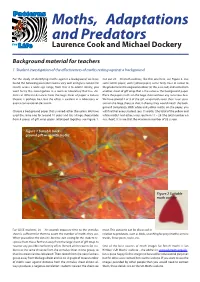
Moths, Adaptations and Predators
Patterns Moths, Adaptations and Predators forLife MOTHS Laurence Cook and Michael Dockery Background material for teachers 1. Student investigation of the effectiveness of moths resting against a background For the study of identifying moths against a background we have Cut out 20 – 30 moth outlines, like this one here, see Figure 2. Use found the following procedure works very well and gives consistent some white paper, some yellow paper, some fairly close in colour to results across a wide age range, from Year 2 to adults! Ideally, you the predominant background colour (in this case red) and some from want to try this investigation in a room or laboratory that has stu- another sheet of gift wrap that is the same as the background paper. dents at different distances from the large sheet of paper: a lecture Place the paper moths on the large sheet without any conscious bias. theatre is perhaps best but the effect is evident in a laboratory or We have placed 2 or 3 of the gift wrap moths over their `true` posi- even a conventional classroom. tion on the large sheet so that, in theory, they would match the back- ground completely. With white and yellow moths on the paper, you Choose a background paper that is varied rather than plain. We have will find that every student sees 11 moths (the total of the yellow and used the same one for around 10 years and it is a large sheet made white moths) and others may see from 11 – 26 (the total number on from 4 pieces of gift wrap paper sellotaped together, see Figure 1. -

CHECKLIST of WISCONSIN MOTHS (Superfamilies Mimallonoidea, Drepanoidea, Lasiocampoidea, Bombycoidea, Geometroidea, and Noctuoidea)
WISCONSIN ENTOMOLOGICAL SOCIETY SPECIAL PUBLICATION No. 6 JUNE 2018 CHECKLIST OF WISCONSIN MOTHS (Superfamilies Mimallonoidea, Drepanoidea, Lasiocampoidea, Bombycoidea, Geometroidea, and Noctuoidea) Leslie A. Ferge,1 George J. Balogh2 and Kyle E. Johnson3 ABSTRACT A total of 1284 species representing the thirteen families comprising the present checklist have been documented in Wisconsin, including 293 species of Geometridae, 252 species of Erebidae and 584 species of Noctuidae. Distributions are summarized using the six major natural divisions of Wisconsin; adult flight periods and statuses within the state are also reported. Examples of Wisconsin’s diverse native habitat types in each of the natural divisions have been systematically inventoried, and species associated with specialized habitats such as peatland, prairie, barrens and dunes are listed. INTRODUCTION This list is an updated version of the Wisconsin moth checklist by Ferge & Balogh (2000). A considerable amount of new information from has been accumulated in the 18 years since that initial publication. Over sixty species have been added, bringing the total to 1284 in the thirteen families comprising this checklist. These families are estimated to comprise approximately one-half of the state’s total moth fauna. Historical records of Wisconsin moths are relatively meager. Checklists including Wisconsin moths were compiled by Hoy (1883), Rauterberg (1900), Fernekes (1906) and Muttkowski (1907). Hoy's list was restricted to Racine County, the others to Milwaukee County. Records from these publications are of historical interest, but unfortunately few verifiable voucher specimens exist. Unverifiable identifications and minimal label data associated with older museum specimens limit the usefulness of this information. Covell (1970) compiled records of 222 Geometridae species, based on his examination of specimens representing at least 30 counties. -

Winter Cutworm: a New Pest Threat in Oregon J
OREGON STATE UNIVERSITY EXTENSION SERVICE Winter Cutworm: A New Pest Threat in Oregon J. Green, A. Dreves, B. McDonald, and E. Peachey Introduction Winter cutworm is the common name for the larval stage of the large yellow underwing moth (Noctua pronuba [Lepidoptera: Noctuidae]). The cutworm has tolerance for cold temperatures, and larval feeding activity persists throughout fall and winter. Adult N. pronuba moths have been detected in Oregon for at least a decade, and the species is common in many different ecological habitats. Epidemic outbreaks of adult moths have occurred periodically in this region, resulting in captures of up to 500 moths per night. However, larval feeding by N. pronuba has not been a problem in Oregon until recently. In 2013 and 2014, there were isolated instances reported, including damage by larvae to sod near Portland and defoliation of herb and flower gardens in Corvallis. In 2015, large numbers of larvae were observed around homes, within golf courses, and in field crops located in Oregon and Washington. Winter cutworms have a wide host range across agricultural, urban, and natural landscapes (Table Photo: Nate McGhee, © Oregon State University. 1, page 2) and are a concern as a potential crop pest that can cause considerable damage in a short highlights general information about winter amount of time. Above-ground damage occurs when cutworm, including identification, scouting recom- larvae chew through tissues near ground level, cut- mendations, and potential control measures. ting the stems off plants. Leaf chewing and root feeding also have been observed. Winter cutworms Jessica Green, faculty research assistant, Department of are gregarious, which means they feed and move in Horticulture; Amy J. -
Quantifying Dispersal in British Noctuid Moths
Quantifying dispersal in British noctuid moths Hayley Bridgette Clarke Jones Doctor of Philosophy University of York Biology September 2014 1 Abstract Dispersal is an important process in the ecology and evolution of organisms, affecting species’ population dynamics, gene flow, and range size. Around two thirds of common and widespread British macro-moths have declined in abundance over the last 40 years, and dispersal ability may be important in determining whether or not species persist in this changing environment. However, knowledge of dispersal ability in macro-moths is lacking because dispersal is difficult to measure directly in nocturnal flying insects. This thesis investigated the dispersal abilities of British noctuid moths to examine how dispersal ability is related to adult flight morphology and species’ population trends. Noctuid moths are an important taxon to study because of their role in many ecosystem processes (e.g. as pollinators, pests and prey), hence their focus in this study. I developed a novel tethered flight mill technique to quantify the dispersal ability of a range of British noctuid moths (size range 12 – 27 mm forewing length). I demonstrated that this technique provided measures of flight performance in the lab (measures of flight speed and distance flown overnight) that reflected species’ dispersal abilities reported in the wild. I revealed that adult forewing length was a good predictor of inter- specific differences in flight performance among 32 noctuid moth species. I also found high levels of intra-specific variation in flight performance, and both adult flight morphology and resource-related variables (amount of food consumed by individuals prior to flight, mass loss by adults during flight) contributed to this variation. -
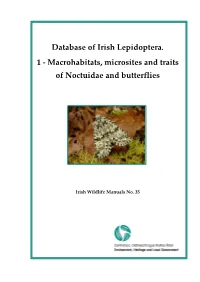
Database of Irish Lepidoptera. 1 - Macrohabitats, Microsites and Traits of Noctuidae and Butterflies
Database of Irish Lepidoptera. 1 - Macrohabitats, microsites and traits of Noctuidae and butterflies Irish Wildlife Manuals No. 35 Database of Irish Lepidoptera. 1 - Macrohabitats, microsites and traits of Noctuidae and butterflies Ken G.M. Bond and Tom Gittings Department of Zoology, Ecology and Plant Science University College Cork Citation: Bond, K.G.M. and Gittings, T. (2008) Database of Irish Lepidoptera. 1 - Macrohabitats, microsites and traits of Noctuidae and butterflies. Irish Wildlife Manual s, No. 35. National Parks and Wildlife Service, Department of the Environment, Heritage and Local Government, Dublin, Ireland. Cover photo: Merveille du Jour ( Dichonia aprilina ) © Veronica French Irish Wildlife Manuals Series Editors: F. Marnell & N. Kingston © National Parks and Wildlife Service 2008 ISSN 1393 – 6670 Database of Irish Lepidoptera ____________________________ CONTENTS CONTENTS ........................................................................................................................................................1 ACKNOWLEDGEMENTS ....................................................................................................................................1 INTRODUCTION ................................................................................................................................................2 The concept of the database.....................................................................................................................2 The structure of the database...................................................................................................................2 -
MOTH CHECKLIST Species Listed Are Those Recorded on the Wetland to Date
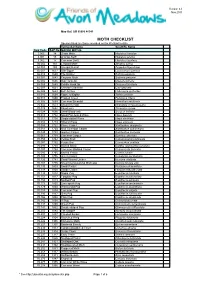
Version 4.0 Nov 2015 Map Ref: SO 95086 46541 MOTH CHECKLIST Species listed are those recorded on the Wetland to date. Vernacular Name Scientific Name New Code B&F No. MACRO MOTHS 3.005 14 Ghost Moth Hepialus humulae 3.001 15 Orange Swift Hepialus sylvina 3.002 17 Common Swift Hepialus lupulinus 50.002 161 Leopard Moth Zeuzera pyrina 54.008 169 Six-spot Burnet Zygaeba filipendulae 66.007 1637 Oak Eggar Lasiocampa quercus 66.010 1640 The Drinker Euthrix potatoria 68.001 1643 Emperor Moth Saturnia pavonia 65.002 1646 Oak Hook-tip Drepana binaria 65.005 1648 Pebble Hook-tip Drepana falcataria 65.007 1651 Chinese Character Cilix glaucata 65.009 1653 Buff Arches Habrosyne pyritoides 65.010 1654 Figure of Eighty Tethia ocularis 65.015 1660 Frosted Green Polyploca ridens 70.305 1669 Common Emerald Hermithea aestivaria 70.302 1673 Small Emerald Hemistola chrysoprasaria 70.029 1682 Blood-vein Timandra comae 70.024 1690 Small Blood-vein Scopula imitaria 70.013 1702 Small Fan-footed Wave Idaea biselata 70.011 1708 Single-dotted Wave Idaea dimidiata 70.016 1713 Riband Wave Idaea aversata 70.053 1722 Flame Carpet Xanthorhoe designata 70.051 1724 Red Twin-spot Carpet Xanthorhoe spadicearia 70.049 1728 Garden Carpet Xanthorhoe fluctuata 70.061 1738 Common Carpet Epirrhoe alternata 70.059 1742 Yellow Shell Camptogramma bilineata 70.087 1752 Purple Bar Cosmorhoe ocellata 70.093 1758 Barred Straw Eulithis (Gandaritis) pyraliata 70.097 1764 Common Marbled Carpet Chloroclysta truncata 70.085 1765 Barred Yellow Cidaria fulvata 70.100 1776 Green Carpet Colostygia pectinataria 70.126 1781 Small Waved Umber Horisme vitalbata 70.107 1795 November/Autumnal Moth agg Epirrita dilutata agg. -

Magyar Közlöny 128
MAGYAR KÖZLÖNY 128. szám MAGYARORSZÁG HIVATALOS LAPJA 2012. szeptember 28., péntek Tartalomjegyzék 2012. évi CXXXVIII. törvény A személyi jövedelemadó meghatározott részének az adózó rendelkezése szerinti felhasználásáról szóló 1996. évi CXXVI. törvény, valamint a magyar hõsök emlékének megörökítésérõl és a Magyar Hõsök Emlékünnepérõl szóló 2001. évi LXIII. törvény módosításáról 20726 2012. évi CXXXIX. törvény Magyarország 2012. évi központi költségvetésérõl szóló 2011. évi CLXXXVIII. törvény módosításáról 20728 2012. évi CXL. törvény Egyes közjogi méltóságok halála esetén járó hozzátartozói nyugellátásokkal összefüggõ törvényi rendelkezések módosításáról 20728 272/2012. (IX. 28.) Korm. Egyes foglalkoztatási tárgyú kormányrendeletek módosításáról 20729 rendelet 273/2012. (IX. 28.) Korm. A közszolgálati tisztviselõk továbbképzésérõl 20735 rendelet 274/2012. (IX. 28.) Korm. A rendészeti alapvizsgáról és a rendészeti szakvizsgáról, a Rendészeti Alap- rendelet és Szakvizsga Bizottságról, valamint a rendészeti alapvizsga vizsgabiztosi és a rendészeti szakvizsga vizsgabizottsági névjegyzékrõl 20746 275/2012. (IX. 28.) Korm. Az Országgyûlési Õrséggel összefüggésben egyes kormányrendeletek, rendelet valamint az országos településrendezési és építési követelményekrõl szóló 253/1997. (XII. 20.) Korm. rendelet módosításáról 20779 276/2012. (IX. 28.) Korm. A Kristályház Korlátolt Felelõsségû Társaságnak a csõdeljárásról és a rendelet felszámolási eljárásról szóló törvény szerinti stratégiailag kiemelt jelentõségû gazdálkodó szervezetté minõsítésérõl 20781 277/2012. (IX. 28.) Korm. Az állami olimpiai jutalomról szóló 241/2012. (VIII. 30.) Korm. rendelet rendelet módosításáról 20782 278/2012. (IX. 28.) Korm. A mezõgazdasági és vidékfejlesztési támogatási szerv kijelölésérõl szóló rendelet 154/2011. (VIII. 10.) Korm. rendelet módosításáról 20783 279/2012. (IX. 28.) Korm. Az Országos Statisztikai Adatgyûjtési Program adatgyûjtéseirõl és rendelet adatátvételeirõl szóló 288/2009. (XII. 15.) Korm. rendelet és a statisztikáról szóló 1993. évi XLVI.