Star Formation Rates in Nearby Markarian Galaxies
Total Page:16
File Type:pdf, Size:1020Kb
Load more
Recommended publications
-

Marat Arakelian: Life and Scientific Activity 0.7 MB
Communications of BAO, Vol. 66, Issue 2, 2019, pp. 112-120 Marat Arakelian: Life and Scientific Activity A. M. Mickaelian∗ NAS RA Byurakan Astrophysical Observatory (BAO), Byurakan 0213, Aragatzotn Province, Armenia Abstract We review the life and scientific activity of one of the outstanding Armenian astronomers Marat Arakelian (1929-1983). Arakelian was one of the prominent Byurakan astronomers, the author of famous Arakelian galaxies, which at present are target for many-sided studies with ground-based and space telescopes. Arakelian is known as a distinguished specialist in the theoretical astrophysics and extragalactic astronomy. Keywords: active galaxies, AGN, Starburst Galaxies, quasars, Seyfert galaxies, LINERs Introduction Prof. Arakelian is one of the prominent Byurakan astronomers, the author of famous Arakelian galaxies, which at present are target for many-sided studies with ground-based and space telescopes. Arakelian is known as a distinguished specialist in the theoretical astrophysics and extragalactic as- tronomy. Life and Activities Marat Arsen Arakelian was born on January 15, 1929, in Goris, Armenia, USSR. He studied at the Physical-Mathematical Department of the Yerevan State University (YSU) and graduated from ∗aregmick@yahoo.com, Corresponding author A. M. Mickaelian 112 DOI: 10.52526/25792776-2019.66.2-112 Marat Arakelian: Life and Scientific Activity it in 1951, among the first students specialized on Astrophysics. He was directed to the Byurakan Astrophysical Observatory (BAO), where he worked first as assistant astronomer, and later as junior research associate. Soon he became a postgraduate student at the Leningrad State University (LSU, presently, St. Petersburg), finished the studies in 1955, and in 1956 successfully passed his Ph.D. -
And Ecclesiastical Cosmology
GSJ: VOLUME 6, ISSUE 3, MARCH 2018 101 GSJ: Volume 6, Issue 3, March 2018, Online: ISSN 2320-9186 www.globalscientificjournal.com DEMOLITION HUBBLE'S LAW, BIG BANG THE BASIS OF "MODERN" AND ECCLESIASTICAL COSMOLOGY Author: Weitter Duckss (Slavko Sedic) Zadar Croatia Pусскй Croatian „If two objects are represented by ball bearings and space-time by the stretching of a rubber sheet, the Doppler effect is caused by the rolling of ball bearings over the rubber sheet in order to achieve a particular motion. A cosmological red shift occurs when ball bearings get stuck on the sheet, which is stretched.“ Wikipedia OK, let's check that on our local group of galaxies (the table from my article „Where did the blue spectral shift inside the universe come from?“) galaxies, local groups Redshift km/s Blueshift km/s Sextans B (4.44 ± 0.23 Mly) 300 ± 0 Sextans A 324 ± 2 NGC 3109 403 ± 1 Tucana Dwarf 130 ± ? Leo I 285 ± 2 NGC 6822 -57 ± 2 Andromeda Galaxy -301 ± 1 Leo II (about 690,000 ly) 79 ± 1 Phoenix Dwarf 60 ± 30 SagDIG -79 ± 1 Aquarius Dwarf -141 ± 2 Wolf–Lundmark–Melotte -122 ± 2 Pisces Dwarf -287 ± 0 Antlia Dwarf 362 ± 0 Leo A 0.000067 (z) Pegasus Dwarf Spheroidal -354 ± 3 IC 10 -348 ± 1 NGC 185 -202 ± 3 Canes Venatici I ~ 31 GSJ© 2018 www.globalscientificjournal.com GSJ: VOLUME 6, ISSUE 3, MARCH 2018 102 Andromeda III -351 ± 9 Andromeda II -188 ± 3 Triangulum Galaxy -179 ± 3 Messier 110 -241 ± 3 NGC 147 (2.53 ± 0.11 Mly) -193 ± 3 Small Magellanic Cloud 0.000527 Large Magellanic Cloud - - M32 -200 ± 6 NGC 205 -241 ± 3 IC 1613 -234 ± 1 Carina Dwarf 230 ± 60 Sextans Dwarf 224 ± 2 Ursa Minor Dwarf (200 ± 30 kly) -247 ± 1 Draco Dwarf -292 ± 21 Cassiopeia Dwarf -307 ± 2 Ursa Major II Dwarf - 116 Leo IV 130 Leo V ( 585 kly) 173 Leo T -60 Bootes II -120 Pegasus Dwarf -183 ± 0 Sculptor Dwarf 110 ± 1 Etc. -

12 Strong Gravitational Lenses
12 Strong Gravitational Lenses Phil Marshall, MaruˇsaBradaˇc,George Chartas, Gregory Dobler, Ard´ısEl´ıasd´ottir,´ Emilio Falco, Chris Fassnacht, James Jee, Charles Keeton, Masamune Oguri, Anthony Tyson LSST will contain more strong gravitational lensing events than any other survey preceding it, and will monitor them all at a cadence of a few days to a few weeks. Concurrent space-based optical or perhaps ground-based surveys may provide higher resolution imaging: the biggest advances in strong lensing science made with LSST will be in those areas that benefit most from the large volume and the high accuracy, multi-filter time series. In this chapter we propose an array of science projects that fit this bill. We first provide a brief introduction to the basic physics of gravitational lensing, focusing on the formation of multiple images: the strong lensing regime. Further description of lensing phenomena will be provided as they arise throughout the chapter. We then make some predictions for the properties of samples of lenses of various kinds we can expect to discover with LSST: their numbers and distributions in redshift, image separation, and so on. This is important, since the principal step forward provided by LSST will be one of lens sample size, and the extent to which new lensing science projects will be enabled depends very much on the samples generated. From § 12.3 onwards we introduce the proposed LSST science projects. This is by no means an exhaustive list, but should serve as a good starting point for investigators looking to exploit the strong lensing phenomenon with LSST. -
Radio Investigations of Clusters of Galaxies
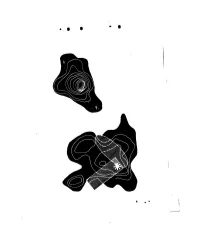
• • RADIO INVESTIGATIONS OF CLUSTERS OF GALAXIES a study of radio luminosity functions, wide-angle head-tailed radio galaxies and cluster radio haloes with the Westerbork Synthesis Radio Telescope proefschrift ter verkrijging van degraad van Doctor in de Wiskunde en Natuurwetenschappen aan de Rijksuniversiteit te Leiden, op gezag van de Rector Magnificus Or. D.J. Kuenen, hoogleraar in de Faculteit der Wiskunde en Natuurwetenschappen, volgens besluit van het College van Dekanen te verdedigen op woensdag 20 december 1978 teklokke 15.15 uur door Edwin Auguste Valentijn geboren te Voorburg in 1952 Sterrewacht Leiden 1978 elve/labor vincit - Leiden Promotor: Prof. Dr. H. van der Laan aan Josephine aan mijn ouders Cover: Some radio contours (1415 MHz) of the extended radio galaxies NGC6034, NGC6061 and 1B00+1SW2 superimposed to a smoothed galaxy distribution (number of galaxies per unit area, taken from Shane) of the Hercules Superoluster. The 90 % confidence error boxes of the Ariel VandUHURU observations of the X-ray source A1600+16 are also included. In the region of overlap of these two error boxes the position of a oD galaxy is indicated. The combined picture suggests inter-galactic material pervading the whole superaluster. CONTENTS CHAPTER 1 GENERAL INTRODUCTION AND SUMMARY 9 PART 1 OBSERVATIONS OF THE COI1A CLUSTER AT 610 MHZ 15 CHAPTER 2 COMA CLUSTER GALAXIES 17 Observation of the Coma Cluster at 610 MHz (Paper III, with W.J. Jaffe and G.C. Perola) I Introduction 17 II Observations 18 III Data Reduction 18 IV Radio Source Parameters 19 V Optical Data 20 VI The Radio Luminosity Function of the Coma Cluster Galaxies 21 a) LF of the (E+SO) Galaxies 23 b) LF of the (S+I) Galaxies 25 c) Radial Dependence of the LF 26 VII Other Properties of the Detected Cluster Galaxies 26 a) Spectral Indexes b) Emission Lines VIII The Central Radio Sources 27 a) 5C4.85 = NGC4874 27 b) 5C4.8I - NGC4869 28 c) Coma C 29 CHAPTER 3 RADIO SOURCES IN COMA NOT IDENTIFIED WITH CLUSTER GALAXIES 31 Radio Data and Identifications (Paper IV, with G.C. -

Dust and CO Emission Towards the Centers of Normal Galaxies, Starburst Galaxies and Active Galactic Nuclei, I
A&A 462, 575–579 (2007) Astronomy DOI: 10.1051/0004-6361:20047017 & c ESO 2007 Astrophysics Dust and CO emission towards the centers of normal galaxies, starburst galaxies and active galactic nuclei, I. New data and updated catalogue M. Albrecht1,E.Krügel2, and R. Chini3 1 Instituto de Astronomía, Universidad Católica del Norte, Avenida Angamos 0610, Antofagasta, Chile e-mail: malbrecht@ucn.cl 2 Max-Planck-Institut für Radioastronomie (MPIfR), Auf dem Hügel 69, 53121 Bonn, Germany 3 Astronomisches Institut der Ruhr-Universität Bochum (AIRUB), Universitätsstr. 150 NA7, 44780 Bochum, Germany Received 6 January 2004 / Accepted 27 October 2006 ABSTRACT Aims. The amount of interstellar matter in a galaxy determines its evolution, star formation rate and the activity phenomena in the nucleus. We therefore aimed at obtaining a data base of the 12CO line and thermal dust emission within equal beamsizes for galaxies in a variety of activity stages. Methods. We have conducted a search for the 12CO (1–0) and (2–1) transitions and the continuum emission at 1300 µmtowardsthe centers of 88 galaxies using the IRAM 30 m telescope (MRT) and the Swedish ESO Submillimeter Telescope (SEST). The galaxies > are selected to be bright in the far infrared (S 100 µm ∼ 9 Jy) and optically fairly compact (D25 ≤ 180 ). We have applied optical spectroscopy and IRAS colours to group the galaxies of the entire sample according to their stage of activity into three sub-samples: normal, starburst and active galactic nuclei (AGN). The continuum emission has been corrected for line contamination and synchrotron contribution to retrieve the thermal dust emission. -
The Assembly of the First Massive Black Holes Arxiv:1911.05791V1
The Assembly of the First Massive Black Holes Kohei Inayoshi,1 Eli Visbal,2 and Zolt´an Haiman3 1Kavli Institute for Astronomy and Astrophysics, Peking University, Beijing 100871, China; email: inayoshi@pku.edu.cn 2Department of Physics & Astronomy, University of Toledo, Toledo, Ohio 43606; email: Elijah.Visbal@utoledo.edu 3Department of Astronomy, Columbia University, New York, NY 10027; email: zoltan@astro.columbia.edu Annu. Rev. Astron. Astrophys. 2019. Keywords 58:1{79 black holes, cosmology, first galaxies, active galactic nuclei, quasars https://doi.org/10.1146/(please add article doi) Abstract Copyright c 2019 by Annual Reviews. All rights reserved 9 The existence of ∼10 M supermassive black holes (SMBHs) within the first billion year of the universe has stimulated numerous ideas for the prompt formation and rapid growth of BHs in the early universe. Here we review ways in which the seeds of massive BHs may have first assembled, how they may have subsequently grown as massive as 9 ∼10 M , and how multi-messenger observations could distinguish be- tween different SMBH assembly scenarios. We conclude the following: 9 • The ultra-rare ∼10 M SMBHs represent only the tip of the iceberg. Early BHs likely fill a continuum from stellar-mass (∼ 10 M ) to the super-massive (∼ 109) regime, reflecting a range of initial masses and growth histories. • Stellar-mass BHs were likely left behind by the first generation of stars at redshifts as high as ∼ 30, but their initial growth was typically stunted due to the shallow potential wells of their host galaxies. arXiv:1911.05791v1 [astro-ph.GA] 13 Nov 2019 • Conditions in some larger, metal-poor galaxies soon became conducive to the rapid formation and growth of massive `seed' holes, via gas accretion and by mergers in dense stellar clusters. -
Markarian Survey and Markarian Galaxies Areg M
Multiwavelength AGN Surveys and Studies Proceedings IAU Symposium No. 304, 2013 c International Astronomical Union 2014 A. M. Mickaelian & D. B. Sanders, eds. doi:10.1017/S1743921314003147 Markarian survey and Markarian galaxies Areg M. Mickaelian Byurakan Astrophysical Observatory (BAO), Byurakan 0213, Aragatzotn province, Armenia E-mail: aregmick@yahoo.com Abstract. Markarian survey (or the First Byurakan Survey, FBS) was the first systematic survey for active galaxies and was a new method for search for such objects. Until now, it is the largest objective prism survey of the sky (17,000 deg2 ). It was carried out in 1965–1980 by B. E. Markarian and his colleagues and resulted in discovery of 1517 UV-excess (Markarian) galaxies. They contain many active galaxies, as well as powerful gamma-, X-ray, IR and radio sources (Mrk 180, 231, 421, 501, etc.), BCDGs (Mrk 116) and interacting/merging systems (Mrk 266, 273, etc.). They led to the classification of Seyfert galaxies into Sy1 and Sy2 and the definition of Starbursts (SB). Several catalogs of Markarian galaxies have been published (Mazzarella & Balzano 1986; Markarian et al. 1989; Bicay et al. 1995; Petrosian et al. 2007) and they are accessible in all corresponding databases. Markarian survey also served as a basis for search for UVX stellar objects (including QSOs and Seyferts), late-type stars and optical identification of IR sources. At present the survey is digitized and DFBS database is available. I will review the main characteristics of the Markarian survey, its comparison with other similar surveys and the importance of Markarian galaxies in modern astrophysics. Keywords. -
Near Infrared Observations of Quasars with Extended Ionized Envelopes
A&A manuscript no. ASTRONOMY (will be inserted by hand later) AND Your thesaurus codes are: 11.01.2; 11.06.2; 11.09.2; 11.16.1; 11.17.3; 13.09.1 ASTROPHYSICS Near infrared observations of quasars with extended ionized envelopes ⋆ I. M´arquez1,2, F. Durret2,3, and P. Petitjean2,3 1 Instituto de Astrof´ısica de Andaluc´ıa (C.S.I.C.), Apartado 3004 , E-18080 Granada, Spain 2 Institut d’Astrophysique de Paris, CNRS, 98bis Bd Arago, F-75014 Paris, France 3 DAEC, Observatoire de Paris, Universit´eParis VII, CNRS (UA 173), F-92195 Meudon Cedex, France Received, ; accepted, Abstract. We have observed a sample of 15 and 8 1. Introduction quasars with redshifts between 0.11 and 0.87 (mean value 0.38) in the J and K’ bands respectively. Eleven of the Attempts to understand properties of active galactic nu- quasars were previously known to be associated with ex- clei (AGN) and their cosmological evolution has led to the tended emission line regions. After deconvolution of the conclusion that the AGN activity as a whole is most likely image, substraction of the PSF when possible, and identi- to be described as a succession of episodic and time lim- fication of companions with the help of HST archive im- ited events happening in most if not all galaxies (Cavaliere ages when available, extensions are seen for at least eleven & Padovani 1989, Collin-Souffrin 1991). The most plausi- quasars. However, average profiles are different from that ble explanation for the onset of activity is fuelling of the of the PSF in only four objects, for which a good fit is nucleus by gas streaming towards the center of the galaxy obtained with an r1/4 law, suggesting that the underlying as a result of interaction, accretion or merging events. -

V·M·I University Microfilms International a Bell & Howell Informal Ion Company 300 North Zeeb Road
Near-infrared properties of quasar and Seyfert host galaxies. Item Type text; Dissertation-Reproduction (electronic) Authors McLeod, Kim Katris. Publisher The University of Arizona. Rights Copyright © is held by the author. Digital access to this material is made possible by the University Libraries, University of Arizona. Further transmission, reproduction or presentation (such as public display or performance) of protected items is prohibited except with permission of the author. Download date 26/09/2021 16:45:20 Link to Item http://hdl.handle.net/10150/186821 INFORMATION TO USERS This manuscript has been reproduced from the microfilm master. UMI films the text directly from the original or copy submitted. Thus, some thesis and dissertation copies are in typewriter face, while others may be from any type of computer printer. The quality of this reproduction is dependent upon the quality of the copy submitted. Broken or indistinct print, colored or poor quality illustrations and photographs, print bleedthrough, substandard margins, and improper alignment can adversely affect reproduction. In the unlikely. event that the author did not send UMI a complete manuscript and there are missing pages, these will be noted. Also, if unauthorized copyright material had to be removed, a note will indicate the deletion. Oversize materials (e.g., maps, drawings, charts) are reproduced by sectioning the original, beginning at the upper left-hand corner and continuing from left to right in equal sections with small overlaps. Each original is also photographed in one exposure and is included in reduced form at the back of the book. Photographs included in the original manuscript have been reproduced xerographically in this copy. -
The AIMSS Project – I. Bridging the Star Cluster–Galaxy Divide †‡§¶
MNRAS 443, 1151–1172 (2014) doi:10.1093/mnras/stu1186 ? The AIMSS Project – I. Bridging the star cluster–galaxy divide †‡§¶ Mark A. Norris,1,2k Sheila J. Kannappan,2 Duncan A. Forbes,3 Aaron J. Romanowsky,4,5 Jean P. Brodie,5 Favio Raul´ Faifer,6,7 Avon Huxor,8 Claudia Maraston,9 Amanda J. Moffett,2 Samantha J. Penny,10 Vincenzo Pota,3 Anal´ıa Smith-Castelli,6,7 Jay Strader,11 David Bradley,2 Kathleen D. Eckert,2 Dora Fohring,12,13 JoEllen McBride,2 David V. Stark2 and Ovidiu Vaduvescu12 Downloaded from https://academic.oup.com/mnras/article-abstract/443/2/1151/1058316 by guest on 04 September 2019 Affiliations are listed at the end of the paper Accepted 2014 June 16. Received 2014 May 13; in original form 2014 January 27 ABSTRACT We describe the structural and kinematic properties of the first compact stellar systems dis- covered by the Archive of Intermediate Mass Stellar Systems project. These spectroscopically 6 confirmed objects have sizes (∼6 < Re [pc] < 500) and masses (∼2 × 10 < M∗/M¯ < 6 × 10⁹) spanning the range of massive globular clusters, ultracompact dwarfs (UCDs) and compact elliptical galaxies (cEs), completely filling the gap between star clusters and galax- ies. Several objects are close analogues to the prototypical cE, M32. These objects, which are more massive than previously discovered UCDs of the same size, further call into question the existence of a tight mass–size trend for compact stellar systems, while simultaneously strengthening the case for a universal ‘zone of avoidance’ for dynamically hot stellar systems in the mass–size plane. -

Servatory, the University of Arizona (Tucson, Arizona)
Investigation of the Cancer Cluster of Galaxies Item Type text Authors Tifft, W. G.; Jewsbury, C. P.; Sargent, T. A. Citation APJ 185: 115-119 (1973) Publisher Steward Observatory, The University of Arizona (Tucson, Arizona) Rights Copyright © All Rights Reserved. Download date 24/09/2021 14:33:29 Link to Item http://hdl.handle.net/10150/627247 iVilli /YWVV i'M/ W4W ///VV,W///////W/W/V//VYiiiiW/A. /VY/ Ae// WA/M/ iiiJW/ A// W//ViiiiiiiiiiiiiW//WV/A,WVWVAi YVWYZ///A VY:eAeW/VMA,WV,"/A ie/ZAI VW"/iiiii REPRINTS OF THE STEWARD O . SERVATORY THE UNIVERSITY OF ARIZONA TUCSON, ARIZONA 85721, U.S.A. //, / /,,, / /, /, / / // // /,,, / // / / // /, /, /,,, / / //, / / / // /, / /, // / / /, / / / / /, // /// / / / // / / / / // / / / /,,,, / // / / / / / / / /, / // / / /,,,, / / //, / /, /, //, /, / /, / / /, /,/ // // // / /, /,,,,,, / / 4 4/ A A A A , PREPRINT NO. 58 INVESTIGATION OF THE CANCER CLUSTER OF GALAXIES W. G. Tifft, C. P. Jewsbury, and T. A. Sargent Steward Observatory University of Arizona Tucson, Arizona 85721 Received 1973 April ABSTRACT Redshifts for nine galaxies in the center of the Cancer cluster are reported. Four show emission lines and one of these galaxies is a high excitation peculiar object showing a distorted dust lane and "jet" or edge -on disc structure. A conventional virial theorem analysis of the cluster indicates a total cluster mass near 1014Mo and suggests that the usual instability problem found in galaxy clusters is present. INTRODUCTION The Cancer cluster of galaxies has been described by Zwicky (1957) as a spherically symmetric, small to medium size aggregation of appar- ent diameter 7° with 300 members in the magnitude range 13.8<m <18.2. This paper contains the results of a spectroscopic investigation of nine galaxies in the central region of the cluster and a discussion of other data available in the region. -
The Structure & Stellar Populations of Nuclear Star Clusters in Late-Type
UC Irvine UC Irvine Electronic Theses and Dissertations Title The Structure and Stellar Populations of Nuclear Star Clusters in Late-Type Spiral Galaxies Permalink https://escholarship.org/uc/item/3634g66n Author Carson, Daniel James Publication Date 2016 Peer reviewed|Thesis/dissertation eScholarship.org Powered by the California Digital Library University of California UNIVERSITY OF CALIFORNIA, IRVINE The Structure & Stellar Populations of Nuclear Star Clusters in Late-Type Spiral Galaxies DISSERTATION submitted in partial satisfaction of the requirements for the degree of DOCTOR OF PHILOSOPHY in Physics by Daniel J. Carson Dissertation Committee: Professor Aaron Barth, Chair Associate Professor Michael Cooper Professor James Bullock 2016 Portion of Chapter 1 c 2015 The Astronomical Journal Chapter 2 c 2015 The Astronomical Journal Chapter 3 c 2015 The Astronomical Journal Portion of Chapter 5 c 2015 The Astronomical Journal All other materials c 2016 Daniel J. Carson TABLE OF CONTENTS Page LIST OF FIGURES iv LIST OF TABLES vi ACKNOWLEDGMENTS vii CURRICULUM VITAE viii ABSTRACT OF THE DISSERTATION x 1 Introduction 1 2 HST /WFC3 data 9 2.1 SampleSelection ................................. 9 2.2 DescriptionofObservations . 10 2.3 DataReduction.................................. 14 3 Analysis of Structural Properties 17 3.1 Surface Brightness Profile Fitting . 17 3.1.1 PSFModels................................ 18 3.1.2 FittingMethod .............................. 19 3.1.3 Comparison with ISHAPE ......................... 21 3.1.4 1DRadialProfiles ............................ 22 3.1.5 Uncertainties in Cluster Parameters . 25 3.2 Results....................................... 29 3.2.1 SingleBandResults ........................... 29 3.2.2 PanchromaticResults........................... 40 3.2.3 Stellar Populations . 46 3.3 CommentsonIndividualObjects . 51 3.3.1 IC342................................... 51 3.3.2 M33 ...................................