The Soviet General Staff : Antecedents and Current Organizatio N
Total Page:16
File Type:pdf, Size:1020Kb
Load more
Recommended publications
-
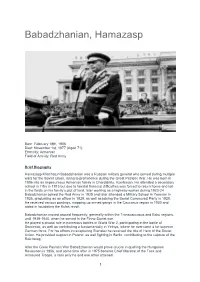
Babadzhanian, Hamazasp
Babadzhanian, Hamazasp Born: February 18th, 1906 Died: November 1st, 1977 (Aged 71) Ethnicity: Armenian Field of Activity: Red Army Brief Biography Hamazasp Khachaturi Babadzhanian was a Russian military general who served during multiple wars for the Soviet Union, rising to prominence during the Great Patriotic War. He was born in 1906 into an impecunious Armenian family in Chardakhlu, Azerbaijan. He attended a secondary school in Tiflis in 1915 but due to familial financial difficulties was forced to return home and toil in the fields on his family’s plot of land, later working as a highway worker during 1923-24. Babadzhanian joined the Red Army in 1925 and later attended a Military School in Yerevan in 1926, graduating as an officer in 1929, as well as joining the Soviet Communist Party in 1928. He received various postings, mopping up armed gangs in the Caucasus region in 1930 and aided in liquidating the Kulak revolt. Babadzhanian moved around frequently, generally within the Transcaucasus and Baku regions, until 1939-1940, when he served in the Finno-Soviet war. He played a pivotal role in numerous battles in World War 2, participating in the battle of Smolensk, as well as contributing a fundamentally in Yelnya, where he overcame a far superior German force. For his efforts in recapturing Stanslav he received the title of Hero of the Soviet Union. He provided support in Poland, as well fighting in Berlin, contributing to the capture of the Reichstag. After the Great Patriotic War Babadzhanian would prove crucial in quelling the Hungarian Revolution in 1956, and some time after in 1975 became Chief Marshal of the Tank and Armoured Troops, a rank only he and one other attained. -
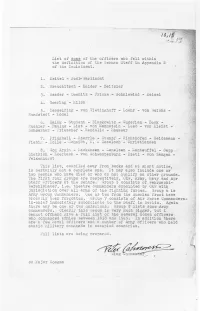
List of Some of the Officers ~~10 Fall Within the Definition of the German
-------;-:-~---,-..;-..............- ........- List of s ome of t he officers ~~10 fall within t he de finition of t he German St af f . in Appendix B· of t he I n cii c tment . 1 . Kei t e l - J odl- Aar l imont 2 . Br auchi t s ch - Halder - Zei t zl er 3. riaeder - Doeni t z - Fr i cke - Schni ewi nd - Mei s el 4. Goer i ng - fu i l ch 5. Kes s el r i ng ~ von Vi et i nghof f - Loehr - von ~e i c h s rtun c1 s t ec t ,.. l.io d eL 6. Bal ck - St ude nt - Bl a skowi t z - Gud er i an - Bock Kuchl er - Pa ul us - Li s t - von Manns t ei n - Leeb - von Kl e i ~ t Schoer ner - Fr i es sner - Rendul i c - Haus s er 7. Pf l ug bei l - Sper r l e - St umpf - Ri cht hof en - Sei a emann Fi ebi £; - Eol l e - f)chmi dt , E .- Des s l och - .Christiansen 8 . Von Arni m - Le ck e ris en - :"emelsen - l.~ a n t e u f f e l - Se pp . J i et i i ch - 1 ber ba ch - von Schweppenburg - Di e t l - von Zang en t'al kenhol's t rr hi s' list , c ompiled a way f r om books and a t. shor t notice, is c ertai nly not a complete one . It may also include one or t .wo neop .le who have ai ed or who do not q ual ify on other gr ounds . -
Assessing the Implications of Possible Changes to Women in Service Restrictions: Practices of Foreign Militaries and Other Organizations
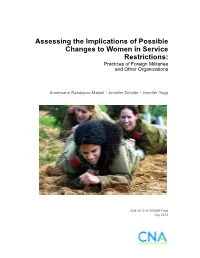
Assessing the Implications of Possible Changes to Women in Service Restrictions: Practices of Foreign Militaries and Other Organizations Annemarie Randazzo-Matsel • Jennifer Schulte • Jennifer Yopp DIM-2012-U-000689-Final July 2012 Photo credit line: Young Israeli women undergo tough, initial pre-army training at Zikim Army Base in southern Israel. REUTERS/Nir Elias Approved for distribution: July 2012 Anita Hattiangadi Research Team Leader Marine Corps Manpower Team Resource Analysis Division This document represents the best opinion of CNA at the time of issue. It does not necessarily represent the opinion of the Department of the Navy. Cleared for Public Release; Distribution Unlimited. Specific authority: N00014-11-D-0323. Copies of this document can be obtained through the CNA Document Control and Distribution Section at 703-824-2123. Copyright 2012 CNA This work was created in the performance of Federal Government Contract Number N00014-11-D-0323. Any copyright in this work is subject to the Government's Unlimited Rights license as defined in DFARS 252.227-7013 and/or DFARS 252.227-7014. The reproduction of this work for commercial purposes is strictly prohibited. Nongovernmental users may copy and distribute this document in any medium, either commercially or noncommercially, provided that this copyright notice is reproduced in all copies. Nongovernmental users may not use technical measures to obstruct or control the read-ing or further copying of the copies they make or distribute. Nongovernmental users may not accept compensation of any manner in exchange for copies. All other rights reserved. Contents Executive summary . 1 Foreign militaries . 3 Australia . 4 ADF composition . -

Aleksandr Sergeevich Lukomskii Papers
http://oac.cdlib.org/findaid/ark:/13030/kt9d5nc6t9 No online items Register of the Aleksandr Sergeevich Lukomskii Papers Hoover Institution Archives Stanford University Stanford, California 94305-6010 Phone: (650) 723-3563 Fax: (650) 725-3445 Email: hooverarchives@stanford.edu © 2003 Hoover Institution Archives. All rights reserved. Register of the Aleksandr 75008 1 Sergeevich Lukomskii Papers Register of the Aleksandr Sergeevich Lukomskii Papers Hoover Institution Archives Stanford University Stanford, California Contact Information Hoover Institution Archives Stanford University Stanford, California 94305-6010 Phone: (650) 723-3563 Fax: (650) 725-3445 Email: hooverarchives@stanford.edu Prepared by: Date Completed: Encoded by: ByteManagers using OAC finding aid conversion service specifications © 2003 Hoover Institution Archives. All rights reserved. Descriptive Summary Title: Aleksandr Sergeevich Lukomskii papers, Date (inclusive): 1914-1939 Collection number: 75008 Creator: Lukomskii, Aleksandr Sergeevich Extent: 4 manuscript boxes, 1 envelope(1.7 linear feet) Repository: Hoover Institution on War, Revolution, and Peace Stanford, California 94305-6010 Abstract: Correspondence, memoranda, reports, writings, notes, and printed matter, relating to Russian military operations during World War I, and to the Russian Civil War. Also available on microfilm (5 reels). Physical Location: Hoover Institution Archives Language: Russian. Access Collection is open for research. Publication Rights For copyright status, please contact the Hoover Institution -

Nigeria: the Challenge of Military Reform
Nigeria: The Challenge of Military Reform Africa Report N°237 | 6 June 2016 International Crisis Group Headquarters Avenue Louise 149 1050 Brussels, Belgium Tel: +32 2 502 90 38 Fax: +32 2 502 50 38 brussels@crisisgroup.org Table of Contents Executive Summary ................................................................................................................... i Recommendations..................................................................................................................... iii I. Introduction ..................................................................................................................... 1 II. The Long Decline .............................................................................................................. 3 A. The Legacy of Military Rule ....................................................................................... 3 B. The Military under Democracy: Failed Promises of Reform .................................... 4 1. The Obasanjo years .............................................................................................. 4 2. The Yar’Adua and Jonathan years ....................................................................... 7 3. The military’s self-driven attempts at reform ...................................................... 8 III. Dimensions of Distress ..................................................................................................... 9 A. The Problems of Leadership and Civilian Oversight ................................................ -

Conrad Von Hötzendorf and the “Smoking Gun”: a Biographical Examination of Responsibility and Traditions of Violence Against Civilians in the Habsburg Army 55
1914: Austria-Hungary, the Origins, and the First Year of World War I Günter Bischof, Ferdinand Karlhofer (Eds.) Samuel R. Williamson, Jr. (Guest Editor) CONTEMPORARY AUSTRIAN STUDIES | VOLUME 23 uno press innsbruck university press Copyright © 2014 by University of New Orleans Press, New Orleans, Louisiana, USA All rights reserved under International and Pan-American Copyright Conventions. No part of this book may be reproduced or transmitted in any form, or by any means, electronic or mechanical, including photocopy, recording, or any information storage and retrieval system, without prior permission in writing from the publisher. All inquiries should be addressed to UNO Press, University of New Orleans, LA 138, 2000 Lakeshore Drive. New Orleans, LA, 70119, USA. www.unopress.org. Printed in the United States of America Design by Allison Reu Cover photo: “In enemy position on the Piave levy” (Italy), June 18, 1918 WK1/ALB079/23142, Photo Kriegsvermessung 5, K.u.k. Kriegspressequartier, Lichtbildstelle Vienna Cover photo used with permission from the Austrian National Library – Picture Archives and Graphics Department, Vienna Published in the United States by Published and distributed in Europe University of New Orleans Press by Innsbruck University Press ISBN: 9781608010264 ISBN: 9783902936356 uno press Contemporary Austrian Studies Sponsored by the University of New Orleans and Universität Innsbruck Editors Günter Bischof, CenterAustria, University of New Orleans Ferdinand Karlhofer, Universität Innsbruck Assistant Editor Markus Habermann -

India's National Security Annual Review 2010
Downloaded by [University of Defence] at 01:22 24 May 2016 India’s National Security Annual Review 2010 Downloaded by [University of Defence] at 01:22 24 May 2016 216x138 HB + 8colour pages ii Ç India’s National Security This series, India’s National Security: Annual Review, was con- ceptualised in the year 2000 in the wake of India’s nuclear tests and the Kargil War in order to provide an in-depth and holistic assessment of national security threats and challenges and to enhance the level of national security consciousness in the country. The first volume was published in 2001. Since then, nine volumes have been published consecutively. The series has been supported by the National Security Council Secretariat and the Confederation of Indian Industry. Its main features include a review of the national security situation, an analysis of upcoming threats and challenges by some of the best minds in India, a periodic National Security Index of fifty top countries of the world, and a chronology of major events. It now serves as an indispensable source of information and analysis on critical national security issues of India. Downloaded by [University of Defence] at 01:22 24 May 2016 India’s National Security Annual Review 2010 Editor-in-Chief SATISH KUMAR Downloaded by [University of Defence] at 01:22 24 May 2016 LONDON NEW YORK NEW DELHI Under the auspices of Foundation for National Security Research, New Delhi First published 2011 in India by Routledge 912 Tolstoy House, 15–17 Tolstoy Marg, Connaught Place, New Delhi 110 001 Simultaneously published in the UK by Routledge 2 Park Square, Milton Park, Abingdon, Oxon, OX14 4RN Routledge is an imprint of the Taylor & Francis Group, an informa business Transferred to Digital Printing 2011 © 2010 Satish Kumar Typeset by Star Compugraphics Private Ltd D–156, Second Floor Sector 7, NOIDA 201 301 All rights reserved. -

Hybrid Threats in the 21St Century
Band 17 / 2016 Band 17 / 2016 Die Vernetzung von Gesellschaften wird durch technische Errungenschaften immer komplexer. Somit erweitern Century sich auch Einflussfaktoren auf die Sicherheit von Gesell- st schaftssystemen. Networked Insecurity – Spricht man in diesem Zusammenhang in sicherheits- politischen Fachkreisen von hybrider Kampfführung, ge- hen die Autoren in diesem Buch einen Schritt weiter und Hybrid Threats beschäftigen sich mit Optionen der Machtprojektion, die st über Kampfhandlungen hinausgehen. Dabei sehen sie in the 21 Century hybride Bedrohungen als sicherheitspolitische Herausfor- derung der Zukunft. Beispiele dazu untermauern den im Buch vorangestellten theoretischen Teil. Mögliche Hand- lungsoptionen runden diese Publikation ab. Networked Insecurity – Hybrid Threats in the 21 Threats – Hybrid Insecurity Networked ISBN: 978-3-903121-01-0 Anton Dengg and Michael Schurian (Eds.) 17/16 Schriftenreihe der Dengg, Schurian (Eds.) Dengg, Landesverteidigungsakademie Schriftenreihe der Landesverteidigungsakademie Anton Dengg, Michael Schurian (Eds.) Networked Insecurity – Hybrid Threats in the 21st Century 17/2016 Vienna, June 2016 Imprint: Copyright, Production, Publisher: Republic of Austria / Federal Ministry of Defence and Sports Rossauer Lände 1 1090 Vienna, Austria Edited by: National Defence Academy Institute for Peace Support and Conflict Management Stiftgasse 2a 1070 Vienna, Austria Schriftenreihe der Landesverteidigungsakademie Copyright © Republic of Austria / Federal Ministry of Defence and Sports All rights reserved -

Russian Origins of the First World War
The Russian Origins of the First World War The Russian Origins of the First World War Sean McMeekin The Belknap Press of Harvard University Press Cambridge, Massachusetts • London, Eng land 2011 Copyright © 2011 by Sean McMeekin All rights reserved Printed in the United States of America Library of Congress Cataloging-in- Publication Data McMeekin, Sean, 1974– The Russian origins of the First World War / Sean McMeekin. p. cm. Includes bibliographical references and index. ISBN 978-0-674-06210-8 (alk. paper) 1. World War, 1914–1918—Causes. 2. World War, 1914–1918—Russia. 3. Russia—Foreign relations—1894–1917. 4. Imperialism—History— 20th century. 5. World War, 1914–1918—Campaigns—Eastern Front. 6. World War, 1914–1918—Campaigns—Middle East. I. Title. D514.M35 2011 940.3'11—dc23 2011031427 For Ayla Contents Abbreviations ix Author’s Note xi Introduction: History from the Deep Freeze 1 1. The Strategic Imperative in 1914 6 2. It Takes Two to Tango: The July Crisis 41 3. Russia’s War: The Opening Round 76 4. Turkey’s Turn 98 5. The Russians and Gallipoli 115 6. Russia and the Armenians 141 7. The Russians in Persia 175 8. Partitioning the Ottoman Empire 194 9. 1917: The Tsarist Empire at Its Zenith 214 Conclusion: The October Revolution and Historical Amnesia 234 Notes 245 Bibliography 289 Acknowledgments 303 Index 307 Maps The Russian Empire on the Eve of World War I 8 The Polish Salient 18 The Peacetime Deployment of Russia’s Army Corps 20 The Initial Mobilization Pattern on the Eastern Front 83 Russian Claims on Austrian and German Territory 91 “The Straits,” and Russian Claims on Them 132 Russia and the Armenians 167 Persia and the Caucasian Front 187 The Partition of the Ottoman Empire 206 The Eastern Front 219 Abbreviations ATASE Askeri Tarih ve Stratejik Etüt Başkanlığı Arşivi (Archive of the Turkish Gen- eral Staff). -

DEPARTMENT of the ARMY the Pentagon, Washington, DC 20310 Phone (703) 695–2442
DEPARTMENT OF THE ARMY The Pentagon, Washington, DC 20310 phone (703) 695–2442 SECRETARY OF THE ARMY 101 Army Pentagon, Room 3E700, Washington, DC 20310–0101 phone (703) 695–1717, fax (703) 697–8036 Secretary of the Army.—Dr. Mark T. Esper. Executive Officer.—COL Joel Bryant ‘‘JB’’ Vowell. UNDER SECRETARY OF THE ARMY 102 Army Pentagon, Room 3E700, Washington, DC 20310–0102 phone (703) 695–4311, fax (703) 697–8036 Under Secretary of the Army.—Ryan D. McCarthy. Executive Officer.—COL Patrick R. Michaelis. CHIEF OF STAFF OF THE ARMY (CSA) 200 Army Pentagon, Room 3E672, Washington, DC 20310–0200 phone (703) 697–0900, fax (703) 614–5268 Chief of Staff of the Army.—GEN Mark A. Milley. Vice Chief of Staff of the Army.—GEN James C. McConville (703) 695–4371. Executive Officers: COL Milford H. Beagle, Jr., 695–4371; COL Joseph A. Ryan. Director of the CSA Staff Group.—COL Peter N. Benchoff, Room 3D654 (703) 693– 8371. Director of the Army Staff.—LTG Gary H. Cheek, Room 3E663, 693–7707. Sergeant Major of the Army.—SMA Daniel A. Dailey, Room 3E677, 695–2150. Directors: Army Protocol.—Michele K. Fry, Room 3A532, 692–6701. Executive Communications and Control.—Thea Harvell III, Room 3D664, 695–7552. Joint and Defense Affairs.—COL Anthony W. Rush, Room 3D644 (703) 614–8217. Direct Reporting Units Commanding General, U.S. Army Test and Evaluation Command.—MG John W. Charlton (443) 861–9954 / 861–9989. Superintendent, U.S. Military Academy.—LTG Robert L. Caslen, Jr. (845) 938–2610. Commanding General, U.S. Army Military District of Washington.—MG Michael L. -

Glantz Vol III Book 1 LATEST.Indd
© University Press of Kansas. All rights reserved. Reproduction and distribution prohibited without permission of the Press. Contents List of Maps, Tables, and Illustrations ix Preface xv Selected Abbreviations xxi Part I. Soviet Strategic Planning 1. Framework for Disaster 3 Frustration 3 The Wehrmacht in November 1942 8 German Field Commanders 11 The Red Army in November 1942 12 Soviet Field Commanders 15 2. Soviet Strategic Planning: The Genesis of Plan Uranus 20 Who Formulated Plan Uranus? The Historical Debate 20 Competing Offensive Concepts 23 Triumph of the “Different Solution,” 1–13 October 31 Plan Uranus Takes Shape, 14–31 October 38 Final Preparations, 1–18 November 41 Reflections 50 3. Gathering the Troops: Soviet Order of Battle and the Uranus Plan 55 Regrouping Forces for the Counteroffensive 55 Soviet Order of Battle 58 The Uranus Plan 79 Front and Army Plans 93 4. The Balance of Opposing Forces on 18 November 127 Soviet Forces 127 Axis Forces and Defenses 131 The Correlation of Opposing Forces 165 Part II. The Uranus Counteroffensive 5. The Penetration Battle, 19–20 November 185 Preliminaries 185 © University Press of Kansas. All rights reserved. Reproduction and distribution prohibited without permission of the Press. viii Contents The Southwestern and Don Fronts’ Offensive, 19–20 November 192 The Stalingrad Front’s Offensive, 20 November 248 6. The Encirclement Closes, 21–23 November 268 German Dilemmas on 21 November 268 The Southwestern and Don Fronts’ Offensive, 21 November 271 The Stalingrad Front’s Offensive, 21 November 288 The Southwestern and Don Fronts’ Offensive, 22 November 299 The Stalingrad Front’s Offensive, 22 November 323 The Southwestern and Don Fronts’ Offensive, 23 November 337 The Stalingrad Front’s Offensive, 23 November 358 The Situation Late on 23 November 369 German Dilemmas on 23 November 371 7. -

Soviet Blitzkrieg: the Battle for White Russia, 1944
EXCERPTED FROM Soviet Blitzkrieg: The Battle for White Russia, 1944 Walter S. Dunn, Jr. Copyright © 2000 ISBNs: 978-1-55587-880-1 hc 978-1-62637-976-3 pb 1800 30th Street, Suite 314 Boulder, CO 80301 USA telephone 303.444.6684 fax 303.444.0824 This excerpt was downloaded from the Lynne Rienner Publishers website www.rienner.com D-FM 11/29/06 5:06 PM Page vii CONTENTS List of Illustrations ix Preface xi Introduction 1 1 The Strategic Position 17 2 Comparison of German and Soviet Units 35 3 Rebuilding the Red Army and the German Army 53 4 The Production Battle 71 5 The Northern Shoulder 83 6 Vitebsk 95 7 Bogushevsk 117 8 Orsha 139 9 Mogilev 163 10 Bobruysk 181 11 The Southern Shoulder 207 12 Conclusion 221 Appendix: Red Army Reserves 233 Bibliography 237 Index 241 About the Book 249 vii D-Intro 11/29/06 5:08 PM Page 1 INTRODUCTION he Battle for White Russia erupted south of Vitebsk on the T morning of 22 June 1944, when Russian artillery began a thun- dering barrage of over a thousand guns, mortars, and rockets that blasted away for 2 hours and 20 minutes in an 18-kilometer-long sec- tor. At the same time a Soviet fighter corps, two bomber divisions, and a ground attack division pummeled the bunkers of General Pfeiffer’s VI Corps with bombs and strafed any foolhardy German troops in the trenches with machine gun fire. The sheer weight of explosives that rained down on the German dugouts and bunkers paralyzed the defenders, especially the new replacements who had arrived during the previous few months.