Diptera) Associated with Animal and Human Decomposition in the Czech Republic
Total Page:16
File Type:pdf, Size:1020Kb
Load more
Recommended publications
-

ARTHROPODA Subphylum Hexapoda Protura, Springtails, Diplura, and Insects
NINE Phylum ARTHROPODA SUBPHYLUM HEXAPODA Protura, springtails, Diplura, and insects ROD P. MACFARLANE, PETER A. MADDISON, IAN G. ANDREW, JOCELYN A. BERRY, PETER M. JOHNS, ROBERT J. B. HOARE, MARIE-CLAUDE LARIVIÈRE, PENELOPE GREENSLADE, ROSA C. HENDERSON, COURTenaY N. SMITHERS, RicarDO L. PALMA, JOHN B. WARD, ROBERT L. C. PILGRIM, DaVID R. TOWNS, IAN McLELLAN, DAVID A. J. TEULON, TERRY R. HITCHINGS, VICTOR F. EASTOP, NICHOLAS A. MARTIN, MURRAY J. FLETCHER, MARLON A. W. STUFKENS, PAMELA J. DALE, Daniel BURCKHARDT, THOMAS R. BUCKLEY, STEVEN A. TREWICK defining feature of the Hexapoda, as the name suggests, is six legs. Also, the body comprises a head, thorax, and abdomen. The number A of abdominal segments varies, however; there are only six in the Collembola (springtails), 9–12 in the Protura, and 10 in the Diplura, whereas in all other hexapods there are strictly 11. Insects are now regarded as comprising only those hexapods with 11 abdominal segments. Whereas crustaceans are the dominant group of arthropods in the sea, hexapods prevail on land, in numbers and biomass. Altogether, the Hexapoda constitutes the most diverse group of animals – the estimated number of described species worldwide is just over 900,000, with the beetles (order Coleoptera) comprising more than a third of these. Today, the Hexapoda is considered to contain four classes – the Insecta, and the Protura, Collembola, and Diplura. The latter three classes were formerly allied with the insect orders Archaeognatha (jumping bristletails) and Thysanura (silverfish) as the insect subclass Apterygota (‘wingless’). The Apterygota is now regarded as an artificial assemblage (Bitsch & Bitsch 2000). -

Kenai National Wildlife Refuge Species List, Version 2018-07-24
Kenai National Wildlife Refuge Species List, version 2018-07-24 Kenai National Wildlife Refuge biology staff July 24, 2018 2 Cover image: map of 16,213 georeferenced occurrence records included in the checklist. Contents Contents 3 Introduction 5 Purpose............................................................ 5 About the list......................................................... 5 Acknowledgments....................................................... 5 Native species 7 Vertebrates .......................................................... 7 Invertebrates ......................................................... 55 Vascular Plants........................................................ 91 Bryophytes ..........................................................164 Other Plants .........................................................171 Chromista...........................................................171 Fungi .............................................................173 Protozoans ..........................................................186 Non-native species 187 Vertebrates ..........................................................187 Invertebrates .........................................................187 Vascular Plants........................................................190 Extirpated species 207 Vertebrates ..........................................................207 Vascular Plants........................................................207 Change log 211 References 213 Index 215 3 Introduction Purpose to avoid implying -

Some Types of Sepsidae in the Berlin and Eberswalde Museums (Diptera)
ZOBODAT - www.zobodat.at Zoologisch-Botanische Datenbank/Zoological-Botanical Database Digitale Literatur/Digital Literature Zeitschrift/Journal: Beiträge zur Entomologie = Contributions to Entomology Jahr/Year: 1997 Band/Volume: 47 Autor(en)/Author(s): Ozerov Andrej Leonidovitsch Artikel/Article: Some types of Sepsidae in the Berlin and Eberswalde Museums (Diptera). 477-487 ©www.senckenberg.de/; download www.contributions-to-entomology.org/ Beitr. Ent. Berlin ISSN 0005-805X 47(1997)2 S. 477-487 04.08.1997 Some types of Sepsidae in the Berlin and Eberswalde Museums (Diptera) A ndrej L. Ozerov Summary Fourty three primary types of Sepsidae in the Zoological Museum, Museum für Naturkunde an der Humboldt-Universität zu Berlin, and in the collections of the Deutsches Entomologisches Institut, Eberswalde, are treated. Lectotypes are designated for 26 species, 3 new junior synonyms are reported, and 3 names are re-instated. Zusammenfassung Die Ergebnisse der Untersuchungen des Typenmaterials der Sepsiden in den Sammlungen des Zoo logischen Museums, Museum für Naturkunde an der Humboldt-Universität in Berlin und im Deutschen Entomologischen Institut in Eberswalde werden vorgelegt. Eine alphabetisch geordnete Liste enthält Angaben zu den Typen von 43 Arten. Für 26 Arten werden Lectotypen designiert; 3 neue jüngere Synonyme werden erkannt, und 3 Namen werden revalidisiert. Acknowledgements My visit to Germany would have been impossible without the help of Dr HUBERT SCHUMANN (ZMB) and FRANK Menzel (DEI), to whom I should like to express my most sincere thanks. I am particularly grateful to Dr A drian C. Pont for the his painstaking reading of the manuscript and marking useful suggestions and corrections. This article contains the results of my studies of the types of Sepsidae made during a visit to the Zoological Museum, Museum für Naturkunde an der Humboldt-Universität zu Berlin (ZMB), and to the Deutsches Entomologisches Institut, Eberswalde (DEI), at the November-December of 1994 and September of 1996. -
Insect Egg Size and Shape Evolve with Ecology but Not Developmental Rate Samuel H
ARTICLE https://doi.org/10.1038/s41586-019-1302-4 Insect egg size and shape evolve with ecology but not developmental rate Samuel H. Church1,4*, Seth Donoughe1,3,4, Bruno A. S. de Medeiros1 & Cassandra G. Extavour1,2* Over the course of evolution, organism size has diversified markedly. Changes in size are thought to have occurred because of developmental, morphological and/or ecological pressures. To perform phylogenetic tests of the potential effects of these pressures, here we generated a dataset of more than ten thousand descriptions of insect eggs, and combined these with genetic and life-history datasets. We show that, across eight orders of magnitude of variation in egg volume, the relationship between size and shape itself evolves, such that previously predicted global patterns of scaling do not adequately explain the diversity in egg shapes. We show that egg size is not correlated with developmental rate and that, for many insects, egg size is not correlated with adult body size. Instead, we find that the evolution of parasitoidism and aquatic oviposition help to explain the diversification in the size and shape of insect eggs. Our study suggests that where eggs are laid, rather than universal allometric constants, underlies the evolution of insect egg size and shape. Size is a fundamental factor in many biological processes. The size of an 526 families and every currently described extant hexapod order24 organism may affect interactions both with other organisms and with (Fig. 1a and Supplementary Fig. 1). We combined this dataset with the environment1,2, it scales with features of morphology and physi- backbone hexapod phylogenies25,26 that we enriched to include taxa ology3, and larger animals often have higher fitness4. -

F. Christian Thompson Neal L. Evenhuis and Curtis W. Sabrosky Bibliography of the Family-Group Names of Diptera
F. Christian Thompson Neal L. Evenhuis and Curtis W. Sabrosky Bibliography of the Family-Group Names of Diptera Bibliography Thompson, F. C, Evenhuis, N. L. & Sabrosky, C. W. The following bibliography gives full references to 2,982 works cited in the catalog as well as additional ones cited within the bibliography. A concerted effort was made to examine as many of the cited references as possible in order to ensure accurate citation of authorship, date, title, and pagination. References are listed alphabetically by author and chronologically for multiple articles with the same authorship. In cases where more than one article was published by an author(s) in a particular year, a suffix letter follows the year (letters are listed alphabetically according to publication chronology). Authors' names: Names of authors are cited in the bibliography the same as they are in the text for proper association of literature citations with entries in the catalog. Because of the differing treatments of names, especially those containing articles such as "de," "del," "van," "Le," etc., these names are cross-indexed in the bibliography under the various ways in which they may be treated elsewhere. For Russian and other names in Cyrillic and other non-Latin character sets, we follow the spelling used by the authors themselves. Dates of publication: Dating of these works was obtained through various methods in order to obtain as accurate a date of publication as possible for purposes of priority in nomenclature. Dates found in the original works or by outside evidence are placed in brackets after the literature citation. -

Development and Genetic Regulation of the Novel Abdominal
DEVELOPMENT AND GENETIC REGULATION OF THE NOVEL ABDOMINAL APPENDAGES IN THE MALE SEPSID FLY, THEMIRA BILOBA A Thesis Submitted to the Graduate Faculty of the North Dakota State University of Agriculture and Applied Science By Bodini Jeevanthika Herath In Partial Fulfillment for the Degree of MASTER OF SCIENCE Major Program: Environmental & Conservation Sciences July 2013 Fargo, North Dakota North Dakota State University Graduate School Title DEVELOPMENT AND GENETIC REGULATION OF THE NOVEL ABDOMINAL APPENDAGES IN THE MALE SEPSID FLY, THEMIRA BILOBA By Bodini Jeevanthika Herath The Supervisory Committee certifies that this disquisition complies with North Dakota State University’s regulations and meets the accepted standards for the degree of MASTER OF SCIENCE SUPERVISORY COMMITTEE: Dr. Julia Bowsher Chair Dr. Craig Stockwell Dr. Katie Reindl Dr. Stephen Foster Approved: 06.27.2013 Craig Stockwell Date Department Chair ABSTRACT Evolutionary novel structures do not have a known homology. They often provide a novel function to the organism. Some species of sepsid flies (family Sepsidae) have evolved novel abdominal appendages on the fourth segment in males and are thought to be used during mating, to stimulate the female abdomen. Controlled laboratory experiments were conducted to identify the necessity of these appendages in sepsid Themira biloba. Surgical manipulation of the bristle length of the appendages, specifically the manipulation of long bristles; prevented successful mating. In-situ hybridization was done to examine the expression of abdominal-A and Abdominal-B genes in sepsid T. biloba, and to determine whether their expression has deviated in forming the appendages. However, the expression domains of these genes are conserved in T. -

Diptera : Sepsidae) and Adds One Species to the Alpine Fauna While Questioning the Synonymy of Sepsis Helvetica Munari
10.1071/IS14023_AC © CSIRO 2014 Supplementary Material: Invertebrate Systematics 28 , 555–563. SUPPLEMENTARY MATERIAL Genetic data confirm the species status of Sepsis nigripes Meigen (Diptera : Sepsidae) and adds one species to the Alpine fauna while questioning the synonymy of Sepsis helvetica Munari Patrick T. Rohner A,E , Yuchen Ang B, Zhao Lei B, Nalini Puniamoorthy C, Wolf U. Blanckenhorn A and Rudolf Meier B,D AInstitute of Evolutionary Biology and Environmental Studies, University of Zurich, Winterthurerstrasse 190, CH-8057 Zurich, Switzerland. BDepartment of Biological Sciences, National University of Singapore, 14 Science Dr 4, Singapore 117543, Singapore. CDepartment of Biology, Life Sciences Complex, Syracuse University, 107 College Place, Syracuse, NY 13244, USA. DUniversity Scholars Programme, National University of Singapore, Singapore 138593, Singapore. ECorresponding author. Email: patrick.rohner@uzh.ch Page 1 of 1 Dicranosepsis distincta Outgroups: Allosepsis sp.1 Sepsis arotrolabis 100 Sepsis thoracica (Europe) Sepsis thoracica (South Africa) 98.2 47.1 Sepsis neglecta 91.6 100 Sepsis cynipsea 100 Sepsis neocynipsea 100 Sepsis latiforceps 100 Sepsis punctum 88.4 43.7 100 Sepsis luteipes (Europe) Sepsis luteipes (North America) 99 Sepsis violacea 97.2 100 Sepsis fulgens Sepsis orthocnemis Sepsis fissa 97.8 56.9 Sepsis flavimana Sepsis nigripes 100 98.2 Sepsis pyrrhosoma 64.7 Sepsis biflexuosa 98.6 100 Sepsis duplicata Sepsis secunda 60.5 Sepsis dissimilis Sepsis hirsuta Sepsis frontalis 67.9 100 100 Sepsis niveipennis -

A Report on Some Miocene Diptera from Florissant, Colorado
AMEIR]ICAN MUSEUM NOVITATES PUBLISHED BY THE AMERICAN MUSEUM OF NATURAL HISTORY CITY OF NEW YORK FEBRUARY 3, 1949 NIJMBER 1407 A REPORT ON SOME MIOCENE DIPTERA FROM FLORISSANT, COLORADO BY AXEL LEONARD MELANDERI Florissant, Colorado, is justly famous for the multitude of fossils that have been discovered there. In Miocene times the region was the scene of intense volcanic activity. Subterranean explosions now and again showered poisonous fumes and fine ashes on the creatures of the area to overwhelm and bury them. Outbursts of molten lava descending on shallow Lake Florissant and the adjacent swamps boiled the water and baked the silt into shale. Ants and beetles crawling over the marshland were en- tombed. Insects flying over the water instantaneously perished, dropping to the surface, and then were carried down by the cloud of volcanic dust falling upon them. As they lay sprawled out, some flat, others on their side, many left an imprint in the accumulating silt. Perhaps the sulphurous gases preserved them from immediate decay, or their bodies were sterilized in the boiling water, which might account for the astounding number of fossilized specimens now being uncovered in this locality. It is interesting to note that frequently the expanded abdo- mens of the fossils, evidenced by the wide interstices between the sclerites, suggest an internal bloating while the insects were being encased in the drying mud, as if they had been boiled. In Yellowstone National Park, insects can be seen to drop in their flight over the fumaroles and hot pools. Their bodies when seen in the water show a similar puffing of the abdominal segments. -
PROVISIONAL ATLAS of the Is.11L4 SEPSIDAE(DIPTERA) S OF
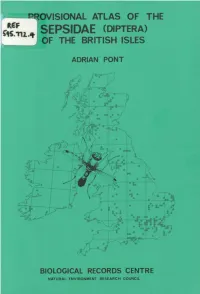
PROVISIONAL ATLAS OF THE REF sis.11L4 SEPSIDAE(DIPTERA) OF THE BRITISH ISLES ADRIAN PONT BIOLOGICAL RECORDS CENTRE NATURAL ENVIRONMENT RESEARCH COUNCIL Printed in Great Britain by Middletons of Ambleside C NERC Copyright 1987 Published in 1987 by Institute of Terrestrial Ecology Merlewood Research Station Orange-over-Sands Cumbria 1411 7H/4 ISBN 1 870393 00 7 The Institute of Terrestrial Ecology was (CIE) established in 1973, from the former Nature Conservancy's research stations and staff, joined later by the Institute of Tree Biology and Culture Centre of Algae and Protozoa. ITE contributes to, and draws upon, the collective knowledge of the 14 sister institutes which make up the Natural Environment Research Council, spanning all the environmental sciences. The Institute studies the factors determining the structure, composition and processes ef land and freshwater systems, and of individual plant and animal species. It is developing a sounder scientific basis for predicting and modelling environmental trends arising from natural or man-made change. The results of this research are available to those respensible for the protection, management and wise use of our natural resources. One quarter of ITE's work is research commissioned by customers, such as the Department of Environment, the European Economic Community, the Nature Conservancy Council and the Overseas Development Administration. The remainder is fundamental research supported by NERC. ITE's expertise is widely used by international organizations in overseas projects and programmes of research. The Biological Records Centre is operated by ITE, and receives financial support from the Nature Conservancy Council. It seeks to help naturalists and research biologists to co-ordinate their efforts in studying the occurrence of plants and animals in the British Isles, and to make the results of these studies available to others. -
Vickermania Gen. Nov., Trypanosomatids That Use Two Joined Flagella to Resist Midgut Peristaltic Flow Within the Fly Host Alexei Y
Kostygov et al. BMC Biology (2020) 18:187 https://doi.org/10.1186/s12915-020-00916-y RESEARCH ARTICLE Open Access Vickermania gen. nov., trypanosomatids that use two joined flagella to resist midgut peristaltic flow within the fly host Alexei Y. Kostygov1,2* , Alexander O. Frolov2, Marina N. Malysheva2, Anna I. Ganyukova2, Lyudmila V. Chistyakova2, Daria Tashyreva3, Martina Tesařová3, Viktoria V. Spodareva1,2, Jana Režnarová1, Diego H. Macedo1, Anzhelika Butenko1,3, Claudia M. d’Avila-Levy4, Julius Lukeš3,5 and Vyacheslav Yurchenko1,6 Abstract Background: The family Trypanosomatidae encompasses parasitic flagellates, some of which cause serious vector- transmitted diseases of humans and domestic animals. However, insect-restricted parasites represent the ancestral and most diverse group within the family. They display a range of unusual features and their study can provide insights into the biology of human pathogens. Here we describe Vickermania, a new genus of fly midgut-dwelling parasites that bear two flagella in contrast to other trypanosomatids, which are unambiguously uniflagellate. Results: Vickermania has an odd cell cycle, in which shortly after the division the uniflagellate cell starts growing a new flagellum attached to the old one and preserves their contact until the late cytokinesis. The flagella connect to each other throughout their whole length and carry a peculiar seizing structure with a paddle-like apex and two lateral extensions at their tip. In contrast to typical trypanosomatids, which attach to the insect host’s intestinal wall, Vickermania is separated from it by a continuous peritrophic membrane and resides freely in the fly midgut lumen. Conclusions: We propose that Vickermania developed a survival strategy that relies on constant movement preventing discharge from the host gut due to intestinal peristalsis. -

Part 1. Entomologists and Their Works Before the Biologia Centrali-Americana Acta Zoológica Mexicana (Nueva Serie), Núm
Acta Zoológica Mexicana (nueva serie) ISSN: 0065-1737 azm@ecologia.edu.mx Instituto de Ecología, A.C. México Papavero, Nelson; Ibáñez Bernal, Sergio Contributions to a History of Mexican Dipterology,- Part 1. Entomologists and their works before the Biologia Centrali-Americana Acta Zoológica Mexicana (nueva serie), núm. 84, 2001, pp. 115-173 Instituto de Ecología, A.C. Xalapa, México Available in: http://www.redalyc.org/articulo.oa?id=57508406 How to cite Complete issue Scientific Information System More information about this article Network of Scientific Journals from Latin America, the Caribbean, Spain and Portugal Journal's homepage in redalyc.org Non-profit academic project, developed under the open access initiative Acta Zool. Mex. (n.s.) 84 (2001) 10. THE SPECIES DESCRIBED BY CARL EDUARD ADOLPH GERSTAECKER Carl Eduard Adolph Gerstaecker died on July 20, 1895 at Greifswald, at the age of 67. He was educated for the medical profession and took his degree, but devoted himself to zoology, especially to entomology. For many years he was keeper of the entomological department of the Berlin Natural History Museum and also a professor of zoology at the University of Berlin. About the year 1876, differences with the then director of the Berlin Museum induced him to resign his appointment in Berlin, and he subsequently accepted the professorship of Zoology at Greifswald, which he held until his death. Gerstaecker was an industrious and thorough worker in all departments of entomology. Among his principal works may be noted the “Arthropoda” in the “Handbuch der Zoologie” (1863) and the same phylum in Bronn´s “Klassen und Ordnungen der Tierreichs”. -

Evidence for Deep Regulatory Similarities in Early Developmental Programs Across Highly Diverged Insects
GBE Evidence for Deep Regulatory Similarities in Early Developmental Programs across Highly Diverged Insects Majid Kazemian1,2,y, Kushal Suryamohan3,4,y,Jia-YuChen1,y, Yinan Zhang1, Md. Abul Hassan Samee1, Marc S. Halfon3,4,5,6,*, and Saurabh Sinha1,7,* 1Department of Computer Science, University of Illinois at Urbana-Champaign 2Laboratory of Molecular Immunology, National Heart Lung and Blood Institute, National Institutes of Health, Bethesda, Maryland 3Department of Biochemistry, University at Buffalo-State University of New York 4NY State Center of Excellence in Bioinformatics and Life Sciences, Buffalo, New York 5Department of Biological Sciences, University at Buffalo-State University of New York 6Molecular and Cellular Biology Department and Program in Cancer Genetics, Roswell Park Cancer Institute, Buffalo, New York 7Institute of Genomic Biology, University of Illinois at Urbana-Champaign *Corresponding author: E-mail: mshalfon@buffalo.edu; sinhas@illinois.edu. yThese authors contributed equally to this work. Accepted: August 17, 2014 Abstract Many genes familiar from Drosophila development, such as the so-called gap, pair-rule, and segment polarity genes, play important roles in the development of other insects and in many cases appear to be deployed in a similar fashion, despite the fact that Drosophila- like “long germband” development is highly derived and confined to a subset of insect families. Whether or not these similarities extend to the regulatory level is unknown. Identification of regulatory regions beyond the well-studied