Coastal Forest Research Programme Kazimzumbwi Forest Reserve 1
Total Page:16
File Type:pdf, Size:1020Kb
Load more
Recommended publications
-

119 Genus Amauris Huebner
AFROTROPICAL BUTTERFLIES 17th edition (2018). MARK C. WILLIAMS. http://www.lepsocafrica.org/?p=publications&s=atb Genus Amauris Hübner, [1816] In: Hübner, [1816-[1826]. Verzeichniss bekannter Schmettlinge 14 (432 + 72 pp.). Augsburg. Type-species: Papilio niavius Linnaeus, by subsequent designation (Scudder, 1875. Proceedings of the American Academy of Arts and Sciences 10: 108 (91-293).). The genus Amauris belongs to the Family Nymphalidae Rafinesque, 1815; Subfamily Danainae Boisduval, 1833; Tribe Danaini Boisduval, 1833; Subtribe Amaurina Le Cerf, 1922. Amauris is the only Afrotropical genus in the Subtribe Amaurina. Amauris is an exclusively Afrotropical genus containing 16 species. Relevant literature: De Vries, 2002 [Differential wing toughness with other taxa]. Amauris species. Final instar larva. Images courtesy Raimund Schutte Amauris species. Pupa. 1 Image courtesy Raimund Schutte Subgenus Amauris Hübner, [1816] In: Hübner, [1816-26]. Verzeichniss bekannter Schmettlinge 14 (432 + 72 pp.). Augsburg. Type-species: Papilio niavius Linnaeus, by subsequent designation (Scudder, 1875. Proceedings of the American Academy of Arts and Sciences 10: 108 (91-293).). *Amauris (Amauris) niavius (Linnaeus, 1758)# Friar Male of the Friar Butterfly (Amauris niavius) at Lake Sibaya, Zululand. Image courtesy Steve Woodhall. Papilio niavius Linnaeus, 1758. Systema Naturae 1, Regnum Animale, 10th edition: 470 (824 pp.). Holmiae. Amauris (Amauris) niavius (Linnaeus, 1758). Pringle et al., 1994: 48. Amauris niavius niavius. Male (Wingspan 75 mm). Left -
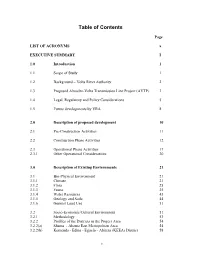
Table of Contents
Table of Contents Page LIST OF ACRONYMS a EXECUTIVE SUMMARY I 1.0 Introduction 1 1.1 Scope of Study 1 1.2 Background – Volta River Authority 2 1.3 Proposed Aboadze-Volta Transmission Line Project (AVTP) 3 1.4 Legal, Regulatory and Policy Considerations 5 1.5 Future developments by VRA 8 2.0 Description of proposed development 10 2.1 Pre-Construction Activities 11 2.2 Construction Phase Activities 12 2.3 Operational Phase Activities 17 2.3.1 Other Operational Considerations 20 3.0 Description of Existing Environments 21 3.1 Bio-Physical Environment 21 3.1.1 Climate 21 3.1.2 Flora 25 3.1.3 Fauna 35 3.1.4 Water Resources 43 3.1.5 Geology and Soils 44 3.1.6 General Land Use 51 3.2 Socio-Economic/Cultural Environment 51 3.2.1 Methodology 53 3.2.2 Profiles of the Districts in the Project Area 54 3.2.2(a) Shama - Ahanta East Metropolitan Area 54 3.2.2(b) Komenda - Edina - Eguafo - Abirem (KEEA) District 58 i 3.2.2(c) Mfantseman District 61 3.2.2(d) Awutu-Effutu-Senya District 63 3.2.2(e) Tema Municipal Area 65 3.2.2(f) Abura-Asebu-Kwamankese 68 3.2.2(g) Ga District 71 3.2.2(h) Gomoa District 74 3.3 Results of Socio-Economic Surveys 77 (Communities, Persons and Property) 3.3.1 Information on Affected Persons and Properties 78 3.3.1.1 Age Distribution of Affected Persons 78 3.3.1.2 Gender Distribution of Affected Persons 79 3.3.1.3 Marital Status of Affected Persons 80 3.3.1.4 Ethnic Composition of Afected Persons 81 3.3.1.5 Household Size/Dependents of Affected Persons 81 3.3.1.6 Religious backgrounds of Affected Persons 82 3.3.2 Economic Indicators -

Phylogenetic Relationships and Historical Biogeography of Tribes and Genera in the Subfamily Nymphalinae (Lepidoptera: Nymphalidae)
Blackwell Science, LtdOxford, UKBIJBiological Journal of the Linnean Society 0024-4066The Linnean Society of London, 2005? 2005 862 227251 Original Article PHYLOGENY OF NYMPHALINAE N. WAHLBERG ET AL Biological Journal of the Linnean Society, 2005, 86, 227–251. With 5 figures . Phylogenetic relationships and historical biogeography of tribes and genera in the subfamily Nymphalinae (Lepidoptera: Nymphalidae) NIKLAS WAHLBERG1*, ANDREW V. Z. BROWER2 and SÖREN NYLIN1 1Department of Zoology, Stockholm University, S-106 91 Stockholm, Sweden 2Department of Zoology, Oregon State University, Corvallis, Oregon 97331–2907, USA Received 10 January 2004; accepted for publication 12 November 2004 We infer for the first time the phylogenetic relationships of genera and tribes in the ecologically and evolutionarily well-studied subfamily Nymphalinae using DNA sequence data from three genes: 1450 bp of cytochrome oxidase subunit I (COI) (in the mitochondrial genome), 1077 bp of elongation factor 1-alpha (EF1-a) and 400–403 bp of wing- less (both in the nuclear genome). We explore the influence of each gene region on the support given to each node of the most parsimonious tree derived from a combined analysis of all three genes using Partitioned Bremer Support. We also explore the influence of assuming equal weights for all characters in the combined analysis by investigating the stability of clades to different transition/transversion weighting schemes. We find many strongly supported and stable clades in the Nymphalinae. We are also able to identify ‘rogue’ -

Zambia Pitta Tour & Black-Cheeked Lovebird Extension 01 - 11 December 2015 Tour Leader Tertius Gous Photographs by Tertius Gous Taken on This Tour
Zambia Pitta Tour & Black-cheeked Lovebird Extension 01 - 11 December 2015 Tour Leader Tertius Gous Photographs by Tertius Gous taken on this tour www.birdingafrica.com Day 1: The first day was mostly a travel day as we departed from Livingstone at noon and traveled in a westerly direction to our lodge situated along the Zambezi River. Roadside birds seen during the journey consisted of Pied Crow, Helmeted Guineafowl, Yellow-billed Kite, Knob-billed Duck, White- browed Sparrow-weaver, Meve’s Starling and Hamerkop. We made a short birding stop in some well-developed mopane woodland where we recorded Southern Carmine and Blue-cheeked Bee- eaters, Red-breasted Swallow, Grey-backed Camaroptera, Brubru and White-crested Helmet- Shrike. Our lodge was situated along a quiet backwater of the Zambezi River and late afternoon birding produced good sightings of Southern Masked-Weaver, Holub’s Golden Weaver, African Jacana, African Openbill, White-faced Duck, Wire-tailed Swallow, White-winged Tern, while Little Rush Warbler and Luapula Cisticola called from the reed beds. Days 2 - 3: We were woken the next morning by the melodious calls of White-browed Robin-Chats emanating from the lush riverine vegetation and gardens of the lodge. Breakfast was served on a wooden deck overlooking the river and we soon got onto a Slaty Egret foraging along the shore, while the antics of Tilapia around their nesting circles in the river was fascinating to watch. The morning was alive with birds and our list was growing quickly with additions such as Red- billed Francolin, Swamp Boubou, Southern Grey- headed Sparrow, African Mourning Dove, Common Waxbill, nesting African Paradise-Flycatcher, Southern Brown-throated Weaver, Brown and Red- billed Firefinch, White- browed and Coppery-tailed Coucal, African Green Pigeon and Diderik Cuckoo. -

NABRO Ecological Analysts CC Natural Asset and Botanical Resource Ordinations Environmental Consultants & Wildlife Specialists
NABRO Ecological Analysts CC Natural Asset and Botanical Resource Ordinations Environmental Consultants & Wildlife Specialists ENVIRONMENTAL BASELINE REPORT FOR HANS HOHEISEN WILDLIFE RESEARCH STATION Compiled by Ben Orban, PriSciNat. June 2013 NABRO Ecological Analysts CC. - Reg No: 16549023 / PO Box 11644, Hatfield, Pretoria. Our reference: NABRO / HHWRS/V01 NABRO Ecological Analysts CC Natural Asset and Botanical Resource Ordinations Environmental Consultants & Wildlife Specialists CONTENTS 1 SPECIALIST INVESTIGATORS ............................................................................... 3 2 DECLARATION ............................................................................................................ 3 3 INTRODUCTION ......................................................................................................... 3 4 LOCALITY OF STUDY AREA .................................................................................... 4 4.1 Location ................................................................................................................... 4 5 INFRASTRUCTURE ..................................................................................................... 4 5.1 Fencing ..................................................................................................................... 4 5.2 Camps ...................................................................................................................... 4 5.3 Buildings ................................................................................................................ -

Check-List of the Butterflies of the Kakamega Forest Nature Reserve in Western Kenya (Lepidoptera: Hesperioidea, Papilionoidea)
Nachr. entomol. Ver. Apollo, N. F. 25 (4): 161–174 (2004) 161 Check-list of the butterflies of the Kakamega Forest Nature Reserve in western Kenya (Lepidoptera: Hesperioidea, Papilionoidea) Lars Kühne, Steve C. Collins and Wanja Kinuthia1 Lars Kühne, Museum für Naturkunde der Humboldt-Universität zu Berlin, Invalidenstraße 43, D-10115 Berlin, Germany; email: lars.kuehne@museum.hu-berlin.de Steve C. Collins, African Butterfly Research Institute, P.O. Box 14308, Nairobi, Kenya Dr. Wanja Kinuthia, Department of Invertebrate Zoology, National Museums of Kenya, P.O. Box 40658, Nairobi, Kenya Abstract: All species of butterflies recorded from the Kaka- list it was clear that thorough investigation of scientific mega Forest N.R. in western Kenya are listed for the first collections can produce a very sound list of the occur- time. The check-list is based mainly on the collection of ring species in a relatively short time. The information A.B.R.I. (African Butterfly Research Institute, Nairobi). Furthermore records from the collection of the National density is frequently underestimated and collection data Museum of Kenya (Nairobi), the BIOTA-project and from offers a description of species diversity within a local literature were included in this list. In total 491 species or area, in particular with reference to rapid measurement 55 % of approximately 900 Kenyan species could be veri- of biodiversity (Trueman & Cranston 1997, Danks 1998, fied for the area. 31 species were not recorded before from Trojan 2000). Kenyan territory, 9 of them were described as new since the appearance of the book by Larsen (1996). The kind of list being produced here represents an information source for the total species diversity of the Checkliste der Tagfalter des Kakamega-Waldschutzge- Kakamega forest. -

Mombasa Cement Ltd Vipingo EIA Study Report for Proposed Expansion MOMBASA CEMENT LTD (VIPINGO UNIT)
Mombasa Cement Ltd Vipingo EIA Study Report for Proposed expansion MOMBASA CEMENT LTD (VIPINGO UNIT) P.O. BOX 83594-80100 MOMBASA Email: nyumba@africanonline.com; mcl@nyumba.com GPS coordinates UTM X-0593567 & UTM Y- 9586780 PROPOSED EXPANSION OF MOMBASA CEMENT VIPINGO CLINKER AND CEMENT PRODUCTION PLANT ENVIRONMENTAL IMPACT ASSESSMENT STUDY REPORT PROJECT REPORT REF NO: NEMA/PR/5/2/13,587 Compiled by: J.Morumbasi Mong’oni EIA/EA Lead Expert Reg. No.0357 Philip. Manyi Omenge EIA/EA Lead Expert Reg. No. 1559 Dr. George Eshiamwata EIA/EA Lead Expert Reg. No 1781 P.O. Box 569-80100 Mombasa Kenya 0722 493 772 philipomenge@yahoo.com DECEMBER 2015 Compiled by Philip M. Omenge, J. Morumbasi Mong‘oni, & Dr. George Eshiamwta, EIA/EA Lead Experts 2015 Page i Mombasa Cement Ltd Vipingo EIA Study Report for Proposed expansion MOMBASA CEMENT LTD (VIPINGO UNIT) P.O. BOX 83594-80100 MOMBASA Email: nyumba@africanonline.com; mcl@nyumba.com PROPOSED EXPANSION OF MOMBASA CEMENT VIPINGO CLINKER AND CEMENT PRODUCTION PLANT ENVIRONMENTAL IMPACT ASSESSMENT STUDY REPORT PROJECT REPORT REF NO: NEMA/PR/5/2/13,587 Compiled by: J.Morumbasi Mong’oni EIA/EA Lead Expert Reg. No.0357 Philip. Manyi Omenge EIA/EA Lead Expert Reg. No. 1559 Dr. George Eshiamwata EIA/EA Lead Expert Reg. No 1781 Compiled by Philip M. Omenge, J. Morumbasi Mong‘oni, & Dr. George Eshiamwta, EIA/EA Lead Experts 2015 Page ii Mombasa Cement Ltd Vipingo EIA Study Report for Proposed expansion Environmental Audit Report Submitted by MOMBASA CEMENT LIMITED P.O BOX 83594-80100 MOMBASA Tel 041 3434486 Email: nyumba@africanonline.co.ke HASHUMUKH PATEL ....................................... -

Download Full-Text
Research in Zoology 2015, 5(2): 32-37 DOI: 10.5923/j.zoology.20150502.02 First Records of Butterfly Diversity on Two Remote Islands on the Volta Lake of Ghana, the Largest Reservoir by Total Surface Area in the World Daniel Opoku Agyemang1, Daniel Acquah-Lamptey1,*, Roger Sigismond Anderson2, Rosina Kyerematen1,2 1Department of Animal Biology and Conservation Science, University of Ghana, Legon, Ghana 2African Regional Postgraduate Programme in Insect Science, University of Ghana, Legon, Ghana Abstract The construction of the Akosombo Dam in Ghana for hydroelectric energy led to the creation of many islands on the Volta Lake. The biological diversity on these islands is unknown and so a rapid assessment was conducted in January 2014 as part as a region wide assessment to determine the butterfly diversity on two of these islands, Biobio and Agbasiagba. Diversity indices were computed for both islands using the Shannon-Weiner index, Margalef’s index for richness and Whittaker’s index for comparison of diversity between the two islands. A total of eight hundred and eighty-one (881) individual butterflies representing forty-five (45) species belonging to eight (8) families were recorded during the study. Thirty-nine (39) species of butterflies were recorded on Biobio island whiles twenty-eight (28) species were recorded on Agbasiagba. This was expected as the larger islands are expected to support more species than smaller ones, with Biobio island being relatively bigger than Agbasiagba. The shared species of butterflies on both islands were twenty-two (22) representing 48.9% of the total species accumulated. Indicator species like Junonia oenone, Danaus chrysippus and Papilio demodocus were also recorded indicating the degraded floral quality of the Islands. -

Zambia and Zimbabwe 28 Ovember – 6 December 2009
Zambia and Zimbabwe 28 ovember – 6 December 2009 Guide: Josh Engel A Tropical Birding Custom Tour All photos taken by the guide on this tour. The Smoke that Thunders: looking down one end of the mile-long Victoria Falls. ITRODUCTIO We began this tour by seeing one of Africa’s most beautiful and sought after birds: African Pitta . After that, the rest was just details. But not really, considering we tacked on 260 more birds and loads of great mammals. We saw Zambia’s only endemic bird, Chaplin’s Barbet , as well as a number of miombo and broad-leaf specialties, including Miombo Rock-Thrush, Racket-tailed Roller, Southern Hyliota, Miombo Pied Barbet, Miombo Glossy Starling, Bradfield’s Hornbill, Pennant-winged ightjar, and Three-banded Courser. With the onset of the rainy season just before the tour, the entire area was beautifully green and was inundated with migrants, so we were able to rack up a great list of cuckoos and other migrants, including incredible looks at a male Kurrichane Buttonquail . Yet the Zambezi had not begun to rise, so Rock Pratincole still populated the river’s rocks, African Skimmer its sandbars, and Lesser Jacana and Allen’s Gallinule its grassy margins. Mammals are always a highlight of any Africa tour: this trip’s undoubted star was a leopard , while a very cooperative serval was also superb. Victoria Falls was incredible, as usual. We had no problems in Zimbabwe whatsoever, and our lodge there on the shores of the Zambezi River was absolutely stunning. The weather was perfect throughout the tour, with clouds often keeping the temperature down and occasional rains keeping bird activity high. -

English Cop17 Inf. 47 (English Only / Únicamente En Inglés / Seulement En Anglais)
Original language: English CoP17 Inf. 47 (English only / Únicamente en inglés / Seulement en anglais) CONVENTION ON INTERNATIONAL TRADE IN ENDANGERED SPECIES OF WILD FAUNA AND FLORA Seventeenth meeting of the Conference of the Parties Johannesburg (South Africa), 24 September – 5 October 2016 TRADE STUDY OF SELECTED EAST AFRICAN TIMBER PRODUCTION SPECIES This document has been submitted by Germany* in relation to agenda items 62, 77 and 88. * The geographical designations employed in this document do not imply the expression of any opinion whatsoever on the part of the CITES Secretariat (or the United Nations Environment Programme) concerning the legal status of any country, territory, or area, or concerning the delimitation of its frontiers or boundaries. The responsibility for the contents of the document rests exclusively with its author. CoP17 Inf. 47 – p. 1 Anthony B. Cunningham Trade study of selected east African timber production species BfN-Skripten 445 2016 Trade study of selected east African timber production species Handelsstudie zu ostafrikanischen Holzarten (FKZ 3514 53 2003) Anthony B. Cunnigham Cover picture: A worker of a sawmill in front of Dalbergia melanoxylon logs in Montepuez/Mozambique (A.B. Cunningham) Author’s address: Dr. Anthony B. Cunningham Cunningham Consultancy WA Pty Ltd. 2 Tapper Street Au-6162 Fremantle E-Mail: tonyc05@bigpond.net.au Scientific Supervision at BfN: Dr. Daniel Wolf Division II 1.2 “Plant Conservation“ This publication is included in the literature database “DNL-online” (www.dnl-online.de) BfN-Skripten are not available in book trade. Publisher: Bundesamt für Naturschutz (BfN) Federal Agency for Nature Conservation Konstantinstrasse 110 53179 Bonn, Germany URL: http://www.bfn.de The publisher takes no guarantee for correctness, details and completeness of statements and views in this report as well as no guarantee for respecting private rights of third parties. -
1995 a Large Scale Migration of The
240 LARSEN, T. B. 1995. A large-scale migration of the African skipper Andronymus gander Evans, 1946 near Calabar, Nigeria (Lepidoptera: Hesperiidae). Entomologists' Record and Journal of Variation , 107:263-267. (WA 16) A LARGE-SCALE MIGRATION OF THE AFRICAN SKIPPER ANDRONYMUS GANDER Evans, 1946 NEAR CALABAR, NIGERIA (LEPIDOPTERA: HESPERIIDAE) Torben B. Larsen Introduction I spent all of March, 1995 surveying the butterflies of the Oban Hills in the Cross River National Park, Nigeria. The Park lies just north of Calabar, the type locality of numerous African butterflies from the past hundred years and more. The Park is by far the largest forest area in Nigeria and one of the largest in West Africa. The habitat is wet evergreen forest in good shape and the park is being conserved and developed by grants from the European Union and Germany, with technical assistance from, among others, the Worldwide Fund for Nature (WWF). It is one of the centres of biodiversity in Africa. I recorded about 430 butterfly species during my own trip. However, many other collectors have been active in the area, so the total confirmed checklist stands at almost 650. My own 'discovery curve', my knowledge of the habitat, and the distribution of other butterflies both east and west of the Park make the prediction that at least 950 species are found in the Park area quite safe. The lowland wet evergreen forest of the southern Nigeria/Cameroun border area is almost certainly the richest habitat anywhere in Africa for butterflies - and by implication other arthropods as well. Nowhere in Asia are as many butterflies found in one locality, but in the Neotropical Region up to 1300 may be found in some localities (B ECCALONI & G ASTON 1995). -

Mombasa Cement Limited EIA Study Report for Proposed Wind Farm
MOMBASA CEMENT LTD P.O. BOX 83594-80100 MOMBASA Email: csl@nyumba.com PROPOSED DEVELOPMENT OF 36 MEGAWATTS WIND FARM AT TAKAUNGU/ MAVUENI LOCATION, VIPINGO ON LAND PARCELS MN/III/291/2 AND MN/III/4391, KILIFI COUNTY ENVIRONMENTAL IMPACT ASSESSMENT STUDY REPORT PROJECT REPORT REF. NEMA/ PR/5/2/16,805 Compiled by: Philip Manyi Omenge – EIA/EA Lead Expert Reg. No 1559 Dr. George Eshiamwata – EIA/EA Lead Expert Reg. No. 1781 J. Morumbasi Mong.oni – EIA/EA Lead ExpertReg. No. 0357 2016 Mombasa Cement Limited EIA Study Report for Proposed Wind Farm MOMBASA CEMENT LTD P.O. BOX 83594-80100 MOMBASA Email: csl@nyumba.com PROPOSED DEVELOPMENT OF 36 MEGAWATTS WIND FARM AT TAKAUNGU/ MAVUENI LOCATION, VIPINGO ON LAND PARCELS MN/III/291/2 AND MN/III/4391 KILIFI COUNTY ENVIRONMENTAL IMPACT ASSESSMENT STUDY REPORT Compiled by: J.Morumbasi Mong’oni EIA/EA Lead Expert Reg. No.0357 Philip. Manyi Omenge EIA/EA Lead Expert Reg. No. 1559 Dr. George Eshiamwata EIA/EA Lead Expert Reg. No 1781 Compiled by P.M. Omenge EIA/EA Lead Expert, Dr. G. Eshiamwata EIA/EA Lead Expet and J.M Mong’oni EIA/EA Lead Expert Page ii Mombasa Cement Limited EIA Study Report for Proposed Wind Farm MOMBASA CEMENT LTD P.O. BOX 83594-80100 MOMBASA Email: csl@nyumba.com PROPOSED DEVELOPMENT OF 36 MEGAWATTS WIND FARM AT TAKAUNGU/ MAVUENI LOCATION, VIPINGO ON LAND PARCELS MN/III/291/2 AND MN/III/4391 KILIFI COUNTY ENVIRONMENTAL IMPACT ASSESSMENT STUDY REPORT Submitted by HASHUMUKH PATEL ................................................................................ Director Compiled by P.M.