Beautiful Bromeliads
Total Page:16
File Type:pdf, Size:1020Kb
Load more
Recommended publications
-

Bromgaz Draft Nov Dec 2009
Vol 33 Number 6 Nov/Dec 2009 PUBLISHED BY: COMMITTEE MEMBERS President: Len Colgan 1 Ailsa Avenue, Warradale, 5046. Ph: 82969426 Secretary: Derek Butcher. 25 Crace Road, Fulham, 5024. Ph: 83567728 Vice president: Adam Bodzioch Treasurer: Bill Treloar Margaret Butcher Maureen Hick Colin Waterman Lainie Stainer Bev Masters Email address: Meetings Venue: Secretary - tillands@senet.com.au Maltese Cultural Centre, Web site: http://www.bromeliad.org.au 6 Jeanes Street, Beverley Time: 2.00pm. Second Sunday of each month Exceptions –1st Sunday in May, & August & no meeting in December or unless advised otherwise VISITORS & NEW MEMBERS WELCOME T. aeranthos Pots, Labels & Hangers - Small quantities available all meetings. For special orders/ larger quantities call Ron Masters on 83514876 Dates for 2009 Meeting dates:- Nov 8 th. Special Events:- Nov 7th Sales day Dates for 2010 Meeting dates:-Jan 10th, Feb 14th - AGM, March 14 Special Events:- March Show 27th & 28th. Applications for membership always welcome. Subscriptions $10.00 per year Feb. to Feb. Several reference photos courtesy of “fcbs.org” September meeting from the Secretary’s desk It was a bit of a change to have Adam in the Chair while Len was trying to get home from Melbourne after a somewhat sorrowful visit. He was not in mourning from the Crows loss. Margaret and I were giving the main talk on a visit to northern NSW and these days when we do such visits we are often asked for advice on names, never on culture. I wonder why? As such the meeting was on a querying note, where members had to have their brains in gear. -

Insect Survey of Four Longleaf Pine Preserves
A SURVEY OF THE MOTHS, BUTTERFLIES, AND GRASSHOPPERS OF FOUR NATURE CONSERVANCY PRESERVES IN SOUTHEASTERN NORTH CAROLINA Stephen P. Hall and Dale F. Schweitzer November 15, 1993 ABSTRACT Moths, butterflies, and grasshoppers were surveyed within four longleaf pine preserves owned by the North Carolina Nature Conservancy during the growing season of 1991 and 1992. Over 7,000 specimens (either collected or seen in the field) were identified, representing 512 different species and 28 families. Forty-one of these we consider to be distinctive of the two fire- maintained communities principally under investigation, the longleaf pine savannas and flatwoods. An additional 14 species we consider distinctive of the pocosins that occur in close association with the savannas and flatwoods. Twenty nine species appear to be rare enough to be included on the list of elements monitored by the North Carolina Natural Heritage Program (eight others in this category have been reported from one of these sites, the Green Swamp, but were not observed in this study). Two of the moths collected, Spartiniphaga carterae and Agrotis buchholzi, are currently candidates for federal listing as Threatened or Endangered species. Another species, Hemipachnobia s. subporphyrea, appears to be endemic to North Carolina and should also be considered for federal candidate status. With few exceptions, even the species that seem to be most closely associated with savannas and flatwoods show few direct defenses against fire, the primary force responsible for maintaining these communities. Instead, the majority of these insects probably survive within this region due to their ability to rapidly re-colonize recently burned areas from small, well-dispersed refugia. -

UNIVERSIDADE ESTADUAL DE PONTA GROSSA PROGRAMA DE PÓS-GRADUAÇÃO EM BIOLOGIA EVOLUTIVA (Associação Ampla Entre a UEPG E a UNICENTRO)
UNIVERSIDADE ESTADUAL DE PONTA GROSSA PROGRAMA DE PÓS-GRADUAÇÃO EM BIOLOGIA EVOLUTIVA (Associação ampla entre a UEPG e a UNICENTRO) SHYGUEK NAGAZAK ALVES MIYAMOTO O GÊNERO Aechmea Ruiz & Pav. (BROMELIACEAE – BROMELIOIDEAE) NO ESTADO DO PARANÁ, BRASIL PONTA GROSSA 2013 UNIVERSIDADE ESTADUAL DE PONTA GROSSA PROGRAMA DE PÓS-GRADUAÇÃO EM BIOLOGIA EVOLUTIVA (Associação ampla entre a UEPG e a UNICENTRO) SHYGUEK NAGAZAK ALVES MIYAMOTO O GÊNERO Aechmea Ruiz & Pav. (BROMELIACEAE – BROMELIOIDEAE) NO ESTADO DO PARANÁ, BRASIL Dissertação de mestrado apresentada ao Programa de Pós-Graduação em Biologia Evolutiva da Universidade Estadual de Ponta Grossa, em associação com a Universidade Estadual do Centro Oeste, como parte dos requisitos para a obtenção do título de mestre em Ciências Biológicas (Área de Concentração em Biologia Evolutiva). Orientadora: Prof. Dra. Rosângela Capuano Tardivo PONTA GROSSA 2013 Ficha Catalográfica Elaborada pelo Setor de Tratamento da Informação BICEN/UEPG Miyamoto, Shyguek Nagazak Alves M685 O gênero Aechmea Ruiz & Pav. (Bromeliaceae – Bromelioideae) no Estado Paraná, Brasil/ Shyguek Nagazak Alves Miyamoto. Ponta Grossa, 2013. 122f. Dissertação (Mestrado em Ciências Biológicas - Área de Concentração: Biologia Evolutiva), Universidade Estadual de Ponta Grossa. Orientadora: Profª Drª Rosâgela Capuano Tardivo. 1.Bromélia. 2.Sul Brasil. 3.Morfologia. 4.Taxonomia. I.Tardivo, Rosâgela Capuano. II. Universidade Estadual de Ponta Grossa. Mestrado em Ciências Biológicas. III. T. CDD: 581 Agradecimentos Agradeço à minha orientadora, professora Dra. Rosângela Capuano Tardivo, pela confiança em mim depositada, pela orientação, pelas discussões sempre motivadoras e pela amizade que seguirá para muito além deste trabalho. À minha avó, Shirley, pelo amor incondicional em todas as horas de nossas vidas, e pela serenidade e equilíbrio que tornam tudo muito mais fácil. -

Pu'u Wa'awa'a Biological Assessment
PU‘U WA‘AWA‘A BIOLOGICAL ASSESSMENT PU‘U WA‘AWA‘A, NORTH KONA, HAWAII Prepared by: Jon G. Giffin Forestry & Wildlife Manager August 2003 STATE OF HAWAII DEPARTMENT OF LAND AND NATURAL RESOURCES DIVISION OF FORESTRY AND WILDLIFE TABLE OF CONTENTS TITLE PAGE ................................................................................................................................. i TABLE OF CONTENTS ............................................................................................................. ii GENERAL SETTING...................................................................................................................1 Introduction..........................................................................................................................1 Land Use Practices...............................................................................................................1 Geology..................................................................................................................................3 Lava Flows............................................................................................................................5 Lava Tubes ...........................................................................................................................5 Cinder Cones ........................................................................................................................7 Soils .......................................................................................................................................9 -
Multi-National Conservation of Alligator Lizards
MULTI-NATIONAL CONSERVATION OF ALLIGATOR LIZARDS: APPLIED SOCIOECOLOGICAL LESSONS FROM A FLAGSHIP GROUP by ADAM G. CLAUSE (Under the Direction of John Maerz) ABSTRACT The Anthropocene is defined by unprecedented human influence on the biosphere. Integrative conservation recognizes this inextricable coupling of human and natural systems, and mobilizes multiple epistemologies to seek equitable, enduring solutions to complex socioecological issues. Although a central motivation of global conservation practice is to protect at-risk species, such organisms may be the subject of competing social perspectives that can impede robust interventions. Furthermore, imperiled species are often chronically understudied, which prevents the immediate application of data-driven quantitative modeling approaches in conservation decision making. Instead, real-world management goals are regularly prioritized on the basis of expert opinion. Here, I explore how an organismal natural history perspective, when grounded in a critique of established human judgements, can help resolve socioecological conflicts and contextualize perceived threats related to threatened species conservation and policy development. To achieve this, I leverage a multi-national system anchored by a diverse, enigmatic, and often endangered New World clade: alligator lizards. Using a threat analysis and status assessment, I show that one recent petition to list a California alligator lizard, Elgaria panamintina, under the US Endangered Species Act often contradicts the best available science. -

Entry Worksheet - Bromeliad Society of South Florida
BromeliAdvisory March 2017 InThis Issue President’s Message . 2 Michalski’s Suggestions for Show . 2 The Show is Just Around the Corner . 3-5 In Case You Missed It . 6 Upcoming Events . 6-7 News From Florida Council . 7 Murder in Corbin . 7-8 Renewal of Membership Form . 9 Show Entry Sheet . 10 BromeliAdvisory Stop and Smell the Bromeliads March 2017 MARCH 21, 2017 WEBPAGE: http://www.bssf-miami.org/ SPEAKER: Dave Johnston http://www.facebook.com/groups/BromeliadS RAFFLE TABLE: Barbara Partagas SF/?bookmark_t=group FOOD: Usual Suspects http://www.facebook.com/pages/Bromeliad-S ociety-of-South-Florida/84661684279 Alex Bello, President Dave Johnston Sandy Roth, VP Dave’s interest in Bromeliads began in 1985 when he Fred Sussenberger, Treasurer purchased two bromeliads that Frank’s Lenny Goldstein, Secretary nursery had for sale. A cryptanthus Pink _________________ Starlight and a neoregelia carolinae type. DIRECTORS Soon thereafter, he learned there were Past Pres.: Sandy Roth bromeliad clubs that shared similar Directors: interests. He joined some. By 1990, Barbara Sparling ’16 –’17 Dave had acquired so many bromeliads Karen Bradley ’17 –’18 that he launched Bromeliads Galore – a Ellis Brown’17 –’18 collector’s nursery. Stephanie LaRusso ‘17-‘18 Over the past 32 years, Dave has Editor: Robert Meyer acquired over 2,000 different species and hybrids. As time passes, he became more sensible and has since significantly scaled back the number of plants – now he Advertising: Robert Meyer has perhaps 1200 different species or hybrids. Door Prize: Alan Herndon Education: Alan Herndon Dave has served five terms as President of The Bromeliad Hospitality: Elaine Mills Guild of Tampa and two terms as President of the Florida Library: Barbara Partagas West Coast Bromeliad Society. -

Catalogue of the Vascular Epiphytic Flora of Uruguay
Acta Botanica Brasilica doi: 10.1590/0102-33062019abb0059 Catalogue of the vascular epiphytic flora of Uruguay Patricia Mai1* , Andrés Rossado2 , José Mauricio Bonifacino2,3 and Jorge Luiz Waechter4 Received: February 21, 2019 Accepted: June 17, 2019 . ABSTRACT We provide an updated list of the vascular epiphytic flora occurring in native environments of Uruguay based on literature review, herbarium specimens, and fieldwork throughout the country. The catalogue provides standardized information for each species, including accepted name, synonyms used within Uruguay, epiphytic category, distribution within the country, habitat, conservation status, observations, and a voucher citation. The effort documented 73 species for the epiphytic flora of Uruguay (3 % of the flora), distributed among 29 genera and 12 families. Bromeliaceae was the richest family (17), followed by Polypodiaceae (16) and Orchidaceae (12). Tillandsia stood out as the most speciose genus with 15 species. Characteristic holoepiphytes was the most diverse ecological category. More than half of the epiphytic species documented for Uruguay (53 %) reach their southernmost geographic distribution in the country, whereas only two mostly epipetric species of Tillandsia — T. arequitae and T. uruguayensis — are endemic to the country. Almost half of the epiphytic species found are presently under categories of threat of extinction, with 60 % of them occurring in national protected areas. Both the richest epiphytic families and the predominance of characteristic holoepiphytes coincide with findings from floristic and ecological studies previously carried out in humid subtropical regions. Keywords: conservation status, epiphytic category, geographic distribution, hemiepiphytes, holoepiphytes, subtropical forests, Uruguay, vascular epiphytes The most recent estimation of vascular epiphytes in the Introduction world reports 27,614 species, distributed in 73 families and 913 genera. -

Morphoanatomical Characterization and Antimicrobial Activity of Tillandsia Imperialis (Bromeliaceae)
Núm. 31, pp. 21-29, ISSN 1405-2768; México, 2011 MORPHOANATOMICAL CHARACTERIZATION AND ANTIMICROBIAL ACTIVITY OF TILLANDSIA IMPERIALIS (BROMELIACEAE) J. Alejandro Vite-Posadas1, Alicia E. Brechú-Franco1, Guillermo Laguna-Hernández1, M. Gabriela Rojas-Bribiesca2 and H. Reyna Osuna-Fernández1. 1Laboratorio de Estructura y Fisiología de Plantas, Facultad de Ciencias, Universidad Nacional Autónoma de México, Ciudad de México; 2Laboratorio de Microbiología, Centro de Investigación Biomédica del Sur (CIBIS), IMSS, Xochitepec, Morelos, México. ABSTRACT trichomes, tetracyclic stomata and non- sclerotic hypodermis with spherical silica Tillandsia imperialis C.J. Morren ex Roezl is bodies. Microbiological research revealed a bromeliad used in Mexican folk medicine specifi c antimicrobial activity against re- mixed with other plant and animal parts as a spiratory pathogenic microorganisms such good remedy for respiratory diseases, which as Staphylococcus aureus and Streptococ- are one of the main causes of morbility and cus pyogenes as well as six other bacteria. mortality in the rural population of Mexico. These results indicate the existence of anti- The commercialization of medicinal plants microbial compounds in the extracts and a for therapeutic use must comply with high correlation between the traditional uses of standards for quality, safety and effi cacy; this plant and the experimental data. structural, microbiological and pharmaceuti- cal studies make a decisive contribution to Key words: antimicrobial activity, me- this quality control. The aim of this study dicinal plants, structural and histochemical was to analyze the morpho-anatomical char- characteristics, Tillandsia imperialis. acteristics and histochemistry of bracts and leaves of Tillandsia imperialis and evaluate RESUMEN their antimicrobial activity to corroborate the effectiveness of this plant for traditional Tillandsia imperialis (Bromeliaceae) es una uses with experimental data. -

Contributions Toward a Lepidoptera (Psychidae, Yponomeutidae, Sesiidae, Cossidae, Zygaenoidea, Thyrididae, Drepanoidea, Geometro
Contributions Toward a Lepidoptera (Psychidae, Yponomeutidae, Sesiidae, Cossidae, Zygaenoidea, Thyrididae, Drepanoidea, Geometroidea, Mimalonoidea, Bombycoidea, Sphingoidea, & Noctuoidea) Biodiversity Inventory of the University of Florida Natural Area Teaching Lab Hugo L. Kons Jr. Last Update: June 2001 Abstract A systematic check list of 489 species of Lepidoptera collected in the University of Florida Natural Area Teaching Lab is presented, including 464 species in the superfamilies Drepanoidea, Geometroidea, Mimalonoidea, Bombycoidea, Sphingoidea, and Noctuoidea. Taxa recorded in Psychidae, Yponomeutidae, Sesiidae, Cossidae, Zygaenoidea, and Thyrididae are also included. Moth taxa were collected at ultraviolet lights, bait, introduced Bahiagrass (Paspalum notatum), and by netting specimens. A list of taxa recorded feeding on P. notatum is presented. Introduction The University of Florida Natural Area Teaching Laboratory (NATL) contains 40 acres of natural habitats maintained for scientific research, conservation, and teaching purposes. Habitat types present include hammock, upland pine, disturbed open field, cat tail marsh, and shallow pond. An active management plan has been developed for this area, including prescribed burning to restore the upland pine community and establishment of plots to study succession (http://csssrvr.entnem.ufl.edu/~walker/natl.htm). The site is a popular collecting locality for student and scientific collections. The author has done extensive collecting and field work at NATL, and two previous reports have resulted from this work, including: a biodiversity inventory of the butterflies (Lepidoptera: Hesperioidea & Papilionoidea) of NATL (Kons 1999), and an ecological study of Hermeuptychia hermes (F.) and Megisto cymela (Cram.) in NATL habitats (Kons 1998). Other workers have posted NATL check lists for Ichneumonidae, Sphecidae, Tettigoniidae, and Gryllidae (http://csssrvr.entnem.ufl.edu/~walker/insect.htm). -

Embriologia De Tillandsia Aeranthos (Lois.) L
UNIVERSIDADE FEDERAL DE SANTA MARIA CENTRO DE CIÊNCIAS NATURAIS E EXATAS PROGRAMA DE PÓS-GRADUAÇÃO EM AGROBIOLOGIA EMBRIOLOGIA DE TILLANDSIA AERANTHOS (LOIS.) L. B. SM. (TILLANDSIOIDEAE- BROMELIACEAE) DISSERTAÇÃO DE MESTRADO Cristiele Spat Santa Maria, RS, Brasil 2012 EMBRIOLOGIA DE TILLANDSIA AERANTHOS (LOIS.) L. B. SM. (TILLANDSIOIDEAE-BROMELIACEAE) Cristiele Spat Dissertação apresentada ao Curso de Mestrado do Programa de Pós-Graduação em Agrobiologia, da Universidade Federal de Santa Maria (UFSM, RS), como requisito parcial para obtenção do grau de Mestre em Agrobiologia Orientador: Prof. Dr. João Marcelo Santos de Oliveira Santa Maria, RS, Brasil 2012 AGRADECIMENTOS À minha família, pelo apoio, incentivo e por compreender as ausências durante esses dois anos. Ao meu Orientador, Prof. Dr. João Marcelo Santos de Oliveira, pela amizade e dedicação durante minha formação, os quais foram fundamentais na execução desse trabalho. Ao Glauber, pelo carinho, apoio e paciência. À Drª. Jaqueline Sarzi Sartori, pela amizade, dedicação, aprendizado e discussões, sempre valiosas, sobre Bromeliaceae Ao César Carvalho de Freitas, pela ajuda e disponibilidade na confecção do material botânico, indispensável na execução deste trabalho. À Marisa Binotto, pela amizade, companherismo e auxílio técnico no laboratório, muito importantes na execução deste estudo. Aos amigos e colegas do Laboratório de Botânica Estrutural, Patrícia, Merielen e Mariane, pelo convívio diário, incentivo e discussões acadêmicas, muito importantes para a realização deste trabalho. Às minhas amigas, Renata, Lara e Letícia, pelos encontros, momentos de descontração e por lembrarem, todos os dias, o valor de uma amizade. À Prof. Drª. Thais Scotti do Canto-Dorow, pela análise taxonômica e disponibilidade em realizar as coletas. -
Supplementary Material What Do Nectarivorous Bats Like? Nectar Composition in Bromeliaceae with Special Emphasis on Bat-Pollinated Species
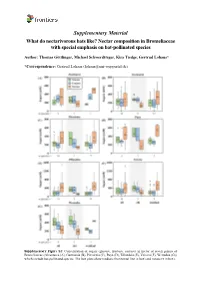
Supplementary Material What do nectarivorous bats like? Nectar composition in Bromeliaceae with special emphasis on bat-pollinated species Author: Thomas Göttlinger, Michael Schwerdtfeger, Kira Tiedge, Gertrud Lohaus* *Correspondence: Gertrud Lohaus (lohaus@uni-wuppertal.de) Supplementary Figure S1: Concentration of sugars (glucose, fructose, sucrose) in nectar of seven genera of Bromeliaceae (Alcantarea (A), Guzmania (B), Pitcairnia (C), Puya (D), Tillandsia (E), Vriesea (F), Werauhia (G)) which include bat-pollinated species. The box plots show medians (horizontal line in box) and means (x in box). Supplementary Material What do nectarivorous bats like? Nectar composition in Bromeliaceae with special emphasis on bat-pollinated species Author: Thomas Göttlinger, Michael Schwerdtfeger, Kira Tiedge, Gertrud Lohaus* *Correspondence: Gertrud Lohaus (lohaus@uni-wuppertal.de) Supplementary Figure S2: Concentration of amino acids (ala, arg, asn, asp, gaba, gln, glu, gly, his, iso, leu, lys, met, phe, pro, ser, thr, trp, tyr, val) in nectar of seven genera of Bromeliaceae (Alcantarea (A), Guzmania (B), Pitcairnia (C), Puya (D), Tillandsia (E), Vriesea (F), Werauhia (G)), which include bat-pollinated species. The box plots show medians (horizontal line in box) and means (x in box). Supplementary Material What do nectarivorous bats like? Nectar composition in Bromeliaceae with special emphasis on bat-pollinated species Author: Thomas Göttlinger, Michael Schwerdtfeger, Kira Tiedge, Gertrud Lohaus* *Correspondence: Gertrud Lohaus (lohaus@uni-wuppertal.de) Supplementary Figure S3: Cation concentrations (Ca2+, K+, Na+, Mg2+) in nectar of seven genera of Bromeliaceae (Alcantarea (A), Guzmania (B), Pitcairnia (C), Puya (D), Tillandsia (E), Vriesea (F), Werauhia (G)), which include bat-pollinated species. The box plots show medians (horizontal line in box) and means (x in box). -
VARIEGATION in BROMELIADS (By Luiz Felipe Nevares De Carvalho)
VARIEGATION IN BROMELIADS (by Luiz Felipe Nevares de Carvalho) Editorial comment (Bob Reilly) Reprinted, with permission of the Bromeliad Society International, from the Journal of The Bromeliad Society, 2000, volume 50 (4), pp. 182-185. Variegated bromeliads are often keenly sought after by collectors. In this article, the author discusses the causes and types of variegation, as well as the propagation of variegated bromeliads. Note that the process of naming a particular variegated plant can sometimes be more complex than might be inferred from the article. Variegation is a rather common phenomenon in the plant kingdom, and is found in many plant families. It is especially pronounced in Bromeliaceae. The word “variegata” comes from Latin – variegatuus, variegata, variegatum – meaning variable coloration with patches of different colors. A bromeliad is known as “variegata” when it has two or more different colors. Over 60% of cultivated bromeliads have bands, dots, lines, and streaks, and can therefore be considered variegated. However, the term is accepted in horticulture, when applied to bromeliads that have lines, streaks and longitudinal bands of contrasting colors, especially those that show differences in pigmentation between the green chlorophyll-containing tissues and albino tissues. On the other hand, if we look at the many bromeliads that grow in the wild, it appears that variegation is a rare phenomenon. As a general rule, patently variegated plants are less hardy and slower growing than normal, and those that arise spontaneously in nature normally survive the competition for space and light only when man intervenes, taking them from the wild for cultivation. Variegation is rarely found in the subfamily Pitcairnioideae, and is not particularly common in Tillandsioideae.