Rehearsal and Concert
Total Page:16
File Type:pdf, Size:1020Kb
Load more
Recommended publications
-

Page 1 (1/31/20) Waltz in E-Flat Major, Op. 19 FRÉDÉRIC CHOPIN
Page 1 (1/31/20) Waltz in E-flat major, Op. 19 FRÉDÉRIC CHOPIN (1810-1849) Composed in 1831. Chopin’s Waltz in E-flat major, Op. 18, his first published specimen of the genre and one of his most beloved, was composed in 1831, when he was living anxiously in Vienna, almost unknown as a composer and only slightly appreciated as a pianist. In 1834, he sold it to the Parisian publisher Pleyel to finance his trip with Ferdinand Hiller to the Lower Rhineland Music Festival at Aachen, where Hiller introduced him to his long-time friend Felix Mendelssohn. The piece was dedicated upon its publication to Mlle. Laura Horsford, one of two sisters Chopin then counted among his aristocratic pupils. (Sister Emma had received the dedication of the Variations on “Je vends des scapulaires” from Hérold’s Ludovic, Op. 12 the year before.) The Waltz in E-flat follows the characteristic Viennese form of a continuous series of sixteen- measure strains filled with both new and repeated melodies that are capped by a vigorous coda. Ballade No. 1 in G minor, Op. 23 FRÉDÉRIC CHOPIN Composed 1831. In the Ballades, “Chopin reaches his full stature as the unapproachable genius of the pianoforte,” according to Arthur Hedley, “a master of rich and subtle harmony and, above all, a poet — one of those whose vision transcends the confines of nation and epoch, and whose mission it is to share with the world some of the beauty that is revealed to them alone.” Though the Ballades came to form a nicely cohesive set unified by their temporal scale, structural fluidity and supranational idiom, Chopin composed them over a period of more than a decade. -

Die Ukraine Zwischen Ost Und West
Ernst-Moritz-Arndt-Universität Greifswald Greifswalder Ukrainistische Hefte Heft 4 Die Ukraine zwischen Ost und West Rolf Göbner zum 65. Geburtstag Herausgegeben von Ulrike Jekutsch und Alexander Kratochvil Shaker Verlag Aachen 2007 Bibliografische Information der Deutschen Nationalbibliothek Die Deutsche Nationalbibliothek verzeichnet diese Publikation in der Deutschen Nationalbibliografie; detaillierte bibliografische Daten sind im Internet über http://dnb.d-nb.de abrufbar. Gedruckt mit finanzieller Unterstützung der Philosophischen Fakultät der E.-M.-Arndt-Universität Greifswald und der Deutschen Assoziation der Ukrainisten Greifswalder Ukrainistische Hefte Herausgeber: Alexander Kratochvil Redaktionsrat: Guido Hausmann, Timofij Havryliv, Michael Moser Copyright Shaker Verlag 2007 Alle Rechte, auch das des auszugsweisen Nachdruckes, der auszugsweisen oder vollständigen Wiedergabe, der Speicherung in Datenverarbeitungs- anlagen und der Übersetzung, vorbehalten. Printed in Germany. ISBN 978-3-8322-6625-7 ISSN 1860-2215 Shaker Verlag GmbH • Postfach 101818 • 52018 Aachen Telefon: 02407 / 95 96 - 0 • Telefax: 02407 / 95 96 - 9 Internet: www.shaker.de • E-Mail: info@shaker.de 3 4 Inhaltsverzeichnis Geleitwort der Herausgeber 9 Anatolij Tkaenko Ukrainicum – – (-) 12 LITERATURWISSENSCHAFT Mychajlo Najenko . 15 Mykola Sulyma „“ 26 Anna-Halja Horbatsch Tschornobyl in der ukrainischen Literatur 33 Stefanija Andrusiv 0* 0 40 Jutta Lindekugel Pseudonyme schreibender Frauen in der ukrainischen Literatur Ende 19. - Anfang 20. Jahrhundert: -

Hifi /Stereo Review of April 1968
fulStereo Review APRIL 1968 60 CENTS NINE SOLUTIONS TO THE STEREO -INSTALLATION PROBLEM WHICH RECORDINGS FOR A DESERT -ISLAND DISCOGRAPHY? *AMERICAN COMPOSERS SERIES: WALLINGFORD RIEGGER * Hifi/StereoReview APRIL 1968 VOLUME 20 NUMBER 4 THE MUSIC GIACOMO MEYERBEER'S OPERA OF THE SEVEN STARS A report on Les Huguenots and Wagner inLondon HENRY PLEASANTS 48 THE BASIC REPERTOIRE Beethoven's Symphony No. 1, in C Major MARTIN BOOKSPA 53 WALLINGFORD RI EGGER A true original among the Great American Composers RICHARD FRANKO GOLDMAN 57 DESERT -ISLAND DISCOGRAPHY One man's real -life answers to a popular speculation 68 THE BAROQUE MADE PLAIN A new Vanguard release demonstrates Baroque ornamentation IGOR KIPNIS 106 THE EQUIPMENT NEW PRODUCTS A roundup of the latest high-fidelity equipment 22 HI-FI Q & A Answers to your technical questions LARRY KLEIN 28 AUDIO BASICS Specifications XX: Separation HANSH. FANTEL 34 TECHNICAL TALK ProductEvaluation;Hirsch -HoucklaboratoryreportsontheA ltec711stereo FM receiver, the Switchcraft 307TR studio mixer, and the Wollensah 5800 tape re- corder JULIAN D. HIRSCH 37 STEREO INGENUITY Clever and inexpensive component cabinets-a photo portfolio LARRY KLEIN 70 TAPE HORIZONS Tape and Home Movies DRUMMOND MCINNIS 127 THE REVIEWS BEST RECORDINGS OF THE MONTH 75 CLASSICAL 81 ENTERTAINMENT 109 STEREO TAPE 123 THE REGULARS EDITORIALLY SPEAKING WII.LIAM ANDERSON 4 LETTERS TO THE EDITOR 6 GOING ON RECORD JAMESGOODFRIEND 44 ADVERTISERS' INDEX; PRODUCT INDEX 130 COVER: .1. B. S. CHARDIN: STILL LIFE WITH HURDY-GURDY: PHOTO BY PETER ADEI.IIERG. EURDPF.AN ART COLOR SLIDE COMPANY, NEW YORK Copyright 1968 by Ziff -Davis Publishing Company. All rights reserved. -

Schenker's First “Americanization”: George Wedge, the Institute of Musical Art, And
Gamut: Online Journal of the Music Theory Society of the Mid-Atlantic Volume 4 Issue 1 Article 7 January 2011 Schenker’s First “Americanization”: George Wedge, the Institute of Musical Art, and the “Appreciation Racket” David Carson Berry trace@utk.edu Follow this and additional works at: https://trace.tennessee.edu/gamut Part of the Music Commons Recommended Citation Berry, David Carson (2011) "Schenker’s First “Americanization”: George Wedge, the Institute of Musical Art, and the “Appreciation Racket”," Gamut: Online Journal of the Music Theory Society of the Mid-Atlantic: Vol. 4 : Iss. 1 , Article 7. Available at: https://trace.tennessee.edu/gamut/vol4/iss1/7 This A Music-Theoretical Matrix: Essays in Honor of Allen Forte (Part III), edited by David Carson Berry is brought to you for free and open access by Volunteer, Open Access, Library Journals (VOL Journals), published in partnership with The University of Tennessee (UT) University Libraries. This article has been accepted for inclusion in Gamut: Online Journal of the Music Theory Society of the Mid-Atlantic by an authorized editor. For more information, please visit https://trace.tennessee.edu/gamut. SCHENKER’S FIRST “AMERICANIZATION”: GEORGE WEDGE, THE INSTITUTE OF MUSICAL ART, AND THE “APPRECIATION RACKET” DAVID CARSON BERRY quarter of a century ago, William Rothstein first employed a now common phrase when A he spoke of the “Americanization of Schenker”—that is, the accommodation that had to be made to bring Schenker’s ideas into the American academy, a process that involved ex- punging (or at least reconstituting) “those elements of Schenker’s thought [that clashed] most spectacularly with the American mind.”1 Rothstein focused mainly on émigrés displaced by the Second World War (e.g., Oswald Jonas, Ernst Oster, and Felix Salzer), and on Americans a generation younger (e.g., Milton Babbitt and Allen Forte). -

Volume 65, Number 08 (August 1947) James Francis Cooke
Gardner-Webb University Digital Commons @ Gardner-Webb University The tudeE Magazine: 1883-1957 John R. Dover Memorial Library 8-1-1947 Volume 65, Number 08 (August 1947) James Francis Cooke Follow this and additional works at: https://digitalcommons.gardner-webb.edu/etude Part of the Composition Commons, Music Pedagogy Commons, and the Music Performance Commons Recommended Citation Cooke, James Francis. "Volume 65, Number 08 (August 1947)." , (1947). https://digitalcommons.gardner-webb.edu/etude/181 This Book is brought to you for free and open access by the John R. Dover Memorial Library at Digital Commons @ Gardner-Webb University. It has been accepted for inclusion in The tudeE Magazine: 1883-1957 by an authorized administrator of Digital Commons @ Gardner-Webb University. For more information, please contact digitalcommons@gardner-webb.edu. XUQfr JNftr o 10 I s vation Army Band, has retired, after an AARON COPLAND’S Third Symphony unbroken record of sixty-four years’ serv- and Ernest Bloch’s Second Quartet have ice as Bandmaster in the Salvation Army. won the Award of the Music Critics Cir- cle of New York as the outstanding music American orchestral and chamber THE SALZBURG FESTI- BEGINNERS heard for the first time in New York VAL, which opened on PIANO during the past season. YOUNG July 31, witnessed an im- FOB portant break with tra- JOHN ALDEN CARPEN- dition when on August TER, widely known con- 6 the world premiere of KEYBOARD TOWN temporary American Gottfried von Einem’s composer, has been opera, “Danton’s Tod,” By Louise Robyn awarded the 1947 Gold was produced. -

Liszt and Christus: Reactionary Romanticism
LISZT AND CHRISTUS: REACTIONARY ROMANTICISM A Dissertation Submitted to the Temple University Graduate Board In Partial Fulfillment of the Requirements for the Degree DOCTOR OF PHILOSOPHY by Robert Pegg May 2020 Examining Committee Members: Dr. Maurice Wright, Advisory Chair, Music Studies Dr. Michael Klein, Music Studies Dr. Paul Rardin, Choral Activities Dr. Christine Anderson, Voice and Opera, external member © Copyright 2020 by Robert Pegg All Rights Reserved € ii ABSTRACT This dissertation seeks to examine the historical context of Franz Lizt’s oratorio Christus and explore its obscurity. Chapter 1 makes note of the much greater familiarity of other choral works of the Romantic period, and observes critics’ and scholars’ recognition (or lack thereof) of Liszt’s religiosity. Chapter 2 discusses Liszt’s father Adam, his religious and musical experiences, and his influence on the young Franz. Chapter 3 explores Liszt’s early adulthood in Paris, particularly with respect to his intellectual growth. Special attention is given to François-René, vicomte de Chateaubriand and the Abbé Félicité de Lamennais, and the latter’s papal condemnation. After Chapter 4 briefly chronicles Liszt’s artistic achievements in Weimar and its ramifications for the rest of his work, Chapter 5 examines theological trends in the nineteenth century, as exemplified by David Friedrich Strauss, and the Catholic Church’s rejection of such novelties. The writings of Charles Rosen aid in decribing the possible musical ramifications of modern theology. Chapter 6 takes stock of the movements for renewal in Catholic music, especially the work of Prosper Gueranger and his fellow Benedictine monks of Solesmes, France, and of the Society of Saint Cecilia in Germany. -
A Brief History of Re-Performance
A Brief History of Re-performance by Nicholas Patrick Seaver B.A. Literature Yale University, 2007 SUBMITTED TO THE PROGRAM IN COMPARATIVE MEDIA STUDIES IN PARTIAL FULFILLMENT OF THE REQUIREMENTS FOR THE DEGREE OF MASTER OF SCIENCE IN COMPARATIVE MEDIA STUDIES AT THE MASSACHUSETTS INSTITUTE OF TECHNOLOGY JUNE 2010 © 2010 Nicholas Patrick Seaver. All rights reserved. The author hereby grants to MIT permission to reproduce and to distribute publicly paper and electronic copies of this thesis document in whole or in part in any medium now known or hereafter created. Signature of Author: ____________________________________________________________ Program in Comparative Media Studies 11 May 2010 Certified by: __________________________________________________________________ William Uricchio Professor of Comparative Media Studies Director, Comparative Media Studies Thesis Supervisor Accepted by: _________________________________________________________________ William Uricchio Professor of Comparative Media Studies Director, Comparative Media Studies A Brief History of Re-performance by Nicholas Patrick Seaver Submitted to the Program in Comparative Media Studies on May 11, 2010, in Partial Fulfillment of the Requirements for the Degree of Master of Science in Comparative Media Studies Abstract Discussions of music reproduction technology have generally focused on what Jonathan Sterne calls “tympanic” reproduction: the recording and playback of sounds through microphones and speakers. While tympanic reproduction has been very successful, its success has limited the ways in which music reproduction is popularly imagined and discussed. This thesis explores the history of “re-performance,” an alternative mode of reproduction epitomized by the early twentieth-century player piano. It begins with a discussion of nineteenth-century piano recorders and the historical role of material representation in the production of music. -

Boston Symphony Orchestra Concert Programs, Season 39,1919
ACADEMY OF MUSIC . PHILADELPHIA Monday Evening, January 5, at 8.15 *'.. 1% "v V Mly$fr BOSTON ^wd -^ SYMPHONY ORCHESTRA INCORPORATED THIRTY-NINTH SEASON J9J9-J920 / ',i V ll |U«.,....,|.U PRSQRsnnc THIS IMSTBUMEINIT ©F QUALITY SlOJXOtir CL6AB AS A ©5'I~L " TZ^ Highest Class Talking Machine in the World" Josef Hofmann says: "The Orchestra is the greatest MUSICAL MEDIUM and stimu- lus of the Community." The Talking Machine is the only Musical Instrument that brings the orchestra into the home 1311 WALNUT STREET PHILADELPHIA ACADEMY OF MUSIC, PHILADELPHIA Thirty-fifth Season in Philadelphia INCORPORATED Thirty-ninth Season, 1919-1920 PIERRE MONTEUX, Conductor WITH HISTORICAL AND DESCRIPTIVE NOTES BY PHILIP HALE MONDAY EVENING, JANUARY 5 AT 8.15 COPYRIGHT, 1920, BY BOSTON SYMPHONY ORCHESTRA, INCORPORATED W. H. BRENNAN, Manager G. E. JUDD, Assistant Manager — ww% I 1 Xl p <m* A name that is spoken with the full pride of ownership—that carries with it the deep satis- faction of possessing the ultimate expression of man's handiwork in Musical Art. A name that is cherished as a Family Tradition that keeps afresh for the next generation the associations and fond remembrances which cluster around the home piano. Supreme achievement of patience, skill and ex- perience, founded on inborn Ideals of Artistry. vmp i mmm iJPs f Catalogue and prices on application Sold on convenient payments Old pianos taken in exchange Inspection invited 107-109 East 14th Street New York Subway Express Stations at the Door REPRESENTED BY THE FOREMOST DEALERS EVERYWHERE Thirty-ninth Season, 1919-1920 PIERRE MONTEUX, Conductor Violins. -
72001 for PDF 11/05
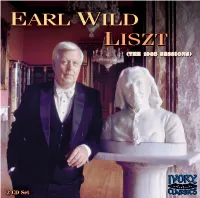
EARL WILD LISZT THE 1985 SESSIONS DISC 1 From “Années de Pèlerinage” Second Year: Italy (S161/R10b) 1 Après une lecture du Dante (Fantasia quasi Sonata) 15:58 [“Dante Sonata”] (Andante maestoso - Presto agitato assai - Tempo I (Andante) - Andante (quasi improvvisato) - Andante - Recitativo - Adagio - Allegro moderato - Più mosso - Tempo rubato e molto ritenuto - Andante - Più mosso - Allegro - Allegro vivace - Presto - Andante (Tempo I)) 2 Sonetto 47 del Petrarca 6:20 (Preludio con moto - Sempre mosso con intimo sentimento) 3 Sonetto 104 del Petrarca 6:31 (Agitato assai - Adagio - Agitato) 4 Sonetto 123 del Petrarca 7:04 (Lento placido - Sempre lento - Più lento - (Tempo iniziale)) From “Années de Pèlerinage” Third Year (S163/R10e) 5 Les jeux d’eau à la Villa d’Este 7:41 (Fountains of the Villa d’Este) (Allegretto) 6 Ballade No.2 in B minor (S171/R16) 13:59 (Allegro moderato - Lento assai - Tempo I - Lento assai - Allegretto - Allegro deciso - Allegretto - Allegretto sempre legato - Allegro moderato - Un poco più mosso - Andantino) From “Liebesträume, 3 Notturnos” (S541/R211) 7 Liebesträume (Notturno) No.2 in E flat Major (2nd Version) 4:27 (“Seliger Tod”) (Quasi lento, abbandonandosi) 8 Liebesträume (Notturno) No.3 in A flat Major 4:26 (“O lieb, so lang du lieben kannst!”) (Poco allegro, con affetto) 9 Concert Étude No.3 in D flat Major (“Un Sospiro”) (S144/R5) 5:14 (Allegro affettuoso) Total Playing Time : 72:16 – 2 – DISC 2 Bach/Liszt: Fantasia and Fugue in G minor (S463/R120) 11:12 1 Fantasia (Grave) 5:49 2 Fugue (Allegro) 5:23 Sonata -

REHEARSAL and CONCERT
Boston Symphony Orchestra. SYMPHONY Hall, boston, HUNTINGTON AND MASSACHUSETTS AVENUES. (Telephone, 1492 Back Bay.) TWENTY-FIFTH SEASON, I905-J906. WILHELM GERICKE, CONDUCTOR. programme OF THE SIXTH REHEARSAL and CONCERT WITH HISTORICAL AND DESCRIPTIVE NOTES BY PHILIP HALE. FRIDAY AFTERNOON, NOVEMBER 24, AT 2.30 O'CLOCK. SATURDAY EVENING, NOVEMBER 25, AT 8.00 O'CLOCK. Published by C. A. ELLIS, Maiuger. 381 HAROLD BAUER Who gives his first Boston Recital of this season in Jordan Hall on Monday Afternoon, November 27, writes as follows of the iiasini&3|araltn PIANO Messrs. Mason & Hamlin, Boston. Gentlemen : In a former letter to you I expressed my delight and satisfaction with your magnifi- cent pianofortes, and I have once more to thank you and to admire your untiring efforts to attain an artistic ideal. Your latest model, equipped with the centri(>etal tendon bars, has developed and intensified the qualities of its precursors and has surpassed my highest expectations. As you know, I have used these instruments under many different conditions, in recital, with orchestra, in small and in large halls, and their adaptability to all require- ments has equally astonished and delighted me. The tone is, as always, one of never- failing beauty, the action is wonderful in its delicacy and responsiveness, and I consider that, as an instrument for bringing into prominence the individual qualities of tone and touch of the player, the Mason & Hamlin piano stands absolutely pre-eminent. The vertical grand (style O) is the only instrument of its kind, as far as I am aware, capable of giving complete satisfaction lo any one accustomed to play upon a grand, and I have no hesitation in saying that it is without exception the finest upright piano I have ever met with. -

Journal 128.Qxd 04/10/00 09:32 Page 1
Journal 128 Cover.qxd 04/10/00 09:37 Page 1 The Delius Society JOURNAL Autumn 2000 Number 128 Journal 128.qxd 04/10/00 09:32 Page 1 The Delius Society Journal Autumn 2000, Number 128 The Delius Society (Registered Charity No. 298662) Full Membership and Institutions £20 per year UK students £10 per year USA and Canada US$38 per year Africa, Australasia and Far East £23 per year President Felix Aprahamian Vice Presidents Roland Gibson MSc, PhD (Founder Member) Lionel Carley BA, PhD Meredith Davies CBE Sir Andrew Davis CBE Vernon Handley MA, FRCM, D Univ (Surrey) Richard Hickox FRCO (CHM) Lyndon Jenkins Tasmin Little FGSM, ARCM (Hons), Hon D.Litt, DipGSM Sir Charles Mackerras CBE Rodney Meadows Robert Threlfall Chairman Roger J. Buckley Treasurer and Membership Secretary Stewart Winstanley Windmill Ridge, 82 Highgate Road, Walsall, WS1 3JA Tel: 01922 633115 Email: delius@ukonline.co.uk Secretary Squadron Leader Anthony Lindsey 1 The Pound, Aldwick Village, West Sussex PO21 3SR Tel: 01243 824964 Journal 128.qxd 04/10/00 09:32 Page 2 Editor Jane Armour-Chélu ************************************************************* **************************** ******************************* Website: http://www.delius.org.uk Email: delius@ukonline.co.uk ISSN-0306-0373 Journal 128.qxd 04/10/00 09:32 Page 3 CONTENTS Chairman’s Message........................................................................................... 5 Editorial................................................................................................................ 7 ORIGINAL -

Ignacy Jan Paderewski's Sonata in E-Flat Minor
IGNACY JAN PADEREWSKI’S PIANO SONATA IN E-FLAT MINOR, OPUS 21: INSIGHTS INTO HIS COMPOSITIONAL TECHNIQUE AND PERFORMANCE STYLE Anne Marie Nelson, B.A., M.M. Dissertation Prepared for the Degree of DOCTOR OF MUSICAL ARTS UNIVERSITY OF NORTH TEXAS May 2003 APPROVED: Adam Wodnicki, Major Professor and Examination Chair Deanna Bush, Minor Professor Pamela Mia Paul, Committee Member James C. Scott, Dean of the College of Music C. Neal Tate, Dean of the Robert B. Toulouse School of Graduate Studies Nelson, Anne Marie, Ignacy Jan Paderewski’s Sonata in E-Flat Minor, Op. 21: Insights into his compositional technique and performance style. Doctor of Musical Arts (Performance), May 2003, 192 pp., 9 tables, 80 examples, references, 132 titles. The recordings of the legendary pianist Ignacy Jan Paderewski are a valuable documentation of his piano performance style. Knowledge of late-Romantic performance practices gleaned from Paderewski’s recordings suggest ways of approaching the performance of his Sonata in E-Flat Minor, Op. 21. This Sonata, composed in 1903 near the end of his compositional career, is a work of the highest caliber, deserving a permanent place in the concert pianist’s repertoire. The purpose of this paper is to provide performance suggestions based on Paderewski’s performance style which will produce a performance closer to the spirit of the times in which it was written. This study provides an overview of the project in Chapter 1, and a background of Paderewski’s life as pianist, composer, and statesman in Chapter 2. A time-line chart of his complete works is included for reference.