M Carlton Premiership~
Total Page:16
File Type:pdf, Size:1020Kb
Load more
Recommended publications
-

RECONCILIATION ACTION PLAN May 2015 to May 2017
WEST COAST EAGLES FOOTBALL CLUB AND WIRRPANDA FOUNDATION RECONCILIATION ACTION PLAN May 2015 to May 2017 1 2 “My name is Josh Hill. I was born and bred “I am a proud Noongar person, with strong in WA and play football for the West Coast cultural beliefs that were passed on to me Eagles. I’m 26 years old and proud to be a by my father and grandparents. I am a past member of two Indigenous tribes, namely player of the West Coast Eagles Football Club the Noongar and Bardi tribes. I’m very proud and currently employed at the club as an of my culture. We have faced tough times Indigenous Liaison Officer. The West Coast in the past, but still manage to stand strong Eagles Football Club’s Reconciliation Action together and fight racism, discrimination and Plan outlines the club’s actions and outcomes, which will strengthen inequality. The club’s development of a Reconciliation Action Plan will their relationships and gain respect with the Aboriginal and Torres be amazing in demonstrating respect for our culture and helping create Strait Islander peoples. I personally will support the West Coast Eagles opportunities for Aboriginal and Torres Strait Islander people. The Football Club and will assist the club to understand our cultural ways to opportunities will help drive and motivate those in need to push for a achieve the positive outcomes for Aboriginal and Torres Strait Islander better future. A lot of people out there don’t get the opportunities and peoples. We need to walk the pathway through the West Coast Eagles I personally will be helping as much as possible to mentor those in need gateway together as ONE. -
The Modern Coach Is
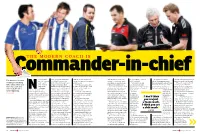
Commander-in-chiefthe modern coach is ot for the first club,” said North Melbourne staff, the media and, through implementation of different the performance of all our One minute it is about a intoned with sharp directness if The demands of modern time, the concept coach Brad Scott, who has the media, supporters to impress systems or structures to make staff,” Scott said. player’s living arrangements, anyone stepped over the mark. coaching are becoming of the coach been in the job two years, after along the way. sure things are geared around “To be able to do that, the next training loads are being What such a system allowed more complex than ever. in the modern an apprenticeship as Mick No wonder effective senior working towards that vision.” I need to have relevant discussed. Then the president was for people to flourish As the face and leader game needs Malthouse’s development and coaches are now up there with The coach is pivotal in setting qualifications and at least a base is on the phone, then there is within their area of expertise— of the club, the role is explaining. assistant coach at Collingwood. the best and the brightest in that direction, but he does not level of understanding in all the team meeting detailing whether as an assistant coach, As the role has become What clubs need now more the community. work in isolation. The club’s those areas.” systems for the a physiotherapist, sports all-encompassing. N scientist, doctor or information more complicated, the gap than ever is a coach-manager, “The tactical side of things system must work to support It is hard game ahead, PETER RYAN between what the talkback set someone with a skill set akin to and actual football planning is the football department’s vision to imagine and then the technology manager—without imagines clubs require and what that of any modern executive potentially the easiest thing,” so the club CEO, the board Jock McHale list manager over-reaching it. -

Coaching Lessons
VOLUME 23, No 1 May 2009 How AFL Coaches Learn Jeff Gieschen’s Coaching Lessons Celebrating Culture Getting the best out of Indigenous players COACHING EDGE CoachingEdge CONTENTS Jeff Gieschen: coaching 0 5 lessons I have learned Coaching your 10 own child Nutrition for 12 football How AFL 1 4 coaches learn Coaching Indigenous 19 players 28 The key to tackling best in the business: Geelong coach Mark Thompson has transformed the Cats into one of the most dominant sides of the modern era; after round six this year they had won 45 of their past 48 matches. INtrODUCtION A resource for coaches at all levels Welcome to Coaching Edge. the Australian Football Coaches conducted junior development As part of the changes to Association (AFCA) Vic Branch in programs until the VFL assumed CoachingEdge CrEdITS the Australian Football Coaches 1987. There was also a predecessor, responsibility for state development Publisher Association (AFCA) structure in Australian Football Coach, published in 1988), was the editor and Australian Football 2008, in which membership is now by SANFL from 1972 until 1975. designer of the magazine throughout League automatically a part of the process of The inaugural AFCA Vic branch its life. GPO Box 1449 Melbourne Vic 3001 AFL coach accreditation, the president was Allan Jeans, who Coaching Edge is edited by Ken Correspondence to: AFL is now providing services provided the initial editorials. Davis. Ken has a long history of Peter romaniw nationally to complement those Allan was supported by an involvement in sport, physical Peter.romaniw provided by state and regional active committee, including VFL education and coaching. -

Health and Physical Education
Resource Guide Health and Physical Education The information and resources contained in this guide provide a platform for teachers and educators to consider how to effectively embed important ideas around reconciliation, and Aboriginal and Torres Strait Islander histories, cultures and contributions, within the specific subject/learning area of Health and Physical Education. Please note that this guide is neither prescriptive nor exhaustive, and that users are encouraged to consult with their local Aboriginal and Torres Strait Islander community, and critically evaluate resources, in engaging with the material contained in the guide. Page 2: Background and Introduction to Aboriginal and Torres Strait Islander Health and Physical Education Page 3: Timeline of Key Dates in the more Contemporary History of Aboriginal and Torres Strait Islander Health and Physical Education Page 5: Aboriginal and Torres Strait Islander Health and Physical Education Organisations, Programs and Campaigns Page 6: Aboriginal and Torres Strait Islander Sportspeople Page 8: Aboriginal and Torres Strait Islander Health and Physical Education Events/Celebrations Page 12: Other Online Guides/Reference Materials Page 14: Reflective Questions for Health and Physical Education Staff and Students Please be aware this guide may contain references to names and works of Aboriginal and Torres Strait Islander people that are now deceased. External links may also include names and images of those who are now deceased. Page | 1 Background and Introduction to Aboriginal and Torres Strait Islander Health and Physical Education “[Health and] healing goes beyond treating…disease. It is about working towards reclaiming a sense of balance and harmony in the physical, psychological, social, cultural and spiritual works of our people, and practicing our profession in a manner that upholds these multiple dimension of Indigenous health” –Professor Helen Milroy, Aboriginal Child Psychiatrist and Australia’s first Aboriginal medical Doctor. -

Race, Photographs and Cathy Freeman at the Northcote Koori Mural
A Forgotten Picture: Race, Photographs and Cathy Freeman at the Northcote Koori Mural This is the Accepted version of the following publication Osmond, Gary and Klugman, Matthew (2019) A Forgotten Picture: Race, Photographs and Cathy Freeman at the Northcote Koori Mural. Journal of Australian Studies, 43 (2). pp. 203-217. ISSN 1444-3058 The publisher’s official version can be found at https://www.tandfonline.com/doi/full/10.1080/14443058.2019.1581247 Note that access to this version may require subscription. Downloaded from VU Research Repository https://vuir.vu.edu.au/39123/ A Forgotten Picture: Race, Photographs, and Cathy Freeman at the Northcote Koori Mural Visual images have played a key role in the history of Australia’s troubled race relations. As Jane Lydon has detailed, images of Aboriginal Australians and Torres Straight Islanders have been not only a key route by which non-Indigenous Australians have come to believe they know Indigenous Australians, but also a powerful site of intervention, protest and resistance by Indigenous Australians.1 The power of these images as a site of engagement, negotiation and struggle has depended on their circulation and reproduction – images typically need to be seen, often over and over again, in order to have a significant impact. It is a simple point, but one that is often taken for granted in the study of photographs and other visual images. It leads to the question of why certain images have become renowned, celebrated or decried, while others that appear equally (or more) deserving have not. This paper is concerned with one such image – of Australian athlete Cathy Freeman – that seems to have had little impact and was quickly forgotten, despite appearing on the front page of Melbourne’s most-read newspaper, the tabloid Herald Sun, in 1994, a time of intense debate around Australia’s race- relations. -

Lives & Breathes His Way To
OFFICIAL PUBLICATION OF THE WAFL ROUND 3 AprIL 1, 2017 $3.00 Jones lives300 & breathes games his way to » Game previews » Entertainment » Collectables CONTENTS 3 Every Week 6 Collectables 7 Tipping 7 Tweets of the Week 20-22 WAFC 23 Club Notes 25 Stats 26 Scoreboards and ladders 27 Fixtures Features 4-5 Jones lives and breathes his way to 300 games 8 Entertainment Game time 9 Game previews 10-11 Perth v Claremont 12-13 Peel v South Fremantle 14-15 East Perth v Swan Districts 16-17 West Perth v Subiaco 18 West Coast v St Kilda 18 CONTENTS Port Adelaide v Fremantle 4 Jones lives and300 breathes his way to Publisher games This publication is proudly produced for the WA Football Commission by Media Tonic. Phone 9388 7844 Fax 9388 7866 Sales: sales@mediatonic.com.au Editor Tracey Lewis Email: traceylewis@bigpond.com Photography Andrew Ritchie, Duncan Watkinson, Showcase photgraphix Design/Typesetting Jacqueline Holland Direction Design and Print Printing Data Documents www.datadocuments.com.au Cover Clint Jones - by Duncan Watkinson The Football Budget is printed on Gloss 90gsm paper, which is sourced from a sustainably managed forest and uses manufacturing processes of the highest environmental standards. Bouncedown is printed by an Environmental Accredited printer. The magazine is 100% recyclable. WAFL admission prices $15 – Adult* $12 – Concession* Free – Children 15 and under *Includes a copy of Football Budget Find us on Copyright © No part of this publication may be reproduced or stored in a retrieval system without the permission of the publisher. Opinions expressed in the Football Budget are not necessarily those of the WAFC. -
Aboriginal Rules: the Black History of Australian Football Abstract
Original Articles Aboriginal Rules: The Black History of Australian Football Full access ArticleDoiMeta DOI:10.1080/09523367.2015.1124861 Sean Gormana*, Barry Juddb, Keir Reevesc, Gary Osmondd, Matthew Klugmane & Gavan McCarthyf Abstract This paper is interested in the significance of Australian football to the Aboriginal and Torres Strait Islander people of Australia. In particular, this paper is interested in the cultural power of football and how it has foregrounded the struggle and highlighted the contribution that Indigenous people have made to the national football code of Australia. This paper also discusses key moments in Indigenous football history in Australia. It questions further that a greater understanding of this contribution needs to be more fully explored from a national perspective in order to appreciate Indigenous peoples’ contribution to the sport not just in elite competitions but also at a community and grass roots level. Introduction What may have begun as a simple forgetting of other possible views turned under habit and over time into something like a cult of forgetfulness practised on a national scale. W.E.H. Stanner 1968.1 Graham ‘Polly’ Farmer is regarded as one of the best exponents of Australian Rules football. This was due to his abilities and innovative play that reshaped the game. Specifically, his agility and his long, quick handballs became great attacking manoeuvres that complemented Geelong’s potent midfield.2 Yet there is a distinct aspect to Farmer’s story that many historians and sports journalists do not know about, have forgotten or simply ignore. That is Farmer may never have had this illustrious career, if not for a vital change in Western Australia’s labour policies in 1952. -

Venue Information
Event Details Parking Public parking is available in all City of Perth car parks, Gloucester Park Foreshore & Arden St Reserve From 3.30pm @ $8.00 per bay. Public Transport Tickets purchased for New Years Eve include Public Transport on all Transperth services including special event services (see below) for 3 hours before, during and 3 hours after the event. BUS SERVICE TO GLOUCESTER PARK Red Cat Service: Will operate normal services running every 5 minutes from 6.50am until 6.20pm. Info on public transport phone the Transperth infoLine on 13 62 13 TTY 9428 1999 or visit the website www.transperth.wa.gov.au A shuttle bus service numbered 603 will run from the Wellington St Bus Station (Stand A15) to Gloucester Park from 5.00pm until 9.30pm. The buses will pick up patrons from Stand A15 at the Wellington St Bus Station and Cat Stops. BUS SERVICE FROM GLOUCESTER PARK A shuttle bus service numbered 603 will run from the main gates at Gloucester Park to the Perth Train Station & Wellington St Bus Station from midnight until 1.30am. Venue Pickup: Venue Collection Prepaid tickets will NOT be available for collection at the ground on the night. General Rules: Seating is general admission. Reserved seating is available in the JP Stratton Grandstand – contact Gloucester Park direct on 08 9323 3555. All other grandstand seating is open to the public. Catering: No BYO – licensed premises. Food & bars are positioned around the venue. For restaurant bookings please phone Red Pepper Catering 08 6210 8688. Children Rules: Children under the age of 5 are free. -

Thank You to This Year's Club Sponsors
THANK YOU TO THIS YEAR’S CLUB SPONSORS MAJOR SPONSOR MAJOR SUPPORT SPONSORS PREMIER PARTNERS OFFICIAL PARTNERS WOMENS SPONSORS STADIUM SPONSOR Claremont Football Club Annual Report 2020 | 2 Claremont Football Club Claremont Football Club (Inc) 95th Annual General Meeting Financial Statements and Balance Sheet to be presented to the Members at the Annual General Meeting. This will be held at the Claremont Football Club 3 Davies Road, Claremont on Thursday the 10th of December 2020 at 6.00pm. 1. APOLOGIES 5. FINANCE REPORT 2. MINUTES OF PREVIOUS MEETING 6. FOOTBALL REPORT 3. PRESIDENTS REPORT 7. RECOMMENDATIONS FOR AWARDS 4. RETURNING OFFICERS REPORT 8. GENERAL BUSINESS Claremont Football Club Annual Report 2020 | 3 2020 CLAREMONT FOOTBALL CLUB BOARD Darcy Coffey Grant Povey Brian Beresford Tim Sullivan Tony Evans CEO President Vice President Director Director Darrell Panizza Rachel Asquith Jeremy Sims Jenny Rogers Director Director Director Director 2020 BOARD MEMBERS ATTENDANCE PATRONAGE From 2020 AGM Meeting - PATRON Peter LAURANCE A.O Total of 13 monthly meetings VICE PATRONS Phillip CRABB PRESIDENT Grant POVEY 13 Meetings Sue KNOWLES VICE PRESIDENT Brian BERESFORD 12 Meetings Anne KYLE DIRECTORS Tony EVANS 12 Meetings Ross LEDGER Darrell PANIZZA 8 Meetings Erroll MARRON Jenny ROGERS 13 Meetings John O’CONNELL Jeremy SIMS 13 Meetings Ian OLDFIELD Kevin SOMES Tim SULLIVAN 11 Meetings Ken VENABLES Rachel ASQUITH 11 Meetings (Seconded in January) No. 1 Ticket Hon Colin BARNETT Holder CLUB OFFICE STAFF CHIEF EXECUTIVE OFFICER TALENT MANAGER FACILITIES MANAGER Darcy Coffey Jordan Smith Pat Coffey ACCOUNTANT ADMIN/MARKETING COORDINATOR BAR MANAGER Lisa MacNiell Holly Reed Arianne Kane FOOTBALL OPERATIONS MANAGER FUNCTIONS MANAGER Kepler Bradley Emma Woods Claremont Football Club Annual Report 2020 | 4 Claremont Football Club FOOTBALL STAFF COACHES Gate Staff Gail COLE League Head Coach Darren HARRIS Jason COLE League Asst. -

The Spoils Murray Caps Its Stellar Season
AFL VICTORIA $ INC TAC CUP ROUND 1, APRIL 4-5, 2009 3GST BUSHIES TAKE THE SPOILS MURRAY CAPS ITS STELLAR SEASON TAC01_Cover.indd 1 1/4/09 10:27:35 AM EDITORIAL The TAC Cup produced more than half of the players selected in the 2008 NAB AFL Draft, with the Murray Bushrangers (seen here celebrating their 2008 TAC Cup premiership) providing four of them. for learner drivers. Coupled with the football development role Major milestone the competition plays for these young men, the competition has been, and continues to be, an for competition outstanding success. AFL Victoria’s partnership In its 18th year, the TAC Cup remains the with the TAC is one of Australian elite under-age competition in the country. sport’s most enduring and successful relationships. Over the years the two organisations his year is a milestone Transport Accident Commission have worked closely together one for the TAC Cup, the (TAC) since 1992. Over those to develop programs that best nation’s premier under-18 18 years thousands of our TAC meet the TAC’s needs. We have no football competition. Cup players, peer group leaders doubt that the work undertaken TEighteen years ago in 1992 the by our region managers and the and role models in their local TAC Cup competition commenced communities across the state, players who have moved through after the former VFL under- have delivered the important road the TAC Cup development system 19s was scrapped following safety messages, the current one has positively contributed to the the formation of the national promoting 120 hours of practice decrease in the road toll since the competition. -

Inside the Teal Cup Treasure <Hest
Compiled by Michael Roberts • • Dean's 200:p JO• Under the hammer:pll • Translating Rex:pI? Inside the Teal Cup treasure <hest ast your mind back ing each other so well ten years. Eagles was a big advantage," he Cwere something you says. "Woosha, Bluey dreamt about on the golf and myself are still course, Dockers were together on the backline allies of Painters, and like we were then." almost every decent 'Bluey' McKenna was young player in Western ruled out of the Teal Cup AustraHa headed east to Grand Final with an find his footballing for- ankle injury but spent all tune. night with his foot in an In 1985 something icy swimming pool and happened that didn't convinced the selectors attract too much atten- he could play. tion outside Perth, but The coach was Grant which would later be Dorrington, now Special revealed as a truly signif- Projects Manager at Fre- icant moment in WA mantle. "What set them football. Western Aus- apart from most junior tralia won the Teal Cup teams was they gelled for the first time, beating unbelievably as a team. the cocky Victorians in YESTERDAY'S HEROES, TODAY'S CHAMPIONS: The team photo of the 1985 They were a unique group Perth. Teal Cup Premiership side includes some great WA talent of guys, with an almost Look through the WA eerie strength of character. side from that year and you can think we were still down at No-one else can be the first, "Their 'no-one's-going-to- see why they went so well. -

Indigenous Participation in Australian Sport History
Sporting Chance: Indigenous Participation in Australian Sport History Sean Gorman Curtin University, Western Australia Abstract For many non-Indigenous Australians the only time they have any engagement with Indigenous peoples, history or issues is through watching sport on television or being at a football match at ground like the MCG. This general myopia and indifference by settler Australians with Indigenous Australians manifests itself in many ways, but perhaps most obscenely in the simple fact that Indigenous Australians die nearly 20 years younger than the rest of Australia’s citizens. Many non-Indigenous Australians do not know this. Sport in many ways has offered Indigenous Australians a platform from which to begin the slow, hard process for social justice and equity to be actualised. This paper will discuss the participation of Indigenous Australians in sport and show how it has enabled Indigenous Australians to create a space so that they can speak out against the injustices they have experienced and to improve race relations going into the future. The central contention is that through sport all Australians can begin a process of engaging with Indigenous history as a means to improve race relations between the two groups. Sport has been our greatest ally (Michael Long 19/5/2009). Background History has shown us that many relationships, friendships or unions between first Australians and settlers has been fraught with danger, and in many cases doomed. Consider, for example, the ramifications of the 1905 Aborigines Act in Western Australia. Anna Haebich notes that this legislation was originally designed out of the concerns of the Chief Protector of Aborigines, Mr Henry Charles Prinsep, who sought to “make provision for the better protection and care of the Aboriginal inhabitants of Western Australia” (Haebich 1988, p.83).