Come Back to Jesus: a Lenten Devotional by the Readers And
Total Page:16
File Type:pdf, Size:1020Kb
Load more
Recommended publications
-

History of Bergen Congregation Compiled for Golden Jubilee (51St Anniversary) July 12-13, 1936 by R
History of Bergen Congregation Compiled for Golden Jubilee (51st Anniversary) July 12-13, 1936 by R. S. Sigdestad The Bergen congregation in Day County, South Dakota, was organized in the home of Nels Williamson Sr., by Lynn Lake, in the autumn of 1885, by Rev. K. 0. Storli of Wilmot, S. Dak., on one of his mission journeys. It consisted of the following 17 voting members: Iver E. Skaare, Rasmus K. Mork, Ole Simonson, Ole E. Bakken, John J. Grove, Sakarias J. Sigdestad, Kolben T. Mork, John S. Sigdestad, Jacob K. Mork, Erik Winson, Ole Aas, Ole Monson, Nels Williamson Sr., Ole Svang, Martin Davidson, Hans Anderson and Martin Anderson. In 1886, together with Webster, Grenville and Fron churches, a call was extended to candidate in theology, .C M. Nordtvedt to become their pastor. He served until the fall of 1889 when he moved to Wisconsin. Two acres of land was donated to the congregation by Anton Norby for a cemetery in 1887. It was consecrated by Rev. Nordtvedt in 1888, and the first one t& be buried there was Anfin Sand, March 13 of that year. The first infant to be baptized of families who later became Bergen Church was Serine Skaare (Mrs. Lars Mydland) in the home of John Tofley, Dec. 5,1984. And the first child of Bergen to be baptized was Selma Grove (Mrs. Rasmus Egge) in the Nels Williamson home in October, 1885. Both were baptized by Rev. Storli. The first confirmation was held by Rev. Nordtvedt June 10, 1887, when the following were confirmed: Kolben K. -

Guide to South Dakota Norwegian-American Collections
GUIDE TO COLLECTIONS RELATING TO SOUTH DAKOTA NORWEGIAN-AMERICANS Compiled by Harry F. Thompson, Ph.D. Director of Research Collections and Publications The Center for Western Studies With the assistance of Arthur R. Huseboe, Ph.D. and Paul B. Olson Additional assistance by Carol Riswold, D. Joy Harris, and Laura Plowman Originally published in 1991 by The Center for Western Studies, Augustana College, Sioux Falls, SD 57197 and updated in 2007. Original publication was made possible by a grant from the South Dakota Committee on the Humanities and by a gift from Harold L. Torness of Sisseton, South Dakota. TABLE OF CONTENTS Introduction 1 Albright College 2 Augustana College, The Center for Western Studies 3 Augustana College, Mikkelsen Library 4 Augustana College (IL), Swenson Swedish Immigration Research Center 5 Black Hills State University 6 Brookings Public Library 7 Canton Public Library 8 Centerville Public Library 9 Codington County Historical Society 10 Cornell University Libraries 11 Dakota State University 12 Dakota Wesleyan University 13 Dewey County Library 14 Elk Point Community Library 15 Grant County Public Library 16 Phoebe Apperson Hearst Library 17 J. Roland Hove 18 Luther College 19 Minnehaha County Historical Society 20 Minnehaha County Rural Public Library 21 Minnesota Historical Society, Research Center 2 22 Mitchell Area Genealogical Society 23 Mobridge Public Library 24 National Archives--Central Plains Region 25 North Dakota State University, North Dakota Institute for Regional Studies 26 Norwegian American Historical Association 27 James B. Olson 28 Rapid City Public Library 29 Rapid City Sons of Norway Borgund Lodge I-532 30 Regional Center for Mission--Region III, ELCA 31 St. -
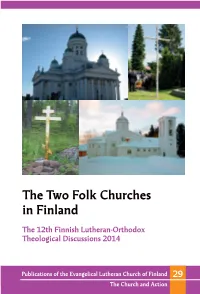
The Two Folk Churches in Finland
The Two Folk Churches in Finland The 12th Finnish Lutheran-Orthodox Theological Discussions 2014 Publications of the Evangelical Lutheran Church of Finland 29 The Church and Action The Two Folk Churches in Finland The 12th Finnish Lutheran-Orthodox Theological Discussions 2014 Publications of the Evangelical Lutheran Church of Finland 29 The Church and Action National Church Council Department for International Relations Helsinki 2015 The Two Folk Churches in Finland The 12th Finnish Lutheran-Orthodox Theological Discussions 2014 © National Church Council Department for International Relations Publications of the Evangelical Lutheran Church of Finland 29 The Church and Action Documents exchanged between the churches (consultations and reports) Tasknumber: 2015-00362 Editor: Tomi Karttunen Translator: Rupert Moreton Book design: Unigrafia/ Hanna Sario Layout: Emma Martikainen Photos: Kirkon kuvapankki/Arto Takala, Heikki Jääskeläinen, Emma Martikainen ISBN 978-951-789-506-4 (paperback) ISBN 978-951-789-507-1 (PDF) ISSN 2341-9393 (Print) ISSN 2341-9407 (Online) Unigrafia Helsinki 2015 CONTENTS Foreword ..................................................................................................... 5 THE TWELFTH THEOLOGICAL DISCUSSIONS BETWEEN THE EVANGELICAL LUTHERAN CHURCH OF FINLAND AND THE ORTHODOX CHURCH OF FINLAND, 2014 Communiqué. ............................................................................................. 9 A Theological and Practical Overview of the Folk Church, opening speech Bishop Arseni ............................................................................................ -

Herran Tulet on Historiallinen Romaani
1 2 VELI TUOMI 3 Kannen kuva ja suunnittelu: Veli Tuomi Puh. 040-592 7510 Sähköposti: veli.tuomi@omanetti.fi Kirjatilaukset kustantajalta: Juurikasvu-kustannus Mankolantie 16 a, 40200 Jyväskylä Puh. (014) 633 334 Sähköposti: juurikasvu@kolumbus.fi Internet: www.juurikasvu.net ISBN 952-99747-1-X Tekninen toteutus: Lievonen T:mi 2007 4 Sisällysluettelo Lukijalle ................................................................................. 8 1. LUKU ..................................................................................... 13 Tulet syttyvät ....................................................................... 13 Seuroissa ............................................................................. 13 Tulet ja seuraukset............................................................... 30 2. LUKU ..................................................................................... 37 Tansseissa .......................................................................... 37 Riihellä ................................................................................. 37 Jälkipuintia ........................................................................... 45 3. LUKU ..................................................................................... 49 Herääminen ......................................................................... 49 Kaksi naista ......................................................................... 49 Kertomus ............................................................................. 50 Iidan löytö ........................................................................... -

Paavo Ruotsalainen
z w (/') (/') w " Paavo Ruotsalainen . " <( ....J Ein Zeuge der Erweckung ' a:::: w > in Finnland 1 z w z Burkard Krug z ::::> a:::: CO Band 184 der Sammlung „Zeugen des gegenwärtigen Gottes" Paavo Ruotsalainen Ein Zeuge der Erweckung in Finnland Von Burkard Krug BRUNNEN=VERLAG GMBH · GIESSEN UND BASEL INHALT Vorwort 5 Wenn Gottes Winde wehen . 7 Paavos Jugend . 9 "Eins aber fehlt dir!" 11 Die Hochschule der "Kiefernfabrik" 13 Reisender im Auftrag Gottes 17 Mitarbeiter und Freunde . 20 Kämpfe und Prozesse 27 Der große Seelsorger 36 Glaube und Humor . 43 Das Boot liegt am Ufer 45 Wie es weiterging 49 Anhang: Warum werden nicht alle Erweckten selig? . 60 Literatur- und Quellenhinweis . 70 © 1969 by Brunnen-Verlag, Gießen Prlnted In Germany Druck: Buch- und Offsetdruckerel Hermann Rathmann, Marburg an der Lahn Vorwort Finnland, das Land der tausend Seen und der uner meßlichen Wälder, der Mitternachtssonne und des Nord lichts, hat in den letzten Jahren schon viele Reisende aus Deutschland angelockt. Aber nur wenige von ihnen wis sen etwas über das Glaubensleben der finnischen Kirche und die in ihr so lebendige Erweckungsbewegung, die nun schon über 170 Jahre wirksam ist. Um eine geistige Bewegung recht verstehen zu können, ist es nötig, auch etwas über ihren geographischen Hinter grund zu wissen. Darum sei dieser Arbeit ein Gedicht von dem finnischen Dichter Eino Leino über Finnland voran gestellt: Finnland Einst zog der Heiland auch nach Norden weit, wo Finnland liegt in seiner Einsamkeit. Nur zögernd folgte Petrus seinem Herrn; Wacholderpfade wandelt er nicht gern. "Ach Herr, in welches Land sind wir gelangt! Welch Volk, das ohne Kraft und Willen schwankt! Das Moor verhöhnt den Pflug, Schutt deckt die Felder, Frucht tragen hierzulande nur die Wälder." Doch mild und leise redete Herr Christ: "Daß dieses Land ein wenig ärmlich ist und allzu karge Ernten trägt, macht Sorgen; doch Zukunft ist in dieser Art verborgen." Es lächelte der Herr, indem er sprach. -

HL:N Vapaasti Tykitettävät Laulut V. 2011
HL:n vapaasti tykitettävät laulut v. 2011 (olettaen, että tuntemattomat ovat oikeasti tuntemattomia… Jos joku tietää paremmin, ilmoittakoot: hsm(at)hsmry.fi) 1 Pyhä, pyhä, pyhä san. Reginald Heber (k. 1826) suom. Mikael Nyberg (k. 1940) 4 Jumala ompi linnamme san. Martti Luther (k. 1546) suom. Jacobus Petri Finno (Jaakko Suomalainen) (k. 1588) 5 Herralle kiitos ainiaan san. Thomas Ken (k. 1711) suom. tuntematon 7 Armo Jumalan san, Jens Nicolai Ludvig Schjörring (k. 1900) suom. tuntematon 9 Laula Herran rakkaudesta san. Samuel Trevor Francis (k. 19259 suom. tuntematon 10 Laula minulle uudestaan san. Philip Paul Bliss (k. 1876) suom. tuntematon 11 Uskomme Jumalaan san. Saksalainen suom. Julius Leopold Fredrik Krohn (k. 1888) 12 Min lupaapi Herra san. S. C. Kirk (k. 1900-luvulla) suom. tuntematon 13 Suuri Jumala, sinussa san. Josepha Gulseth (k. ?) suom. tuntematon 14 Oi Herra suuri san. Carl Gustaf Boberg (k. 1940) suom. tuntematon 15 Oi Jeesus, sanas ääreen san. Anna Helena Ölander (k. 1939) suom. Tekla Renfors, os. Mömmö (k. 1912) 17 Minä tyydyn Jumalaan san. Benjamin Schmolock (k. 1700-luvulla) suom. tuntematon 18 On Herra suuri san. Anton Valtavuo (k. 1931) 22 Suuri Luoja, kiittäen san. Ignaz Franz (k. 1790) suom. Aina G. Johansson (k. 1932) 24 Tää sana varma san. Joël Blomqvist (k. 1930) suom. tuntematon 26 En etsi valtaa loistoa san. Sakari Topelius (k. 1898) suom. tuntematon 28 Joulu, joulu tullut on san. Olli Vuorinen (k. 1917) 29 Enkeli taivaan san. Martti Luther suom. Hemminki Maskulainen, uud. Julius Krohn (k. 1888) 31 Kun joulu valkeneepi san. Abel Burckhart (k. 1800-luvulla) suom. tuntematon 32 Juhla on rauhainen san. -

The Körtti Movement and Dress in Battles Over Finnish Politics
Title A tale of two centuries: The körtti movement and dress in battles over Finnish politics and identities Type Article URL https://ualresearchonline.arts.ac.uk/id/eprint/15285/ Dat e 2 0 1 9 Citation Almila, Anna-Mari (2019) A tale of two centuries: The körtti movement and dress in battles over Finnish politics and identities. Clothing Cultures. ISSN 2050-0742 Cr e a to rs Almila, Anna-Mari Usage Guidelines Please refer to usage guidelines at http://ualresearchonline.arts.ac.uk/policies.html or alternatively contact ualresearchonline@arts.ac.uk . License: Creative Commons Attribution Non-commercial No Derivatives Unless otherwise stated, copyright owned by the author This is the accepted article in its pre-edited stage. Please refer to the published article in the journal Clothing Cultures https://www.intellectbooks.com/clothing-cultures A tale of two centuries: The körtti movement and dress in battles over Finnish politics and identities Anna-Mari Almila Abstract This paper looks into the transforming sartorial styles of a certain Christian Protestant revivalist movement in Finland in and around two very specific historical moments: independence from Russia in 1917; and 2017, when the Marriage Act was amended such that same-sex marriage become legal. The analysis covers crucial periods before and after the independence: late 19th and early 20th century, when Russia sought to tighten its control over autonomous Finland, and the Finnish intelligentsia organised to resist such attempts, through the civil war of 1918, to the turbulent right/left-divided years of the 1920s and 1930s. Then, the liberalisation of the körtti movement from the 1960s and 1970s onwards, and the effect of this upon the debates and battles over the equal marriage law before and after the law came into effect is discussed. -
This Is a Self-Archived Version of an Original Article. This Version May Differ from the Original in Pagination and Typographic Details
This is a self-archived version of an original article. This version may differ from the original in pagination and typographic details. Author(s): Mangeloja, Esa Title: Religious Revival Movements and the Development of the Twentieth-century Welfare- state in Finland Year: 2019 Version: Published version Copyright: © 2019 the Authors Rights: CC BY-NC-ND 4.0 Rights url: https://creativecommons.org/licenses/by-nc-nd/4.0/ Please cite the original version: Mangeloja, E. (2019). Religious Revival Movements and the Development of the Twentieth- century Welfare-state in Finland. In K. Sinnemäki, A. Portman, J. Tilli, & R. Nelson (Eds.), On the Legacy of Lutheranism in Finland : Societal Perspectives (pp. 220-236). Suomalaisen Kirjallisuuden Seura. Studia Fennica Historica, 25. https://oa.finlit.fi/site/books/10.21435/sfh.25/ On the Legacy of Lutheranism in Finland Societal Perspectives Edited by Kaius Sinnemäki, Anneli Portman, Jouni Tilli and Robert H. Nelson Finnish Literature Society Ü SKS Ü Helsinki Ü 2019 studia fennica historica 25 The publication has undergone a peer review. © 2019 Kaius Sinnemäki, Anneli Portman, Jouni Tilli, Robert H. Nelson and SKS License CC-BY-NC-ND 4.0 International Cover Design: Timo Numminen EPUB: Tero Salmén ISBN 978-951-858-135-5 (Print) ISBN 978-951-858-150-8 (PDF) ISBN 978-951-858-149-2 (EPUB) ISSN 0085-6835 (Studia Fennica. Print) ISSN 2669-9605 (Studia Fennica. Online) ISSN 1458-526X (Studia Fennica Historica. Print) ISSN 2669-9591 (Studia Fennica Historica. Online) DOI: https://doi.org/10.21435/sfh.25 This work is licensed under a Creative Commons CC-BY-NC-ND 4.0 International License. -
Transformative Readings of Sacred Scriptures: Christians and Muslims in Dialogue Documentation 62/2017
The interpretation of sacred scriptures engenders vivid debates in religious communities, both at the scholarly and grass-roots levels. Issues of debate LWF are the hermeneutical assumptions, the methods of interpretation, and the constructive and harmful implications of certain readings. For Christian and Muslim communities, themes related to God’s grace, violence, gender relations and ecology, are topical. As scholars from different contexts and faith backgrounds together interpret sacred texts they gain fresh insights into their meaning and their transformative dynamics. Essays by authors with expertise in scriptural interpretation, religious Transformative Readings studies, pastoral care, philosophical theology, gender studies and pedagogy explore Christian and Muslim perspectives on scriptural interpretation, and discuss how to understand how God communicates with the world today. of Sacred Scriptures CONTRIBUTORS: ADAMS, Nicholas; AMOS, Clare; BAIG, Naveed; BEKTOVIC, Christians and Muslims in Dialogue Safet; DRECHSLER, Katja; EL MAAROUFI-ULZHEIMER, Asmaa; EL OMARI, Dina; GRUNG, Anne Hege; KARTZOW BJELLAND, Marianne; LEIRVIK, Oddbjørn; KHORCHIDE, Mouhanad; KNAUTH, Thorsten; KOPP, Martin; MTATA, Kenneth; SCHREINER, Stefan; SINN, Simone; SYAMSUDDIN, Sahiron Transformative ReadingsTransformative of Sacred Scriptures DOC 62/2017 ISBN 9783-374-05430-5 EUR 20,00 [D] Doc 62 Transformative reading EN cover.indd 1 15.11.17 09:30 Transformative Readings of Sacred Scriptures: Christians and Muslims in Dialogue Documentation 62/2017 The views expressed in this publication are those of the authors and do not necessarily reflect the official position of the Lutheran World Federation Transformative Readings of Sacred Scriptures: Christians and Muslims in Dialogue Edited by Simone Sinn, Dina El Omari and Anne Hege Grung LWF Documentation 62 Bibliographic information published by the German National Library The Deutsche Nationalbibliothek lists this publication in the Deutsche Nationalbibliografie; detailed bibliographic data are available on the internet at http://dnd. -

Lutheran World Information
Lutheran World Information The Lutheran World Federation LWI – A Communion of Churches FEATURE: Where the LWF 150, route de Ferney P.O. Box 2100 Becomes Part of Civil Society CH-1211 Geneva 2, Switzerland The Lutheran World Fed- Telephone +41/22-791 61 11 eration (LWF) has partici- Fax +41/22-791 66 30 pated in the World Social E-mail: info@lutheranworld.org Forum (WSF) since the www.lutheranworld.org second such forum in 2002 Editor-in-Chief in Porto Alegre, Brazil. Karin Achtelstetter With each passing year, ka@lutheranworld.org the LWF delegation has grown in numbers and in- English Editor volvement in the various Pauline Mumia pmu@lutheranworld.org activities offered under the WSF theme “Another German Editor World is Possible.” Bra- World Social Forum 2005: A workshop on the Global Week of Action on trade and justice. © LWF/P. Prove Dirk-Michael Grötzsch zilian journalist Susanne dmg@lutheranworld.org Buchweitz, reporting for Lutheran World Information (LWI), spoke with a cross section of the 60-person Layout Stéphane Gallay delegation attending the January 26–31 forum in Porto Alegre. sga@lutheranworld.org “It was a very good opportunity for me to learn many things about the forum and current global issues,” said Mr Imrul Kayes Muniruzzaman, director for Circulation/Subscription social empowerment projects at the Rangpur Dinajpur Rural Service (RDRS) Janet Bond-Nash in Bangladesh. RDRS is one of the 24 field programs of the LWF Department jbn@lutheranworld.org for World Service (DWS). The Lutheran World Information (LWI) is the (See page 12) information service of the Lutheran World Federation (LWF). -

Why Is There No Church Unity Among Norwegian Lutherans in America?
WHY IS THERE NO CHURCH UNITY AMONG NORWEGIAN LUTHERANS IN AMERICA? Ulrik Vilhelm Koren [As printed in the Clergy Bulletin, V. 12:1, pp. 3-6; V. 12:2, pp. 19-24; V. 12:3, pp. 39-42; V. 12:4, pp. 49-52; V. 12:5, pp. 63-64. (Printed in Kirkentidende in 1905, and in Koren’s Samlede Skrifter, pp. 454-498 – translation by C. U. Faye)] Answer to Mr. Ulvestad and to many others. Mr. M. Ulvestad has, in several periodicals in January of this year, written an article with the heading, “Church Union,” and asks: “What separates Norwegian Lutherans in America?” He subscribes to what has often been said, that “most people do not know what is at issue in the conflict.” He says that “there are some (among the uninitiated) who believe, that this is merely a conflict among the leaders, while the majority do not know what they are to believe.” He says that “what is needed is a straight-forward explanation and comparison of the doctrinal differences that are said to exist.” He says that he has diligently tried to find the difference between us, especially by reading our respective periodicals, but has found no essential difference. He “has come to the conclusion, that it is our Christianity, and not our doctrinal concepts, that has suffered the most.” He says that “if this were the main issue about which there was disagreement, namely, the way to life in God and the way to salvation, then there would be no talk of uniting. One cannot compromise the Word of God. -

The Bible Among the Croatian People
S. Jambrek: The Bible Among the Croatian People The Bible Among the Croatian People Translating, printing and distributing the Bible in the context of proclaiming the Gospel STANKO JAMBREK The Biblical Institute, Kušlanova 21, Zagreb stanko.jambrek@zg.t-com.hr translated by Roger Massey UDK 22:27:286 Original scientific paper Received: February 14, 2007. Accepted: March 27, 2007. Summary Unfolding translations, editions and distributing of the Bible are underway in the context of evangelization in Croatia. The spiritual atmosphere in which the translations originated and the recognized spiritual movements from which the influences for translation sprang and whose members mainly spread indi- vidual editions of the New Testament and the whole Bible are analyzed within the framework of this paper. Introduction Throughout history, translation and distribution of the Bible have gone hand in hand with the spreading of the Christian faith. Jesus told his disciples, “All au- thority in heaven and earth has been given to me. Therefore go and make dis- ciples of all nations, baptizing them in the name of the Father and of the Son and of the Holy Spirit, teaching them to obey everything I have commanded you. And surely, I am with you always, to the very end of the age.” (Mt 28:18-20)1 Jesus’ commission to take the gospel to all nations and the coming and receiving of the power of the Holy Spirit on the day of Pentecost (Ac 1:5-8; 2:1-12) made the translation of the Scriptures foundational for the Christian identity. With the coming of the Holy Spirit on the Galilean disciples, they spoke in numerous languages about the magnificent works of God.