Last Film Directed by Yash Chopra Candt
Total Page:16
File Type:pdf, Size:1020Kb
Load more
Recommended publications
-

Movie Aquisitions in 2010 - Hindi Cinema
Movie Aquisitions in 2010 - Hindi Cinema CISCA thanks Professor Nirmal Kumar of Sri Venkateshwara Collega and Meghnath Bhattacharya of AKHRA Ranchi for great assistance in bringing the films to Aarhus. For questions regarding these acquisitions please contact CISCA at cisca@hum.au.dk (Listed by title) Aamir Aandhi Directed by Rajkumar Gupta Directed by Gulzar Produced by Ronnie Screwvala Produced by J. Om Prakash, Gulzar 2008 1975 UTV Spotboy Motion Pictures Filmyug PVT Ltd. Aar Paar Chak De India Directed and produced by Guru Dutt Directed by Shimit Amin 1954 Produced by Aditya Chopra/Yash Chopra Guru Dutt Production 2007 Yash Raj Films Amar Akbar Anthony Anwar Directed and produced by Manmohan Desai Directed by Manish Jha 1977 Produced by Rajesh Singh Hirawat Jain and Company 2007 Dayal Creations Pvt. Ltd. Aparajito (The Unvanquished) Awara Directed and produced by Satyajit Raj Produced and directed by Raj Kapoor 1956 1951 Epic Productions R.K. Films Ltd. Black Bobby Directed and produced by Sanjay Leela Bhansali Directed and produced by Raj Kapoor 2005 1973 Yash Raj Films R.K. Films Ltd. Border Charulata (The Lonely Wife) Directed and produced by J.P. Dutta Directed by Satyajit Raj 1997 1964 J.P. Films RDB Productions Chaudhvin ka Chand Dev D Directed by Mohammed Sadiq Directed by Anurag Kashyap Produced by Guru Dutt Produced by UTV Spotboy, Bindass 1960 2009 Guru Dutt Production UTV Motion Pictures, UTV Spot Boy Devdas Devdas Directed and Produced by Bimal Roy Directed and produced by Sanjay Leela Bhansali 1955 2002 Bimal Roy Productions -
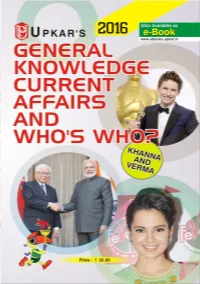
General Knowledge ABBREVIATIONS a A.A.F
General Knowledge ABBREVIATIONS A A.A.F. Auxiliary Air Force A.A.S.U. All Asom Students Union A.C.D. Asian Co-operation Dialogue A.D.B. Asian Development Bank A.E.C. Atomic Energy Commission A.F.P.R.O. Action for Food Production A.I.C.C. All India Congress Committee A.I.D.W.A. All India Democratic Women’s Association A.I.D.S. Acquired Immune Deficiency Syndrome A.I.H.B. All India Handicrafts Board A.I.R. Annual Information Report A.J.T. Advanced Jet Trainer A.P.E.C. Asia-Pacific Economic Cooperation A.R.F. ASEAN Regional Forum A.S.E.A.N. Association of South-East Asian Nations A.S.L.V. Augmented Satellite Launch Vehicle A.U. African Union A.V.E.S. Acute Viral Encephalitic Syndrome A.W.A.N. Army Wide Area Network A.Y.U.S.H. Ayurveda, Yoga, Unani, Siddha and Homeopathy B B.A.R.C. Bhabha Atomic Research Centre B.C.C.I. Board of Control of Cricket in India/Bank of Credit and Commerce International B.C.G. Bacillus Calmette Guerin (Anti-T.B. vaccine) B.C.T.T. Bank Cash Transaction Tax B.O.A.C. British Overseas Airways Corporation B.P.O. Business Process Outsourcing BREAD Basic Research Education And Development (SOCIENTY) B.S.N.L. Bharat Sanchar Nigam Ltd. B.V.R.A.A.M. Beyond Visual Range Air-to-Air Missile C C.A. Chartered Accountant C.A.C. Capital Account Convertibility 4 | G.K. C.A.C.C.I. -

Yash Chopra the Legend
YASH CHOPRA THE LEGEND Visionary. Director. Producer. Legendary Dream Merchant of Indian Cinema. And a trailblazer who paved the way for the Indian entertainment industry. 1932 - 2012 Genre defining director, star-maker and a studio mogul, Yash Chopra has been instrumental in shaping the symbolism of mainstream Hindi cinema across the globe. Popularly known as the ‘King of Romance’ for his string of hit romantic films spanning over a five-decade career, he redefined drama and romance onscreen. Born on 27 September 1932, Yash Chopra's journey began from the lush green fields of Punjab, which kept reappearing in his films in all their splendour. © Yash Raj Films Pvt. Ltd. 1 www.yashrajfilms.com Yash Chopra started out as an assistant to his brother, B. R. Chopra, and went on to direct 5 very successful films for his brother’s banner - B. R. Films, each of which proved to be a significant milestone in his development as a world class director of blockbusters. These were DHOOL KA PHOOL (1959), DHARMPUTRA (1961), WAQT (1965) - India’s first true multi-starrer generational family drama, ITTEFAQ (1969) & AADMI AUR INSAAN (1969). He has wielded the baton additionally for 4 films made by other film companies - JOSHILA (1973), DEEWAAR (1975), TRISHUL (1978) & PARAMPARA (1993). But his greatest repertoire of work were the 50 plus films made under the banner that he launched - the banner that stands for the best of Hindi cinema - YRF. Out of these films, he directed 13 himself and these films have defined much of the language of Hindi films as we know them today. -

Volume-13-Skipper-1568-Songs.Pdf
HINDI 1568 Song No. Song Name Singer Album Song In 14131 Aa Aa Bhi Ja Lata Mangeshkar Tesri Kasam Volume-6 14039 Aa Dance Karen Thora Romance AshaKare Bhonsle Mohammed Rafi Khandan Volume-5 14208 Aa Ha Haa Naino Ke Kishore Kumar Hamaare Tumhare Volume-3 14040 Aa Hosh Mein Sun Suresh Wadkar Vidhaata Volume-9 14041 Aa Ja Meri Jaan Kishore Kumar Asha Bhonsle Jawab Volume-3 14042 Aa Ja Re Aa Ja Kishore Kumar Asha Bhonsle Ankh Micholi Volume-3 13615 Aa Mere Humjoli Aa Lata Mangeshkar Mohammed RafJeene Ki Raah Volume-6 13616 Aa Meri Jaan Lata Mangeshkar Chandni Volume-6 12605 Aa Mohabbat Ki Basti BasayengeKishore Kumar Lata MangeshkarFareb Volume-3 13617 Aadmi Zindagi Mohd Aziz Vishwatma Volume-9 14209 Aage Se Dekho Peechhe Se Kishore Kumar Amit Kumar Ghazab Volume-3 14344 Aah Ko Chahiye Ghulam Ali Rooh E Ghazal Ghulam AliVolume-12 14132 Aah Ko Chajiye Jagjit Singh Mirza Ghalib Volume-9 13618 Aai Baharon Ki Sham Mohammed Rafi Wapas Volume-4 14133 Aai Karke Singaar Lata Mangeshkar Do Anjaane Volume-6 13619 Aaina Hai Mera Chehra Lata Mangeshkar Asha Bhonsle SuAaina Volume-6 13620 Aaina Mujhse Meri Talat Aziz Suraj Sanim Daddy Volume-9 14506 Aaiye Barishon Ka Mausam Pankaj Udhas Chandi Jaisa Rang Hai TeraVolume-12 14043 Aaiye Huzoor Aaiye Na Asha Bhonsle Karmayogi Volume-5 14345 Aaj Ek Ajnabi Se Ashok Khosla Mulaqat Ashok Khosla Volume-12 14346 Aaj Hum Bichade Hai Jagjit Singh Love Is Blind Volume-12 12404 Aaj Is Darja Pila Do Ki Mohammed Rafi Vaasana Volume-4 14436 Aaj Kal Shauqe Deedar Hai Asha Bhosle Mohammed Rafi Leader Volume-5 14044 Aaj -

Bollywood Lens Syllabus
Bollywood's Lens on Indian Society Professor Anita Weiss INTL 448/548, Spring 2018 aweiss@uoregon.edu Mondays, 4-7:20 pm 307 PLC; 541 346-3245 Course Syllabus Film has the ability to project powerful images of a society in ways conventional academic mediums cannot. This is particularly true in learning about India, which is home to the largest film industries in the world. This course explores images of Indian society that emerge through the medium of film. Our attention will be focused on the ways in which Indian society and history is depicted in film, critical social issues being explored through film; the depicted reality vs. the historical reality; and the powerful role of the Indian film industry in affecting social orientations and values. Course Objectives: 1. To gain an awareness of the historical background of the subcontinent and of contemporary Indian society; 2. To understand the sociocultural similarities yet significant diversity within this culture area; 3. To learn about the political and economic realities and challenges facing contemporary India and the rapid social changes the country is experiencing; 4. To learn about the Indian film industry, the largest in the world, and specifically Bollywood. Class format Professor Weiss will open each class with a short lecture on the issues which are raised in the film to be screened for that day. We will then view the selected film, followed by a short break, and then extensive in- class discussion. Given the length of most Bollywood films, we will need to fast-forward through much of the song/dance and/or fighting sequences. -
Chapter 1, Version A
INCLUSIVE EDUCATION AND SCHOOL REFORM IN POSTCOLONIAL INDIA Mousumi Mukherjee MA, MPhil, Calcutta University; MA Loyola University Chicago; EdM University of Illinois, Urbana-Champaign Submitted in total fulfilment of the requirements for the degree of Doctor of Philosophy Education Policy and Leadership Melbourne Graduate School of Education University of Melbourne [5 June 2015] Keywords Inclusive Education, Equity, Democratic School Reform, Girls’ Education, Missionary Education, Postcolonial theory, Globalization, Development Inclusive Education and School Reform in Postcolonial India i Abstract Over the past two decades, a converging discourse has emerged around the world concerning the importance of socially inclusive education. In India, the idea of inclusive education is not new, and is consistent with the key principles underpinning the Indian constitution. It has been promoted by a number of educational thinkers of modern India such as Vivekananda, Aurobindo, Gandhi, Ambedkar, Azad and Tagore. However, the idea of inclusive education has been unevenly and inadequately implemented in Indian schools, which have remained largely socially segregated. There are of course major exceptions, with some schools valiantly seeking to realize social inclusion. One such school is in Kolkata, which has been nationally and globally celebrated as an example of best practice. The main aim of this thesis is to examine the initiative of inclusive educational reform that this school represents. It analyses the school’s understanding of inclusive education; provides an account of how the school promoted its achievements, not only within its own community but also around the world; and critically assesses the extent to which the initiatives are sustainable in the long term. -

Clare M. Wilkinson-Weber
Clare M. Wilkinson-Weber TAILORING EXPECTATIONS How film costumes become the audience’s clothes ‘Bollywood’ film costume has inspired clothing trends for many years. Female consumers have managed their relation to film costume through negotiations with their tailor as to how film outfits can be modified. These efforts have coincided with, and reinforced, a semiotic of female film costume where eroticized Indian clothing, and most forms of western clothing set the vamp apart from the heroine. Since the late 1980s, consumer capitalism in India has flourished, as have films that combine the display of material excess with conservative moral values. New film costume designers, well connected to the fashion industry, dress heroines in lavish Indian outfits and western clothes; what had previously symbolized the excessive and immoral expression of modernity has become an acceptable marker of global cosmopolitanism. Material scarcity made earlier excessive costume display difficult to achieve. The altered meaning of women’s costume in film corresponds with the availability of ready-to-wear clothing, and the desire and ability of costume designers to intervene in fashion retailing. Most recently, as the volume and diversity of commoditised clothing increases, designers find that sartorial choices ‘‘on the street’’ can inspire them, as they in turn continue to shape consumer choice. Introduction Film’s ability to stimulate consumption (responding to, and further stimulating certain kinds of commodity production) has been amply explored in the case of Hollywood (Eckert, 1990; Stacey, 1994). That the pleasures associated with film going have influenced consumption in India is also true; the impact of film on various fashion trends is recognized by scholars (Dwyer and Patel, 2002, pp. -

Shah Rukh Khan from Wikipedia, the Free Encyclopedia "SRK" Redirects Here
Shah Rukh Khan From Wikipedia, the free encyclopedia "SRK" redirects here. For other uses, see SRK (disambiguation). Shah Rukh Khan Shah Rukh Khan in a white shirt is interacting with the media Khan at a media event for Kolkata Knight Riders in 2012 Born Shahrukh Khan 2 November 1965 (age 50)[1] New Delhi, India[2] Residence Mumbai, Maharashtra, India Occupation Actor, producer, television presenter Years active 1988present Religion Islam Spouse(s) Gauri Khan (m. 1991) Children 3 Signature ShahRukh Khan Sgnature transparent.png Shah Rukh Khan (born Shahrukh Khan, 2 November 1965), also known as SRK, is an I ndian film actor, producer and television personality. Referred to in the media as "Baadshah of Bollywood", "King of Bollywood" or "King Khan", he has appeared in more than 80 Bollywood films. Khan has been described by Steven Zeitchik of t he Los Angeles Times as "perhaps the world's biggest movie star".[3] Khan has a significant following in Asia and the Indian diaspora worldwide. He is one of th e richest actors in the world, with an estimated net worth of US$400600 million, and his work in Bollywood has earned him numerous accolades, including 14 Filmfa re Awards. Khan started his career with appearances in several television series in the lat e 1980s. He made his Bollywood debut in 1992 with Deewana. Early in his career, Khan was recognised for portraying villainous roles in the films Darr (1993), Ba azigar (1993) and Anjaam (1994). He then rose to prominence after starring in a series of romantic films, including Dilwale Dulhania Le Jayenge (1995), Dil To P agal Hai (1997), Kuch Kuch Hota Hai (1998) and Kabhi Khushi Kabhie Gham.. -

Veer–Zaara Regie: Yash Chopra
Veer–Zaara Regie: Yash Chopra Land: Indien 2004. Produktion: Yash Raj Films (Mumbai). Regie: Yash Chopra. Buch: Aditya Chopra. Regie Actionszenen: Allan Amin. Kamera: Anil Mehta. Ton: Anuj Mathur. Musik: Madan Mohan. Neueinspielung: Sanjeev Kohli. Arrangements: R.S. Mani. Liedtexte: Javed Akhtar. Sänger: Lata Mangeshkar, Udit Narayan, Sonu Nigam, Roop Kumar Rathod, Gurdas Mann, Ahmed Hussain, Mohammed Hussain, Mohammed Vakil, Javed Hussain, Pritha Majumder. Ausstattung: Sharmishta Roy. Choreographie: Saroj Khan, Vaibhavi Merchant. Kostüme: Manish Malhotra. Beratung (Drehbuch & Ausstattung): Nasreen Rehman. Schnitt: Ritesh Soni. Produzenten: Yash Chopra, Aditya Chopra. Co-Produzenten: Pamela Chopra, Uday Chopra, Payal Chopra. Aufnahmeleitung: Sanjay Shivalkar, Padam Bhushan. Darsteller: Shahrukh Khan (Veer Pratap Singh), Rani Mukerji (Saamiya Siddiqui), Preity Zinta (Zaara), Kirron Kher, Divya Dutta, Boman Irani, Anupam Kher, Amitabh Bachchan, Hema Malini, Manoj Bajpai, Zohra Segal (Bebe), S.M. Zaheer (Justice Qureshi), Tom Alter (Dr. Yusuf), Gurdas Mann (als er selbst), Arun Bali (Abdul Mallik Shirazi, Razas Vater), Akhilendra Mishra (Gefängniswärter Majid Khan), Rushad Rana (Saahil), Vinod Negi (Ranjeet), Balwant Bansal (Qazi), Rajesh Jolly (Priester), Anup Kanwal Singh (Sänger), Kanwar Jagdish (Glatzkopf im Bus), Dev K. Kantawalla (Munir), Vicky Ahuja (Vernehmungsbeamtin), Ranjeev Verma (Vernehmungsbeamter), Jas Keerat (Junger Cricket-Spieler), Sanjay Singh Bhadli (Bauer), Kulbir Baderson (Töpferin), Shivaya Singh (Kamli), Huzeifa Gadiwalla -
Kajol Ready for a Comeback
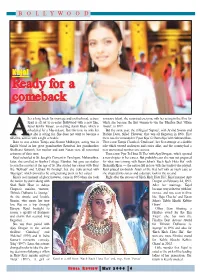
BOLLYWOOD KajolKajol RReeaaddyy ffoorr aa ccoommeebbaacckk fter a long break for marriage and motherhood, actress immense talent, she surprised everyone with her acting in the film, for Kajol is all set to re-enter Bollywood with a new film, which she became the first woman to win the ‘Filmfare Best Villain Kunal Kohli’s ‘Fanaa’, co-starring Aamir Khan, which is Award’, in 1997. scheduled for a May release. But this time its only fun But the same year, the trilingual ‘Sapnay’, with Arvind Swamy and that she is acting for. She does not want to become a Prabhu Deva, failed. However, that was all forgotten in 1998. First full-timeAA actress with a tight schedule. there was the runaway hit ‘Pyaar Kiya To Darna Kya’ with Salman Khan. Born to star actress Tanuja and Shomu Mukherjee, acting was in Then came Tanuja Chandra’s ‘Dushman’, her first attempt at a double Kajol’s blood as her great grandmother Ratanbai, her grandmother role which wowed audiences and critics alike, and the country had a Shobhana Samarth, her mother and aunt Nutan were all renowned new uncrowned number one actress. actresses of their time. Then came ‘Pyar To Hona Hi Tha’ with Ajay Devgan , which opened Kajol schooled at St. Joseph’s Convent in Panchgani, Maharashtra. a new chapter in her career. But probably even she was not prepared Later, she enrolled in Sophia College, Mumbai, but gave up studies for what was coming with Karan Johar’s ‘Kuch Kuch Hota Hai’ with to join the movies at the age of 16. -

A Study of Kashmir As Portrayed Through Popular Indian Cinema
The valley of desire : A study of Kashmir as portrayed through popular Indian cinema by Maliha Siddiqi M.A. (Mass communication), Jamia Millia Islamia, 2018 B.Sc., Kashmir University, 2016 Extended Essay Submitted in Partial Fulfillment of the Requirements for the Degree of Master of Arts in the School of Communication(Dual degree program in Global Communication) Faculty of communication, art and technology © Maliha Siddiqi 2020 SIMON FRASER UNIVERSITY Summer 2020 Copyright in this work rests with the author. Please ensure that any reproduction or re-use is done in accordance with the relevant national copyright legislation. Approval Name: Maliha Siddiqi Degree: Master of Arts Title: “The valley of desire”: A study of Kashmir as portrayed through popular Indian cinema Zoë Druick Senior Supervisor Professor Katherine Reilly Program director Associate Professor Date Defended/Approved: 31st August 2020 ii Abstract Indian-administered Kashmir has been a conflicted territory since 1947. This paper studies the representation of Kashmir and its civilian population in popular Hindi films. As Bollywood has an immensely dedicated audience, both in India as well as globally, the sensitive issues surrounding Kashmir make for extremely sought-after and therefore potentially influential content in films. I argue that these films reflect a sharp bias and a myopic approach towards showcasing the area and its civilian population. This paper employs the use of film analysis and critical discourse analysis to examine seven films — Mission Kashmir (2000), Yahaan (2005),Fanaa (2006), I am (2010), Lamhaa (2010), Haider (2014) and Hamid (2018) — to support the argument. The results show that all the films except Haider and Hamid misrepresent or underrepresent the realities of Kashmir. -
Beneath the Red Dupatta: an Exploration of the Mythopoeic Functions of the 'Muslim' Courtesan (Tawaif) in Hindustani Cinema
DOCTORAL DISSERTATIO Beneath the Red Dupatta: an Exploration of the Mythopoeic Functions of the ‘Muslim’ Courtesan (tawaif) in Hindustani cinema Farhad Khoyratty Supervised by Dr. Felicity Hand Departament de Filologia Anglesa i Germanística Universitat Autònoma de Barcelona 2015 Table of Contents Acknowledgements iv 1. Introduction 1 2. Methodology & Literature Review 5 2.1 Methodology 5 2.2 Towards Defining Hindustani Cinema and Bollywood 9 2.3 Gender 23 2.3.1 Feminism: the Three Waves 23 2.4 Feminist Film Theory and Laura Mulvey 30 2.5 Queer Theory and Judith Butler 41 2.6 Discursive Models for the Tawaif 46 2.7 Conclusion 55 3. The Becoming of the Tawaif 59 3.1 The Argument 59 3.2 The Red Dupatta 59 3.3 The Historical Tawaif – the Past’s Present and the Present’s Past 72 3.4 Geisha and Tawaif 91 4. The Courtesan in the Popular Hindustani cinema: Mapping the Ethico-Ideological and Mythopoeic Space She Occupies 103 4.1 The Argument 103 4.2 Mythopoeic Functions of the Tawaif 103 4.3 The ‘Muslim’ Courtesan 120 4.4 Agency of the Tawaif 133 ii 4.5 Conclusion 147 5. Hindustani cinema Herself: the Protean Body of Hindustani cinema 151 5.1 The Argument 151 5.2 Binary Narratives 151 5.3 The Politics of Kissing in Hindustani Cinema 187 5.4 Hindustani Cinema, the Tawaif Who Seeks Respectability 197 Conclusion 209 Bibliography 223 Filmography 249 Webography 257 Photography 261 iii Dedicated to My Late Father Sulliman For his unwavering faith in all my endeavours It is customary to thank one’s supervisor and sadly this has become such an automatic tradition that I am lost for words fit enough to thank Dr.