The Brothers Grimm and Their Folk Tales
Total Page:16
File Type:pdf, Size:1020Kb
Load more
Recommended publications
-

WAGNER and the VOLSUNGS None of Wagner’S Works Is More Closely Linked with Old Norse, and More Especially Old Icelandic, Culture
WAGNER AND THE VOLSUNGS None of Wagner’s works is more closely linked with Old Norse, and more especially Old Icelandic, culture. It would be carrying coals to Newcastle if I tried to go further into the significance of the incom- parable eddic poems. I will just mention that on my first visit to Iceland I was allowed to gaze on the actual manuscript, even to leaf through it . It is worth noting that Richard Wagner possessed in his library the same Icelandic–German dictionary that is still used today. His copy bears clear signs of use. This also bears witness to his search for the meaning and essence of the genuinely mythical, its very foundation. Wolfgang Wagner Introduction to the program of the production of the Ring in Reykjavik, 1994 Selma Gu›mundsdóttir, president of Richard-Wagner-Félagi› á Íslandi, pre- senting Wolfgang Wagner with a facsimile edition of the Codex Regius of the Poetic Edda on his eightieth birthday in Bayreuth, August 1999. Árni Björnsson Wagner and the Volsungs Icelandic Sources of Der Ring des Nibelungen Viking Society for Northern Research University College London 2003 © Árni Björnsson ISBN 978 0 903521 55 0 The cover illustration is of the eruption of Krafla, January 1981 (Photograph: Ómar Ragnarsson), and Wagner in 1871 (after an oil painting by Franz von Lenbach; cf. p. 51). Cover design by Augl‡singastofa Skaparans, Reykjavík. Printed by Short Run Press Limited, Exeter CONTENTS PREFACE ............................................................................................ 6 INTRODUCTION ............................................................................... 7 BRIEF BIOGRAPHY OF RICHARD WAGNER ............................ 17 CHRONOLOGY ............................................................................... 64 DEVELOPMENT OF GERMAN NATIONAL CONSCIOUSNESS ..68 ICELANDIC STUDIES IN GERMANY ......................................... -

Beauties Vs Beasts by Tatar.Pdf
Page 1 of 6 Title: Beauties vs. Beasts in the Grimms' Nursery and Household Tales Author(s): Maria M. Tatar Publication Details: The Brothers Grimm and Folktale. Urbana: University of Illinois Press, 1988. Source: Short Story Criticism. Ed. Rachelle Mucha and Thomas J. Schoenberg. Vol. 88. Detroit: Gale, 2006. From Literature Resource Center. Document Type: Critical essay Full Text: COPYRIGHT 2006 Gale, COPYRIGHT 2007 Gale, Cengage Learning [(essay date 1988) In the following essay, Tatar examines the textual history of the Bluebeard folktale in Nursery and Household Tales, contrasting narrative elements of "Mary's Child" and "Fowler's Fowl."] Fairy-tale beauties may all be very much alike, but there are two quite different types of beasts in the Grimms' Nursery and Household Tales. First, there are the animal-grooms who make life unpleasant for many a female protagonist: these are the frogs, bears, hedgehogs, and other creatures that press themselves on attractive young girls. But these beasts invariably turn out to be handsome young princes in disguise and generally prove to be perfect gentlemen. The real fairy-tale beasts, even if they are beasts in only the figurative rather than the literal sense of the term, turn out to be murderers masquerading as civilized men: Bluebeard, the Robber Bridegroom (in the tale of that title), and the wizard in "Fowler's Fowl" ("Fitchers Vogel") are the most prominent examples in the Nursery and Household Tales. Bluebeard, the most infamous of this entire lot of beasts, entered the pages of the Grimms' collection, but only in its first edition. For the second, revised edition of 1819, the Grimms eliminated the tale, evidently because it was too close in both substance and verbal realization to its French source. -

GERMAN LITERARY FAIRY TALES, 1795-1848 by CLAUDIA MAREIKE
ROMANTICISM, ORIENTALISM, AND NATIONAL IDENTITY: GERMAN LITERARY FAIRY TALES, 1795-1848 By CLAUDIA MAREIKE KATRIN SCHWABE A DISSERTATION PRESENTED TO THE GRADUATE SCHOOL OF THE UNIVERSITY OF FLORIDA IN PARTIAL FULFILLMENT OF THE REQUIREMENTS FOR THE DEGREE OF DOCTOR OF PHILOSOPHY UNIVERSITY OF FLORIDA 2012 1 © 2012 Claudia Mareike Katrin Schwabe 2 To my beloved parents Dr. Roman and Cornelia Schwabe 3 ACKNOWLEDGMENTS First and foremost, I would like to thank my supervisory committee chair, Dr. Barbara Mennel, who supported this project with great encouragement, enthusiasm, guidance, solidarity, and outstanding academic scholarship. I am particularly grateful for her dedication and tireless efforts in editing my chapters during the various phases of this dissertation. I could not have asked for a better, more genuine mentor. I also want to express my gratitude to the other committee members, Dr. Will Hasty, Dr. Franz Futterknecht, and Dr. John Cech, for their thoughtful comments and suggestions, invaluable feedback, and for offering me new perspectives. Furthermore, I would like to acknowledge the abundant support and inspiration of my friends and colleagues Anna Rutz, Tim Fangmeyer, and Dr. Keith Bullivant. My heartfelt gratitude goes to my family, particularly my parents, Dr. Roman and Cornelia Schwabe, as well as to my brother Marius and his wife Marina Schwabe. Many thanks also to my dear friends for all their love and their emotional support throughout the years: Silke Noll, Alice Mantey, Lea Hüllen, and Tina Dolge. In addition, Paul and Deborah Watford deserve special mentioning who so graciously and welcomingly invited me into their home and family. Final thanks go to Stephen Geist and his parents who believed in me from the very start. -
COPYRIGHTED MATERIAL NOT for DISTRIBUTION Introduction
Contents Acknowledgments vii Introduction 3 Biographies Alice (McCarthy) Lannon (1927– 2013) 21 Philip Pius Power (1912–1993) 24 Anita Best 30 Martin Lovelace 32 Pauline Greenhill 35 Graham Blair 36 THE TALES Johnson and the Fellow Traveler (Power) 39 Comments 60 Open! Open! Green House (Lannon) 65 Comments 70 The Gifts of the Little People (Lannon) 75 Comments 76 The Big Black Bull of Hollow Tree (Lannon) 79 CommentsCOPYRIGHTED 85 MATERIAL Jack and the CatNOT (Lannon) FOR 91 DISTRIBUTION Jack Ships to the Cat (Power) 93 Comments 101 Peg Bearskin (Power) 105 The Clever Girls (Lannon) 115 Comments 117 The Maid in the Thick of the Well (Power) 123 Comments 133 Jack Shipped to the Devil at Blackhead (Power) 139 Comments 154 v vi Contents The White King of Europe (Power) Friends version 159 Goldstein version 177 Comments 194 The Suit the Color of the Clouds (Power) 199 Comments 223 The Ship That Sailed over Land and Water (Lannon) 229 Comments 241 Pretty Raven/The Copper Castle of the Lowlands (Power) 247 Comments 285 Afterword 289 Appendix 1. Ethnopoetic System 293 Appendix 2. Newfoundland Map 297 Appendix 3. Tale Types 299 Appendix 4. Motifs 301 References 307 Index 313 COPYRIGHTED MATERIAL NOT FOR DISTRIBUTION Introduction FAIRY TALES ARE AMONG THE OLDEST ORAL STORIES whose history can be traced; in the West this documentation stretches back to classical antiquity. Their themes inspire writers, visual artists, and filmmakers; in the twenty- first centuryfew media creators fail to find in them something relevant (see Greenhill et al. 2018). Yet we don’t know their original makers. -
Study Guide: Student Edition
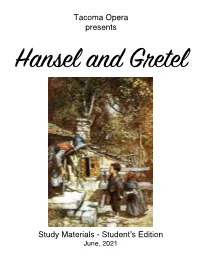
Tacoma Opera presents Hansel and Gretel Study Materials - Student’s Edition June, 2021 Contents From Folk Tale to Opera The origins of Hansel and Gretel From folktale to opera - The origins of Hansel and Gretel Folktales Folktales Grimm’s Fairy Tales Hansel and Gretel, the opera Folktales are stories that are passed from person to person. Because they are generally not written down, the same story might exist in many different versions. These stories were especially popular before most people were educated in how to read and write. But we still have different kinds of About the creators folktales today, such as “urban legends.” The Brothers Grimm In time, many folktales were written down. Some of the earliest collections were made in France and Adelheid Wette gave these stories the familiar name of fairy tales, because of the frequent presence of magical Engelbert Humperdinck beings in the stories. These stories were not originally told or written down for children. They contained violence and descriptions of horrible people and their actions. But many of the authors changed some of the traditional elements to make them more suitable for children. Synopsis of the Opera Folktales were often built around individual story elements or events that could be pieced together to make a new story. The original story of Hansel and Gretel probably started in the Medieval Ages Additional Resources during a great famine, and various traditional elements were used to create the story. For example, in the familiar Grimm version, Hansel and Gretel were able to find their way home by leaving a trail of stones. -
Via Brentano – Route Der Romantik Romantische Orte an Rhein, Main Und Kinzig
Via Brentano – Route der Romantik Romantische Orte an Rhein, Main und Kinzig 1 Inhaltsverzeichnis Vorwort „Wo der Rhein einen tiefen Strudel macht, tauchten die Nymphen unter“ Bingen und das Museum am Strom – am Tor zum UNESCO-Welterbe „Mittelrheintal“ Das Brentano-Haus in Oestrich-Winkel „Nur das Wilde, Große, Glänzende gefällt mir“ Das Grab der Karoline von Günderrode in Oestrich-Winkel Postkutschenromantik in Hattersheim Alter Posthof und Nassauer Hof Von Riesen, Rittern und Geistern Französische Schauerromantik und die Burgruine Eppstein im Taunus Champagnerbrunnen Bad Soden am Taunus Kurort und Künstlertreffpunkt Felix Mendelssohn Bartholdy auf Sommerfrische in Soden am Taunus „Sie scheinen den Aufenthalt in Königstein für einen kühlen Sommertraum zu nehmen“ Caroline Schlegel-Schelling als Gefangene auf der Festung Königstein Prinzen- und Hirschgärten, Alleen, Inseln, Tempel und eine englische Prinzessin Die Landgräfliche Gartenlandschaft und das Gotische Haus in Bad Homburg v. d.Höhe „Wenn Menschen sich aus innrem Werte kennen / So können sie sich freudig Freunde nennen“ Friedrich Hölderlin und Isaac von Sinclair in Homburg v. d.Höhe Dichter, Wanderer und Liebende Seite 24 Der Hölderlinpfad zwischen Bad Homburg v. d.Höhe und Frankfurt am Main „Ein wahres Paradies“ Seite 26 Brentanopark und Petrihaus in Frankfurt-Rödelheim Frankfurt am Main Seite 28 Lebens- und Kommunikationsraum dreier junger Romantiker: Clemens Brentano, Bettine Brentano, Karoline von Günderrode Altersruhesitz in Offenbach Seite 36 Die Schriftstellerin Sophie von La Roche – Großmutter von Clemens und Bettine Brentano Hanau Seite 38 Geburtsstadt der Brüder Grimm und der Familie Hassenpflug Hofgut Trages Seite 40 Treffpunkt der Romantiker Die Brüder Grimm in Steinau an der Straße Seite 42 Clemens Brentanos Spuren in Aschaffenburg Seite 44 Impressum / Bildnachweis Seite 46 Vorwort Eine romantische Ideallandschaft ist sie sicher nicht mehr, die dicht besiedelte Rhein-Main-Region mit ihren Autobahntrassen und Verkehrsknoten. -

Education Resource Stephen Sondheim & James Lapine
Stephen Sondheim & James Lapine INTO THE WOODS Education Resource Music INTO THE WOODS - MUSIC RESOURCE INTRODUCTION From the creators of Sunday in the Park with George comes Into the Woods, a darkly enchanting story about life after the ‘happily ever after’. Stephen Sondheim and James Lapine reimagine the magical world of fairy tales as the classic stories of Jack and the Beanstalk, Cinderella, Little Red Ridinghood and Rapunzel collide with the lives of a childless baker and his wife. A brand new production of an unforgettable Tony award-winning musical. Into the Woods | Stephen Sondheim & James Lapine. 19 – 26 July 2014 | Arts Centre Melbourne, Playhouse Music and lyrics by Stephen Sondheim Book by James Lapine Originally Directed on Broadway by James Lapine By arrangement with Hal Leonard Australia Pty Ltd Exclusive agent for Music Theatre International (NY) 2 hours and 50 minutes including one interval. Victorian Opera 2014 – Into the Woods Music Resource 1 BACKGROUND Broadway Musical Music and Lyrics by Stephen Sondheim Book and Direction by James Lapine Orchestration: Jonathan Tunick Opened in San Diego on the 4th of December 1986 and premiered in Broadway on the 5th of November, 1987 Won 3 Tony Awards in 1988 Drama Desk for Best Musical Laurence Olivier Award for Best Revival Figure 1: Stephen Sondheim Performances Into the Woods has been produced several times including revivals, outdoor performances in parks, a junior version, and has been adapted for a Walt Disney film which will be released at the end of 2014. Stephen Sondheim (1930) Stephen Joshua Sondheim is one of the greatest composers and lyricists in American Theatre. -

Fairy Tale Reader's Theater: Cinderella
Fairy Tale Reader’s Theater: Cinderella Reader Roles: Narrator, Cinderella, Stepsister 1, Stepsister 2, Fairy godmother, Guest 1, Guest 2, Prince Scene 1 (at Cinderella’s home) Narrator: The night of the ball arrived. Narrator: Once upon a time there was a beautiful young girl named Stepsister 1: (laughing) Ha, ha! We are going to have a great time at the Cinderella. She had two ugly stepsisters who were very cruel to her. ball. Stepsister 1: Did you clean the kitchen? Stepsister 2: (laughing) Have a great night working, Cinderella. Cinderella: Yes, I did. Narrator: After the evil stepsisters had left, suddenly, a fairy appeared. Stepsister 2: Did you polish my shoes? Cinderella: Oh my! Who are you? Cinderella: Yes, I did. Fairy godmother: I’m your fairy godmother, beautiful Cinderella. I am here to help you go to the ball tonight. Stepsister 1: Did you iron my clothes? Narrator: The fairy godmother waved her magic wand. Cinderella’s rags Cinderella: Yes, I did. turned into a beautiful dress. On her feet were sparkling glass slippers. Stepsister 2: And...did you make breakfast? Cinderella: Oh, I feel so beautiful! Cinderella: Yes, breakfast is ready. Narrator: The fairy godmother turned a pumpkin into an amazing coach Narrator: The evil stepsisters made Cinderella do all the hard work. and some mice into horses. Cinderella: (calling out) Stepsisters! A letter from the royal palace has Cinderella: What a lovely coach and handsome horses. arrived for you. Fairy godmother: You are ready now, my dear. Have fun tonight, but be Stepsister 1: (fighting) Give it to me! I want to open it. -

German/Interdisciplinary (GRIN) 1
German/Interdisciplinary (GRIN) 1 GERMAN/INTERDISCIPLINARY (GRIN) GRIN 226 Fairy Tales from Grimm to Disney (3 credits) Prerequisite(s): WRIT 105 or HONP 100 or GERM 112. This course examines the oral roots and multimedia afterlife of German fairy tales documented by the Brothers Grimm in the late eighteenth and early nineteenth centuries. Depending on the instructor’s background, folk tales from different national traditions can be added to the curriculum. Core fairy tale themes and motifs will be discussed, as will later treatments of the narrative material, and theoretical approaches to understanding fairy tales from structuralist, psychoanalytical, feminist, and poststructuralist perspectives. After in-depth analysis of the Grimm fairy tales, the course explores Romantic literary fairy tales by Ludwig Tieck and E.T.A. Hoffmann, as well as twentieth-century appropriations of the fairy tales. Concluding discussions will engage with the pressing question of how contemporary individuals can mobilize these multiform cultural tales to help establish new social roles and identities. Taught in English. Students registering for GERM 226 will do assignments in German; for students in GRIN 226, all assignments are in English. Meets Gen Ed - Great Works and their Influences. Mutually Exclusive with GERM 226. GRIN 250 Special Topics in German Literature and Culture (3 credits) Exploration of a timely topic or significant area of German literature or culture. The specific topic will be announced at the appropriate time before registration begins. May be repeated twice for a maximum of 9 credits. GRIN 295 German Expressionism (3 credits) Prerequisite(s): HUMN 115 or HUMN 151 or WRIT 105 or HONP 100. -

7. Goethe, the Brothers Grimm and Academic Freedom1
https://www.openbookpublishers.com © 2021 Roger Paulin This work is licensed under a Creative Commons Attribution 4.0 International license (CC BY 4.0). This license allows you to share, copy, distribute and transmit the text; to adapt the text and to make commercial use of the text providing attribution is made to the authors (but not in any way that suggests that they endorse you or your use of the work). Attribution should include the following information: Roger Paulin, From Goethe to Gundolf: Essays on German Literature and Culture. Cambridge, UK: Open Book Publishers, 2021, https://doi.org/10.11647/OBP.0258 Copyright and permissions for the reuse of many of the images included in this publication differ from the above. Copyright and permissions information for images is provided separately in the List of Illustrations. In order to access detailed and updated information on the license, please visit, https://doi.org/10.11647/OBP.0258#copyright Further details about CC-BY licenses are available at, https://creativecommons.org/ licenses/by/4.0/ All external links were active at the time of publication unless otherwise stated and have been archived via the Internet Archive Wayback Machine at https://archive.org/web Updated digital material and resources associated with this volume are available at https://doi.org/10.11647/OBP.0258#resources Every effort has been made to identify and contact copyright holders and any omission or error will be corrected if notification is made to the publisher. ISBN Paperback: 9781800642126 ISBN Hardback: 9781800642133 ISBN Digital (PDF): 9781800642140 ISBN Digital ebook (epub): 9781800642157 ISBN Digital ebook (mobi): 9781800642164 ISBN Digital (XML): 9781800642171 DOI: 10.11647/OBP.0258 Cover photo and design by Andrew Corbett, CC-BY 4.0. -

Education Pack 2019.Cdr
BUXTON OPERA HOUSE & PAVILION ARTS CENTRE EDUCATION PACK HISINTRTORODUCY OFTION PANTOMIME Welcome to Buxton Opera House's Pantomime Educaon Pack for our 2019 producon of Cinderella! The Christmas Pantomime is a huge highlight in the Opera House programme, and one which we look forward to sharing with you every year. A visit to the Pantomime may be a child's very first experience of theatre or live performance, and if it is capvang enough, it will leave an inspiring lasng impression. At Buxton Opera House, we are commied to capturing the hearts and minds of children across the Peak District, so we have designed this Educaon Pack to ensure your students get as much out of their trip to the theatre as they possibly can. Offering both entertainment and educaon, this pack contains reference informaon, resources, fun acvies and creave tasks that will help to further your students' understanding and enjoyment of our producon of Cinderella. Please feel free to use it as you wish! We hope you enjoy exploring this much-loved tale as much as we have, and we look forward to welcoming you to the Opera House soon! HISTORY OF PANTOMIME Pantomime is a type of theatre producon intended for family entertainment which includes music, dance and comedy. Pantomime found its heart, and developed in the United Kingdom, where it is performed typically during the Christmas and New Year season. These days, Pantomime is oen seen as a quintessenally Brish tradion, but the origins of this form of theatre actually stem from much warmer parts of Europe! One of the first recorded references to Pantomime was in Ancient Greece; the Greek words “pan” meaning “all”, and “mimos” which translates as “imitator” described a group who “imitate all” – the performances would feature songs, music and comedy. -
The Tales of the Grimm Brothers in Colombia: Introduction, Dissemination, and Reception
Wayne State University Wayne State University Dissertations 1-1-2012 The alest of the grimm brothers in colombia: introduction, dissemination, and reception Alexandra Michaelis-Vultorius Wayne State University, Follow this and additional works at: http://digitalcommons.wayne.edu/oa_dissertations Part of the German Literature Commons, and the Modern Languages Commons Recommended Citation Michaelis-Vultorius, Alexandra, "The alet s of the grimm brothers in colombia: introduction, dissemination, and reception" (2012). Wayne State University Dissertations. Paper 386. This Open Access Dissertation is brought to you for free and open access by DigitalCommons@WayneState. It has been accepted for inclusion in Wayne State University Dissertations by an authorized administrator of DigitalCommons@WayneState. THE TALES OF THE GRIMM BROTHERS IN COLOMBIA: INTRODUCTION, DISSEMINATION, AND RECEPTION by ALEXANDRA MICHAELIS-VULTORIUS DISSERTATION Submitted to the Graduate School of Wayne State University, Detroit, Michigan in partial fulfillment of the requirements for the degree of DOCTOR OF PHILOSOPHY 2011 MAJOR: MODERN LANGUAGES (German Studies) Approved by: __________________________________ Advisor Date __________________________________ __________________________________ __________________________________ __________________________________ © COPYRIGHT BY ALEXANDRA MICHAELIS-VULTORIUS 2011 All Rights Reserved DEDICATION To my parents, Lucio and Clemencia, for your unconditional love and support, for instilling in me the joy of learning, and for believing in happy endings. ii ACKNOWLEDGEMENTS This journey with the Brothers Grimm was made possible through the valuable help, expertise, and kindness of a great number of people. First and foremost I want to thank my advisor and mentor, Professor Don Haase. You have been a wonderful teacher and a great inspiration for me over the past years. I am deeply grateful for your insight, guidance, dedication, and infinite patience throughout the writing of this dissertation.