Theinternational Daffodil Register & Classified List (2008)
Total Page:16
File Type:pdf, Size:1020Kb
Load more
Recommended publications
-

Records of Narcissus Elegans (Fam
The Central Mediterranean Naturalist 5(2): 19-29 Malta, December 2010 __________________________________________________________________________________________ RECORDS OF NARCISSUS ELEGANS (FAM. AMARYLLIDACEAE) AND NOTES ON THE WILD NARCISSUS IN THE MALTESE ISLANDS Stephen MIFSUD1 and Emanuel CARUANA2 __________________________________________________________________________________________ ABSTRACT Substantiated records of Narcissus elegans are reported from Malta and for the first time in Gozo. Habitat and ecological analysis of the three different populations and a distribution map is given. Morphological characters between the populations are compared between each other and the described taxa. Also discussed and illustrated are the intermediate range of specimens found in Malta between N. serotinus, N. elegans and N. tazetta Keywords: Narcissus elegans; Narcissus serotinus; Narcissus tazetta; new records; Narcissus intermediates; Malta; Gozo INTRODUCTION Narcissus elegans (Haw.) Spach [Hist. Vég. (Phan.) 12: 452 (1841)], (Syn: Narcissus autumnalis Link , N. oxypetalus Boiss., N. cupanianus Guss., Hermione autumnalis (Link) M. Roem., H. elegans Haw.) is an Autumn flowering bulbous plant with canaliculated leaves 8-25 cm × 2-4·5 mm, appearing before or with the flowers. It produces two to seven fragrant flowers on 15-35 cm long scapes. Flowers have six white tepals, 12-20 × 3-6 mm, narrowly oblong to elliptical, not overlapping and a central corona 1-2 × 3-4 mm yellowish or brownish-green. Fruit are vertically dehiscent capsules forming black seeds (Webb, 1980). Narcissus elegans has a restricted distribution in the central Mediterranean region where it ranges from North West Africa ; reported from Libya, Tunisia (USDA, 2009), Algeria and Morocco (USDA, 2009; GBIF, 2009) to South West Europe; reported from South and West of Italy (Webb, 1980 ; GBIF, 2009), Malaga, south of Spain (Lopez, 2007), the Balearic Islands (HV, 2009), and from France (FN, 2009). -

Folia Botanica Extremadurensis, 14
Volumen 14 NOVIEMBRE 2020 FOLIA BOTANICA EXTREMADURENSIS BOTANICA FOLIA Coordinación: Francisco Mª Vázquez Pardo Secretaría: Francisco Márquez García Equipo de edición: David García Alonso, Francisco Márquez García y María José Guerra Barrena. Equipo de redacción y revisión de textos: José Blanco Salas David García Alonso Francisco Márquez García José Luis Pérez Chiscano Carlos Pinto Gomes Francisco Mª Vázquez Pardo Ilustración de portada: Ejemplar de Dactyloctenium aegyptium (L.) Willd. Edita: Centro de Investigaciones Científicas y Tecnológicas de Extremadura (CICYTEX). ISSN: 1887-6587 Depósito legal: BA-178-07 Diseño: Grupo HABITAT. Imprime: IBERPRINT. Montijo (Badajoz, España). Unidad de Biodiversidad Vegetal. Herbario HSS. Instituto de Investigaciónes Agrarias “La Orden”. A-V, km 372. 06187 GUADAJIRA (BADAJOZ (España)). Centro de Investigaciones Científicas y Tecnológicas de Extremadura (CICYTEX). Consejería de Economía, Ciencia y Agenda Digital. Junta de Extremadura. FOLIA BOTANICA EXTREMADURENSIS Vol. 14 NOVIEMBRE 2020 Coordinación: Francisco Mª Vázquez Pardo Secretaría: Francisco Márquez García Equipo de edición: David García Alonso, Francisco Márquez García, y María José Guerra Barrena. Equipo de redacción y revisi ón de textos: José Blanco Salas David García Alonso Francisco Márquez García José Luis Pérez Chiscano Carlos Pinto Gomes Francisco Mª Vázquez Pardo Ilustración de portada: Ejemplar de Dactyloctenium aegyptium (L.) Willd. Edita: Centro de Investigaciones Científicas y Tecnológicas de Extremadura (CICYTEX). ISSN: 1887-6587 Depósito legal: BA-178-07 Diseño: Grupo HABITAT. Imprime: IBERPRINT. Montijo (Badajoz, España). Unidad de Biodiversidad Vegetal. Herbario HSS. Instituto de Investigaciones Agrarias “La Orden”. A-V, km 372. 06187 GUADAJIRA (BADAJOZ (España)). Centro de Investigaciones Científicas y Tecnológicas de Extremadura (CICYTEX). Consejería de Economía, Ciencia y Agenda Digital. -

Nomenclatural Notes on Some Autumn Flowering Daffodils (Narcissus, Amaryllidaceae)
See discussions, stats, and author profiles for this publication at: https://www.researchgate.net/publication/314088340 Nomenclatural notes on some autumn flowering daffodils (Narcissus, Amaryllidaceae) Article in Phytotaxa · February 2017 DOI: 10.11646/phytotaxa.297.2.3 CITATIONS READS 0 159 3 authors, including: Maarten Christenhusz Plant Gateway 130 PUBLICATIONS 1,547 CITATIONS SEE PROFILE Some of the authors of this publication are also working on these related projects: Ferns and lycophytes from Paraná View project Teaching Plant Systematics View project All content following this page was uploaded by Maarten Christenhusz on 24 March 2017. The user has requested enhancement of the downloaded file. Phytotaxa 297 (2): 157–167 ISSN 1179-3155 (print edition) http://www.mapress.com/j/pt/ PHYTOTAXA Copyright © 2017 Magnolia Press Article ISSN 1179-3163 (online edition) https://doi.org/10.11646/phytotaxa.297.2.3 Nomenclatural notes on some autumn flowering daffodils (Narcissus, Amaryllidaceae) HAROLD KOOPOWITZ1*, MARILYNN HOWE2 & MAARTEN J. M. CHRISTENHUSZ3, 4 1Ecology and Evolutionary Biology, University of California, Irvine, California 92705, U.S.A; e-mail: paph2@earthlink.net 2P.O. Box 11372, Marina del Rey, California 90295, U.S.A. 3Plant Gateway, Hertford, Hertfordshire, U.K. 4Royal Botanic Gardens, Kew, Richmond, Surrey, U.K. *author for correspondence Keyword: Taxonomic key, historical confusion, Narcissus obsoletus, Narcissus miniatus, Narcissus serotinus Autumn flowering daffodils have been recorded in taxonomic history for at least 500 years. First descriptions were often merely based on hearsay, as they were often not studied alive. Consequently, many errors in interpretation of these names have occurred and taxonomic confusion, errors in identification and misapplication of names have led to an accumulation of taxonomic entanglement in Narcissus Linnaeus (1753: 289) nomenclature. -

Garden Mastery Tips October 2002 from Clark County Master Gardeners
Garden Mastery Tips October 2002 from Clark County Master Gardeners "D" is for Daffodil September is upon us. The leaves and colors of the garden are brilliant in their last displays. The sun is still shining and bright. But mornings have a touch of chill. Soon Jack Frost will tiptoe in putting to bed any remaining flowers of the summer still up and partying. Quiet will descend upon the garden. The coloring will become more subdued and staid. Did you ever know there were so many shades of brown? The weather in the Pacific Northwest lends itself to a long winter's nap. The days are overcast, bleak and dreary with mist or rain bathing the land. The garden slumbers on forever it seems. Then in the short dark days of February, tiny green leaves begin to push their way up out of the ground. Each day they grow stronger and larger followed by a stem with a swelling flower bud that gladdens the soul when it bursts into bloom: rain or snow the daffodils bloom. Spring cannot be far behind. Pretty picture isn't it? What a glad sight all those lovely flowers will be next spring. Do you remember this William Wordsworth poem from school? Daffodils I wandered lonely as a cloud That floats on high o'er vales and hills, When all at once I saw a crowd, A host, of golden daffodils; Beside the lake, beneath the trees, Fluttering and dancing in the breeze. Continuous as the stars that shine And twinkle on the milky way, They stretched in never-ending line Along the margin of a bay: Ten thousand saw I at a glance, Tossing their heads in sprightly dance. -

Cibulnaté a Hlíznaté Rostliny
Cibulnaté a hlíznaté rostliny Přehled druhů 2: Asparagales Řád Asparagales rozsáhlý řád, 14 čeledí, některé obrovské semena rostlin obsahují černé barvivo melanin (některé druhy ho druhotně ztratily) Hosta PREZENTACE © JN Iridaceae (kosatcovité) Řád Asparagales Čeleď Iridaceae (kosatcovité) vytrvalé byliny s oddenky, hlízami, nebo cibulemi stonek přímý nevětvený, někdy zkrácený listy mečovité nebo čárkovité, dvouřadé se souběžnou žilnatinou květy jednotlivé nebo v chudých květenstvích (vějířek nebo srpek) – významné druhy okrasného zahradnictví subtropy až mírné pásmo 70/1750, ČR 3/12 PREZENTACE © JN Iridaceae (kosatcovité) Řád Asparagales Čeleď Iridaceae (kosatcovité) Zahradnicky významné jsou: mečíky (Gladiolus), frézie (Freesia), kosatce (Iris), šafrány (Crocus) Mezi další zahradnicky významné Iridaceae patří např. Crocosmia, Ixia, Tigridia © Saxifraga-Dirk Hilbers © Saxifraga-Inigo Sanchez Iris xiphium http://www.freenatureimages.eu/Plants/Flora%20D-I/Iris%20xiphium/slides/Iris%20xiphium%201,%20Saxifraga-Dirk%20Hilbers.jpg http://www.freenatureimages.eu/Plants/Flora%20D-I/Iris%20xiphium/slides/Iris%20xiphium%202,%20Saxifraga-Inigo%20Sanchez.jpg Iridaceae (kosatcovité) Iris (kosatec) zahrnuje i množství druhů které se neřadí mezi cibuloviny. Do cibulovin patří kosatce sekce Xiphium a Reticulata Sekce Xiphium - původní druhy pocházejí ze středomoří, hlavně Pyrenejí, zde rostou v 1500 m na mořem Cibule se 3-5 masitými šupinami, žlábkovité listy , stvol s 2-3 tuhými zelenými listeny a 2-3 květy, jsou modré se žlutým středem na vnějších okvětních lístcích, v přírodě kvetou koncem června Křížením původních druh této sekce hlavně Iris xiphium a I. tingitana vzniklo velké množství kutivarů – označované jako Dutch iris (holandské kosatce), pěstují se tržně v mnoha barvách (od bílé, žluté, modré až po fialovou) a prodávají jako řezané květiny např. -

Flowering Phenology and Reproductive Biology in Subtropical Geophytes: Case Studies with Sympatric Species of Amaryllidaceae
UNIVERSIDADE ESTADUAL DE CAMPINAS INSTITUTO DE BIOLOGIA NATHÁLIA SUSIN STREHER FLOWERING PHENOLOGY AND REPRODUCTIVE BIOLOGY IN SUBTROPICAL GEOPHYTES: CASE STUDIES WITH SYMPATRIC SPECIES OF AMARYLLIDACEAE FENOLOGIA DA FLORAÇÃO E BIOLOGIA REPRODUTIVA EM GEÓFITAS SUBTROPICAIS: ESTUDOS DE CASO COM ESPÉCIES SIMPÁTRICAS DE AMARYLLIDACEAE CAMPINAS 2016 NATHÁLIA SUSIN STREHER FLOWERING PHENOLOGY AND REPRODUCTIVE BIOLOGY IN SUBTROPICAL GEOPHYTES: CASE STUDIES WITH SYMPATRIC SPECIES OF AMARYLLIDACEAE FENOLOGIA DA FLORAÇÃO E BIOLOGIA REPRODUTIVA EM GEÓFITAS SUBTROPICAIS: ESTUDOS DE CASO COM ESPÉCIES SIMPÁTRICAS DE AMARYLLIDACEAE Dissertation presented to the Institute of Biology of the University of Campinas in partial fulfillment of the requirements for the degree of Master in the area of Plant Biology Dissertação apresentada ao Instituto de Biologia da Universidade Estadual de Campinas como parte dos requisitos exigidos para a obtenção do Título de Mestra em Biologia Vegetal. ORIENTADOR: JOÃO SEMIR COORIENTADORA: JULIE HENRIETTE ANTOINETTE DUTILH ESTE ARQUIVO DIGITAL CORRESPONDE À VERSÃO FINAL DA DISSERTAÇÃO DEFENDIDA PELA ALUNA NATHÁLIA SUSIN STREHER E ORIENTADA PELO PROF. DR. JOÃO SEMIR. CAMPINAS 2016 Campinas, 22 de fevereiro de 2016. COMISSÃO EXAMINADORA Prof. Dr. João Semir Prof. Dr. Vinícius Lourenço Garcia de Brito Profa. Dra. Marlies Sazima Profa. Dra. Kayna Agostini Profa. Dra. Marina Wolowski Torres Os membros da Comissão Examinadora acima assinaram a Ata de defesa, que se encontra no processo de vida acadêmica do aluno. AGRADECIMENTOS Agradeço aos meus orientadores, João e Julie, por terem me dado a oportunidade de chegar neste ponto. Por terem se dedicado a mim não só profissionalmente, mas pessoalmente também. Agradeço por cada contribuição de vocês para a botânica, espero um dia saber um pouquinho do que vocês sabem. -
Srgc Bulb Log Diary
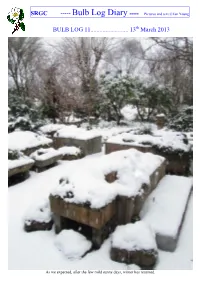
SRGC ----- Bulb Log Diary ----- Pictures and text © Ian Young th BULB LOG 11......................... 13 March 2013 As we expected, after the few mild sunny days, winter has returned. Last week I showed this same view with open flowers enjoying the sunshine and mild conditions now they are blanketed in snow. The snow does create a striking contrast with the deep warm yellow flowers of Crocus herbertii. Galanthus, Crocus and Corydalis are all able to withstand our erratic spring swinging as it does from sunny warm days to freezing snowy days. Despite their delicate look the reticulate Iris flowers are also tough and able to cope with being covered in snow. Galanthus ‘Elizabeth Harrison’ Galanthus ‘Elizabeth Harrison’ holds the record for fetching the highest price ever fetched by a single snowdrop bulb, a record that surely will never be beaten. This crazy price more reflects the desire for people to be among the first to own a new different form than it does the actual value of the plant. However it is a beautiful form with its striking yellow ovary contrasting so well with the green and because of that it stands out as you walk around the garden without the need to bend down and squeeze the flower open to view the interior markings. Last year I got some seeds from our plant which I sowed 5cms deep - now I am delighted to see them starting to germinate with three seed leaves visible so far. Galanthus platyphyllus Galanthus platyphyllus is not so commonly seen in gardens perhaps as it has a reputation of the flowers hiding themselves down in the leaves. -

Spring Flowering Bulbs for Kentucky Gardens
HortFacts 52-04 SPRING FLOWERING BULBS FOR KENTUCKY GARDENS Robert G. Anderson, Extension Specialist in Floriculture Spring flowering bulbs are an important part of the landscape in Kentucky. Crocus and daffodils tell us that spring is on its way and red tulips are a Derby Day tradition. These flowers are recognized by most people but there are many other spring flowering bulbs that can be used around your home. Hundreds of different kinds of flower bulbs are available for fall planting. You may obtain them from mail order bulb companies, garden centers, supermarkets or department stores. Some are familiar and others have long, hard-to-pronounce names. Generally, spring flowering bulbs do very well the first spring after they are planted. Yet, many home gardeners want the bulbs to come back year after year or naturalize in their home landscape. Continuing trials at the UK College of Agriculture's Arboretum and Horticulture Research Farm have focused on the naturalization of spring flowering bulbs. Bulbs planted in various sites and given different types of care have been observed through four spring flowering seasons. The following list of recommended bulbs for Kentucky landscapes is based on these trials. Planting Site Well-drained sites are essential. Established gardens and Wind Flower – ‘Radar’ beds or newly cultivated areas are fine. The soil pH should be 6.0 to 7.0. Bulbs will not do well in heavy clay soils, so poor soils should be amended with compost, peat moss or other organic matter. Most bulbs prefer a site that does not receive full sunlight in the middle of the day. -

MAPEAMENTO DOS SÍTIOS DE Dnar 5S E 45S E ORGANIZAÇÃO DA CROMATINA EM REPRESENTANTES DA FAMÍLIA AMARYLLIDACEAE JAUME ST.-HIL
EMMANUELLY CALINA XAVIER RODRIGUES DOS SANTOS MAPEAMENTO DOS SÍTIOS DE DNAr 5S E 45S E ORGANIZAÇÃO DA CROMATINA EM REPRESENTANTES DA FAMÍLIA AMARYLLIDACEAE JAUME ST.-HIL. RECIFE-PE 2015 i EMMANUELLY CALINA XAVIER RODRIGUES DOS SANTOS MAPEAMENTO DOS SÍTIOS DE DNAr 5S E 45S E ORGANIZAÇÃO DA CROMATINA EM REPRESENTANTES DA FAMÍLIA AMARYLLIDACEAE JAUME ST.-HIL. Tese apresentada ao Programa de Pós-Graduação em Botânica da Universidade Federal Rural de Pernambuco como parte dos requisitos para obtenção do título de Doutora em Botânica. Orientador: Prof. Dr. Reginaldo de Carvalho Dept° de Genética/Biologia, Área de Genética/UFRPE Co-orientador: Prof. Dr. Leonardo Pessoa Felix Dept° de Fitotecnia, UFPB RECIFE-PE 2015 ii MAPEAMENTO DOS SÍTIOS DE DNAr 5S E 45S E ORGANIZAÇÃO DA CROMATINA EM REPRESENTANTES DA FAMÍLIA AMARYLLIDACEAE JAUME ST.-HIL. Emmanuelly Calina Xavier Rodrigues dos Santos Tese defendida e _________________ pela banca examinadora em ___/___/___ Presidente da Banca/Orientador: ______________________________________________ Dr. Reginaldo de Carvalho (Universidade Federal Rural de Pernambuco – UFRPE) Comissão Examinadora: Membros titulares: ______________________________________________ Dra. Ana Emília de Barros e Silva (Universidade Federal da Paraíba – UFPB) ______________________________________________ Dra. Andrea Pedrosa Harand (Universidade Federal de Pernambuco – UFPE) ______________________________________________ Dr. Felipe Nollet Medeiros de Assis (Universidade Federal da Paraíba – UFPB) ______________________________________________ Dr. Marcelo Guerra (Universidade Federal de Pernambuco – UFPE) Suplentes: ______________________________________________ Dra. Lânia Isis Ferreira Alves (Universidade Federal da Paraíba – UFPB) ______________________________________________ Dra. Sônia Maria Pereira Barreto (Universidade Federal de Pernambuco – UFRPE) iii A minha família, em especial ao meu pai José Geraldo Rodrigues dos Santos que sempre foi o meu maior incentivador e a quem responsabilizo o meu amor pela docência. -

UNZ\Rersm of TORONTO
PHYLOC;ENETIC ANALY SIS OF BREEDING-SYSTEM EVOLUTION IN EETEFtOSTYLOUS MONOCOTYLEDONS SEAN W. GRAHAM A THESIS SUBMTED IN CONFORMITY WlTH REQUTREMENTS FOR THE DEGREE OF DOCTOR OF PHILOSOPHY IN THE UNZ\rERSm OF TORONTO National Library Bibliothëque nationale I*m of Canada du Canada Acquisitions and Acquisitions et Bibliographie Services services bibliographiques 395 Wellington Street 395, me Wellington Ottawa ON K 1A ON4 OttawaON K1AON4 Canada Canada Your hie Votre relenmce our nie Naire reterence The author has granted a non- L'auteur a accordé une licence non exclusive licence allowing the exclusive permettant à la National Library of Canada to Bibliothèque nationale du Canada de reproduce, loan, distribute or sel1 reproduire, prêter, distribuer ou copies of this thesis in microfonn, vendre des copies de cette thèse sous paper or electronic formats. la forme de microfiche/nlm, de reproduction sur papier ou sur format électronique. The author retains ownership of the L'auteur conserve la propriété du copyright in this thesis. Neither the droit d'auteur qui protège cette thèse. thesis nor substantid extracts from it Ni la thèse ni des extraits substantiels may be printed or otherwise de celle-ci ne doivent être imprimés reproduced without the author's ou autrement reproduits sans son permission. autorisation. Canada PI-IYLOGE~JE~ICANALYSIS OF BREEDING-SYSTEMEVOL~ON IN HE?EROS?rtOUS MONOCOTYLEDONS Sean W. Graham, Department of Botany, University of Toronto The evolutionary histories of various stylar conditions (heierostyly, enantiostyly, stylar dirnorphism and monomorphism) were examined in two groups of rnonocotyledons, Pontederiaceae and Narcissus, using several soures of phylogenetic information and severai different weighting schemes for reconstructions of c haracter evolution. -

Similarities Between Elevations in a Rare Species of Some Locations at Al- Jabal Al- Akhdar in Libya
International Journal of Environment Volume : 06 | Issue : 03 | July-Sept. | 2017 ISSN 2077-4505 Page:78-102 Similarities between elevations in a rare species of some locations at Al- Jabal Al- Akhdar in Libya Abusaief, H. M. A. Agronomy Department, Fac. Agric., Omar Al-Mukhtar Univ., Libya Received: 20 May 2017 / Accepted: 28 June 2017 / Publication Date: 10 July 2017 ABSTRACT Survey of rare species in fifteen sites selected according to elevation of Al-Jabal Al-Akhdar, Libya of 828-232 m M.S.L. The site of Habun and Shahat old city is approaches in altitude from sea level, Habun site elevation 614 M.S.L. while the Shahat old city 580 m M.S.L, indicating the importance of the elevation importance in distribution of rare species in Al-Jabal Al-Akhdar. It was noticed that 85 % of species was perennial and 15 % was annuals. Herbs 43 %, Shrubs 40 %, 17 % Trees. Most of the species following Chamaephytes which represented 37 % of the species, while, Phanerophyte annual plants 30 % followed by Therophytes 15 %, Geophytes and Hemicryptophytes 7 %, as well as Hydrophytes 4 %. The variation in the number of plants per species gave two groups the first group was in the two sites of Slonta and Sidi Alhamri, about 781 – 802 m M.S.L., and 75 %, the second group is divided into the Shahat old city group, Cyrenaica is the largest plant diversity region in Libya.One species of Extinct was Narcissus tazetta L. in IUCN was Endangered. Five species classified Critically Endangered includes Ephedra alata (Decne.), Foeniculm vulgar (Mill. -

08. TIPOS DE NARCISSUS.Indd
Acta Botanica Malacitana 35. 133-142 Málaga, 2010 TYPYFICATIONS OF THE NAMES OF IBERIAN ACCEPTED SPECIES OF NARCISSUS L. (AMARYLLIDACEAE) Carlos AEDO Real Jardín Botánico, CSIC. Plaza de Murillo 2, 28014 Madrid. Spain. aedo@rjb.csic.es Recibido el 7 de sepriembre de 2010, aceptado para su publicación el 15 de octubre de 2010 ABSTRACT. Typifi cations of the names of Iberian accepted species of Narcissus L. (Amaryllidaceae). While preparing the taxonomic treatment of Narcissus for Flora iberica fourteen names of accepted taxa were found without any type designation. Thirteen lectotypes and one neotype are designated for these taxa. Additionally, fi ve epitypes are selected for accepted species with old drawings as types, and one for a Linnaean name which has a defi cient specimen as lectotype. Key words. Narcissus, nomenclature, Iberian Peninsula, Western Mediterranean, typifi cation. RESUMEN. Tipificación de los nombres aceptados de las especies ibéricas del género Narcissus (Amaryllidaceae). En el curso de la preparación del tratamiento taxonómico del género Narcissus para Flora Ibérica, catorce nombres de taxa aceptados han sido encontrados sin designación de tipo nomenclatural. Trece lectotipos y un neotipo han sido designados para estos taxa. Adicionalmente, cinco epitipos se han seleccionado para las especies aceptadas con ilustración como tipos y uno para un nombre de Linneo que presenta un defi ciente especímen como lectotipo. Palabras clave. Narcissus, nomenclatura, Península Ibérica, oeste del Mediterráneo, tipifi cación. INTRODUCTION selections (Mathew, 2002). As a consequence of this complexity the number of recognised The genus Narcissus L. is widely species is very variable in different taxonomic recognized as group of great taxonomic treatments: Webb (1980) recognised 26 complexity (Fernandes, 1969; Webb, 1980; species while Fernandes (1969) accepted Mathew, 2002).