A Framework for the Sustainability of Laguna De Bay, Philippines
Total Page:16
File Type:pdf, Size:1020Kb
Load more
Recommended publications
-

Senate of the Philippines
SIXTEENTH CONGRESS OF THE ) REPUBLIC OF THE PHILIPPINES ) First Regular Session ) '13 JUL{'ll p·1:36 SENATE SENATE BILL NO. 1096 INTRODUCED BY SENATOR JOSEPH VICTOR G. EJERCITO EXPLANATORY NOTE Mter more than four (4) decades since the enactment of Republic Act No. 4850 entitled "An Act Creating the Laguna Lake Development Authority, Prescribing its Powers, Functions and Duties, Providing Funds Therefor and for Other Purposes" in 1966, there is a need to amend and strengthen this law to make it more responsive and effective in view of the social, economic and political development in the country. Laguna de Bay is one of the important water resources in the country. It is our largest inland body of water that covers 14 cities and 17 municipalities located within the Provinces of Laguna and Rizal and parts of Batangas, Cavite, Quezon and Metro Manila. There are about 28,000 fisher folk families that depend on it for livelihood. The water resources of the lake and its tributary rivers are used for irrigation, power generation, recreation, domestic water supply and navigation, among others. However, the protection and conservation of Laguna de Bay is greatly affected by unrestrained population growth, deforestation, land conversion, extractive fisheries and rapid urbanization. These factors have led to problems relating to solid waste management, sanitation and public health, congestion of shore land areas, rapid siltation and sedimentation, unmitigated input of domestic, agricultural and industrial wastes, flooding and loss of biodiversity and water quality This bill seeks to strengthen the policy-making and regulatory powers of the LLDA to realize its vision of a self-sufficient and highly dynamic integrated water resource management authority, with competent and profeSSional personnel who take the lead towards the sustainable development of Laguna de Bay. -
1 Introduction
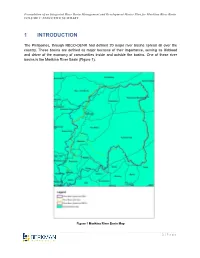
Formulation of an Integrated River Basin Management and Development Master Plan for Marikina River Basin VOLUME 1: EXECUTIVE SUMMARY 1 INTRODUCTION The Philippines, through RBCO-DENR had defined 20 major river basins spread all over the country. These basins are defined as major because of their importance, serving as lifeblood and driver of the economy of communities inside and outside the basins. One of these river basins is the Marikina River Basin (Figure 1). Figure 1 Marikina River Basin Map 1 | P a g e Formulation of an Integrated River Basin Management and Development Master Plan for Marikina River Basin VOLUME 1: EXECUTIVE SUMMARY Marikina River Basin is currently not in its best of condition. Just like other river basins of the Philippines, MRB is faced with problems. These include: a) rapid urban development and rapid increase in population and the consequent excessive and indiscriminate discharge of pollutants and wastes which are; b) Improper land use management and increase in conflicts over land uses and allocation; c) Rapidly depleting water resources and consequent conflicts over water use and allocation; and e) lack of capacity and resources of stakeholders and responsible organizations to pursue appropriate developmental solutions. The consequence of the confluence of the above problems is the decline in the ability of the river basin to provide the goods and services it should ideally provide if it were in desirable state or condition. This is further specifically manifested in its lack of ability to provide the service of preventing or reducing floods in the lower catchments of the basin. There is rising trend in occurrence of floods, water pollution and water induced disasters within and in the lower catchments of the basin. -

Policy Briefing
WAVES Policy Brieng Philippines Policy October 2015 Brieng Summary Ecosystem Accounts Inform Policies for Better A pilot ecosystem Resource Management of Laguna de Bay account was developed for the Laguna de Bay Laguna de Bay is the largest inland body of water in the Philippines to provide information providing livelihood, food, transportation and recreation to key on ood mitigation capacity, water, shery provinces and cities within and around the metropolitan area of Manila. resource management; Competing uses, unsustainable land and water uses coupled with to identify priority areas population and industrial expansion have caused the rapid degradation for protection, regulation of the lake and its watershed. The data from the ecosystem accounts of pollution and sediment can help counter the factors that are threatening the Laguna de Bay's loading; and to inform water quality and ecology. strategies on water pricing and sustainable Land Cover Condition Water Quality development planning. Land conversion due to urban Pollution coming from domestic, sprawl and rapid industrial industrial and agricultural/forest Background development are causing a decline wastes contribute to the The development of the in forest cover and impacting degradation of the water quality. agriculture production. ecosystem accounts is Fish Production based on data collection Flood Mitigation The lake can still sustain sheries and analysis conducted Increase in soil erosion from the production but is threatened by by the Laguna Lake watershed has changed the pollution. Development Authority contours of the lake. (LLDA), the agency responsible for the water and land management of the Laguna Lake Basin. 2003 2010 Technical staff from the different units of the LLDA undertook the analyses supported by international and local experts under the World Bank's Wealth Accounting and the Valuation of Ecosystem Services (WAVES) Global Partnership Programme. -

Laguna Lake, the Philippines: Industrial Contamination Hotspots
Laguna Lake, The Philippines: industrial contamination hotspots Iryna Labunska, Kevin Brigden, Paul Johnston Greenpeace Research Laboratories Technical Note 06/2011 June 2011 1. Introduction Contamination of natural water resources by discharges from the industrial sector in the Philippines continues to be a significant problem. In 2007, Greenpeace launched the Water Patrol to document the impact of water pollution on local communities in the Philippines. Within the framework of this project, several industrial sites located around Laguna Lake were visited in July 2010. During these visits, samples of wastewater discharges into creeks and tributaries of Laguna Lake and corresponding sediment or soil samples were collected. The sites which were chosen for investigation in this study were those accommodating potentially polluting facilities in the area. The selection of the facilities was based on the following criteria: facility operations were thought to involve the use of toxic chemicals; the facility discharged wastewater directly into Laguna Lake or one of its tributaries; in some cases, the facility had been previously identified by government agencies as a polluting industry and listed in the black or red lists by the Laguna Lake Development Authority or the Department of Environment and Natural Resources. Four facilities located to the south-east of Laguna Lake were targeted in the current study: Mayer Textile; Philippine Industrial Sealants and Coatings Corporation (PIS); TNC Chemicals; Carmelray 1 Industrial Park. Wastewater is discharged from these facilities into the San Juan River and the San Cristobal River. Two other target facilities were located to the north of Laguna Lake - Hansson Papers and Litton Mills. -

2018 Expanded National Nutrition Survey Monograph Series
2018 Expanded National Nutrition Survey Monograph Series The Food, Health and Nutrition Situation of Cagayan de Oro City 2018 Expanded National Nutrition Survey ISSN 2782-8964 ISBN 978-971-8769-56-0 This report provides data and information on the health and nutritional status of Cagayan de Oro City as a result of the different assessments undertaken during the conduct of the Expanded National Nutrition Survey by the Department of Science and Technology-Food and Nutrition Research Institute (DOST-FNRI). This monograph series will be published every five years, in the next cycle of the Expanded National Nutrition Survey. Additional information about the survey could be obtained from the DOST-FNRI website https:// www.fnri.dost.gov.ph/ or at the DOST-FNRI Office located at the DOST Compound, Gen. Santos Avenue, Bicutan, Taguig City, Metro Manila, Philippines 1631. Tel. Numbers.: (632) 8837-2071 local 2282/ 2296; (632) 8839-1846; (632) 8839-1839 Telefax: (632) 8837-2934; 8839-1843 Website: www.fnri.dost.gov.ph Recommended Citation: Department of Science and Technology - Food and Nutrition Research Institute (DOST-FNRI). 2020. 2018 Expanded National Nutrition Survey Monograph Series: The food, health and nutrition situation of Cagayan de Oro City. FNRI Bldg., DOST Compound, Gen. Santos Avenue, Bicutan, Taguig City, Metro Manila, Philippines. The 2018 Expanded National Nutrition Survey Monograph Series is published by the Department of Science and Technology-Food and Nutrition Research Institute (DOST-FNRI). 2018 Expanded National Nutrition -
Chapter 2. Geophysical Environment
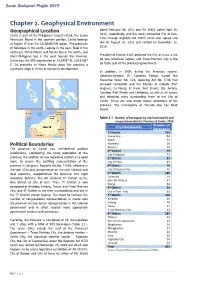
Chapter 2. Geophysical Environment Geographical Location dated February 08, 2012 and RA 10161 dated April 10, Cavite is part of the Philippines’ largest island, the Luzon 2012, respectively, and the newly converted City of Gen. Peninsula. Found in the southern portion, Cavite belongs Trias through Republic Act 10675 which was signed into to Region IV-A or the CALABARZON region. The provinces law on August 19, 2015 and ratified on December 12, of Batangas in the south, Laguna in the east, Rizal in the 2015. northeast, Metro Manila and Manila Bay in the north, and West Philippine Sea in the west bounds the Province. Presidential Decree 1163 declared the City of Imus is the de jure provincial capital, and Trece Martires City is the Cavite has the GPS coordinates of 14.2456º N, 120.8786º E. Its proximity to Metro Manila gives the province a de facto seat of the provincial government. significant edge in terms of economic development. In addition, in 1909, during the American regime, Governor-General W. Cameron Forbes issued the Executive Order No. 124, declaring Act No. 1748 that annexed Corregidor and the Islands of Caballo (Fort Hughes), La Monja, El Fraile (Fort Drum), Sta. Amalia, Carabao (Fort Frank) and Limbones, as well as all waters and detached rocks surrounding them to the City of Cavite. These are now major tourist attractions of the province. The municipality of Ternate also has Balut Island. Table 2.1 Number of barangays by city/municipality and congressional district; Province of Cavite: 2018 Number of City/Municipality Barangays 1st District 143 Cavite City 84 Kawit 23 Political Boundaries Noveleta 16 Rosario 20 The province of Cavite has well-defined political 2nd District 73 subdivisions. -

ABOITIZ POWER CORPORATION NAC Tower, 32Nd Street Bonifacio Global City, Taguig City 1634 Metro Manila, Philippines
Corporate Stockholder ABOITIZ POWER CORPORATION NAC Tower, 32nd Street Bonifacio Global City, Taguig City 1634 Metro Manila, Philippines The undersigned stockholder of ABOITIZ POWER CORPORATION (the “Company”) hereby appoints _________________________ or in his absence, the Chairman of the meeting, as attorney-in-fact and proxy, with power of substitution, to represent and vote all shares registered in the name of undersigned stockholder, at the Annual Stockholders’ Meeting of the Company on May 19, 2014 at 11:00 a.m. at the Banyan Pavilion of The Blue Leaf Events Pavilion, 100 Park Avenue, McKinley Hill Village, Fort Bonifacio, Taguig City, Philippines and at any adjournments thereof. The above-named proxy is to vote as follows: 1. Approval of minutes of previous stockholders’ (c) Distribute its shares on the same principle as meeting held last May 20, 2013 option (b) among as many candidates as he shall Yes No Abstain see fit, provided, that the total number of votes cast by him shall not exceed the number of 2. Approval of the 2013 Annual Report and Financial shares owned by him multiplied by the whole Statements number of directors to be elected. Yes No Abstain 6. Amendment of the Articles of Incorporation to adopt 3. Delegation of the authority to elect the Company’s revisions to the primary purpose clause and External Auditors for 2014 to the Board of Directors additional secondary purpose clauses. Yes No Abstain Yes No Abstain 4. Ratification of the acts, resolutions and proceedings 7. Renewal of the delegated authority to the Board of of the Board of Directors, Corporate Officers and Directors to amend or repeal the Company’s By-Laws Management in 2013 up to May 19, 2014 or adopt new By-Laws Yes No Abstain Yes No Abstain 5. -
IFC in the Philippines Creating Opportunity Where It’S Needed Most
EAST ASIA AND THE PACIFIC IFC in the Philippines Creating Opportunity Where It’s Needed Most IFC supports the Philippines’ sustainable development by helping attract international investors to sectors such as infrastructure and public utilities, financial institutions, and agribusinesses. We provide loans and equity investments to private sector companies, including small and medium enterprises with growth potential, and mobilize financing from other sources. We advise firms and the government on how to enhance businesses’ competitiveness. Since 1962, IFC has invested more than $3 billion in equity and loans for more than 100 private sector companies. We have expanded access to finance and infrastructure, facilitated public-private partnerships, improved the investment climate, mitigated climate change, and supported agribusinesses. IFC’s unique financing and advisory products combine global expertise with local knowledge, maximizing investment returns and social benefits. EAST ASIA AND THE PACIFIC Mitigating Climate Change • IFC helps scale up lending for projects in renewable energy, energy efficiency, and climate-change mitigation by advising and providing risk guarantees to our partner banks to support their loans. • We are supporting a 180-megawatt solar-and-biomass plant investment on the island of Negros in central Philippines. • To promote energy efficiency, IFC supported Mandaluyong City in Metro Manila in drafting a green-building ordinance that requires new buildings to adopt environmentally friendly features. Supporting Public-Private Supporting Agribusiness Expanding Financing Partnership Projects • The World Bank Group supports • IFC supports banks to • IFC helps the government and agribusiness investments in expand their lending to private investors collaborate on the Bangsamoro region in farmers and micro, small, financing and executing major southern Philippines to promote and women-led enterprises. -

The Ideology of the Dual City: the Modernist Ethic in the Corporate Development of Makati City, Metro Manila
bs_bs_banner Volume 37.1 January 2013 165–85 International Journal of Urban and Regional Research DOI:10.1111/j.1468-2427.2011.01100.x The Ideology of the Dual City: The Modernist Ethic in the Corporate Development of Makati City, Metro Manila MARCO GARRIDO Abstractijur_1100 165..185 Postcolonial cities are dual cities not just because of global market forces, but also because of ideological currents operating through local real-estate markets — currents inculcated during the colonial period and adapted to the postcolonial one. Following Abidin Kusno, we may speak of the ideological continuity behind globalization in the continuing hold of a modernist ethic, not only on the imagination of planners and builders but on the preferences of elite consumers for exclusive spaces. Most of the scholarly work considering the spatial impact of corporate-led urban development has situated the phenomenon in the ‘global’ era — to the extent that the spatial patterns resulting from such development appear wholly the outcome of contemporary globalization. The case of Makati City belies this periodization. By examining the development of a corporate master-planned new city in the 1950s rather than the 1990s, we can achieve a better appreciation of the influence of an enduring ideology — a modernist ethic — in shaping the duality of Makati. The most obvious thing in some parts of Greater Manila is that the city is Little America, New York, especially so in the new exurbia of Makati where handsome high-rise buildings, supermarkets, apartment-hotels and shopping centers flourish in a setting that could well be Palm Beach or Beverly Hills. -

San Juan Sub-Basin
Table of Contents Volume 19. San Juan Sub-basin ........................................................................................... 3 Geographic location ................................................................................................................ 3 Political and Administrative Boundary ..................................................................................... 4 Land Cover ............................................................................................................................. 6 Sub-basin Characterization and Properties............................................................................. 8 Drainage Network ............................................................................................................... 8 Sub-sub basin Properties ...................................................................................................10 Water Quantity ......................................................................................................................11 Streamflow .........................................................................................................................11 Water Balance ...................................................................................................................12 LIST OF FIGURES Figure 19-1 Geographical Map ..................................................................................................................... 3 Figure 19-2 Political Map ............................................................................................................................. -
Application of Indicators in Urban and Megacities Disaster Risk Management
Progress Report EMI Topical Report TR-07-01 Earthquakes and Megacities Initiative A member of the U.N. Global Platform for Disaster Risk Reduction 3cd Program Application of Indicators in Urban and Megacities Disaster Risk Management A Case Study of Metro Manila September 2006 Copyright © 2007 EMI. Permission to use this document is granted provided that the copyright notice appears in all reproductions and that both the copyright and this permission notice appear, and use of document or parts thereof is for educational, informational, and non-commercial or personal use only. EMI must be acknowledged in all cases as the source when reproducing any part of this publication. Opinions expressed in this document are those of the authors and do not necessarily refl ect those of the participating agencies and organizations. Report prepared by Jeannette Fernandez, Shirley Mattingly, Fouad Bendimerad and Omar D. Cardona Dr. Martha-Liliana Carreño, Researcher (CIMNE, UPC) Ms. Jeannette Fernandez, Project Manager (EMI/PDC) Layout and Cover Design: Kristoffer Berse Printed in the Philippines by EMI An international, not-for-profi t, scientifi c organization dedicated to disaster risk reduction of the world’s megacities EMI 2F Puno Bldg. Annex, 47 Kalayaan Ave., Diliman Quezon City 1101, Philippines T/F: +63-2-9279643; T: +63-2-4334074 Email: info@emi-megacities.org Website: http://www.emi-megacities.org 3cd Program EMI Topical Report TR-07-01 Application of Indicators in Urban and Megacities Disaster Risk Management A Case Study of Metro Manila By Jeannette Fernandez, Shirley Mattingly, Fouad Bendimerad and Omar D. Cardona Contributors Earthquakes and Megacities Initiative, EMI Ms. -

Maynilad Water Services, Inc. Public Disclosure Authorized
Fall 08 Maynilad Water Services, Inc. Public Disclosure Authorized Public Disclosure Authorized Valenzuela Sewerage System Project Environmental Assessment Report Public Disclosure Authorized Public Disclosure Authorized M a r c h 2 0 1 4 Environmental Assessment Report VALENZUELA SEWERAGE SYSTEM PROJECT CONTENTS Executive Summary ...................................................................................................................................... 7 Project Fact Sheet ..................................................................................................................................... 7 Introduction ................................................................................................................................................ 7 Brief Description of the Project .................................................................................................................. 8 A. Project Location ............................................................................................................................. 8 B. Project Components ....................................................................................................................... 9 C. Project Rationale .......................................................................................................................... 10 D. Project Cost .................................................................................................................................. 10 E. Project Phases ............................................................................................................................