Dagmar Berghoff: Deutschlands Erste Miss Tagesschau
Total Page:16
File Type:pdf, Size:1020Kb
Load more
Recommended publications
-

Profile Persönlichkeiten Der Universität Hamburg Profile Persönlichkeiten Der Universität Hamburg Inhalt
FALZ FÜR EINKLAPPER U4 RÜCKENFALZ FALZ FÜR EINKLAPPER U1 4,5 mm Profile persönlichkeiten der universität hamburg Profile persönlichkeiten der universität hamburg inhalt 6 Grußwort des Präsidenten 8 Profil der Universität Portraits 10 von Beust, Ole 12 Breloer, Heinrich 14 Dahrendorf, Ralf Gustav 16 Harms, Monika 18 Henkel, Hans-Olaf 20 Klose, Hans-Ulrich 22 Lenz, Siegfried 10 12 14 16 18 20 22 24 Miosga, Caren 26 von Randow, Gero 28 Rühe, Volker 30 Runde, Ortwin 32 Sager, Krista 34 Schäuble, Wolfgang 24 26 28 30 32 34 36 36 Schiller, Karl 38 Schmidt, Helmut 40 Scholz, Olaf 42 Schröder, Thorsten 44 Schulz, Peter 46 Tawada, Yoko 38 40 42 44 46 48 50 48 Voscherau, Henning 50 von Weizsäcker, Carl Friedrich 52 Impressum grusswort des präsidenten Grußwort des Präsidenten der Universität Hamburg Dieses Buch ist ein Geschenk – sowohl für seine Empfänger als auch für die Universität Hamburg. Die Persönlichkeiten in diesem Buch machen sich selbst zum Geschenk, denn sie sind der Universität auf verschiedene Weise verbunden – als Absolventinnen und Absolventen, als ehemalige Rektoren, als prägende Lehrkräfte oder als Ehrendoktoren und -senatoren. Sie sind über ihre unmittelbare berufliche Umgebung hinaus bekannt, weil sie eine öffentliche Funktion wahrnehmen oder wahrgenommen haben. Die Universität Hamburg ist fern davon, sich selbst als Causa des beruflichen Erfolgs ihrer prominenten Alumni zu betrach- ten. Dennoch hat die Universität mit ihnen zu tun. Sie ist der Ort gewesen, in dem diese Frauen und Männer einen Teil ihrer Sozialisation erfahren haben. Im glücklicheren Fall war das Studium ein Teil der Grundlage ihres Erfolges, weil es Wissen, Kompetenz und Persönlichkeitsbildung ermöglichte. -
Application of Operator Theory for the Representation of Continuous and Discrete Distributed Parameter Systems
Application of Operator Theory for the Representation of Continuous and Discrete Distributed Parameter Systems Der Technischen Fakult¨at der Friedrich-Alexander-Universit¨at Erlangen-Nurnberg¨ zur Erlangung des Grades Doktor-Ingenieur vorgelegt von Vitali Dymkou Erlangen, 2006 Als Dissertation genehmigt von der Technischen Fakult¨at der Friedrich-Alexander-Universit¨at Erlangen-Nurnberg¨ Tag der Einreichung: 22. Dezember 2005 Tag der Promotion: 23. March 2006 Dekan: Prof. Dr.-Ing. Alfred Leipertz Berichterstatter: Apl. Prof. Dr.-Ing. habil. Peter Steffen Apl. Prof. Dr.-Ing. habil. Krzysztof Galkowski Acknowledgements I would like to thank my supervisors, Apl. Prof. Dr.-Ing. habil. Peter Steffen and Priv. Doz. Dr.-Ing. habil. Rudolf Rabenstein, who introduced me to the subject of engineering problems and gave me the opportunity to work in their group. I would like to express them my gratitude for the excellent supervision and support and of course for the very warm atmosphere during my work and life in Erlangen. Also, I would like to thank Apl. Prof. Dr.-Ing. habil. Krzysztof Galkowski, who wisely advised me to start my scientific work in the Telecommunications Laboratory in Erlangen and for reviewing my thesis. I would like to thank ”Graduiertenkolleg Dreidimensionale Bildanalyse und -Synthese” and especially Prof. Dr. Gunther¨ Greiner for their financial support. I am deeply thankful to all my colleagues from the Telecommunications Laboratory for their patience and support over many months. I wish to thank Ursula Arnold for her help with all my administrative questions, Wolfgang Preiss for his software support and Manfred Lindner for his wonderful refrigerator. Especially I would like to thank Stefan Petrausch, who was always ready to translate, explain and answer all my private and scientific questions. -

Arnold Schwarzenegger Now and Then: a Longitudinal Case Study of Schwarzenegger’S English and German Pronunciation
Arnold Schwarzenegger Now and Then: A longitudinal case study of Schwarzenegger’s English and German pronunciation Dissertation zur Erlangung des Doktorgrades der Philosophie an der Karl- Franzens-Universität Graz eingereicht von Mag.phil. Lisa Kornder am Institut für Anglistik Erstbegutachterin: Univ.-Prof. Catharina Henrica Elisabeth Mennen, PhD Zweitbegutachter: Mag.phil. Dr. Robert Mayr 2020 DECLARATION I confirm that I have authored this thesis independently, that I have not used other than the declared sources and that I have explicitly marked all material which has been quoted either literally or by content from the used sources. ___________________ ______________________ Date Lisa Kornder i Language is a living thing. We can feel it changing. Parts of it become old: they drop off and are forgotten. New pieces bud out, spread into leaves, and become big branches, proliferating. Gilbert Highet, Explorations (1971) ii ACKNOWLEDGEMENTS If someone had told me years ago that I would write my PhD thesis in linguistics one day, I would probably have frowned upon them. Now here it is – and it would have not been possible without the support, help and guidance of many people. First and foremost, I want to express my sincere gratitude to my supervisor, Prof. Ineke Mennen, not only for guiding and supporting me throughout the process of writing my thesis, but also for encouraging me to do a PhD in the first place. You were and still are a great inspiration to me. Thanks to Dr. Robert Mayr for his willingness to be part of the committee and for being the second supervisor of my thesis. -
Dr Mabuse Prosecutor Von Wenk Investigating a at the Time) to Create Chaos and Usher in Series of Gambling Frauds, Which Have a Reign of Crime
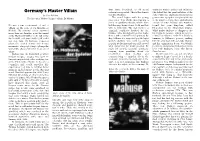
drug abuse flourished, as old moral engineers market crashes and inflations Germany’s Master Villain restraints evaporated. This is the climate (the belief that the great inflation of the by Cora Buhlert that bred Mabuse. early 1920s was engineered by nefarious The novel begins with the young powers was a popular conspiracy theory The history of Norbert Jacques’ villain, Dr Mabuse prosecutor Von Wenk investigating a at the time) to create chaos and usher in series of gambling frauds, which have a reign of crime. Mabuse also wants to He was a true mastermind of evil, a led the easy living Count Todd and his found his own kingdom, called villain on the scale of Fu Manchu or wife to their ruin. The trail leads to a Eitopomar, in the Amazonian jungles. Blofeld. His criminal career spawned criminal syndicate headed by Dr. What makes Mabuse so dangerous are more than six decades, from the unrest Mabuse (who incidentally got his name his hypnotic powers, which he uses to of the Weimar Republic to the fall of the from a 15th century Flemish painter). By control his victims. Only Von Wenk is Berlin Wall, and even death itself could day, Mabuse is a respected psychologist immune to Mabuse’s powers, making not stop him. Dr Mabuse, respected (psychoanalysis was only becoming him the only man who can take Mabuse physician, crazed genius and master popular at the time and was still viewed and his organisation down. Von Wenk’s mesmerist, always plotting to plunge the with suspicions by many people). By resolve is strengthened when he falls in world into chaos and usher in an age of night, he controls criminal operations love with Mabuse’s lover, the dancer crime. -

Pamięć Lat Nazizmu W Niemieckim Filmie Fabularnym Lat 1946-1955
http://dx.doi.org/10.18778/7969-559-1 Konrad Klejsa – Uniwersytet Łódzki, Wydział Filologiczny Katedra Mediów i Kultury Audiowizualnej, Zakład Historii i Teorii Filmu 90-236 Łódź, ul. Pomorska nr 171/173 RECENZENT Ewelina Nurczyńska-Fidelska REDAKTOR INICJUJĄCY Urszula Dzieciątkowska REDAKTOR WYDAWNICTWA UŁ Katarzyna Gorzkowska SKŁAD I ŁAMANIE Oficyna Wydawnicza Edytor.org Lidia Ciecierska PRZYGOTOWANIE KADRÓW FILMOWYCH Mikołaj Zacharow PROJEKT OKŁADKI Adrian Dutkowski Na okładce wykorzystano kadr z filmu Przygody Wernera Holta (reż. Joachim Kunert, NRD 1965) Publikacja powstała w ramach grantu Narodowego Centrum Nauki przyznanego na podstawie decyzji nr 4298/B/H03/2011/40 © Copyright by Uniwersytet Łódzki, Łódź 2015 © Copyright for this edition by Wydawnictwo Biblioteki PWSFTviT, Łódź 2015 Wydane przez Wydawnictwo Uniwersytetu Łódzkiego i Wydawnictwo Biblioteki PWSFTviT Wydanie I. W.06773.14.0.M Ark. wyd. 27,0; ark. druk. 26,125 Wydawnictwo Uniwersytetu Łódzkiego: ISBN 978-83-7969-559-1 e-ISBN 978-83-7969-560-7 Wydawnictwo Biblioteki PWSFTviT: ISBN 978-83-87870-93-5 Spis treści Podziękowania 7 Wprowadzenie 9 Rozdział I. Okres 1945–1949: kino doby denazyfikacji w strefach okupowanych Niemiec 37 1.1. Mordercy są wśród nas: traumy pośród ruin 60 1.2. Projektowanie modelowej przeszłości 80 1.3. W kostiumie melodramatu 87 1.4. Między pokoleniami 95 1.5. Problem antysemityzmu 108 1.6. Obrazy obozów 111 Rozdział II. Kino Niemieckiej Republiki Demokratycznej do 1965 roku: antyfa- szyzm jako doktryna 123 2.1. Bohaterscy oponenci Hitlera 136 2.2. Honor munduru 153 2.3. Nowi sojusznicy: ZSRR 166 2.4. Wróg zewnętrzny: mordercy są wśród nich 171 2.5. Kraj po denazyfikacji: NRD jako alternatywa 183 2.6. -

Geschichtsästhetik Und Affektpolitik. Stauffenberg Und Der 20
Repositorium für die Medienwissenschaft Drehli Robnik Geschichtsästhetik und Affektpolitik. Stauffenberg und der 20. Juli im Film 1948 - 2008 2009 https://doi.org/10.25969/mediarep/3736 Veröffentlichungsversion / published version Buch / book Empfohlene Zitierung / Suggested Citation: Robnik, Drehli: Geschichtsästhetik und Affektpolitik. Stauffenberg und der 20. Juli im Film 1948 - 2008. Wien: Turia + Kant 2009. DOI: https://doi.org/10.25969/mediarep/3736. Nutzungsbedingungen: Terms of use: Dieser Text wird unter einer Creative Commons - This document is made available under a creative commons - Namensnennung - Weitergabe unter gleichen Bedingungen 4.0/ Attribution - Share Alike 4.0/ License. For more information see: Lizenz zur Verfügung gestellt. Nähere Auskünfte zu dieser Lizenz https://creativecommons.org/licenses/by-sa/4.0/ finden Sie hier: https://creativecommons.org/licenses/by-sa/4.0/ GESCHICHTSÄSTHETIK UND AFFEKTPOLITIK Drehli Robnik Historiker und Filmwissenschaftler; Studium in Wien und Amsterdam; Forschungstätigkeit am Ludwig Boltzmann-Institut für Geschichte und Gesellschaft, Wien; Lehrtätigkeit an der Universität Wien, an der Masaryk University, Brno und der Johann Wolfgang Goethe-Universität, Frankfurt/M. Gelegentlich Disk-Jockey und Edutainer. »Lebt« in Wien-Erdberg. DREHLI ROBNIK Geschichtsästhetik und Affektpolitik Stauffenberg und der 20. Juli im Film 1948 - 2008 VERLAG TURIA + KANT WIEN Bibliografische Information Der Deutschen Bibliothek Die Deutsche Bibliothek verzeichnet diese Publikation in der Deutschen Nationalbibliografie; -

Masterthesis
Fakultät Medien Masterthesis Constanze Hundt Analyse langjährig erfolgreicher und weltweit verbreiteter TV-Formate und Adaptierung der jeweiligen Kernpunkte auf eine Gesamtsendung Chemnitz, 2012 Fakultät Medien Masterthesis Autor Constanze Hundt Studiengang Information and communication Sciences Seminargruppe IC09w1-M Erstprüfer Prof. Peter Gottschalk Zweitprüfer Prof. Dipl. Kaufm. Günther Graßau Thema Analyse langjährig erfolgreicher und weltweit verbreiteter TV-Formate und Adaptierung der jeweiligen Kernpunkte auf eine Gesamtsendung Chemnitz, 2012 Faculty of Media Masterthesis author Hundt, Constanze course of studies Information and communication Sciences seminar group IC09w1-M first examiner Prof. Peter Gottschalk second examiner Prof. Dipl. Kaufm. Günther Graßau topic Analysis of longtime running, successful and worldwide distributed television formats as well as adaption of respective key frames for creation of a new televison format Chemnitz, 2012 Analyse und Adaptierung langjährig erfolgreicher TV-Formate IV „Am zuverlässigsten unterscheiden sich die einzelnen Fernsehprogramme noch immer durch den Wetterbericht.“1 --- Woody Allan --- 1 Allan, Woody: Tintenfass - Das Magazin für den überforderten Intellektuellen Nr. 32 - "The show must go on ?", Wien, 2008 Analyse und Adaptierung langjährig erfolgreicher TV-Formate V Bibliografische Beschreibung und Referat „Hundt, Constanze: Analyse langjährig erfolgreicher und weltweit verbreiteter TV-Formate und Adaptierung der jeweiligen Kernpunkte auf eine Gesamtsendung – 2012 – 162 Seiten -

UCLA Electronic Theses and Dissertations
UCLA UCLA Electronic Theses and Dissertations Title The Representation of Forced Migration in the Feature Films of the Federal Republic of Germany, German Democratic Republic, and Polish People’s Republic (1945–1970) Permalink https://escholarship.org/uc/item/0hq1924k Author Zelechowski, Jamie Publication Date 2017 Peer reviewed|Thesis/dissertation eScholarship.org Powered by the California Digital Library University of California UNIVERSITY OF CALIFORNIA Los Angeles The Representation of Forced Migration in the Feature Films of the Federal Republic of Germany, German Democratic Republic, and Polish People’s Republic (1945–1970) A dissertation submitted in partial satisfaction of the requirements for the degree Doctor of Philosophy in Germanic Languages by Jamie Leigh Zelechowski 2017 © Copyright by Jamie Leigh Zelechowski 2017 ABSTRACT OF THE DISSERTATION The Representation of Forced Migration in the Feature Films of the Federal Republic of Germany, German Democratic Republic, and Polish People’s Republic (1945–1970) by Jamie Leigh Zelechowski Doctor of Philosophy in Germanic Languages University of California, Los Angeles, 2017 Professor Todd S. Presner, Co-Chair Professor Roman Koropeckyj, Co-Chair My dissertation investigates the cinematic representation of forced migration (due to the border changes enacted by the Yalta and Potsdam conferences in 1945) in East Germany, West Germany, and Poland, from 1945–1970. My thesis is that, while the representations of these forced migrations appear infrequently in feature film during this period, they not only exist, but perform an important function in the establishment of foundational national narratives in the audiovisual sphere. Rather than declare the existence of some sort of visual taboo, I determine, firstly, why these images appear infrequently; secondly, how and to what purpose(s) existing representations are mobilized; and, thirdly, their relationship to popular and official discourses. -

Historia Militar Revista De Educación Histórica
Edición especial Historia Militar Revista de educación histórica Historia militar en imagen: Peter Becker en «Stauffenberg – la historia verdadera» Resistencia y atentado: el 20 de julio de 1944 La paz, ¿por fin? El Tratado de Versalles, 1919 Trabajo forzado y explotación: el imperio económico nazi ¿Guerra en miniatura? El deporte y las fuerzas armadas La caída del Muro de Berlín en 1989 Impressum Contenido Militärgeschichte Zeitschrift für historische Bildung El 20 de julio de 1944 en su Historia Militar dimensión militar 4 Revista de educación histórica Editada por Centro de Historia Militar y Ciencias Sociales de la Bundeswehr (ZMSBw) La Resistencia y el final 10 Responsables según la ley de prensa: de la guerra en el Oeste Capitán de navío Dr. Jörg Hillmann y Coronel Dr. Frank Hagemann Coronel (r) Prof. Dr. Winfried Heinemann, nacido en Dortmund en 1956, fue historiador en el ZMSBw hasta 2018; Coordinación de esta edición especial: ahora es profesor honorario de Historia Moderna en Dr. Christian Adam la Universidad Técnica de Brandeburgo en Cottbus-Senftenberg. Traducción y corrección: El imperio económico de los Centro Federal de Idiomas campos de concentración 14 Redacción: Trabajo forzado para la «victoria final» Cornelia Grosse M.A. (cg) Oberleutnant Helene Heldt M.A. (hh) Dr. habil. Hermann Kaienburg, nacido en Major Chris Helmecke M.A. (ch) Kapellen (Moers) en 1950, historiador jubilado; Fregattenkapitän Dr. Christian Jentzsch (cj) su enfoque investigador: el nacionalsocialismo. Oberstleutnant Dr. Harald Potempa (hp) Oberstleutnant Dr. Klaus Storkmann (ks) Reportero gráfico:Esther Geiger Tratado de Versalles Lectorado de los textos originales: ¿Hipoteca para el futuro? 20 Dr. -
Comparing Hitler and Stalin: Certain Cultural Considerations
City University of New York (CUNY) CUNY Academic Works All Dissertations, Theses, and Capstone Projects Dissertations, Theses, and Capstone Projects 6-2014 Comparing Hitler and Stalin: Certain Cultural Considerations Phillip W. Weiss Graduate Center, City University of New York How does access to this work benefit ou?y Let us know! More information about this work at: https://academicworks.cuny.edu/gc_etds/303 Discover additional works at: https://academicworks.cuny.edu This work is made publicly available by the City University of New York (CUNY). Contact: AcademicWorks@cuny.edu Comparing Hitler and Stalin: Certain Cultural Considerations by Phillip W. Weiss A master’s thesis submitted to the Graduate Faculty in Liberal Studies in partial fulfillment of the requirements for the degree of Master of Arts, The City University of New York 2014 ii Copyright © 2014 Phillip W. Weiss All Rights Reserved iii This manuscript has been read and accepted for the Graduate Faculty in Liberal Studies in satisfaction of the dissertation requirement for the degree of Master of Arts. (typed name) David M. Gordon __________________________________________________ (required signature) __________________________ __________________________________________________ Date Thesis Advisor (typed name) Matthew K. Gold __________________________________________________ (required signature) __________________________ __________________________________________________ Date Executive Officer THE CITY UNIVERSITY OF NEW YORK iv Acknowledgment I want to thank Professor David M. Gordon for agreeing to become my thesis advisor. His guidance and support were major factors in enabling me to achieve the goal of producing an interesting and informative scholarly work. As my mentor and project facilitator, he provided the feedback that kept me on the right track so as to ensure the successful completion of this project. -

70 Jahre Ccc Filmkunst Inhalt Grusswort 3
FILMREIHE 70 JAHRE CCC FILMKUNST INHALT GRUSSWORT 3 03 Grußwort Wer hätte im September 1946 gedacht, dass sich die Gründung der CCC Filmkunst durch 04 70 Jahre CCC Filmkunst / Claudia Dillmann den Produzenten Artur Brauner zu einer für die deutsche Filmgeschichte beispiellosen Er- folgsgeschichte entwickeln würde, die das Unternehmen in den 1950ern nicht nur zur er- DIE FILME folgreichsten unabhängigen Filmproduktion Europas machte, sondern auch allen Kinokrisen 10 MORITURI zum Trotz bis heute andauert. Mit mehr als 250 Kinofilmen und unzähligen TV-Produktionen 12 DIE SPUR FÜHRT NACH BERLIN hat die Produktionsfirma ihr Publikum über die Jahrzehnte hinweg begeistert und beglückt, 14 LIEBE, TANZ UND 1000 SCHLAGER brüskiert und herausgefordert. Nun kann die CCC ihr 70. Jubiläum feiern. Gratulation! 16 VOR SONNENUNTERGANG 18 ES GESCHAH AM HELLICHTEN TAG / EL CEBO Zum Jubiläum präsentieren die Deutsche Kinemathek (Berlin) und das Deutsche Filmins- 20 AM TAG, ALS DER REGEN KAM titut – DIF (Frankfurt am Main) gemeinsam diese Werkschau. Beide Institutionen sind der 22 DIE 1000 AUGEN DES DR. MABUSE / IL DIABOLICO CCC eng verbunden: Die Deutsche Kinemathek archiviert und verleiht die Filme der Firma, DR. MABUSE / LE DIABOLIQUE DOCTEUR MABUSE während das Deutsche Filminstitut – DIF die reichhaltigen Produktionsunterlagen der CCC 24 DER BRAVE SOLDAT SCHWEJK bewahrt, erschließt und zugänglich macht. 28 EICHMANN UND DAS DRITTE REICH 30 OLD SHATTERHAND / LA BATTAGLIA DI FORT APACHE / Die für die Filmreihe ausgewählten Filme dokumentieren die enorme Bandbreite -

Magisterhausarbeit Lothar Eichhorn
Abschlussarbeit zur Erlangung des Magister Artium im Fachbereich Neuere Philologien (FB 10) der Johann Wolfgang Goethe-Universität Institut für Theater-, Film- und Medienwissenschaft Thema: Der Wahrheitsanspruch filmischer Geschichtsdarstellung, betrachtet mit Gilles Deleuze am Beispiel neuerer deutscher Filme zum Themenkomplex RAF. 1. Gutachter: Prof. Dr. Burkhardt Lindner 2. Gutachterin: Prof. Dr. Heide Schlüpmann vorgelegt von: Lothar Eichhorn aus: Bensheim Einreichungsdatum: 16.02.2006 1. Einleitung Seite 1 2. Gilles Deleuze' Philosophie des Films Seite 13 2.1. »Der kinematographische Mechanismus des Denkens« Seite 16 2.2. »Das Auge ist nicht die Kamera, es ist die Leinwand« Seite 19 2.3. »Die Krise des Aktionsbildes« Seite 25 2.4. »Ein Bild ist nie allein« Seite 30 2.5. »Die Leinwand ist das Gehirn« Seite 37 3. Zwei Sichtweisen auf den »Deutschen Herbst« 1977 Seite 42 3.1. Deutschland im Herbst Seite 44 3.1.1. »Auf der Suche nach den Grundlagen deutscher Geschichte« Seite 45 3.1.2. »Kraut und Rüben« Seite 48 3.1.3. »Das Volk fehlt« Seite 51 3.2. Terrorismus im deutschen Film von 1978 bis 1997 Seite 56 3.3. Todesspiel Seite 58 3.3.1. »Die perfekte Imitation des Gewesenen« Seite 59 3.3.2. Die Geburt einer Nation Seite 66 4. Wahrheitsmodelle des Films Seite 70 4.1. »Organische« und »kristalline« Ordnung Seite 70 4.2. »In einer Welt, die wesentlich falsch ist« Seite 73 4.3. Das Kino der »Fälscher« Seite 77 4.4. »Ich ist ein anderer« Seite 80 4.5. »Die Wahrheit des Kinos« Seite 83 5. Neue Sichtweisen auf die RAF Seite 87 5.1.