Nataraja Rama Krishna‟S Contribution; Perini Siva Tandavam
Total Page:16
File Type:pdf, Size:1020Kb
Load more
Recommended publications
-

Indian Classical Dance Is a Relatively New Umbrella Term for Various Codified Art Forms Rooted in Natya, the Sacred Hindu Musica
CLASSICAL AND FOLK DANCES IN INDIAN CULTURE Palkalai Chemmal Dr ANANDA BALAYOGI BHAVANANI Chairman: Yoganjali Natyalayam, Pondicherry. INTRODUCTION: Dance in India comprises the varied styles of dances and as with other aspects of Indian culture, different forms of dances originated in different parts of India, developed according to the local traditions and also imbibed elements from other parts of the country. These dance forms emerged from Indian traditions, epics and mythology. Sangeet Natak Akademi, the national academy for performing arts, recognizes eight distinctive traditional dances as Indian classical dances, which might have origin in religious activities of distant past. These are: Bharatanatyam- Tamil Nadu Kathak- Uttar Pradesh Kathakali- Kerala Kuchipudi- Andhra Pradesh Manipuri-Manipur Mohiniyattam-Kerala Odissi-Odisha Sattriya-Assam Folk dances are numerous in number and style, and vary according to the local tradition of the respective state, ethnic or geographic regions. Contemporary dances include refined and experimental fusions of classical, folk and Western forms. Dancing traditions of India have influence not only over the dances in the whole of South Asia, but on the dancing forms of South East Asia as well. In modern times, the presentation of Indian dance styles in films (Bollywood dancing) has exposed the range of dance in India to a global audience. In ancient India, dance was usually a functional activity dedicated to worship, entertainment or leisure. Dancers usually performed in temples, on festive occasions and seasonal harvests. Dance was performed on a regular basis before deities as a form of worship. Even in modern India, deities are invoked through religious folk dance forms from ancient times. -

In the Kingdom of Nataraja, a Guide to the Temples, Beliefs and People of Tamil Nadu
* In the Kingdom of Nataraja, a guide to the temples, beliefs and people of Tamil Nadu The South India Saiva Siddhantha Works Publishing Society, Tinnevelly, Ltd, Madras, 1993. I.S.B.N.: 0-9661496-2-9 Copyright © 1993 Chantal Boulanger. All rights reserved. This book is in shareware. You may read it or print it for your personal use if you pay the contribution. This document may not be included in any for-profit compilation or bundled with any other for-profit package, except with prior written consent from the author, Chantal Boulanger. This document may be distributed freely on on-line services and by users groups, except where noted above, provided it is distributed unmodified. Except for what is specified above, no part of this book may be reproduced or transmitted in any form or by any means, electronic or mechanical, including photocopying, recording, or by an information storage and retrieval system - except by a reviewer who may quote brief passages in a review to be printed in a magazine or newspaper - without permission in writing from the author. It may not be sold for profit or included with other software, products, publications, or services which are sold for profit without the permission of the author. You expressly acknowledge and agree that use of this document is at your exclusive risk. It is provided “AS IS” and without any warranty of any kind, expressed or implied, including, but not limited to, the implied warranties of merchantability and fitness for a particular purpose. If you wish to include this book on a CD-ROM as part of a freeware/shareware collection, Web browser or book, I ask that you send me a complimentary copy of the product to my address. -
Guide to 275 SIVA STHALAMS Glorified by Thevaram Hymns (Pathigams) of Nayanmars
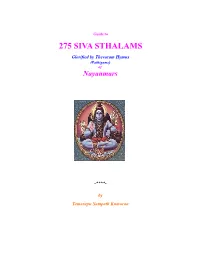
Guide to 275 SIVA STHALAMS Glorified by Thevaram Hymns (Pathigams) of Nayanmars -****- by Tamarapu Sampath Kumaran About the Author: Mr T Sampath Kumaran is a freelance writer. He regularly contributes articles on Management, Business, Ancient Temples and Temple Architecture to many leading Dailies and Magazines. His articles for the young is very popular in “The Young World section” of THE HINDU. He was associated in the production of two Documentary films on Nava Tirupathi Temples, and Tirukkurungudi Temple in Tamilnadu. His book on “The Path of Ramanuja”, and “The Guide to 108 Divya Desams” in book form on the CD, has been well received in the religious circle. Preface: Tirth Yatras or pilgrimages have been an integral part of Hinduism. Pilgrimages are considered quite important by the ritualistic followers of Sanathana dharma. There are a few centers of sacredness, which are held at high esteem by the ardent devotees who dream to travel and worship God in these holy places. All these holy sites have some mythological significance attached to them. When people go to a temple, they say they go for Darsan – of the image of the presiding deity. The pinnacle act of Hindu worship is to stand in the presence of the deity and to look upon the image so as to see and be seen by the deity and to gain the blessings. There are thousands of Siva sthalams- pilgrimage sites - renowned for their divine images. And it is for the Darsan of these divine images as well the pilgrimage places themselves - which are believed to be the natural places where Gods have dwelled - the pilgrimage is made. -

The 45Th ALL INDIA COMPETITIONS in MUSIC and DANCE, 2013
The 45th ALL INDIA COMPETITIONS IN MUSIC AND DANCE, 2013 (This form duly filled in should reach the Organising Secretary, Navya Nataka Samiti, # 1-8-522/12, Chikkadpally, Hyderabad - 500 020 or the Y.M.C.A., Narayanguda, Hyderabad - 500 029 on or before the 20th November, 2012 ENTRY FORM 1. Name in full (in Block Letters) : Sri / Smt. / Kum.________________________________________________ 2. Address with Pin Code ___________________________________________________________________ ___________________________________________________________________Pin : ______________ 3. Age and Date of Birth____________________________________________________________________ (Proof of age to be produced) 4. Contact No.: ___________________________________________________________________________ 5. Branch and Section in which the entry is made : ______________________________________________ (Tick the appropriate item) 1. Karnatak - Vocal - Senior 11. Bharatanatyam - Senior 2. Karnatak - Veena - Senior 12. Bharatanatyam - Junior 3. Karnatak - Violin - Senior 13. Bharatanatyam - Sub - Junior 4. Karnatak - Mridangam - Senior 14. Kuchipudi - Senior 5. Karnatak - Vocal - Junior 15. Kuchipudi - Junior 6. Karnatak - Vocal - Sub-Junior 16. Kuchipudi - Sub-Junior 7. Hindustani - Vocal - Senior 17. Andhra Natyam - Senior 8. Hindustani - Sitar - Senior 18. Andhra Natyam - Junior 9. Hindustani - Tabla - Senior 19. Andhra Natyam - Sub-Junior 10. Hindustani - Tabla - Junior 20. Kathak - Senior 21. Kathak - Junior Entry fee remitted : Seniors / Juniors / Sub-Juniors Rs.100/- -

South-Indian Images of Gods and Goddesses
ASIA II MB- • ! 00/ CORNELL UNIVERSITY* LIBRARY Date Due >Sf{JviVre > -&h—2 RftPP )9 -Af v^r- tjy J A j£ **'lr *7 i !! in ^_ fc-£r Pg&diJBii'* Cornell University Library NB 1001.K92 South-indian images of gods and goddesse 3 1924 022 943 447 AGENTS FOR THE SALE OF MADRAS GOVERNMENT PUBLICATIONS. IN INDIA. A. G. Barraud & Co. (Late A. J. Combridge & Co.)> Madras. R. Cambrav & Co., Calcutta. E. M. Gopalakrishna Kone, Pudumantapam, Madura. Higginbothams (Ltd.), Mount Road, Madras. V. Kalyanarama Iyer & Co., Esplanade, Madras. G. C. Loganatham Brothers, Madras. S. Murthv & Co., Madras. G. A. Natesan & Co., Madras. The Superintendent, Nazair Kanun Hind Press, Allahabad. P. R. Rama Iyer & Co., Madras. D. B. Taraporevala Sons & Co., Bombay. Thacker & Co. (Ltd.), Bombay. Thacker, Spink & Co., Calcutta. S. Vas & Co., Madras. S.P.C.K. Press, Madras. IN THE UNITED KINGDOM. B. H. Blackwell, 50 and 51, Broad Street, Oxford. Constable & Co., 10, Orange Street, Leicester Square, London, W.C. Deighton, Bell & Co. (Ltd.), Cambridge. \ T. Fisher Unwin (Ltd.), j, Adelphi Terrace, London, W.C. Grindlay & Co., 54, Parliament Street, London, S.W. Kegan Paul, Trench, Trubner & Co. (Ltd.), 68—74, iCarter Lane, London, E.C. and 25, Museum Street, London, W.C. Henry S. King & Co., 65, Cornhill, London, E.C. X P. S. King & Son, 2 and 4, Great Smith Street, Westminster, London, S.W.- Luzac & Co., 46, Great Russell Street, London, W.C. B. Quaritch, 11, Grafton Street, New Bond Street, London, W. W. Thacker & Co.^f*Cre<d Lane, London, E.O? *' Oliver and Boyd, Tweeddale Court, Edinburgh. -

M.P.A DANCE Hall Ticket No
s- L1 UNIVERSITY OF HYDERABAD SAROJINI NAIDU SCHOOL OFARTS AND COMMUNICATION Gachibowli, Hyderabad - 500 046 ENTRANCE EXAMINATION, JUNE 2O1O M.P.A DANCE Hall Ticket No. Date:02 - 6 -2010 Time: 10.00 a.m-12.00 pm. Max.Marks:50 Instructions: 1. Part 'A' should be answered in the Question Paper itself and returned to the Invigilator. 2. Part 'B' should be answered in the answer book provided to the candidate. 3. All questions in Part 'A' carry equal marks. There will be a negative marking of 0.33 mart for eacn attemptea won . PART - A z5xl:25 l. Choose the correct Answer: 1. Karagattam is a folk form of A) A.P B) Tamil Nadu c) u.P D) none 2. Bhagavatam or Veedhinatakam involves the performance of ( A) A group with story B) A group without story C) Solo D) None 3. Abhinaya Darpana is written by: ( ) A) Nandikeswara B) Kshetrayya C) Narayanatirdha D) Jayadeva 4. Anita Ratnam is an exponent of A) Contemporary dance B) Kuchipudi C) Bharatanatyam D) Manipuri 5. Kalamandalam of Kerala is founded by: ( A) M.K.Menon B) Swati Tirunal C) Vallathole D) None 6. According to Abhinaya Darpana, the total number of Drishti bhedas is ( 4.)36 B)8 c)6 D) none 7. Tribhanga position is significantly seen in the dance style ( A) Kuchipudi B) BharatanatYam C) Mohiniattam D) Odissi J- , s '21 8. Adhyatma Ramayana Kirtanas are written by ( A) Munipalle Subrahmanya Kavi B) Tyagaraja C) Tandu D) Kshetrayya 9. One of the percussion instruments used traditionally in Kathakal ( A) Pakhawaj B) Mridangam C) Tabla D) Chanda l0' Andhra Praja Natya Mandali is a group actively involved in presenting ( A) classical performances B) only Tribal dance performances C) All Folk performing genres D) none 11. -

The Childhood Love That Became Nilimma's Life
COLUMN Dance: The childhood love that became Nilimma’s life The travails of the partition, and her mother’s determination to give her daughter a chance to partake of the divinity in dance, started CULTURATI the US-based Kuchipudi dancer on a life-long journey in dance ARSHIYA SETHI he has been recorded by made her eyes moist up. The family with the National Heritage great difficulty moved to Delhi and ten Foundation as part of of them lived in one room in old Delhi. Dr Sethi has been their documentation of Her mother loved poetry and despite writing on the arts the cultural wealth of the the fact that everything around them scene in India and united States of America still spoke of loss, her mother would the world for three and has been a member for six years of send Nilimma and her sister Rashma, decades. She has a theS Maryland State Arts Council. She walking, all the way to Bengali Market, doctorate on the link teaches a popular course at George chaperoned by the old family retainer, between dance and Washington University on “Gender in to learn dance from the renowned politics, with the Indian Dance” and was awarded the Life Kathak dancer Uma Sharma’s uncle. Sattriya dance form of time Pola Nireneka Award for Dance Their forays in dance were met with Assam as a case study. by Washington Performing Arts in patriarchal disapproval for every time 2015. And yet, Nilimma Devi’s dance life they were “asked to dance in family set- began with the pain and sadness of the tings, my grandfather would leave the partition of India. -

Hindu Students Organization Sanātana Dharma Saṅgha
Hindu Students Organization Sanātana Dharma Saṅgha Table of Contents About HSO 1 Food for Thought 2 Pronunciation Guide 3 Opening Prayers 4 Gaṇesh Bhajans 6 Guru and Bhagavān Bhajans 9 Nārāyaṇa Bhajans 11 Krishṇa Bhajans 13 Rāma Bhajans 23 Devī Bhajans 27 Shiva Bhajans 32 Subramaṇyam Bhajans 37 Sarva Dharma Bhajans 38 Traditional Songs 40 Aartīs 53 Closing Prayers 58 Index 59 About HSO Columbia University’s Hindu Students Organization welcomes you. The Hindu Students Organization (HSO) is a faith-based group founded in 1992 with the intent of raising awareness of Hindu philosophies, customs, and traditions at Columbia University. HSO's major goals are to encourage dialogue about Hinduism and to provide a forum for students to practice the faith. HSO works with closely with other organizations to host joint events in an effort to educate the general public and the Columbia community. To pursue these goals, HSO engages in educational discussions, takes part in community service, and coordinates religious and cultural events including the following: Be the Change Day Navaratri Diwali Saraswati/Ganesh Puja Study Breaks Lecture Events Shruti: A Classical Night Holi Weekly Bhajans and Discussion Circle/Bhajans Workshop Interfaith Events Interviews to become a part of HSO’s planning board take place at the start of the fall semester. If you are interested in joining our mailing list or if you would like to get in touch with us, email us at hso@columbia.edu or visit us at http://www.columbia.edu/cu/hso/! 1 Food For Thought Om - “OM - This Imperishable Word is the whole of this visible universe. -

Cultural Heritage Tourism Management in Pashupatinath Area
Nepalese Culture Vol. XIII : 95-106, 2019 Central Department of NeHCA, Tribhuvan University, Kathmandu, Nepal Cultural Heritage Tourism Management in Pashupatinath Area Pashupati Nyaupane Abstract Heritage represents irreplaceable resources for the tourism industry so conservation is a vital component of their management. Throughout the world, the tourism industry has been an economic generator including conserving the heritage sites. Today, tourism has been considered to have greater socio economic values. Thus Pashupatinath area, with its rich cultural heritage, has great potential to be tapped through cultural heritage tourism. Pashupatinath area is known for its rich cultural heritage, but lack of proper tourism guidelines in the areas has not been able to showcase its potential. Thus, the paper tries to bring the importance of heritage tourism in the core area of Pashupatinath and its vicinity into limelight. The paper addresses the need of improvement in management, information and development in infrastructure. Moreover it covers the approach of conservation of tangible and intangible cultural heritage. This article examines the significance and value of Pashupatinath area as a cultural heritage tourism destination. This research identifies numerous issues related to cultural heritage tourism management in Pashupatinath area and its cultural heritage tourism products, coordination among stakeholders and interpretation. It explores the current management situation of Pashupati area and provides the suggestion for the betterment of cultural heritage tourism in Pashupatinath area. The paper helps to relate the tourism industry with the economic growth of Pashupatinath area. Key words: Heritage, Cultural Heritage tourism, Interpretation, Authenticity. Introduction Hinduism is known as one of the most ancient religions in the world. -
Shiva, the Destroyer and the Restorer
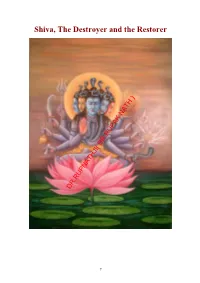
Shiva, The Destroyer and the Restorer DR.RUPNATHJI( DR.RUPAK NATH ) 7 SHIV TATTVA In Me the universe had its origin, In Me alone the whole subsists; In Me it is lost-Siva, The Timeless, it is I Myself, Sivoham! Sivoham! Sivoham! Salutations to Lord Shiva, the vanquisher of Cupid, the bestower of eternal bliss and Immortality, the protector of all beings, destroyer of sins, the Lord of the gods, who wears a tiger-skin, the best among objects of worship, through whose matted hair the Ganga flows. Lord Shiva is the pure, changeless, attributeless, all-pervading transcendental consciousness. He is the inactive (Nishkriya) Purusha (Man). Prakriti is dancing on His breast and performing the creative, preservative and destructive processes. When there is neither light nor darkness, neither form nor energy, neither sound nor matter, when there is no manifestation of phenomenal existence, Shiva alone exists in Himself. He is timeless, spaceless, birthless, deathless, decayless. He is beyond the pairs of opposites. He is the Impersonal Absolute Brahman. He is untouched by pleasure and pain, good and evil. He cannot be seen by the eyes but He can be realised within the heart through devotion and meditation. Shiva is also the Supreme personal God when He is identified with His power. He is then omnipotent, omniscient active God. He dances in supreme joy and creates, sustains and destroys with the rhythm of His dancing movements. DR.RUPNATHJI( DR.RUPAK NATH ) He destroys all bondage, limitation and sorrow of His devotees. He is the giver of Mukti or the final emancipation. -

Hindu Temple of Rochester Newsletter
Hindu Temple of Rochester 120 Pinnacle Road, Pittsford, NY 14534-1008 http://www.hindutempleofrochester.com Telephone: (585) 427- 8091 Jul, Aug, Sep 2015 Newsletter #3 President’s Column! The temple has switched from Quicken to QuickBooks EXECUTIVE effective this year, in order to simplify the Namaste! maintenance of member/donor database and COUNCIL Dear Fellow Devotee: financial records. The donor database has been President In the first few months of the year we all have had opportunity updated through the year 2014. to enjoy the festivities of Holi, Ugadi, Ram Navmi and prana Local media has covered our yoga and meditation Sanjay Mathur prathishtapana of our Sri Krishanji and Devi Mata utsava classes, holi function as well as our Nepal appeal for 585-666-0608 murthis. As we come near completion of the first half of 2015, Prayer and Donation. They will also publicize I would like to share with you all some of our awareness of Upcoming World Yoga day on June 21st accomplishments. 2015. Vice President Special General Body Meeting - Phase IV approved: The Om P. Gupta Board of Trustees are always guiding us in long term The Mandala Puja for Sri Krishna and Sri Durga Utsav 585-385-1020 vision and planning teams, one each for Shikhar, Kitchen Murthis on Friday, 19th and Saturday, 20th June 2015 and and Facility Improvement (internal and external) have World Yoga Day on Sunday, 21st June 2015 was successful been constituted. and without volunteer support, we would not have been Secretary Membership Satisfaction Survey: We have already able to do these events. -

A Historical Survey on the Founders, Speakers and Dynastic Traditions of Pashupata Cult
International Journal of Research and Review Vol.7; Issue: 2; February 2020 Website: www.ijrrjournal.com Research Paper E-ISSN: 2349-9788; P-ISSN: 2454-2237 A Historical Survey on the Founders, Speakers and Dynastic Traditions of Pashupata Cult Satendra Kumar Mishra1, Satyarth Prakash Tripathi2 1Assistant Professor, 2Professor, Amity School of Languages, Amity University, Lucknow Campus, Uttar Pradesh, India-226010 Corresponding Author: Satendra Kumar Mishra ABSTRACT indispensable whether its form was communal or not. It is known that in the Shaivism is highly coordinated with antiquity Maurya period, the general form of (mythology). It is not impossible that the creator Shaivism was questioning the popularity of Indus-civilization was in a state of criteria, its relation cannot be declared as uncertainty on the matter of Pashupata cult. It is specific as any other Shaivite community. If also not without doubt that in the Vedic Aryan literature, Rudra-Pashupati ideology has been in the evidence of Panini and Patanjali is circulation, but expressing this view would be accepted as a historical proof, then the consistent with the view of historical justice that thoughts and feelings of Pashupata cult can the existence of Pashupata cult existed in any be reflected on the field. Panini was related situation preceding the fifth-eighth century BC. to the north-east India thus it is estimated Under the pre-median situation in the sanctum that the existence of Pashupata cult has sanctorum of Panini, Patanjali and other remained subdued in this region. Based on evidences, it has been revealed that the the analysis of Sudhakar Chattopadhyay and phenomenon of Pashupata cult was manifested other Greek authors, the conclusions are that in the sixth century BC.