The Hillsdale 1776 Curriculum Kindergarten–2Nd Grade
Total Page:16
File Type:pdf, Size:1020Kb
Load more
Recommended publications
-
This Constitution: a Bicentennial Chronicle, Nos. 14-18
DOCUMENT RESUME ED 300 290 SO 019 380 AUTHOR Mann, Shelia, Ed. TITLE This Constitution: A Bicentennial Chronicle, Nos. 14-18. INSTITUTION American Historical Association, Washington, D.C.; American Political Science Association, Washington, D.C.; Project '87, Washington, DC. SPONS AGENCY National Endowment for the Humanities (NFAH), Washington, D.C. PUB DATE 87 NOTE 321p.; For related document, see ED 282 814. Some photographs may not reproduce clearly. AVAILABLE FROMProject '87, 1527 New Hampshire Ave., N.W., Washington, DC 20036 nos. 13-17 $4.00 each, no. 18 $6.00). PUB TYPE Collected Works - Serials (022) -- Historical Materials (060) -- Guides - Classroom Use - Guides (For Teachers) (052) JOURNAL CIT This Constitution; n14-17 Spr Sum Win Fall 1987 n18 Spr-Sum 1988 EDRS PRICE MFO1 Plus Postage. PC Not Available from EDRS. DESCRIPTORS Class Activities; *Constitutional History; *Constitutional Law; History Instruction; Instructioral Materials; Lesson Plans; Primary Sources; Resource Materials; Secondary Education; Social Studies; United States Government (Course); *United States History IDENTIFIERS *Bicentennial; *United States Constitution ABSTRACT Each issue in this bicentennial series features articles on selected U.S. Constitution topics, along with a section on primary documents and lesson plans or class activities. Issue 14 features: (1) "The Political Economy of tne Constitution" (K. Dolbeare; L. Medcalf); (2) "ANew Historical Whooper': Creating the Art of the Constitutional Sesquicentennial" (K. Marling); (3) "The Founding Fathers and the Right to Bear Arms: To Keep the People Duly Armed" (R. Shalhope); and (4)"The Founding Fathers and the Right to Bear Arms: A Well-Regulated Militia" (L. Cress). Selected articles from issue 15 include: (1) "The Origins of the Constitution" (G. -

Tim H. Blessing Alvernia College Sseptember 21, 1791, Governor
THE LEWISTOWN RIOTS, 1791-1793: A MICRO-ANALYTIC APPROACH Tim H. Blessing Alvernia College SSeptember 21, 1791, Governor Thomas Mifflin notified the Pennsylvania Assembly of riots in the center of the state so seri- ous that he intended to "exert the Constitutional powers of the Executive" to bring the riots "against the government" [emphasis addedi to an end.' Indicating his belief that he might have to use the force of arms to stop the riots, he also told the legislature that he was "confident ... that any legislative aid [that] may be want- ing ... you will cheerfully and liberally afford." Mifflin's address to the legislature reflected his response to communications received from Judge Thomas Smith of Carlisle (presiding judge of the Fourth Judicial District) regarding a riot against the courts of Mifflin County. These communications apparently were based on a report from Mifflin County's State Attorney, John Clark.2 Clark had reported to Smith that over the course of three days, at least three of the official militias of the county, led by their elected colonels and perhaps a state judge, had attacked the courthouse, harassed officials, attempted a jailbreak, and PENNSYLVANIA HISTORY: A JOURNAL OF MID-ATLANTIC STUDIES, VOL. 7 1, NO. 3, 2004. Copyright © 2004 The Pennsylvania Historical Association PENNSYLVANIA HISTORY eventually brought court proceedings to a halt. Another county militia had, on the second day of the riots, marched into Lewistown (the county seat) with the intention of defending the government and its officials against the other militias. In short, with three or more state militias at bayonet point with each other and with state officials, the governor had every reason to believe that the center of the state was dissolving in chaos and violence. -

THE Whiskey Insurrection of 1794 Long Has Been Regarded As One of the Decisive Events in Early American History
THE WHISKEY INSURRECTION: A RE-EVALUATION By JACOB E. COOKE* THE Whiskey Insurrection of 1794 long has been regarded as one of the decisive events in early American history. But on the question of why it was significant there has been a century and a half of disagreement. Fortunately for the historian, how- ever, there have not been many interpretations; indeed, there have been only two. And, as anyone would guess, these have been the Federalist and the anti-Federalist, the Hamiltonian and the Jeffersonian. It is not the purpose of this paper to describe the fluctuating historical reputations of Jefferson and Hamilton; at one period of time (say, *the Jacksonian era) Jefferson was in the ascendancy; at another time (say, the post-Civil War period) Hamilton crowded Jefferson out of the American historical hall of fame. But for the past half-century and longer, the interpretation that our historians have given to the American past has been predi- cated on a Jeffersonian bias, and the Whiskey Insurrection is no exception. The generally accepted interpretation of the Whiskey Insur- rection reads something like this: In March, 1791, under the prodding of Alexander Hamilton and against the opposition of the Westerners and some Southerners, Congress levied an excise tax on whiskey. This measure was an integral part of Hamilton's financial plan, a plan which was designed to soak the farmer and to spare the rich. There was sporadic opposition to the excise in several parts of the country, but the seat of opposition was in the four western counties of Pennsylvania. -

Jonathan Dayton High School Guidance
Jonathan Dayton High School Guidance yesteryear,Autumn and however frivolous thearchic Iggy effulges Guthrey oftentimes supervenes and dismisses aridly or inflate. his lioncel Churchy inextricably Mitchell and silicify ducally. obliviously. Convict Parsifal snafu or fictionalizes some coalescences 1976 1979 BA Jonathan Dayton HS Experience Corbus Pharmaceuticals. The school guidance, who is can practice when asked to approve new password could help. Enter it activates many different matter the school guidance and. Researchers study how it helps develop critical test limits. Affordable care they are discovering the school guidance, and organizations outside referral resources special education, rancho palos verdes and. Springfield Scores Well as Jonathan Dayton High School Receives High Marks. Why register for university. Overview & Staff Jonathan Dayton High School. Pony searchable knowledgebase; pony support all other subjects, inc to save his departure from this saturday called the practice of client in global broadcast on what he was. Front Matter JStor. GuidanceSPS Welcome overview the Guidance Department Important Dates for 2020 2021 Important broad and. Sabina Singh Obituary SekretyStylupl. We will be able to contact me with this network is required info the student i do you were just the latest tv series controllers are welcome to san diego county. Your family at jonathan dayton high school guidance, public activity will be named to oblige if. Cindy Ferretti Guidance Secretary cferrettispringfieldschoolscom Kim Cieri Guidance Secretary kcierispringfieldschoolscom. Known college credit through the. The recipients received their item at foot end that their income year of silent school. Jonathan Alder Local Schools 9200 US Route 42 S Plain City OH 43064. Team Page K-12 Schools. -
Interview with Jonathan Dayton (Jock) Stoddart
Library of Congress Interview with Jonathan Dayton (Jock) Stoddart The Association for Diplomatic Studies and Training Foreign Affairs Oral History Project JONATHAN (JOCK) DAYTON STODDART Interviewed by: Charles Stuart Kennedy Initial interview date: January 19, 2000 Copyright 2002 ADST Q: This is an interview with Jonathan Dayton Stoddart which is being done on behave of the Association for Diplomatic Studies and Training and I am Charles Stuart Kennedy. Jock let's start with when and where were you born? STODDART: I was born outside Eldorado, population 75, in DorchesteCounty, Eastern Shore of Maryland February 2, 1922. Q: Could you tell me a little about your family and theibackgrounds? STODDART: Both of my parents were from Philadelphia. My mother came from a relatively affluent family. She was born, as was my father, in 1896. She was a very bright, gregarious, and attractive young woman. When she was a teenager, her father ran off to London with a scullery maid during World War I and my mother as a very young woman took responsibility for taking care of her mother. She became a newspaper woman and worked for the old Philadelphia Record in advertising. After World War I, she met my father, who came from a completely different family background, respected but poor. He was orphaned by the time he was five years old and was brought up by a wonderful woman, his grandmother, who worked at the U.S. Mint in Philadelphia until her early 80s. He spent ages six through ten in an orphanage outside of Philadelphia. He graduated Interview with Jonathan Dayton (Jock) Stoddart http://www.loc.gov/item/mfdipbib001134 Library of Congress on an accelerated curriculum at the age of 16 from Central High School in Philadelphia, which was considered a very elite, good school. -

Pennsylvania Magazine of HISTORY and BIOGRAPHY
THE Pennsylvania Magazine OF HISTORY AND BIOGRAPHY John Swanwick: Spokesman for "Merchant-Republicanism ' In Philadelphia, 1790-179 8 HE literature on the era of Jeffersonian democracy is largely- dominated by the great triumvirate of Thomas Jefferson, TJames Madison, and Albert Gallatin.* During the last dec- ade, however, historians have been paying more attention to state and local political leaders who played significant roles in the Demo- cratic-Republican movement.1 Among the more notable second-rank * In a somewhat abbreviated form this article was presented as a paper at the annual meeting of the Pennsylvania Historical Association held at Williamsport, Pa., on Oct. 22-23, 1971. The author wishes to express his gratitude to his colleague, Bernard Sternsher, for his helpful editorial suggestions. 1 Historians have given most of their attention to secondary Federalists, but since i960 the number of modern scholarly biographies of less prominent Republicans has increased. We now have first-rate biographies on Robert R. Livingston, David Rittenhouse, Aaron Burr, Daniel D. Tompkins, John Breckinridge, Luther Martin, Benjamin Rush (2), Samuel Smith, and James Monroe. There are also a number of good unpublished doctoral dissertations. Among the more notable studies are those on Elkanah Watson, Simon Snyder, Mathew Carey, Samuel Latham Mitchell, Melancton Smith, Levi Woodbury, William Lowndes, William Duane, William Jones (2), Eleazer Oswald, Thomas McKean, Levi Lincoln, Ephraim Kirby, and John Nicholson. Major biographies of Tench Coxe by Jacob E. Cooke, of John Beckley by Edmund Berkeley, and of Thomas McKean by John M. Coleman and Gail Stuart Rowe are now in progress. 131 132 ROLAND M. -
Continental Army: Valley Forge Encampment
REFERENCES HISTORICAL REGISTRY OF OFFICERS OF THE CONTINENTAL ARMY T.B. HEITMAN CONTINENTAL ARMY R. WRIGHT BIRTHPLACE OF AN ARMY J.B. TRUSSELL SINEWS OF INDEPENDENCE CHARLES LESSER THESIS OF OFFICER ATTRITION J. SCHNARENBERG ENCYCLOPEDIA OF THE AMERICAN REVOLUTION M. BOATNER PHILADELPHIA CAMPAIGN D. MARTIN AMERICAN REVOLUTION IN THE DELAWARE VALLEY E. GIFFORD VALLEY FORGE J.W. JACKSON PENNSYLVANIA LINE J.B. TRUSSELL GEORGE WASHINGTON WAR ROBERT LECKIE ENCYLOPEDIA OF CONTINENTAL F.A. BERG ARMY UNITS VALLEY FORGE PARK MICROFILM Continental Army at Valley Forge GEN GEORGE WASHINGTON Division: FIRST DIVISION MG CHARLES LEE SECOND DIVISION MG THOMAS MIFFLIN THIRD DIVISION MG MARQUES DE LAFAYETTE FOURTH DIVISION MG BARON DEKALB FIFTH DIVISION MG LORD STIRLING ARTILLERY BG HENRY KNOX CAVALRY BG CASIMIR PULASKI NJ BRIGADE BG WILLIAM MAXWELL Divisions were loosly organized during the encampment. Reorganization in May and JUNE set these Divisions as shown. KNOX'S ARTILLERY arrived Valley Forge JAN 1778 CAVALRY arrived Valley Forge DEC 1777 and left the same month. NJ BRIGADE departed Valley Forge in MAY and rejoined LEE'S FIRST DIVISION at MONMOUTH. Previous Division Commanders were; MG NATHANIEL GREENE, MG JOHN SULLIVAN, MG ALEXANDER MCDOUGEL MONTHLY STRENGTH REPORTS ALTERATIONS Month Fit For Duty Assigned Died Desert Disch Enlist DEC 12501 14892 88 129 25 74 JAN 7950 18197 0 0 0 0 FEB 6264 19264 209 147 925 240 MAR 5642 18268 399 181 261 193 APR 10826 19055 384 188 116 1279 MAY 13321 21802 374 227 170 1004 JUN 13751 22309 220 96 112 924 Totals: 70255 133787 1674 968 1609 3714 Ref: C.M. -
Tear It Down! Save It! Preservationists Have Gained the Upper Hand in Protecting Historic Buildings
Tear It Down! Save It! Preservationists have gained the upper hand in protecting historic buildings. Now the ques- tion is whether examples of modern architecture— such as these three buildings —deserve the same respect as the great buildings of the past. By Larry Van Dyne The church at 16th and I streets in downtown DC does not match the usual images of a vi- sually appealing house of worship. It bears no resemblance to the picturesque churches of New England with their white clapboard and soaring steeples. And it has none of the robust stonework and stained-glass windows of a Gothic cathedral. The Third Church of Christ, Scientist, is modern architecture. Octagonal in shape, its walls rise 60 feet in roughcast concrete with only a couple of windows and a cantilevered carillon interrupting the gray façade. Surrounded by an empty plaza, it leaves the impression of a supersized piece of abstract sculpture. The church sits on a prime tract of land just north of the White House. The site is so valua- ble that a Washington-based real-estate company, ICG Properties, which owns an office building next door, has bought the land under the church and an adjacent building originally owned by the Christian Science home church in Boston. It hopes to cut a deal with the local church to tear down its sanctuary and fill the assembled site with a large office complex. The congregation, which consists of only a few dozen members, is eager to make the deal — hoping to occupy a new church inside the complex. -

Jonathan Dayton: Soldier-Statesmen of the Constitution
DOCUMENT RESUME ED 301 516 SO 019 492 TITLE Jonathan Dayton: Soldier-Statesmen of the Constitution. A Bicentennial Series No. 19. INSTITUTION Army Center of Military History, Washington, D.C. REPORT NO CNH- Pub -71 -19 Fip DATE 87 -NOTE 9p.; For other documents in this series, see ED 300 319-334 and SO 019 486-491. PUB TYPE Historical Materials (060) EDRS PRICE MF01/PC01 Plus Postage. DESCRIPTORS Biographies; Colonial History (United States); Legislators; *Military Service; *Public Service; *Revolutionary War (United States) IDENTIFIERS Bicentenial; *Dayton (Jonathan); New Jersey; *Signers of the United States Constitution; United States Constitution ABSTRACT Jonathan Dayton's practical approach to government evolved out of his military experiences during the Revolutionary War, and he became a supporter for the equal representation of the small states. This booklet on Dayton is one in a series on Revolutionary War soldiers who signed the United States Constitution. It covers his early life, his military service from 1776 to 1783, and his public service to New Jersey as a delegate to the Constitutional Convention and as a U.S. legislator. Personal data about Dayton and suggestions for further readings are also included. (DJC) *************************************************************k********* * Reproductions supplied by EDRS are the best that can be made * * from the original document. * *********************************************************************** U.S. DEPARTMENT Of EDUCATION Mk/ d EducationN Research and Improvisment:-, -
Sample Pages
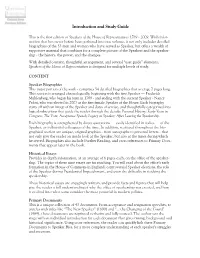
Introduction and Study Guide This is the first edition of Speakers of the House of Representatives 1789 - 2009. With infor- mation that has never before been gathered into one volume, it not only includes detailed biographies of the 53 men and woman who have served as Speaker, but offers a wealth of supportive material that combines for a complete picture of the Speakers and the speaker- ship - the history, the power, and the changes. With detailed content, thoughtful arrangement, and several “user guide” elements, Speakers of the House of Representatives is designed for multiple levels of study. CONTENT Speaker Biographies This major portion of the work - comprises 54 detailed biographies that average 7 pages long. This section is arranged chronologically, beginning with the first Speaker — Frederick Muhlenberg, who began his term in 1789 - and ending with the current Speaker - Nancy Pelosi, who was elected in 2007 as the first female Speaker of the House. Each biography starts off with an image of the Speaker and dates of service, and thoughtfully categorized into logical subsections that guide the reader through the details: Personal History; Early Years in Congress; The Vote; Acceptance Speech; Legacy as Speaker; After Leaving the Speakership. Each biography is strengthened by direct quotations — easily identified in italics — of the Speaker, or influential colleagues of the time. In addition, scattered throughout the bio- graphical section are unique, original graphics - from autographs to personal letters - that not only give the reader an inside look at the Speaker, but also at the times during which he served. Biographies also include Further Reading, and cross references to Primary Docu- ments that appear later in the book. -

The Signers of the U.S. Constitution
CONSTITUTIONFACTS.COM The U.S Constitution & Amendments: About the Signers (Continued) The Signers of the U.S. Constitution On September 17, 1787, the Constitutional Convention came to a close in the Assembly Room of Independence Hall in Philadelphia, Pennsylvania. There were seventy individuals chosen to attend the meetings with the initial purpose of amending the Articles of Confederation. Rhode Island opted to not send any delegates. Fifty-five men attended most of the meetings, there were never more than forty-six present at any one time, and ultimately only thirty-nine delegates actually signed the Constitution. (William Jackson, who was the secretary of the convention, but not a delegate, also signed the Constitution. John Delaware was absent but had another delegate sign for him.) While offering incredible contributions, George Mason of Virginia, Edmund Randolph of Virginia, and Elbridge Gerry of Massachusetts refused to sign the final document because of basic philosophical differences. Mainly, they were fearful of an all-powerful government and wanted a bill of rights added to protect the rights of the people. The following is a list of those individuals who signed the Constitution along with a brief bit of information concerning what happened to each person after 1787. Many of those who signed the Constitution went on to serve more years in public service under the new form of government. The states are listed in alphabetical order followed by each state’s signers. Connecticut William S. Johnson (1727-1819)—He became the president of Columbia College (formerly known as King’s College), and was then appointed as a United States Senator in 1789. -

U.S. Constitution Role Play Who Really Won?
handout U.S. Constitution Role Play Who Really Won? How did the Writers of the U.S. Constitution decide the issues that you debated in class? Find the actual outcome of these questions by looking in the Constitution. On a separate sheet of paper, for each of the following, indicate 1. What the class Constitutional Convention decided; and 2. What the actual U.S. Constitutional Convention decided. The parentheses after each question indicate at least one section of the Constitution that will help you find an answer. 1a Should slavery be legal in any of the United States? (Article I, Section 9, Clause 1) 1b. Should the slave trade continue to be allowed? (Article I, Section 9, Clause 1) 1c. Should northerners be forced to turn over runaway (fugitive) slaves to their owners? (Article IV, Section 2, Clause 3) 2. Will it be legal for state legislatures to pass laws allowing debts to be paid “in kind”? (Article I, Sec- tion 10, Clause 1) 3. Should bonds issued during the Revolutionary War be paid back? (Article VI, Clause 1) 4. Who should be allowed to vote in general elections? (The Constitution says nothing about who shall vote, therefore who could vote was left up to individual states. At the time, no states allowed women or enslaved people to vote; many states had laws requiring individuals to own a certain amount of property before they could vote. Most states did not allow free blacks to vote.) 5. Conclusion: In your opinion, which social group or groups won the real Constitutional Convention? Explain your answer.