Political Leadership, Character & Performamnce
Total Page:16
File Type:pdf, Size:1020Kb
Load more
Recommended publications
-

'Opposition-Craft': an Evaluative Framework for Official Opposition Parties in the United Kingdom Edward Henry Lack Submitte
‘Opposition-Craft’: An Evaluative Framework for Official Opposition Parties in the United Kingdom Edward Henry Lack Submitted in accordance with the requirements for the degree of PhD The University of Leeds, School of Politics and International Studies May, 2020 1 Intellectual Property and Publications Statements The candidate confirms that the work submitted is his own and that appropriate credit has been given where reference has been made to the work of others. This copy has been supplied on the understanding that it is copyright material and that no quotation from the thesis may be published without proper acknowledgement. ©2020 The University of Leeds and Edward Henry Lack The right of Edward Henry Lack to be identified as Author of this work has been asserted by him in accordance with the Copyright, Designs and Patents Act 1988 2 Acknowledgements Page I would like to thank Dr Victoria Honeyman and Dr Timothy Heppell of the School of Politics and International Studies, The University of Leeds, for their support and guidance in the production of this work. I would also like to thank my partner, Dr Ben Ramm and my parents, David and Linden Lack, for their encouragement and belief in my efforts to undertake this project. Finally, I would like to acknowledge those who took part in the research for this PhD thesis: Lord David Steel, Lord David Owen, Lord Chris Smith, Lord Andrew Adonis, Lord David Blunkett and Dame Caroline Spelman. 3 Abstract This thesis offers a distinctive and innovative framework for the study of effective official opposition politics in the United Kingdom. -

Coalition Politics: How the Cameron-Clegg Relationship Affects
Canterbury Christ Church University’s repository of research outputs http://create.canterbury.ac.uk Please cite this publication as follows: Bennister, M. and Heffernan, R. (2011) Cameron as Prime Minister: the intra- executive politics of Britain’s coalition. Parliamentary Affairs, 65 (4). pp. 778-801. ISSN 0031-2290. Link to official URL (if available): http://dx.doi.org/10.1093/pa/gsr061 This version is made available in accordance with publishers’ policies. All material made available by CReaTE is protected by intellectual property law, including copyright law. Any use made of the contents should comply with the relevant law. Contact: create.library@canterbury.ac.uk Cameron as Prime Minister: The Intra-Executive Politics of Britain’s Coalition Government Mark Bennister Lecturer in Politics, Canterbury Christ Church University Email: mark.bennister@canterbury.ac.uk Richard Heffernan Reader in Government, The Open University Email: r.a.heffernan@open.ac.uk Abstract Forming a coalition involves compromise, so a prime minister heading up a coalition government, even one as predominant a party leader as Cameron, should not be as powerful as a prime minister leading a single party government. Cameron has still to work with and through ministers from his own party, but has also to work with and through Liberal Democrat ministers; not least the Liberal Democrat leader Nick Clegg. The relationship between the prime minister and his deputy is unchartered territory for recent academic study of the British prime minister. This article explores how Cameron and Clegg operate within both Whitehall and Westminster: the cabinet arrangements; the prime minister’s patronage, advisory resources and more informal mechanisms. -

The Conservative Party's Credibility Deficit Updated Tax and Spending
The Conservative Party’s credibility deficit Updated tax and spending commitments April 2010 2 Contents Page Introduction 5 Summary 7 Methodology 8 Tables 10 Broken promises 13 45,000 new single rooms in the NHS 15 5,000 new prison places 19 Reducing taxes on savings 22 More places for science courses, training and apprenticeships 24 Maternity nurses for all 25 Reinstate the Defence Export Services Organisation (DESO) 28 National Loan Guarantee Scheme 30 Tax cuts 33 Corporation tax and investment allowance changes 35 Freeze council tax for two years 38 Reduce employers’ NICs for some small companies 41 Tax cuts for married couples 43 Inheritance tax cuts 50 Reverse impact of abolition of dividend tax credit 53 Tax reversals 57 Raise National Insurance Contributions thresholds 59 Oppose Broadband levy 61 Oppose cider duty increase 63 Tax increases 65 Non-domicile levy 67 Spending reductions 73 Cut Government “waste” 75 Savings on employment and skills programmes 78 Reduce spending on Building Schools for the Future 83 Reduce eligibility for tax credits 85 Reduce eligibility for Child Trust Funds 88 Reduce government spending on consultants and advertising 90 Reduce “bureaucracy” spending by a third 92 Welfare savings 95 Scrap ContactPoint 98 NHS IT Programme 100 Freeze pay and cap pensions for public sector workers 103 Reduce spending on Sure Start outreach workers 105 3 Scrap some Regional Development Agencies 107 Scrap regional assemblies 109 Scrap identity cards 110 “Cutting the cost of politics” 112 Scrap the Trade Union Modernisation -
What Happens After an Indecisive Election Result?
BRIEFING PAPER Number 07163, 9 June 2017 What happens after an By Lucinda Maer indecisive election result? Gail Bartlett Inside: 1. Forming a government after a hung parliament 2. “Caretaker” administrations 3. The meeting of a new Parliament 4. The Queen’s Speech 5. An investiture vote? www.parliament.uk/commons-library | intranet.parliament.uk/commons-library | papers@parliament.uk | @commonslibrary Number 07163, 9 June 2017 2 Contents Summary 3 1. Forming a government after a hung parliament 5 1.1 What kind of government can form? 5 1.2 Historical precedents 6 1.3 When should an incumbent Prime Minister resign? 7 1.4 How long does government formation take? 9 1.5 Internal party consultation 9 1.6 Role of the House of Commons 10 1.7 Effects of the Fixed-term Parliaments Act 2011 10 2. “Caretaker” administrations 12 2.1 What is a “caretaker” administration? 12 2.2 The nature of the restrictions on government action 12 2.3 When do the restrictions end? 13 3. The meeting of a new Parliament 15 3.1 When does a Parliament return? 15 4. The Queen’s Speech 17 4.1 When does the Queen’s Speech take place? 17 4.2 The debate on the Address 17 5. An investiture vote? 19 Cover page image copyright UK Parliament 3 What happens after an indecisive election result? Summary Following the 2017 general election, held on 8 June 2017, the Conservative Party was returned as the largest party, but did not have an overall majority in the House of Commons. -

How Do British Political Parties Mobilise and Contact Voters To
How do British political parties mobilise and contact voters to increase turnout? Submitted by William Stephen King to the University of Exeter as a thesis for the degree of MA by Research in Politics In August 2018 This thesis is available for Library use on the understanding that it is copyright material and that no quotation from the thesis may be published without proper acknowledgement. I certify that all material in this thesis which is not my own work has been identified and that no material has previously been submitted and approved for the award of a degree by this or any other University. Signature: ………………………………………………………….. 1 Abstract This thesis will explore how British political parties over the period 2010-2017 have developed their mobilisation and contacting methods. Looking at social media, demographics, and other salient issues, I will construct a coherent and clear narrative of how British political parties have reacted to new technology, and what the advantages and disadvantages of doing so are. I shall be looking in particular at youth political mobilisation and contact, as this demographic has a poor election turnout record, so I shall explain why this is and how British political parties are attempting to contact and mobilise them (and how they have done so successfully). Looking at the 2010, 2015, and 2017 General Elections as well as the 2014 EU and 2016 referendums, this will enable me to take a look at Britain in different political times and differing levels of technology, from the first TV debates in 2010 to the first social media election in 2017. -

The Big Society: a New Policy Environment for the Third Sector? Pete Alcock
Third Sector Research Centre Working Paper 82 The Big Society: a new policy environment for the third sector? Pete Alcock June 2012 Working Paper 82 Paper Working June 2012 June Abstract This Working Paper updates the analysis of the Coalition government’s Big Society policy agenda first published in 2010. It explores the policy context for the Big Society initiative and the key features of the policy programme developed by the Coalition since 2010. It then outlines some of the contradictions and challenges within this policy programme, and for the relations between the third sector and the state more generally. It is also pointed out that the Big Society is an English political discourse with different policy developments now taking place within the devolved administrations in Scotland, Wales and Northern Ireland. Keywords Big Society, third sector, policy, civil society, devolution. Acknowledgements An earlier version of this paper was published in Voluntary Sector Review, Vol. 1, No. 3, pp. 379-90. This version will also be published as a chapter in The Welfare State Reader, 3rd edition, F. Castles, I. Nauman and C. Pierson (eds.) Polity Press, 2012. Thank you to Peter Backus for preparing Figure 1. 1 Contents A new UK policy discourse .................................................................................................................. 3 The policy legacy and the 2010 election ............................................................................................. 3 Building Coalition policy ..................................................................................................................... -

The Big Society
House of Commons Public Administration Select Committee The Big Society Seventeenth Report of Session 2010–12 Volume II Oral and written evidence Additional written evidence is contained in Volume III, available on the Committee website at www.parliament.uk/treascom Ordered by the House of Commons to be printed 7 December 2011 HC 902-II [Incorporating HC 716] Published on 14 December 2011 by authority of the House of Commons London: The Stationery Office Limited £13.00 The Public Administration Select Committee The Public Administration Select Committee is appointed by the House of Commons to examine the reports of the Parliamentary Commissioner for Administration and the Health Service Commissioner for England, which are laid before this House, and matters in connection therewith, and to consider matters relating to the quality and standards of administration provided by civil service departments, and other matters relating to the civil service. Current membership Mr Bernard Jenkin MP (Conservative, Harwich and North Essex) (Chair) Alun Cairns MP (Conservative, Vale of Glamorgan) Michael Dugher MP (Labour, Barnsley East) Charlie Elphicke MP (Conservative, Dover) Paul Flynn MP (Labour, Newport West) Robert Halfon MP (Conservative, Harlow) David Heyes MP (Labour, Ashton under Lyne) Kelvin Hopkins MP (Labour, Luton North) Greg Mulholland MP (Liberal Democrat, Leeds North West) Priti Patel MP (Conservative, Witham) Lindsay Roy MP (Labour, Glenrothes) The following members were also members of the Committee during the inquiry: Nick de Bois MP (Conservative, Enfield North) Mr Charles Walker MP (Conservative, Broxbourne) Powers The powers of the Committee are set out in House of Commons Standing Orders, principally in SO No 146. -
Liberals in Coalition
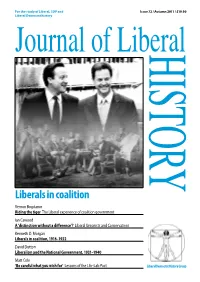
For the study of Liberal, SDP and Issue 72 / Autumn 2011 / £10.00 Liberal Democrat history Journal of LiberalHI ST O R Y Liberals in coalition Vernon Bogdanor Riding the tiger The Liberal experience of coalition government Ian Cawood A ‘distinction without a difference’? Liberal Unionists and Conservatives Kenneth O. Morgan Liberals in coalition, 1916–1922 David Dutton Liberalism and the National Government, 1931–1940 Matt Cole ‘Be careful what you wish for’ Lessons of the Lib–Lab Pact Liberal Democrat History Group 2 Journal of Liberal History 72 Autumn 2011 new book from tHe History Group for details, see back page Journal of Liberal History issue 72: Autumn 2011 The Journal of Liberal History is published quarterly by the Liberal Democrat History Group. ISSN 1479-9642 Riding the tiger: the Liberal experience of 4 Editor: Duncan Brack coalition government Deputy Editor: Tom Kiehl Assistant Editor: Siobhan Vitelli Vernon Bogdanor introduces this special issue of the Journal Biographies Editor: Robert Ingham Reviews Editor: Dr Eugenio Biagini Coalition before 1886 10 Contributing Editors: Graham Lippiatt, Tony Little, York Membery Whigs, Peelites and Liberals: Angus Hawkins examines coalitions before 1886 Patrons A ‘distinction without a difference’? 14 Dr Eugenio Biagini; Professor Michael Freeden; Ian Cawood analyses how the Liberal Unionists maintained a distinctive Professor John Vincent identity from their Conservative allies, until coalition in 1895 Editorial Board The coalition of 1915–1916 26 Dr Malcolm Baines; Dr Roy Douglas; Dr Barry Doyle; Prelude to disaster: Ian Packer examines the Asquith coalition of 1915–16, Dr David Dutton; Prof. David Gowland; Prof. Richard which brought to an end the last solely Liberal government Grayson; Dr Michael Hart; Peter Hellyer; Dr J. -

The Big Society in Context
TThhee BBiigg SSoocciieettyy iinn CCoonntteexxtt:: AAA mmmeeeaaannnsss tttooo wwwhhhaaattt eeennnddd??? DDDrrr GGGuuuyyy BBBrrraaannndddooonnn JJJuuubbbiiillleeeeee CCCeeennntttrrreee The Big Society in Context: A means to what end? Dr Guy Brandon Jubilee Centre Copyright © Jubilee Centre 2011 The author has asserted his rights under Section 77 of the Copyright, Design & Patents Act 1988 to be identified as the Author of this work. First printed in 2011 Published by the Jubilee Centre Jubilee House, 3 Hooper Street, Cambridge CB1 2NZ Freely available to download from www.jubilee-centre.org Cover photo © Shaun Dunmall All rights reserved No part of this publication may be reproduced, or stored in a retrieval system, or transmitted, in any form or by any means, mechanical, electronic, photocopying, recording or otherwise, without the prior permission of the Jubilee Centre. Contents Introduction vii Executive Summary 1 What is the ‘Big Society’? 3 The Theology of Government 11 Measuring the Big Society 19 The role of the Church in the Big Society 25 Conclusion: towards a better society 29 v Introduction The ‘Big Society’ is a new political initiative intended to address these more fundamental questions and to ask decrease the size and scope of government with the what can be learnt from previous ‘Big Societies’. Many effect of enabling local communities, families and of the aims of the Big Society, it will be seen, seem to tie individuals by passing power and responsibility to them. in with biblical ideals about the role of the state. Thus, speaking in 2009, David Cameron promised ‘We However, a more critical analysis also reveals that the will take power from the central state and give it to government could learn much about how to nurture a individuals where possible… Where it doesn’t make society that is not only bigger but also better. -
Mr David Cameron MP Mr George
UKSA UK Shareholders Association Chislehurst Business Centre Mr David Cameron MP 1 Bromley Lane Mr George Osborne MP Chislehurst Mr Nick Clegg MP BR7 6LH Mr Vince Cable MP Phone: 020 8468 1027 Mr Gordon Brown MP Email: uksa3@uksa.org.uk Web: www.uksa.org.uk Mr Alistair Darling MP 5th May 2010 From the UKSA Northern Rock Shareholders' Action Group Open Letter to Prospective Members of Parliament ‘Fairness’ (the impact on Northern Rock and its small shareholders). There has been much quoting of ‘Fairness’ by Politicians in this election campaign. But just how fairly have Rock small shareholders been treated by the outgoing Government - surely the most ‘spin conscious’, disingenuous and morally bankrupt administration in living history? Gordon Brown apparently now accepts, finally, that he helped cause the Banking Crisis when he relaxed the regulations on the Banks, allowing all the banks to lend excessively from cheap borrowed money, i.e. to do exactly what the Government wanted, and encouraged in fact. The resulting taxes were very welcome, no doubt. Don’t take this letter the wrong way. This is not an attack solely on Mr Brown, his Chancellor or his party; Mr Cameron and Mr Clegg (and your respective Chancellors and parties) are jointly and severally liable to the former shareholders and the UK public at large. Failure of control: Then the new ‘light touch’ handling by a confused and muddled ‘tripartite’ regime let the country down, and so, when funding dried up on wholesale markets we had the infamous ‘don’t panic’ leak and then the catastrophic first bank run for over 100 yrs. -

1 the Obama Model and Britain: a Doxological Inquiry Into The
The Obama Model and Britain: A Doxological Inquiry into the Rhetoric and Reception of Strategic Identification in the 2008 American Presidential Election Thesis submitted by Robert Kyle Delp Jr. in partial fulfillment of the requirements for the degree of Doctorate of Philosophy at the Journalism, Media and Cultural Studies Department, Cardiff University. 1 Senate Regulations for PhD Submission 11.5.1.2 I, Robert Kyle Delp Jr., do hereby certify that the work submitted is the result of my own investigation. Signed:________________________________Date:__________________ 2 Senate Regulations for PhD Submission 11.5.1.3 I, Robert Kyle Delp Jr., do hereby certify that the work submitted has not been accepted in substance for any other degree or award, and is not being submitted concurrently in candidature for any degree or other award. Signed:________________________________Date:__________________ 3 Senate Regulations for PhD Submission 14.1.1 I, Robert Kyle Delp Jr., do hereby certify that the thesis should be available for inter- library loan or photocopying (subject to copyright law), and that the title and summary be made to outside organizations. Signed:________________________________Date:__________________ 4 Thesis Declarations 2 List of Non-Audience Response Technology Tables and Graphs 8 Abstract 9 I. Preface 10 II. Scope and Layout 12 III. Thesis Contributions 15 III. Methodology: A Close Textual Analysis of the Text Theoretical Origins of Close Textual Analysis 17 Criticisms of Close Textual Analysis 19 IV. An Exploration of Telos in American Presidential Campaign Speeches Overview 21 Identity to Identification 23 Kenneth Burke and His Theory of Identification 24 Identification as Purpose, Political Campaigns as Subject. -

Orme) Wilberforce (Albert) Raymond Blackburn (Alexander Bell
Copyrights sought (Albert) Basil (Orme) Wilberforce (Albert) Raymond Blackburn (Alexander Bell) Filson Young (Alexander) Forbes Hendry (Alexander) Frederick Whyte (Alfred Hubert) Roy Fedden (Alfred) Alistair Cooke (Alfred) Guy Garrod (Alfred) James Hawkey (Archibald) Berkeley Milne (Archibald) David Stirling (Archibald) Havergal Downes-Shaw (Arthur) Berriedale Keith (Arthur) Beverley Baxter (Arthur) Cecil Tyrrell Beck (Arthur) Clive Morrison-Bell (Arthur) Hugh (Elsdale) Molson (Arthur) Mervyn Stockwood (Arthur) Paul Boissier, Harrow Heraldry Committee & Harrow School (Arthur) Trevor Dawson (Arwyn) Lynn Ungoed-Thomas (Basil Arthur) John Peto (Basil) Kingsley Martin (Basil) Kingsley Martin (Basil) Kingsley Martin & New Statesman (Borlasse Elward) Wyndham Childs (Cecil Frederick) Nevil Macready (Cecil George) Graham Hayman (Charles Edward) Howard Vincent (Charles Henry) Collins Baker (Charles) Alexander Harris (Charles) Cyril Clarke (Charles) Edgar Wood (Charles) Edward Troup (Charles) Frederick (Howard) Gough (Charles) Michael Duff (Charles) Philip Fothergill (Charles) Philip Fothergill, Liberal National Organisation, N-E Warwickshire Liberal Association & Rt Hon Charles Albert McCurdy (Charles) Vernon (Oldfield) Bartlett (Charles) Vernon (Oldfield) Bartlett & World Review of Reviews (Claude) Nigel (Byam) Davies (Claude) Nigel (Byam) Davies (Colin) Mark Patrick (Crwfurd) Wilfrid Griffin Eady (Cyril) Berkeley Ormerod (Cyril) Desmond Keeling (Cyril) George Toogood (Cyril) Kenneth Bird (David) Euan Wallace (Davies) Evan Bedford (Denis Duncan)