14Th Sitting 14:00H Monday 12 February 2007
Total Page:16
File Type:pdf, Size:1020Kb
Load more
Recommended publications
-

Memorandum of the Bolivarian Republic of Venezuela on The
Memorandum of the Bolivarian Republic of Venezuela on the Application filed before the International Court of Justice by the Cooperative of Guyana on March 29th, 2018 ANNEX Table of Contents I. Venezuela’s territorial claim and process of decolonization of the British Guyana, 1961-1965 ................................................................... 3 II. London Conference, December 9th-10th, 1965………………………15 III. Geneva Conference, February 16th-17th, 1966………………………20 IV. Intervention of Minister Iribarren Borges on the Geneva Agreement at the National Congress, March 17th, 1966……………………………25 V. The recognition of Guyana by Venezuela, May 1966 ........................ 37 VI. Mixed Commission, 1966-1970 .......................................................... 41 VII. The Protocol of Port of Spain, 1970-1982 .......................................... 49 VIII. Reactivation of the Geneva Agreement: election of means of settlement by the Secretary-General of the United Nations, 1982-198371 IX. The choice of Good Offices, 1983-1989 ............................................. 83 X. The process of Good Offices, 1989-2014 ........................................... 87 XI. Work Plan Proposal: Process of good offices in the border dispute between Guyana and Venezuela, 2013 ............................................. 116 XII. Events leading to the communiqué of the UN Secretary-General of January 30th, 2018 (2014-2018) ....................................................... 118 2 I. Venezuela’s territorial claim and Process of decolonization -

A Review of the Workforce Situation and the National Baselines of the 20 Goals for Human Resources for Health
HUMAN RESOURCES FOR HEALTH IN THE CARIBBEAN: A Review of the Workforce Situation and the National Baselines of the 20 Goals for Human Resources for Health 2011 HHUUMMAANN RREESSOOUURRCCEESS FFOORR HHEEAALLTTHH IINN TTHHEE CCAARRIIBBBBEEAANN:: AA RReevviieeww ooff tthhee WWoorrkkffoorrccee SSiittuuaattiioonn aanndd tthhee NNaattiioonnaall BBaasseelliinneess ooff tthhee 2200 GGooaallss ffoorr HHuummaann RReessoouurrcceess ffoorr HHeeaalltthh 2011 Pan American Health Organization “Human resources for health in the Caribbean: a review of the workforce situation and the national baselines of the 20 goals for human resources for health ‐ 2011” Washington, D.C.: PAHO, © 2011 © Pan American Health Organization, 2011 All rights reserved. Requests for this publication should be directed to the Area of Health Systems based on Primary Health Care, Project on Human Resources for Health, Pan American Health Organization / World Health Organization, 525 23rd St., NW, Washington, D.C., USA [phone: +(202) 974 ‐3296; e‐mail: goduecha@paho.org]. The names used in this publication and the presentation of its content do not imply any opinion on the part of the Pan American Health Organizaton about the legal status of countries, territories, cities, or zones or their authorities or about the placement of their borders or boundaries. The mention of certain commercial enterprises or the trade names of certain products does not imply their endorsement or recommendation by the Organization in preference to others of a similar nature. Save through error or omission, the first letter of the names of patented products is capitalized. The Pan American Health Organization has taken all reasonable precautions to verify the information contained in this publication. However, the published material is distributed with no guarantee of any type, explicit or implicit. -

June - September 2015
c ss Issue 04 ... June - September 2015 Contents The Parliament's Maces 3 The Election Process 5 The Constituency Office & Representation: 8 o 'AbadiejO'Meara A New Chapter for the Red House 10 And National History Visits by Parliamentary Delegations from: 13 Bermuda, The United Kingdom 0-- Canada Our Region, Our Parliaments: 16 5t. Vincent and the Grenadines and Guyana School Outreach: Taking the Parliament to the nation's youths 19 Here's What's Showing on the Parliament Channel 22 We welcome your comments and suggestions Send CrossTalk feedback to parlbuzz@ttparliament.org or Tel: 624-7275 ext. 2275 2 Issue 04· .. June - September 2015 ~ THE PARLIAMENT'S MACES By Lorraine Berahzer & Danielle Williams The Trinidad and Tobago Parliament is steeped in rich history that embeds almost During the 13005 to 14005 the every symbol, rule and procedure. Two beau mace gradually evolved by tiful pieces of that history take shape in the form of the Parliament Maces. being decorated and adorned Originally used as a weapon by a royal bodyguard to defend the King, the mace has with precious metals and be now become a symbol of the power the Mar came known as the civic mace. shal of the Parliament holds. It also symbolises the authority and privileges of the House. It is interesting to note that this metal staff, which is held over the right shoulder of the Marshal when he escorts the Presiding Officer in and out of the Chamber at the beginning and end of each sitting of the respective House, originated in the 13th century. -
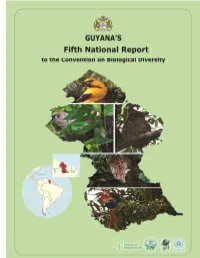
CBD Fifth National Report
i ii GUYANA’S FIFTH NATIONAL REPORT TO THE CONVENTION ON BIOLOGICAL DIVERSITY Approved by the Cabinet of the Government of Guyana May 2015 Funded by the Global Environment Facility Environmental Protection Agency Ministry of Natural Resources and the Environment Georgetown September 2014 i ii Table of Contents ACKNOWLEDGEMENT ........................................................................................................................................ V ACRONYMS ....................................................................................................................................................... VI EXECUTIVE SUMMARY ......................................................................................................................................... I 1. INTRODUCTION .............................................................................................................................................. 1 1.1 DESCRIPTION OF GUYANA .......................................................................................................................................... 1 1.2 RATIFICATION AND NATIONAL REPORTING TO THE UNCBD .............................................................................................. 2 1.3 BRIEF DESCRIPTION OF GUYANA’S BIOLOGICAL DIVERSITY ................................................................................................. 3 SECTION I: STATUS, TRENDS, THREATS AND IMPLICATIONS FOR HUMAN WELL‐BEING ...................................... 12 2. IMPORTANCE OF BIODIVERSITY -

Download File
Between a Promise and a Trench: Citizenship, Vulnerability, and Climate Change in Guyana Sarah E. Vaughn Submitted in partial fulfillment of the requirements for the degree of Doctor of Philosophy in the Graduate School of Arts and Sciences COLUMBIA UNIVERSITY 2013 © 2013 Sarah E. Vaughn All rights reserved ABSTRACT Between a Promise and a Trench: Citizenship, Vulnerability, and Climate Change in Guyana Sarah E. Vaughn Between a Promise and a Trench examines how science is constituted as a strategic practice and site through which citizens make claims about racial democracy in Guyana. It shows how government policymaking around climate adaptation--which drew upon the recommendations of outside actors, including the Intergovernmental Panel on Climate Change (IPCC), the United Nations (UN), and various NGOs and international scientific networks-- profoundly disrupted the country's delicate racial-ethnic balance. A contribution to the burgeoning anthropology on the social and political impact of climate change, the dissertation also speaks to current debates over race and citizenship, the complex relationship between expertise and democracy, and the competing post-colonial claims of Indo-, Afro-, and Amerindian Guyanese to land and self-determination. The dissertation is based on seventeen months of fieldwork and archival research conducted between, 2009-11 in coastal Guyana. It brings together three conflicting perspectives: of engineers, who drew upon datasets and models about flooding and construction of canals around IPCC and UN climate data; the state officials, who sought to reduce vulnerability to flood hazards through land evictions; and of Indo-, Afro-, and Amerindian Guyanese farmers and squatters who were evicted as a result of post-2005 engineering projects. -

Green State Development Strategy: Vision 2040
Diversified, Resilient, Low-carbon, People-centred VOLUME I POLICY RECOMMENDATIONS, FINANCIAL MECHANISM & IMPLEMENTATION An inclusive and prosperous Guyana that provides a good quality of life for all its citizens “ based on sound education and social protection, low-carbon resilient development, new economic opportunities, justice, and political empowerment. ” Executive Summary Background The Green State Development Strategy: Vision 2040 is Guyana’s twenty-year, national development policy that reflects the guiding vision and principles of the ‘green agenda’: “An inclusive and prosperous Guyana that provides a good quality of life for all its citizens based on sound education and social protection, low-carbon and resilient development, providing new economic opportunities, justice and political empowerment.” The central objective is development that provides a better quality of life for all Guyanese derived from the country’s natural wealth – its diversity of people and abundant natural resources (land, water, forests, mineral and aggregates, biodiversity). The vision of the ‘green agenda’ is centred on principles of a green economy defined by sustainable, low-carbon and resilient development that uses its resources efficiently, and sustained over generations. The development philosophy emphasises the importance of a more cohesive society based on principles of equity and tolerance between ethnic groups – recognising that diversity of culture and heritage is the underlying strength of the country’s human capital. Development objectives therefore seek to improve the health, education and overall well-being of Guyanese citizens, to lift people out of poverty through an economy that generates decent jobs and that provides opportunities for sustaining livelihoods over the long term. For decades, geopolitical events, natural disasters and global commodity price swings have weighed upon Guyana’s development. -
Preparation for the National Vision on the Amazon Basin €“ Republic Of
Department for Sustainable Amazon Cooperation Treaty Development Global Environment Organization United Nations Environment Organization of American States Fund Program INTEGRATED AND SUSTAINABLE MANAGEMENT OF TRANSBOUNDARY WATER RESOURCES IN THE AMAZON RIVER BASIN GEF AMAZONAS PROJECT - ACTO/GEF/UNEP/OAS Bolivia, Brazil, Colombia, Ecuador, Guyana, Peru, Suriname, Venezuela Activity 1.1 Vision for the Basin and Transboundary Diagnostic Analysis Final Report NATIONAL VISION DOCUMENT Hydrometeorological Service, Ministry of Agriculture Georgetown - Cooperative Republic of Guyana INTEGRATED AND SUSTAINABLE MANAGEMENT OF TRANSBOUNDARY WATER RESOURCES IN THE AMAZON RIVER BASIN ACTO/GEF/UNEP/OAS Activity 1.1 Vision for the Basin and Transboundary Diagnostic Analysis Final Report NATIONAL VISION DOCUMENT Coordinated by: Hydrometeorological Service Ministry of Agriculture Consultant Anthony R. Cummings Contract CPR/OAS no. 97084 November 2006 EXECUTIVE SUMMARY INTRODUCTION: VISION AND OBJECTIVES The Amazon Cooperation Treaty Organisation (ACTO) was established in 1978 by the Governments of Bolivia, Brazil, Colombia, Ecuador, Guyana, Peru, Suriname and Venezuela. Its goal was WRSODQIRUWKHVXVWDLQDEOHGHYHORSPHQWRIWKHUHJLRQ¶VUHVRXUFHVDQG people, and in 2004, a strategic plan for the years 2004-2012 was published. The plan defines a number of areas or themes for development; including the sustainable management of the region¶s water and soil resources. The project Integrated and Sustainable Management of Transboundary Water Resources in the Amazon River Basin was prepared by the countries that are signatories to the Amazon Cooperation Treaty (ACTO): Bolivia, Brazil, Colombia, Ecuador, Guyana, Peru, Suriname, and Venezuela. The goal of this project was to strengthen the institutional framework for planning and executing, in a coordinated and coherent manner, activities for the protection and sustainable management of the land and water resources of the Amazon River Basin. -

Guyana's REDD+ Agreement with Norway
Guyana’s REDD+ Agreement with Norway: Perceptions of and Impacts on Indigenous Communities Tim Laing Abstract This report examines the impact of the REDD+ agreement between Guyana and Norway on indigenous communities in the country. Through literature review, analysis of secondary data, and interviews with indigenous chiefs and other informed stakeholders, it aims to understand the concerns, hopes, and fears of indigenous communities at the start of the agreement, and the effects, if any, that communities have faced from REDD+. Concerns at the inception of the agreement focused on long-standing issues with land rights, and a sense of lack of consultation. There were hopes, however, in the potential economic benefits that could accompany REDD+. Implementation of REDD+ in Guyana has proved slow, and the cash (or other benefits) received by communities has been small. Deforestation has risen—due to increased mining activity—and costs incurred by REDD+ have been minimal. This has created an overall air of scepticism regarding the future of the initiative. Future developments of REDD+ could be stronger through its indirect effect on changing donor actions, and broader policy thinking in Guyana; but major challenges exist in creating an opt-in mechanism that is fair for all indigenous communities, integrating REDD+ with the extractives industries such as mining, and keeping a focus on low-carbon development in the light of major new oil finds. Keywords: REDD+, Deforestation, Climate Change, Economic Development, Indigenous Peoples, Human Rights, Public Policy, Political Economy JEL: O19, Q01, Q23, Q28, P48 Working Paper 476 February 2018 www.cgdev.org Guyana’s REDD+ Agreement with Norway: Perceptions of and Impacts on Indigenous Communities Tim Laing Brighton Business School, University of Brighton The author would like to thank all the participants to the interviews in this study and also in the interviews for Laing (2014) that informed this work. -

120 the British Empire. and Stewart's Islands, and a Number of Laws Are Passed by the Court of Policy Ex Smaller Islands Scattered Round the Coast
120 The British Empire. and Stewart's islands, and a number of laws are passed by the Court of Policy ex smaller islands scattered round the coast. cept the annual Tax Ordinance passed by They lie between 34 and 48 S. Lat. and 166 the combined Court. The members of the and 179 E. Long, Court of Policy are chosen from names sub Area, 106,260 square miles, of which two- mitted by 7kiezers, chosen by the registered thirds are fit for agriculture and grazing. electors, the Financial representatives every The quantity of land under crop in 1870 was two years by the electors. 900,504 acres. The coast line is more than 3000 miles. The white population in 1867 HONDURAS. ' was 220,092; the native, about 40,000. Among the most valuable productions are the kansi (Settled in the early part of \ihe 16M century. pine, and the native flax. Gold has been Established as a Colony in 1861.) found in several districts and a rich iron ore Between Yucatan and Gautemala. in the form of iron sand. Area, about 15,000 square miles. Revenue, 1869, £1.025,516 stg. Population, 1861. 25,635. Expenditure, 1869, £2,400,000 sis. In 1865, about 500 ChinesChinei e immigrants-were Public Debt, £7,182,744 stg. brought over. Imports, £4,976,126 stg. Revenue, 1869, £36,629 stg. Exports, £4,224,860. Expenditure, 1869, $80,403. Public Debt, £43,008 stg. Sinking Fund, £6,286 stg. y SOUTH AMERICAN COLONIES. Imports fund, £151,189 stg. Exports fund, £175,033 stg. FALKLAND ISLANDS-BRITISH (Sugar, molasses, rum and mahogany.) • . -

Budget Speech 2012
GUYANA SESSIONAL PAPER NO. 1 OF 2012 TENTH PARLIAMENT OF GUYANA UNDER THE CONSTITUTION OF GUYANA FIRST SESSION 2012 BUDGET SPEECH Honourable Dr. Ashni Kumar Singh, M.P. Minister of Finance March 30, 2012 TABLE OF CONTENTS 1. Introduction 1 2. Global Economic Developments 5 3. Domestic Macroeconomic Developments 7 A. Real Gross Domestic Product 7 B. Sectoral Performance 7 C. Balance of Payments 9 D. Monetary Developments 10 E. Prices and Income 11 a. Inflation Rate 11 b. Interest Rate 11 c. Exchange Rate 11 d. Developments in Wages 12 F. Fiscal Position 12 a. Non-Financial Public Sector 12 b. Central Government 12 c. Public Enterprises 14 G. Debt Management 14 4. Sectoral Developments and the Agenda for 2012 and Beyond 16 A. The Medium Term Outlook 16 B. Low Carbon Development Strategy 17 C. Transforming the Economy 19 a. Modernising the Traditional Sectors 19 i Sugar 19 ii Rice 20 iii Bauxite 21 iv Gold 22 b. New and Emerging Sectors 23 i Information and Communication Technology 23 ii Extractive Industries 25 Oil 25 Manganese 26 Uranium and Rare Earth Elements 26 iii Agriculture Diversification 27 iv Tourism 28 v Small Business 30 D. Physical Infrastructure for Transformation 32 a. Road and Bridges 32 b. Air and River Transport 33 c. Sea and River Defence 34 d. Drainage and Irrigation 35 i e. Hydrometeorology 36 f. Energy, Power Generation and Supply 36 E. Investments in our People 39 a. Education 39 b. Health 42 c. Housing 44 d. Water 45 e. Sanitation 46 f. Vulnerable Groups and Other Targeted Interventions 47 i. -

Cybelle Cenac-Maragh Constitutional Reform of the Parliamentary System in Saint Lucia
Cybelle Cenac-Maragh Constitutional Reform of the Parliamentary System in Saint Lucia: A Comparative Analysis of Constitutional Changes in the Caribbean LLM 2015-2016 Advanced Legislative Studies (ALS) Institute of Advanced Legal Studies School of Advanced Study University of London Cybelle Cenac Constitutional Reform of the Parliamentary System in Saint Lucia: A Comparative Analysis of Constitutional Changes in the Caribbean. LLM 2015-2016 LLM in Advanced Legislative Studies (ALS) Student number: 1441647 1 TABLE OF CONTENTS INTRODUCTION 4-9 CHAPTER 1 10-20 Historical Background Parliamentary System in Saint Lucia Separation of Powers Checks and Balances in the Parliamentary system CHAPTER 2 21-25 Reasons for Reform: Separation of Powers Despotic Government Parliamentary Corruption Proposal for Change CHAPTER 3 26-47 Westminster versus Washington Scrutiny of Legislation as a bar to Parliamentary Abuse Westminster/Republican Model in the Caribbean: Dominica, Trinidad & Tobago and Guyana CHAPTER 4 48-55 Can a distinct Separation of Powers be achieved? Could the Westminster Model Survive Successfully in a Caribbean context? Are there greater benefits to be derived from a unicameral or bicameral Parliament? Checks and Balances in a Unicameral Parliament. 2 CHAPTER 5 56-64 Recommendations CONCLUSION 65-67 BIBLIOGRAPHY 68-75 3 INTRODUCTION The parliamentary system under the Saint Lucian constitution is not fulfilling its purpose as intended, due to its perverse application, resulting in multiple abuses which can only be cured by a revision of that model to a hybrid parliamentary presidential one. Many commonwealth countries throughout the world, and indeed many Caribbean countries share a common parliamentary system, entrenched in their constitution, handed down by Britain. -

Informe Del Sr. Doudou Diène, Relator Especial Sobre Las Formas Contemporáneas De Racismo, Discriminación Racial, Xenofobia Y Formas Conexas De Intolerancia
NACIONES UNIDAS E Distr. Consejo Económico GENERAL y Social E/CN.4/2004/18/Add.1 8 de enero 2004 ESPAÑOL Original: FRANCÉS/INGLÉS COMISIÓN DE DERECHOS HUMANOS 60º período de sesiones Tema 6 del programa provisional EL RACISMO, LA DISCRIMINACIÓN RACIAL, LA XENOFOBIA Y TODAS LAS FORMAS DE DISCRIMINACIÓN Informe del Sr. Doudou Diène, Relator Especial sobre las formas contemporáneas de racismo, discriminación racial, xenofobia y formas conexas de intolerancia Adición* MISIÓN A GUYANA Y TRINIDAD Y TOBAGO Resumen El Relator Especial realizó una misión regional a Guyana y Trinidad y Tabago del 14 al 25 de julio de 2003. La misión tenía principalmente por objeto examinar, en el contexto de una sensibilización de las Naciones Unidas sobre la urgencia de la situación en Guyana, el estado de las relaciones interraciales, ilustrado en especial por la gravedad de las tensiones entre las comunidades indo y afroguyanesas que provocaron violencias políticas durante las elecciones parlamentarias y presidenciales entre marzo de 2001 y julio de 2002. En este sentido y con una perspectiva de comparación que tiene en cuenta tanto la semejanza del pasado histórico -esclavista y colonial- como la composición sociodemográfica de Guyana y Trinidad y Tabago, el Relator Especial consideró conveniente trasladarse también a Trinidad y Tabago. El Relator Especial considera que su misión se inscribe también en el marco de la doble estrategia que ha concebido para aumentar la efectividad de su mandato. Inspirándose en el espíritu y la letra de la * El resumen del presente informe se distribuye en todos los idiomas oficiales. El informe figura en el anexo del resumen y se reproduce en el idioma en que se presentó y en inglés.