"A Post Occupancy Evaluation of the Holyrood Parliament Building"
Total Page:16
File Type:pdf, Size:1020Kb
Load more
Recommended publications
-

Spice Briefing
MSPs BY CONSTITUENCY AND REGION Scottish SESSION 1 Parliament This Fact Sheet provides a list of all Members of the Scottish Parliament (MSPs) who served during the first parliamentary session, Fact sheet 12 May 1999-31 March 2003, arranged alphabetically by the constituency or region that they represented. Each person in Scotland is represented by 8 MSPs – 1 constituency MSPs: Historical MSP and 7 regional MSPs. A region is a larger area which covers a Series number of constituencies. 30 March 2007 This Fact Sheet is divided into 2 parts. The first section, ‘MSPs by constituency’, lists the Scottish Parliament constituencies in alphabetical order with the MSP’s name, the party the MSP was elected to represent and the corresponding region. The second section, ‘MSPs by region’, lists the 8 political regions of Scotland in alphabetical order. It includes the name and party of the MSPs elected to represent each region. Abbreviations used: Con Scottish Conservative and Unionist Party Green Scottish Green Party Lab Scottish Labour LD Scottish Liberal Democrats SNP Scottish National Party SSP Scottish Socialist Party 1 MSPs BY CONSTITUENCY: SESSION 1 Constituency MSP Region Aberdeen Central Lewis Macdonald (Lab) North East Scotland Aberdeen North Elaine Thomson (Lab) North East Scotland Aberdeen South Nicol Stephen (LD) North East Scotland Airdrie and Shotts Karen Whitefield (Lab) Central Scotland Angus Andrew Welsh (SNP) North East Scotland Argyll and Bute George Lyon (LD) Highlands & Islands Ayr John Scott (Con)1 South of Scotland Ayr Ian -

Ministers, Law Officers and Ministerial Parliamentary Aides by Cabinet
MINISTERS, LAW OFFICERS AND Scottish MINISTERIAL PARLIAMENTARY AIDES BY Parliament CABINET: SESSION 1 Fact sheet This Fact sheet provides a list of all of the Scottish Ministers, Law Officers and Ministerial Parliamentary Aides during Session 1, from 12 May 1999 until the appointment of new Ministers in the second MSPs: Historical parliamentary session. Series Ministers and Law Officers continue to serve in post during 30 March 2007 dissolution. The first Session 2 cabinet was appointed on 21st May 2003. A Minister is a member of the government. The Scottish Executive is the government in Scotland for devolved matters and is responsible for formulating and implementing policy in these areas. The Scottish Executive is formed from the party or parties holding a majority of seats in the Parliament. During Session 1 the Scottish Executive consisted of a coalition of Labour and Liberal Democrat MSPs. The senior Ministers in the Scottish government are known as ‘members of the Scottish Executive’ or ‘the Scottish Ministers’ and together they form the Scottish ‘Cabinet’. They are assisted by junior Scottish Ministers. With the exception of the Scottish Law Officers, all Ministers must be MSPs. This fact sheet also provides a list of the Law Officers. The Scottish Law Officers listed advise the Scottish Executive on legal matters and represent its interests in court. The final section lists Ministerial Parliamentary Aides (MPAs). MPAs are MSPs appointed by the First Minister on the recommendation of Ministers whom they assist in discharging their duties. MPAs are unpaid and are not part of the Executive. Their role and the arrangements for their appointment are set out in paragraphs 4.6-4.13 of the Scottish Ministerial Code. -

Big City: Civic Symbolism and Scottish Nationalism’
Edinburgh Research Explorer ‘Big City: Civic Symbolism and Scottish Nationalism’ Citation for published version: Hearn, J 2003, '‘Big City: Civic Symbolism and Scottish Nationalism’', Scottish Affairs, vol. 42, pp. 57-82. Link: Link to publication record in Edinburgh Research Explorer Document Version: Peer reviewed version Published In: Scottish Affairs Publisher Rights Statement: © Hearn, J. (2003). ‘Big City: Civic Symbolism and Scottish Nationalism’. Scottish Affairs, 42, 57-82. General rights Copyright for the publications made accessible via the Edinburgh Research Explorer is retained by the author(s) and / or other copyright owners and it is a condition of accessing these publications that users recognise and abide by the legal requirements associated with these rights. Take down policy The University of Edinburgh has made every reasonable effort to ensure that Edinburgh Research Explorer content complies with UK legislation. If you believe that the public display of this file breaches copyright please contact openaccess@ed.ac.uk providing details, and we will remove access to the work immediately and investigate your claim. Download date: 30. Sep. 2021 1 BIG CITY: CIVIC SYMBOLISM AND SCOTTISH NATIONALISMi Jonathan Hearn, University of Edinburgh Published in: Scottish Affairs 42: 57-82, 2003 INTRODUCTION The stock symbols of Scotland and Scottishness are all too familiar. Living in Scotland one becomes almost numb to the drone of bagpipes and kilts, heather and kailyards, Nessie and Braveheart--the low hum of ‘cultural sub-nationalism’ that has so perturbed Tom Nairn (1977) and others over the years. As an American with an academic interest in Scotland and nationalismii I have often found myself straining to draw peoples’ attention away from these symbols and towards others I have found more telling for understanding contemporary nationalist demands in Scotland, such as Covenants and Claims of Right (Hearn 1998; 2000). -

Conservation Plan - December 2015
Royal High School Regent Road, Edinburgh Conservation Plan - December 2015 Simpson & Brown Contents Page 1.0 EXECUTIVE SUMMARY 3 2.0 INTRODUCTION 7 2.1 Objectives of the Conservation Plan 7 2.2 Study Area 8 2.3 Heritage Designations 9 2.4 Structure of the Report 11 2.5 Adoption & Review 12 2.6 Other Studies 12 2.7 Limitations 12 2.8 Orientation 12 2.9 Project Team 12 2.10 Acknowledgements 12 2.11 Abbreviations 13 2.14 Building Names 13 3.0 UNDERSTANDING THE ROYAL HIGH SCHOOL 17 3.1 Introduction 17 3.2 Historical Background 17 3.3 The Royal High School – History and Meaning 25 3.4 Later Developments & Alterations 37 3.5 From School to Scottish Assembly 49 3.6 Summary Historical Development 63 3.7 Architects’ Biographies 65 3.8 Timeline of the Greek Revival 67 4.0 ASSESSMENT OF SIGNIFICANCE 70 4.1 Introduction 70 4.2 Historical Significance 70 4.3 Architectural, Aesthetic and Artistic Significance 71 4.4 Social Significance 72 5.0 SUMMARY STATEMENT OF SIGNIFICANCE 73 6.0 GRADING OF SIGNIFICANCE 74 6.1 Introduction 74 6.2 Graded Elements 78 7.0 CONSERVATION ISSUES & POLICIES 80 7.1 Introduction 80 7.2 Base Policies 81 7.3 Conservation Philosophy 81 7.4 Use of Surrounding Land 84 7.5 Specific Policies 85 7.6 Workmanship & Conservation Planning 86 7.7 Access & Interpretation 87 7.8 Recording & Research 88 7.9 Priority Repair Works & Maintenance 89 Royal High School, Edinburgh – Conservation Plan 1 8.0 APPENDICES 92 APPENDIX I - Listed Building Reports & Inventory Record 92 APPENDIX II - Illustrations at A3 100 2 Royal High School, Edinburgh – Conservation Plan 1.0 EXECUTIVE SUMMARY Thomas Hamiltons’ Royal High School has been described as “arguably the most significant and accomplished Greek Revival building in the UK, it has claims to be amongst the finest on a worldwide stage.”1 This conservation plan for Thomas Hamilton’s Royal High School site is the third such report in ten years. -

Paradores De Turismo
Weddings & Events convents in Spain - garden wedding - historic location - luxury hotel - monasteries in Spain - Spanish cuisine - Spanish wedding Spanish Weddings: Say ‘I Do’ with Paradores Thursday, 5 September, 2013 Paradores Parador de Alcalá de Henares Parador de Almagro Parador de Cangas de Onís Parador de Chinchón Parador de Cuenca Parador de Guadalupe Parador de Mérida Parador de Monforte de Lemos Parador de Plasencia Parador de Santo Estevo Parador de Trujillo Celebrating the most important day of your life – your wedding day – somewhere special is essential. For the big event, there are numerous stunning Parador luxury hotels that were once monasteries and convents across the beautiful, warm country of Spain. These historic locations are a must for a wedding day that is steeped in meaning and love. The buildings, besides their breath-taking appearances, hold a wealth of rooms perfect for celebrating each moment of your romantic Spanish wedding. Many boast heavenly gardens brimming with flowers and lush in greenery with stretching lawns for sipping glasses of champagne whilst toasting the happy couple. Secluded rooms steeped in history are a perfect place to hold your celebration or even to take your vows. Parador Chinchon This luxury hotel was once the monastery of St Mary of Paradise. Its large square and its garden, which was once the monks’ orchard, are the ultimate spots for cocktails, champagne and any kind of celebration. Parador Chinchon Parador Cuenca This former 16th century convent is a regal building overlooking the Hoz del Huecar gorge, lending the place an air of grandeur perfect to celebrate a union. -

Royal-High-School-Letter.Pdf
Longmore House Salisbury Place Edinburgh By E-mail EH9 1SH Planning and Building Standards City of Edinburgh Council Direct Line: 0131 668 8089 Waverley Court Switchboard: 0131 668 8600 4 East Market Street Steven.Robb@gov.scot Edinburgh EH8 8BG Our ref: AMN/16/LA carla.parkes@edinburgh.gov.uk Our Case ID: 201503563 Your ref: 15/03989/FUL & 15/03990/LBC & EIA-EDB053 30 September 2015 Dear Ms Parkes Town And Country Planning (Development Management Procedure) (Scotland) Regulations 2013 Proposed Calton Hill Hotel Development - Former Royal High School, 5-7 Regent Road, Edinburgh Thank you for your consultation which we received on 7 September. You have consulted us because you believe the development may affect: Setting of Category A Listed buildings: o Old Royal High School o St Andrew’s House o Regent Terrace o Burns’ Monument o Monuments on Calton Hill Setting of Scheduled Monuments: Holyrood Palace, Abbey and Gardens New Town Gardens – Historic Gardens/ Designed Landscape – Inventory Site (Calton Hill & Holyrood Palace Gardens & Regent Terrace Gardens) Outstanding Universal Value [‘OUV’] of Edinburgh Old and New Towns World Heritage Site [‘WHS’] In addition this letter responds to the associated Listed Building Consent application (15/03990/LBC) and the Environmental Statement (EIA-EDB053). We have previously objected to the planning permission affecting some of the above heritage assets because we do not consider it is possible to deliver a hotel of this scale on the site without unacceptable harm to the historic environment (our letter dated 17 September). This letter expands on that response and confirms both that we object to the planning application and that we cannot support the application for listed building consent. -
Pub13-02.Pdf
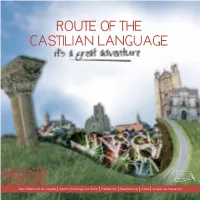
Route of the Castilian Language The Route of the Castilian Language focuses on the history of the Castilian (Spanish) language and proposes six places of particular importance to visit: San Millán de la Cogolla (La Rioja), Santo Domingo de Silos (Burgos), Valladolid, Sa- lamanca, Ávila and Alcalá de Henares (Madrid). In this itinerary, monuments, writers, squares, cloisters, pa- laces, libraries, landscapes, tradition and gastronomy are all intermingled, in an open invitation to discover the be- 1 auty of these six localities. The entire tour encourages visi- tors to discover and experience for themselves all the charm of a history and a language which have evolved in parallel and which are clearly evident in every little spot along the way. San Millan´ de la Cogolla 2 Library Monasteries of Suso and Yuso San Millán walks San Millán de la Cogolla, a World Heritage Site since 1997, is part of the Route of the Castilian Language. It was here where the earliest known writings in the Castilian language were discove- red, the so-called Glosas Emilianenses or Emilian Glosses. The monasteries of Suso and Yuso are both located in San Millán; these two monasteries are of considerable importance in terms of architectural heritage and culture. In fact, the scriptorium at San Millán was one of the most prominent in Spain in the Middle Ages, thanks to the literary work of the monks residing there. Gonzalo de Berceo, the first poet to write in the Castilian lan- guage, also came from these lands. These monasteries and adjoining grounds are a haven for meditation, walks, rests or simply to enjoy the beautiful scenery of the Cárdenas Valley. -
Christian History Answer Key Part Three and Four
Answer Key for Students A Glorious Institution: The Church in History Parts Three and Four Course GS3 Note: Answers are provided only for the "Response" questions (being more fact-based). Other questons require personal opinion and are not evaluated. Part Three: The Reformation and Its Aftermath 1517 - 1648 Lesson 1 The Reformation Begins 1. October 31, 1517. 2. 1546 by Johann Gutenberg. 3. According Catholic dogma, entrance into heaven is based upon merit which can be earned by honoring a system of sacraments as administered by the Church. 4. Baptism, Confirmation, Penance, Holy Eucharist, Holy Orders, Matrimony, Unction 5. a. Indulgence: An indulgence is an official document given by the Church granting in the name of Christ the forgiveness of sins. By making a contribution to the Church an indulgence could be purchased. b. Supererogation: The works of supererogation refers to the good works of Christ and the saints which went beyond the normal requirements to satisfy the demands of a righteous life. These good works, at the discretion of the pope, can be awarded to individuals to ensure salvation. 6. While man is saved by grace through faith alone, the faith which saves him is not alone; it is always accompanied by good works. "Even so faith, if it hath not works, is dead, being alone" (James 2:17). 7. John Tetzel was an eloquent Dominican Friar who was sent by Pope Leo X into towns and villages to raise money to build St. Peter's basilica by selling indulgences. He was very gifted at raising money. When Tetzel began to sell indulgences in the communities near Wittenburg, Luther was outraged for his people were going to Tetzel to buy these unworthy documents. -

Paradores De Turismo
Culture & History Asturias - Bay of Biscay - cloister - countryside - culinary getaway - fabada - historic hotel - historic location - History - holiday destinations - holiday in Spain - luxury four - star hotel - luxury hotel - luxury hotel chain - luxury hotels - Monasteries - monasteries in Spain - nature - nature reserve - nature walks - northern Spain - Parador Corias - Paradores - Paradores in Spain - Spain - Spain museum - Spain Paradores - Spain wineries - spanish - Spanish holiday - Spanish monastery Parador Corias, Spain’s Best Non-Urban Hotel Thursday, 8 May, 2014 Paradores Parador de Corias Given the exceptional quality of their lodgings, Paradores’ luxury and historic hotels are used to receiving accolades, but this year there is special cause for celebration: Parador Corias, the most recently inaugurated Parador in the network, has just been selected as Spain’s Best Non-Urban Hotel by Condè Nast Traveller magazine! Located within a romantic 11th century monastery that is an official Spanish Historic-Artistic Monument, Parador Corias offers the very best of Asturias, with stunning views of verdant landscapes and the Narcea River, peaceful courtyards, and a first-class spa. Enjoy an award-winning holiday in Spain and indulge in a unique, rural escape at this spectacular hotel. Countryside retreat Surrounded by lush forests and right on the banks of the Narcea River, Parador Corias is the sort of place to disconnect from the world within the hotel itself. Take a stroll in the cloisters backed by the sound of the bubbling fountain before settling down in the monastery’s ancestral library with your favourite book, or get a closer look at the building’s amazing architectural features within the in-house museum or inside the hotel’s Tuscan-style church. -

Serving Scotland Better: Scotland and the United Kingdom in the 21St Century
Serving Scotland Better: Better: Scotland Serving Serving Scotland Better: Scotland and the United Kingdom in the 21st Century Final Report – June 2009 Scotland and the United Kingdom in the 21st Century 21st the in Kingdom United the and Scotland Commission on Scottish Devolution Secretariat 1 Melville Crescent Edinburgh EH3 7HW 2009 June – Report Final Tel: (020) 7270 6759 or (0131) 244 9073 Email: info@commissiononscottishdevolution.org.uk This Report is also available online at: www.commissiononscottishdevolution.org.uk © Produced by the Commission on Scottish Devolution 75% Printed on paper consisting of 75% recycled waste Presented to the Presiding Officer of the Scottish Parliament and to the Secretary of State for Scotland, on behalf of Her Majesty’s Government, June 2009 Serving Scotland Better: Scotland and the United Kingdom in the 21st Century | Final Report – June 2009 Serving Scotland Better: Scotland and the United Kingdom in the 21st Century It was a privilege to be asked to chair a Commission to consider how the Scottish Parliament could serve the people of Scotland better. It is a task that has taken just over a year and seen my colleagues and me travelling the length and breadth of Scotland. It has been very hard work – but also very rewarding. Many of the issues are complex, but at the heart of this is our desire to find ways to help improve the lives of the people of Scotland. The reward has been in meeting so many people and discussing the issues with them – at formal evidence sessions, at informal meetings, and at engagement events across the country. -

Communities Committee
COMMUNITIES COMMITTEE Wednesday 13 September 2006 Session 2 £5.00 Parliamentary copyright. Scottish Parliamentary Corporate Body 2006. Applications for reproduction should be made in writing to the Licensing Division, Her Majesty‟s Stationery Office, St Clements House, 2-16 Colegate, Norwich NR3 1BQ Fax 01603 723000, which is administering the copyright on behalf of the Scottish Parliamentary Corporate Body. Produced and published in Scotland on behalf of the Scottish Parliamentary Corporate Body by Astron. CONTENTS Wednesday 13 September 2006 Col. PLANNING ETC (SCOTLAND) BILL: STAGE 2 ..................................................................................................... 3857 COMMUNITIES COMMITTEE 23rd Meeting 2006, Session 2 CONVENER *Karen Whitefield (Airdrie and Shotts) (Lab) DEPUTY CONVENER *Euan Robson (Roxburgh and Berwickshire) (LD) COMMITTEE MEMBERS *Scott Barrie (Dunfermline West) (Lab) *Cathie Craigie (Cumbernauld and Kilsyth) (Lab) *Christine Grahame (South of Scotland) (SNP) *Patrick Harvie (Glasgow) (Green) *John Home Robertson (East Lothian) (Lab) *Tricia Marwick (Mid Scotland and Fife) (SNP) *Dave Petrie (Highlands and Islands (Con) COMMITTEE SUBSTITUTES Chris Ballance (South of Scotland) (Green) Alex Johnstone (North East Scotland) (Con) Christine May (Central Fife) (Lab) Mike Rumbles (West Aberdeenshire and Kincardine) (LD) Ms Sandra White (Glasgow) (SNP) *attended THE FOLLOWING ALSO ATTENDED: Jackie Baillie (Dumbarton) (Lab) Sarah Boyack (Edinburgh Central) (Lab) Donald Gorrie (Central Scotland) (LD) Fiona -

Meeting of the Parliament
MEETING OF THE PARLIAMENT Wednesday 23 March 2005 Session 2 £5.00 Parliamentary copyright. Scottish Parliamentary Corporate Body 2005. Applications for reproduction should be made in writing to the Licensing Division, Her Majesty’s Stationery Office, St Clements House, 2-16 Colegate, Norwich NR3 1BQ Fax 01603 723000, which is administering the copyright on behalf of the Scottish Parliamentary Corporate Body. Produced and published in Scotland on behalf of the Scottish Parliamentary Corporate Body by Astron. CONTENTS Wednesday 23 March 2005 Debates Col. TIME FOR REFLECTION .................................................................................................................................. 15593 ENTERPRISE CULTURE .................................................................................................................................. 15595 The Deputy Minister for Education and Young People (Euan Robson) .................................................. 15595 Jim Mather (Highlands and Islands) (SNP) ............................................................................................. 15600 Murdo Fraser (Mid Scotland and Fife) (Con) ........................................................................................... 15604 Christine May (Central Fife) (Lab) ........................................................................................................... 15608 Stewart Stevenson (Banff and Buchan) (SNP) ....................................................................................... 15611