Between Postdramatic Text and Dramatic Drama: Recent German-Language Playwriting by Lukas Bärfuss and Katja Brunner
Total Page:16
File Type:pdf, Size:1020Kb
Load more
Recommended publications
-
What's Your Status: Exploring Brecht's Idea of HALTUNG Though Keith Johnstone's Status Exercises
Loyola University Chicago Loyola eCommons Department of Fine & Performing Arts: Faculty Publications and Other Works Faculty Publications Fall 2017 Introduction to "What's Your Status: Exploring Brecht's Idea of HALTUNG though Keith Johnstone's Status Exercises Ann M. Shanahan Loyola University Chicago, ashanah@luc.edu Follow this and additional works at: https://ecommons.luc.edu/dfpa Part of the Theatre and Performance Studies Commons Recommended Citation Shanahan, Ann M., "Introduction to "What's Your Status: Exploring Brecht's Idea of HALTUNG though Keith Johnstone's Status Exercises" (2017). Department of Fine & Performing Arts: Faculty Publications and Other Works. 19. https://ecommons.luc.edu/dfpa/19 This Article is brought to you for free and open access by the Faculty Publications at Loyola eCommons. It has been accepted for inclusion in Department of Fine & Performing Arts: Faculty Publications and Other Works by an authorized administrator of Loyola eCommons. For more information, please contact ecommons@luc.edu. This work is licensed under a Creative Commons Attribution-Noncommercial-No Derivative Works 3.0 License. © Stage Directors and Choreographers Society 2017 ---------SDC JOURNAL PEER-REVIEWED SECTION --------- In the political climate surrounding the 2016 US presidential election and its wake, the plays of Bertolt Brecht are produced in professional and university theatres with renewed energy. Several universities will produce The Threepenny Opera and Mother Courage this season. and Brecht's lesser known plays, such as The Resistible Rise ofArtur o Ui, gain new attention in professional venues for the relevancy of their critique of Hitler's rise to power in Nazi Germany. I have found students in university classes- ranging from production courses to general distribution requirements-fascinated and enlivened when we study Brecht's theories, especially when actively demonstrated through performances of his LehrstiJcke, or "learning-plays; and songs. -
Short Stories
Elements and Characteristics of Short Stories Short stories tend to be less complex than novels. Usually, a short story will focus on only one incident, has a single plot, a single setting, a limited number of characters, and covers a short period of time. In longer forms of fiction, stories tend to contain certain core elements of dramatic structure: exposition (the introduction of setting, situation and main characters); complication (the event of the story that introduces the conflict); rising action, crisis (the decisive moment for the protagonist and their commitment to a course of action); climax (the point of highest interest in terms of the conflict and the point of the story with the most action); resolution (the point of the story when the conflict is resolved); and moral. Because of their short length, short stories may or may not follow this pattern. Some do not follow patterns at all. For example, modern short stories only occasionally have an exposition. More typical, though, is an abrupt beginning, with the story starting in the middle of the action. As with longer stories, plots of short stories also have a climax, crisis, or turning-point. However, the endings of many short stories are abrupt and open and may or may not have a moral or practical lesson. Of course, as with any art form, the exact characteristics of a short story will vary by author. Length Determining what exactly separates a short story from longer fictional formats is problematic. A classic definition of a short story is that one should be able to be read it in one sitting, a point most notably made in Edgar Allan Poe's essay "The Philosophy of Composition" (1846). -

OHS Honors English Primer Is the Result of Over a Decade of Collabo- Ration Among the English Teachers of Oviedo High
Honors English Primer Prepared exclusively for the students of Oviedo High School 2008 Edition About Your Primer The 2008 OHS Honors English Primer is the result of over a decade of collabo- ration among the English teachers of Oviedo High. We have worked together to ensure that the materials you will find here are relevant and helpful to your studies both here at Oviedo and later in life. Materials included in this publi- cation have been created specifically for you by the teachers at this school, and the information included is designed to continually build your expertise in communication skills, literary analysis, meaningful composition, and effective research. Your teachers throughout the next four years will refer you to these pages as a resource for reference, instruction, and guidance as you continue to grow as a student of English. Our Primer has four distinct sections that each focus on a different aspect of the skills you will be acquiring: Literature, Composition, Grammar, and Re- search. Some courses may rely more on one section than another, but each course will use the Primer to build off your previous knowledge and prepare you for what lies ahead. Keep this document with you—in class at all times, throughout your career as a high school student, and as you journey into high- er education. It is our sincere hope that you find the2008 OHS Honors English Primer a helpful resource as you continue to prepare yourself for your future. Best wishes for lasting success, The English teachers of Oviedo High School The 2008 edition of The OHS Honors English Primer was set in Myriad® Pro and Warnock® Pro using Adobe® In- Design® CS3. -

The Significance of Anime As a Novel Animation Form, Referencing Selected Works by Hayao Miyazaki, Satoshi Kon and Mamoru Oshii
The significance of anime as a novel animation form, referencing selected works by Hayao Miyazaki, Satoshi Kon and Mamoru Oshii Ywain Tomos submitted for the degree of Doctor of Philosophy Aberystwyth University Department of Theatre, Film and Television Studies, September 2013 DECLARATION This work has not previously been accepted in substance for any degree and is not being concurrently submitted in candidature for any degree. Signed………………………………………………………(candidate) Date …………………………………………………. STATEMENT 1 This dissertation is the result of my own independent work/investigation, except where otherwise stated. Other sources are acknowledged explicit references. A bibliography is appended. Signed………………………………………………………(candidate) Date …………………………………………………. STATEMENT 2 I hereby give consent for my dissertation, if accepted, to be available for photocopying and for inter-library loan, and for the title and summary to be made available to outside organisations. Signed………………………………………………………(candidate) Date …………………………………………………. 2 Acknowledgements I would to take this opportunity to sincerely thank my supervisors, Elin Haf Gruffydd Jones and Dr Dafydd Sills-Jones for all their help and support during this research study. Thanks are also due to my colleagues in the Department of Theatre, Film and Television Studies, Aberystwyth University for their friendship during my time at Aberystwyth. I would also like to thank Prof Josephine Berndt and Dr Sheuo Gan, Kyoto Seiko University, Kyoto for their valuable insights during my visit in 2011. In addition, I would like to express my thanks to the Coleg Cenedlaethol for the scholarship and the opportunity to develop research skills in the Welsh language. Finally I would like to thank my wife Tomoko for her support, patience and tolerance over the last four years – diolch o’r galon Tomoko, ありがとう 智子. -
The Structure of Plays
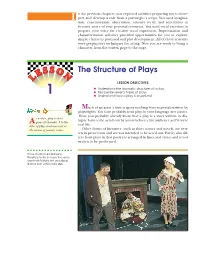
n the previous chapters, you explored activities preparing you to inter- I pret and develop a role from a playwright’s script. You used imagina- tion, concentration, observation, sensory recall, and movement to become aware of your personal resources. You used vocal exercises to prepare your voice for creative vocal expression. Improvisation and characterization activities provided opportunities for you to explore simple character portrayal and plot development. All of these activities were preparatory techniques for acting. Now you are ready to bring a character from the written page to the stage. The Structure of Plays LESSON OBJECTIVES ◆ Understand the dramatic structure of a play. 1 ◆ Recognize several types of plays. ◆ Understand how a play is organized. Much of an actor’s time is spent working from materials written by playwrights. You have probably read plays in your language arts classes. Thus, you probably already know that a play is a story written in dia- s a class, play a short logue form to be acted out by actors before a live audience as if it were A game of charades. Use the titles of plays and musicals or real life. the names of famous actors. Other forms of literature, such as short stories and novels, are writ- ten in prose form and are not intended to be acted out. Poetry also dif- fers from plays in that poetry is arranged in lines and verses and is not written to be performed. ■■■■■■■■■■■■■■■■ These students are bringing literature to life in much the same way that Aristotle first described drama over 2,000 years ago. -

Lehrstücke Von Brecht Im Daf-Unterricht Diplomski Rad
Sveučilište u Zagrebu Filozofski fakultet Odsjek za germanistiku Nastavnički smjer Bojana Tkalčec Lehrstücke von Brecht im DaF-Unterricht Diplomski rad Mentorica: dr. sc. Maja Häusler Zagreb, rujan 2016. Inhaltsverzeichnis 1. Einleitung ............................................................................................................................................ 2 2. Bertolt Brecht ...................................................................................................................................... 3 2.1 Sein Leben und Werk .................................................................................................................... 3 2.2 Brecht heute ................................................................................................................................... 6 2.3 Brecht in Kroatien ......................................................................................................................... 7 3. Lehrstücke von Brecht......................................................................................................................... 9 3.1 Entstehung und Bedeutung ............................................................................................................ 9 4. Schauspiel und Schülertheater im Fremdsprachenunterricht ............................................................ 11 5. Unterrichtsvorschläge zum Thema: Lehrstücke von Bertolt Brecht ................................................. 13 5.1 Zielgruppe .................................................................................................................................. -

A Portrayal of Gender and a Description of Gender Roles in Selected American Modern and Postmodern Plays
East Tennessee State University Digital Commons @ East Tennessee State University Electronic Theses and Dissertations Student Works 5-2002 A Portrayal of Gender and a Description of Gender Roles in Selected American Modern and Postmodern Plays. Bonny Ball Copenhaver East Tennessee State University Follow this and additional works at: https://dc.etsu.edu/etd Part of the English Language and Literature Commons, and the Feminist, Gender, and Sexuality Studies Commons Recommended Citation Copenhaver, Bonny Ball, "A Portrayal of Gender and a Description of Gender Roles in Selected American Modern and Postmodern Plays." (2002). Electronic Theses and Dissertations. Paper 632. https://dc.etsu.edu/etd/632 This Dissertation - Open Access is brought to you for free and open access by the Student Works at Digital Commons @ East Tennessee State University. It has been accepted for inclusion in Electronic Theses and Dissertations by an authorized administrator of Digital Commons @ East Tennessee State University. For more information, please contact digilib@etsu.edu. The Portrayal of Gender and a Description of Gender Roles in Selected American Modern and Postmodern Plays A dissertation presented to the Faculty of the Department of Educational Leadership and Policy Analysis East Tennessee State University In partial fulfillment of the requirements for the degree Doctor of Education in Educational Leadership and Policy Analysis by Bonny Ball Copenhaver May 2002 Dr. W. Hal Knight, Chair Dr. Jack Branscomb Dr. Nancy Dishner Dr. Russell West Keywords: Gender Roles, Feminism, Modernism, Postmodernism, American Theatre, Robbins, Glaspell, O'Neill, Miller, Williams, Hansbury, Kennedy, Wasserstein, Shange, Wilson, Mamet, Vogel ABSTRACT The Portrayal of Gender and a Description of Gender Roles in Selected American Modern and Postmodern Plays by Bonny Ball Copenhaver The purpose of this study was to describe how gender was portrayed and to determine how gender roles were depicted and defined in a selection of Modern and Postmodern American plays. -
Deleuze and the Simulacrum Between the Phantasm and Fantasy (A Genealogical Reading)
Tijdschrift voor Filosofie, 81/2019, p. 131-149 DELEUZE AND THE SIMULACRUM BETWEEN THE PHANTASM AND FANTASY (A GENEALOGICAL READING) by Daniel Villegas Vélez (Leuven) What is the difference between the phantasm and the simulacrum in Deleuze’s famous reversal of Platonism? At the end of “Plato and the Simulacrum,” Deleuze argues that philosophy must extract from moder- nity “something that Nietzsche designated as the untimely.”1 The his- toricity of the untimely, Deleuze specifies, obtains differently with respect to the past, present, and future: the untimely is attained with respect to the past by the reversal of Platonism and with respect to the present, “by the simulacrum conceived as the edge of critical moder- nity.” In relation to the future, however, it is attained “by the phantasm of the eternal return as belief in the future.” At stake, is a certain dis- tinction between the simulacrum, whose power, as Deleuze tells us in this crucial paragraph, defines modernity, and the phantasm, which is Daniel Villegas Vélez (1984) holds a PhD from the Univ. of Pennsylvania and is postdoctoral researcher at the Institute of Philosophy, KU Leuven, where he forms part of the erc Research Pro- ject Homo Mimeticus (hom). Recent publications include “The Matter of Timbre: Listening, Genea- logy, Sound,” in The Oxford Handbook of Timbre, ed. Emily Dolan and Alexander Rehding (Oxford: Oxford Univ. Press, 2018), doi: 10.1093/oxfordhb/9780190637224.013.20 and “Allegory, Noise, and History: TheArcades Project Looks Back at the Trauerspielbuch,” New Writing Special Issue: Convo- luting the Dialectical Image (2019), doi: 10.1080/14790726.2019.1567795. -
Using Postmodernism in Drama and Theatre Making David Porter AS/A2
Using postmodernism in drama and theatre making AS/A2 David Porter AS/A2 Introduction David Porter is former Head of Performing Arts at Kirkley High School, We live in an increasingly ‘cross-genre’ environment where things are mixed, Lowestoft, teacher and one-time sampled and mashed up. History, time, roles, arts, technology and our cultural children’s theatre performer. Freelance and social contexts are in flux. Postmodernism expresses many of the ways in writer, blogger and editor, he is a senior which this is happening. assessor for A level performance studies, IGSCE drama moderator and GCSE drama As the reformed A levels come on stream, postmodernism may appear to examiner. have little place except in BTECs. However, performing arts in general and drama in particular require knowledge and understanding of wider contexts, reinterpretations, devising and study of texts from different periods. Exploring postmodernism is an excellent way to open up a world of artistic interest, exploration, experiment and mash-ups for students who are 16 and over. Although different in details, the Drama and Theatre A level specifications offered for teaching from 2016 (first exam in 2018) are similar in intention and breadth of study. All require exploration of some predetermined and some centre-chosen texts, a variety of leading practitioners, and devising and re- interpretations. Using postmodernism broadens students’ viewpoints, ideas and practical experiences of using art forms to express material. Exam preparation aside, this scheme serves as an -

Mimesis, Chinese Aesthetics, Post-Modern Theatre
In Search of Another Eye: Mimesis, Chinese Aesthetics, Post-modern Theatre Won Jung Sohn Thesis submitted for the examination for the degree of Doctor of Philosophy, University of London DEPARTMENT OF DRAMA AND THEATRE Royal Holloway, University of London 2011 1 Declaration of Authorship I, Won Jung Sohn, hereby declare that this thesis and the work presented in it is entirely my own. Where I have consulted the work of others, this is always clearly stated. 2 Abstract Although a new tradition of non-mimetic theatre has secured a place in Western theatre history, I find that existing critical vocabularies fail to embrace various theatrical forms of today. Alternative frames of discussion are sought after, and I propose that a culturally distinct one will open up possibilities of perceiving contemporary performances in different ways. In this thesis I turn to the aesthetics of Chinese painting. The Western concept of mimesis in theatre is seen as being strictly related to the verbal aspects of the drama rather than the performed spectacle. Turning to paintings as a lens through which to look at theatre enables one to focus on the extra-textual aspects of performance. At the same time, looking at painting directs one to the issue of ways of seeing, which is fundamental to theatre. Looking at Chinese paintings will disclose the unique Chinese ways of seeing that affected their artistic creation and reception, as well as what different concepts of representation prevailed. In this thesis I trace the mimetic foundations of Western theatre by investigating the writings of Plato and Aristotle as well as looking at Classical Greek painting, its modern reflections and counteractions. -
A Character Type in the Plays of Edward Bond
A Character Type in the Plays of Edward Bond Dissertation Presented in Partial Fulfillment of the Requirements for the Degree Doctor of Philosophy in the Graduate School of The Ohio State University By Frank A. Torma, M. A. Graduate Program in English The Ohio State University 2010 Dissertation Committee: Jon Erickson, Advisor Richard Green Joy Reilly Copyright by Frank Anthony Torma 2010 Abstract To evaluate a young firebrand later in his career, as this dissertation attempts in regard to British playwright Edward Bond, is to see not the end of fireworks, but the fireworks no longer creating the same provocative results. Pursuing a career as a playwright and theorist in the theatre since the early 1960s, Bond has been the exciting new star of the Royal Court Theatre and, more recently, the predictable producer of plays displaying the same themes and strategies that once brought unsettling theatre to the audience in the decades past. The dissertation is an attempt to evaluate Bond, noting his influences, such as Beckett, Brecht, Shakespeare, and the postmodern, and charting the course of his career alongside other dramatists when it seems appropriate. Edward Bond‟s characters of Len in Saved, the Gravedigger‟s Boy in Lear, Leonard in In the Company of Men, and the character in a number of other Bond plays provide a means to understand Bond‟s aesthetic and political purposes. Len is a jumpy young man incapable of bravery; the Gravedigger‟s Boy is the earnest young man destroyed too early by total war; Leonard is a needy, spoiled youth destroyed by big business. -

Brechtian Theory
GUTES TUN 1,3: BRECHTIAN THEORY AND CONTEMPORARY DIDACTIC THEATER by ERICA MARIE HAAS (Under the Direction of Martin Kagel) ABSTRACT The play Gutes Tun 1,3 (2005), written and performed by Anne Tismer and Rahel Savoldelli, lends to comparison to the works of Bertolt Brecht: Tismer and Savoldelli aim to educate the audience about social issues, using Brechtian performance techniques such as Verfremdung to relay their ideas. However, upon closer examination, it is clear that Gutes Tun 1,3 ultimately diverges from Brechtian theory, especially with regard to the way that social messages are conveyed. INDEX WORDS: Gutes Tun, Off-Theater, German theater, Modern theater, Anne Tismer, Rahel Savoldelli, Ballhaus Ost, Bertolt Brecht GUTES TUN 1,3: BRECHTIAN THEORY AND CONTEMPORARY DIDACTIC THEATER by ERICA MARIE HAAS B.A., New College of Florida, 2005 A Thesis Submitted to the Graduate Faculty of The University of Georgia in Partial Fulfillment of the Requirements for the Degree MASTER OF ARTS ATHENS, GEORGIA 2009 ©2009 Erica Marie Haas All Rights Reserved iv DEDICATION This thesis is dedicated to my friends, especially my best friend, Jessica, for all of her love, support, and silly text messages from across the miles. Priya, Beau, Matt, Amy the Brit, Kristie, JP, Med School Amy, Mike, Alia, Fereshteh, Sam, Lea, and Sarah the Zwiebel are some of the best cheerleaders that a girl could ever hope for. Finally, this thesis is dedicated to my friends from Joe Brown Hall, who have made the past two years in Athens so memorable. Life would not have been as much fun without the basement camaraderie and YouTube prowess of Will, Zachary, Carlos, Justin, Caskey, Monika, Hugh, Flo, Ulla, Boris, Keith, Janith, Antje, Marcie, Lena, Susa, Cassie, Sarah, Katie, and Paulina.