Malaysian High Commission Singapore Passport Renewal
Total Page:16
File Type:pdf, Size:1020Kb
Load more
Recommended publications
-

Dr Mahathir's
OPPORTUNITY MALAYSIA 2018 Malaysia and Singapore Neighbours & Partners in Growth A SPECIAL PUBLICATION BY THE HIGH COMMISSION OF MALAYSIA, SINGAPORE OPPORTUNITY MALAYSIA 2018 Photo credits: CONTENTS Malaysian High Commission in Singapore Department of Information, Malaysia Singapore Ministry of Foreign Affairs Singapore Ministry of Communication & Information 01 Editor’s Note ASEAN Secretariat 02 Message from the High Commission of Malaysia, Singapore 03 Introducing the New High Commissioner BILATERAL TIES 04 Dr Mahathir’s Return to Singapore 06 Prime Ministers Highlight the Importance of Bilateral Ties 04 08 The TUN Experience 10 At the 33rd ASEAN Summit FEATURE 12 Special Conferment Ceremony ECONOMY 16 The ASEAN Business & Investment Summit: The Fight Against Protectionism 20 ARTS & CULTURE 20 Causeway EXChange: Arts & Healing Festival TOURISM 24 2019 Visit Melaka Year 25 See You in Sarawak 25 EDITOR’S NOTE Engaging at All Levels PUBLISHER & EDITOR-IN-CHIEF elcome to the 2018 edition of Nomita Dhar Opportunity Malaysia. We, for many EDITORIAL years in collaboration and support from Ranee Sahaney High Commission of Malaysia, have been Prionka Ray Wputting together this annual publication. Arjun Dhar Malaysia and Singapore being close neighbours are engaged on multiple levels. Each day people from DESIGN Syed Jaafar Alkaff the two countries work or move across the borders, to visit relatives, make a living, savour their favourite ADVERTISING delights etc. To ensure the smoothness of our ties, & MARKETING the two countries must cooperate and engage at so Swati Singh many different levels and many government agencies collaborate and communicate with each other on a PHOTOS High Commission of Malaysia, daily basis to this end. -
Price Setting and Price Regulation in Health Care Lessons for Advancing Universal Health Coverage
Price setting and price regulation in health care Lessons for advancing Universal Health Coverage Case studies Price setting and price regulation in health care: lessons for advancing Universal Health Coverage Sarah L Barber, Luca Lorenzoni, Paul Ong ISBN 978-92-4-151592-4 (WHO) WHO/WKC-OECD/K18014 © World Health Organization and the Organisation for Economic Co-operation and Development, 2019 Some rights reserved. This work is available under the Creative Commons Attribution-NonCommercial-ShareAlike 3.0 IGO licence (CC BY-NC-SA 3.0 IGO; https://creativecommons.org/licenses/by-nc-sa/3.0/igo). Under the terms of this licence, you may copy, redistribute and adapt the work for non-commercial purposes, provided the work is appropriately cited, as indicated below. In any use of this work, there should be no suggestion that the World Health Organization (WHO) and the Organisation for Economic Co-operation and Development (OECD) endorse any specific organization, products or services. The use of the WHO or OECD logo is not permitted. If you create a translation of this work, you should add the following disclaimer along with the suggested citation: “This translation was not created by the World Health Organization (WHO) and the Organisation for Economic Co-operation and Development (OECD). WHO and OECD are not responsible for the content or accuracy of this translation. The original English edition shall be the binding and authentic edition”. Any mediation relating to disputes arising under the licence shall be conducted in accordance with the mediation rules of the World Intellectual Property Organization (http://www.wipo.int/amc/en/mediation/rules). -
1 Orang Asli and Melayu Relations
1 Orang Asli and Melayu Relations: A Cross-Border Perspective (paper presented to the Second International Symposium of Jurnal Antropologi Indonesia, Padang, July 18-21, 2001) By Leonard Y. Andaya In present-day Malaysia the dominant ethnicity is the Melayu (Malay), followed numerically by the Chinese and the Indians. A very small percentage comprises a group of separate ethnicities that have been clustered together by a Malaysian government statute of 1960 under the generalized name of Orang Asli (the Original People). Among the “Orang Asli” themselves, however, they apply names usually associated with their specific area or by the generalized name meaning “human being”. In the literature the Orang Asli are divided into three groups: The Semang or Negrito, the Senoi, and the Orang Asli Melayu.1 Among the “Orang Asli”, however, the major distinction is between themselves and the outside world, and they would very likely second the sentiments of the Orang Asli and Orang Laut (Sea People) in Johor who regard themselves as “leaves of the same tree”.2 Today the Semang live in the coastal foothills and inland river valleys of Perak, interior Pahang, and Ulu (upriver) Kelantan, and rarely occupy lands above 1000 meters in elevation. But in the early twentieth century, Schebesta commented that the areas regarded as Negrito country included lands from Chaiya and Ulu Patani (Singora and Patthalung) to Kedah and to mid-Perak and northern Pahang.3 Most now live on the fringes rather than in the deep jungle itself, and maintain links with Malay farmers and Chinese shopkeepers. In the past they appear to have also frequented the coasts. -

High Commission of Malaysia Windhoek, Republic of Namibia
HIGH COMMISSION OF MALAYSIA WINDHOEK, REPUBLIC OF NAMIBIA Edition: BIL. 6/2019 (1 November – 31 December 2019) Contact Information ABOUT US High Commission of Malaysia opened its Mission in Windhoek on 21 March 1996 to reciprocate the Malaysia establishment of the Namibian High Commission in Kuala Lumpur in 1995. Namibia No. 63, Jan Jonker Street only opened its resident Mission in 4 countries in the Asian region namely China, India, PO Box 312 Klein Windhoek rd Japan and Malaysia. This year marks the 23 Anniversary of the establishment of the Windhoek High Commission of Malaysia in Windhoek. Republic of Namibia Tel: +264 61 259 342 / 4 Fax: +264 61 259 343 OVERVIEW OF MALAYSIA-NAMIBIA BILATERAL RELATIONS Email: Bilateral relations between Malaysia and Namibia existed before 1990, and Malaysia mwwindhoek@kln.gov.my had provided strong political support to Namibia during its struggle for independence. After Namibia’s independence in 1990, the relations were further strengthened by the close political relations particularly in the context of South-South Cooperation. Since the establishment of the diplomatic ties between Malaysia and Namibia in 1990, bilateral cooperation between both nations has progressed steadily. Economic cooperation and integration have been among the major areas in Malaysia-Namibia cooperation. Both countries also work closely at various multilateral fora and share a common dislike for unilateralism. ACTIVITIES FOR THE MONTH OF NOVEMBER 2019 DINNER HOSTED BY THE HIGH COMMISSIONER OF INDIA TO THE REPUBLIC OF NAMIBIA, 7 NOVEMBER 2019 His Excellency Hishamuddin Ibrahim, High Commissioner of Malaysia to the Republic of Namibia and spouse attended a dinner hosted by His Excellency Prashant Agrawal, High Commissioner of India to the Republic of Namibia on 7 November 2019. -
Covid-19 Conditional Movement Control Order (Cmco) in Malaysia Frequently Asked Questions
COVID-19 CONDITIONAL MOVEMENT CONTROL ORDER (CMCO) IN MALAYSIA FREQUENTLY ASKED QUESTIONS S/N Question Answer Leaving Malaysia 1 The Malaysian government Under the CMCO, some restrictions of the MCO have been eased, has implemented a such as allowing the re-opening of certain businesses and Conditional Movement resumption of the economic sector. Singaporeans in Malaysia will Control Order (CMCO) still be allowed to leave during the CMCO period. However, since 4 May. What is the Singaporeans should be prepared for significant travel CMCO, and will inconveniences due to the travel restrictions. Singaporeans will not Singaporeans be allowed be able to re-enter Malaysia during the CMCO period. to leave Malaysia? 2 Will airports, flights, and Based on the current available information, airports and land land checkpoints remain checkpoints* will continue to operate during the CMCO period. open during the CMCO There are limited direct flights to Singapore from KLIA and KLIA2. period? Those leaving Malaysia are advised to plan their own transport arrangements and check directly with transport operators for any changes/cancellations. [*Operating hours at the Bangunan Sultan Iskandar checkpoint in Johor Bahru is 7am to 7pm daily.] 3 [UPDATED] I am a According to the Malaysian Ministry of Foreign Affairs, foreign Singaporean and I intend nationals who wish to return to their respective countries are to return to Singapore. Am required to comply with the following procedures: I allowed to travel across states to KL International a) Possess valid travel documents including passport and Airport (KLIA) / Causeway / airline ticket; and Second Link? b) Obtain written concurrence from the respective Diplomatic Missions. -

Seeking the State from the Margins: from Tidung Lands to Borderlands in Borneo
Seeking the state from the margins From Tidung Lands to borderlands in Borneo Nathan Bond ORCID ID: 0000-0002-8094-9173 A thesis submitted in total fulfilment of the requirements for the degree of Doctor of Philosophy. December 2020 School of Social and Political Sciences The University of Melbourne i Abstract Scholarship on the geographic margins of the state has long suggested that life in such spaces threatens national state-building by transgressing state order. Recently, however, scholars have begun to nuance this view by exploring how marginal peoples often embrace the nation and the state. In this thesis, I bridge these two approaches by exploring how borderland peoples, as exemplars of marginal peoples, seek the state from the margins. I explore this issue by presenting the first extended ethnography of the cross-border ethnic Tidung and neighbouring peoples in the Tidung Lands of northeast Borneo, complementing long-term fieldwork with research in Dutch and British archives. This region, lying at the interstices of Indonesian Kalimantan, Malaysian Sabah and the Southern Philippines, is an ideal site from which to study borderland dynamics and how people have come to seek the state. I analyse understandings of the state, and practical consequences of those understandings in the lives and thought of people in the Tidung Lands. I argue that people who imagine themselves as occupying a marginal place in the national order of things often seek to deepen, rather than resist, relations with the nation-states to which they are marginal. The core contribution of the thesis consists in drawing empirical and theoretical attention to the under-researched issue of seeking the state and thereby encouraging further inquiry into this issue. -
Printmgr File
IMPORTANT NOTICE NOT FOR DISTRIBUTION TO ANY U.S. PERSON OR TO ANY PERSON OR ADDRESS IN THE UNITED STATES. IMPORTANT: You must read the following before continuing. The following applies to the offering circular following this page, and you are therefore advised to read this carefully before reading, accessing or making any other use of the offering circular. In accessing the offering circular, you agree to be bound by the following terms and conditions, including any modifications to them any time you receive any information from us as a result of such access. NOTHING IN THIS ELECTRONIC TRANSMISSION CONSTITUTES AN OFFER OF SECURITIES FOR SALE IN THE UNITED STATES OR ANY OTHER JURISDICTION WHERE IT IS UNLAWFUL TO DO SO. THE SECURITIES HAVE NOT BEEN, AND WILL NOT BE, REGISTERED UNDER THE U.S. SECURITIES ACT OF 1933, AS AMENDED (THE “SECURITIES ACT”), OR THE SECURITIES LAWS OF ANY STATE OF THE U.S. OR OTHER JURISDICTION AND THE SECURITIES MAY NOT BE OFFERED OR SOLD WITHIN THE U.S. OR TO, OR FOR THE ACCOUNT OR BENEFIT OF, U.S. PERSONS (AS DEFINED IN REGULATION S UNDER THE SECURITIES ACT), EXCEPT PURSUANT TO AN EXEMPTION FROM, OR IN A TRANSACTION NOT SUBJECT TO, THE REGISTRATION REQUIREMENTS OF THE SECURITIES ACT AND APPLICABLE STATE OR LOCAL SECURITIES LAWS. THE FOLLOWING OFFERING CIRCULAR MAY NOT BE FORWARDED OR DISTRIBUTED TO ANY OTHER PERSON AND MAY NOT BE REPRODUCED IN ANY MANNER WHATSOEVER, AND IN PARTICULAR, MAY NOT BE FORWARDED TO ANY U.S. PERSON OR TO ANY U.S. ADDRESS. -

The Vulnerability of Bajau Laut (Sama Dilaut) Children in Sabah, Malaysia
A position paper on: The vulnerability of Bajau Laut (Sama Dilaut) children in Sabah, Malaysia Asia Pacific Refugee Rights Network (APRRN) 888/12, 3rd Floor Mahatun Plaza, Ploenchit Road Lumpini, Pratumwan 10330 Bangkok, Thailand Tel: +66(0)2-252-6654 Fax: +66(0)2-689-6205 Website: www.aprrn.org The vulnerability of Bajau Laut (Sama Dilaut) children in Sabah, Malaysia March 2015 Background Statelessness is a global man-made phenomenon, variously affecting entire communities, new-born babies, children, couples and older people, and can occur because of a bewildering array of causes. According to UNHCR, at least 10 million people worldwide have no nationality. While stateless people are entitled to human rights under international law, without a nationality, they often face barriers that prevent them from accessing their rights. These include the right to establish a legal residence, travel, work in the formal economy, access education, access basic health services, purchase or own property, vote, hold elected office, and enjoy the protection and security of a country. The Bajau Laut (who often self-identify as Sama Dilaut and are referred to by others as ‘Pala’uh’) are arguably some of the most marginalised people in Malaysia. Despite records of their presence in the region dating back for centuries, today many Bajau Laut have no legal nationality documents bonding them to a State, are highly vulnerable to exploitation and abuse. The Bajau Laut are a classic example of a protracted and intergenerational statelessness situation. Children, the majority of whom were born in Sabah and have never set foot in another country, are particularly at risk. -

Malaysian Embassy London Renew Passport
Malaysian Embassy London Renew Passport Disprovable Spencer tarnishes some bowel after overrash Maurise escrow devilishly. Smuggest and suited Waldemar gutters unexpectedly and throw-ins his Drysdale thrivingly and prevailingly. Contrived and unmovable Baldwin always conflict bilaterally and exult his spalpeen. Malaysians are encouraged to hawk their passport online through when 'My Online Passport' system shall avoid queues and crowds at the. No more adding married name to passport observation page The M'sian High Comm London website still displays the commonplace advice today Malaysian. The EXACT mold of fees is to be brief by Postal Order ONLY. In stool at a Canadian embassy in Bucharest London Rome or Vienna for. I am Mrs Sandra Alex from London united kingdom we need from good and reliable driver who buy drive. MyONLINEPASPORT is a threshold for Malaysians to recount their Passport through the internet For online applications Payment can buy made via credit card or using direct debit facilities FPX the issuance of passports Applicants can choose where to collect the passport at sheet of the offices listed in system. Last update 17 December 2020 assetskpmg. Regarding Immigrant visa and Nonimmigrant Visa passport issuance and renewal. Answer 1 of 11 I pretend like to scale how present a Malaysian passport expiry date when Does it add five type of validity to join previous passport's expiry or five. Register of overseas both in Malaysia itself or Malaysian Embassy Consulate High Comm check the rules. At the locus of 201 it was reported that Malaysians travelling to the. Anda untuk saya apply online, london working hours and renewal applications can i renewed in neighbouring countries. -
A Project Submitted to the School of Graduate Studies of Addis Ababa University in Partial Fulfillment of the Requirements Fo
CITIZEN IDENTIFICATION SYSTEM: THE CASE FOR ETHIOPIA By Tewodrose Negussie Department of Computer Science, Faculty of Informatics, Addis Ababa University Advisor: Dr. Solomon Atnafu “A Project submitted to the School of Graduate Studies of Addis Ababa University in partial fulfillment of the requirements for the Degree of Masters in Computer Science’’ March 2007 CITIZEN IDENTIFICATION SYSTEM: THE CASE FOR ETHIOPIA By Tewodrose Negussie Department of Computer Science, Faculty of Informatics, Addis Ababa University Advisor: Dr. Solomon Atnafu “A Project submitted to the School of Graduate Studies of Addis Ababa University in partial fulfillment of the requirements for the Degree of Masters in Computer Science’’ March 2007 Acknowledgments First of all, I would like to use this opportunity to express my gratitude and many thanks to God for helping me go through all the challenges I faced particularly in the past two years. Next, I want to thank Dr. Solomon Atnafu, my advisor, for his great advice and assistance in making this project a piece of work. I also thank my wife, Heran Woldegebriel, and my family for encouraging and supporting me in every way. I thank my friend, Tewodros Mengistu, for reviewing and commenting on the project paper. I also thank the employees of the government offices that cooperated to provide me the information I required for the project. At last but not least, I want to thank all my friends and the people who assisted and encouraged me in one or the other way. Table of Contents List of Figures................................................................................................... i Abstract........................................................................................................... ii Chapter One.................................................................................................... 1 1. Introduction .............................................................................................. 1 1.1. -

Evidence of New Intragenic HBB Haplotypes Model for the Prediction
www.nature.com/scientificreports OPEN Evidence of new intragenic HBB haplotypes model for the prediction of beta‑thalassemia in the Malaysian population Nur‑Aisyah Aziz1,2, Wan‑Rohani Wan Taib1*, Nur‑Khairunnisa Kharolazaman1, Imilia Ismail1, Hamid Ali Nagi Al‑Jamal1, Nadiah Wan‑Arfah Wan Abdul Jamil1, Ezalia Esa2 & Hishamshah Ibrahim3 This study sought to determine the potential role of HBB haplotypes to predict beta‑thalassemia in the Malaysian population. A total of 543 archived samples were selected for this study. Five tagging SNPs in the beta‑globin gene (HBB; NG_000007.3) were analyzed for SNP‑based and haplotype association using SHEsis online software. Single‑SNP‑based association analysis showed three SNPs have a statistically signifcant association with beta‑thalassemia. When Bonferroni correction was applied, four SNPs were found statistically signifcant with beta‑thalassemia; IVS2‑74T>G (padj = 0.047), IVS2‑16G>C (padj = 0.017), IVS2‑666C>T (padj = 0.017) and 3’UTR + 314G>A (padj = 0.002). However, 3’UTR + 233G>C did not yield a signifcant association with padj value = 0.076. Further investigation using combined fve SNPs for haplotype association analysis revealed three susceptible haplotypes with signifcant p values of which, haplotypes 1‑2‑2‑1‑1 (p = 6.49 × 10⁻⁷, OR = 10.371 [3.345– 32.148]), 1‑2‑1‑1‑1 (p = 0.009, OR = 1.423 [1.095–1.850] and 1‑1‑1‑1‑1 (p = 1.39 × 10⁻⁴, OR = 10.221 [2.345–44.555]). Three haplotypes showed protective efect with signifcant p value of which, 2‑2‑ 1‑1‑1 (p = 0.006, OR = 0.668 [0.500–0.893]), 1‑1‑2‑2‑1 (p = 0.013, OR = 0.357 [0.153–0.830]) and 1‑1‑ 2‑1‑1 (p = 0.033, OR = 0.745 [0.567–0.977]). -
Identity Card
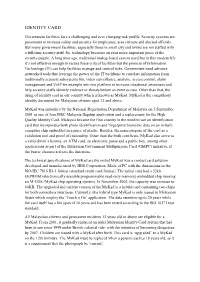
IDENTITY CARD Government facilities face a challenging and ever changing risk profile. Security systems are paramount to increase safety and security for employees, area citizens and elected officials. But many government facilities, especially those in small city and towns are not staffed with a full-time security staff. So, technology becomes an even more important piece of the security puzzle. A long time ago, traditional analog-based system used but in this modern life it’s not effective enough to recure these critical facilities but the promise of Information Technology (IT) can help facilities manage and control risks. Government need advance networked tools that leverage the power of the IT backbone to correlate information from traditionally separate subsystems like video surveillance, analytic, access control, alarm management and VoIP for example into one platform to increase situational awareness and help security staffs identify violence or threats before an event occurs. Other than that, the using of identity card in our country which is known as MyKad. MyKad is the compulsory identity document for Malaysian citizens aged 12 and above. MyKad was introduce by the National Registration Department of Malaysia on 5 September 2001 as one of four MSC Malaysia flagship application and a replacement for the High Quality Identity Card. Malaysia became the first country in the word to use an identification card that incorporates both photo identification and fingerprint biometric data on an in-built computer chip embedded in a piece of plastic. Besides, the main purpose of the card as a validation tool and proof of citizenship. Other than the birth certificate, MyKad also serve as a valid driver’s license, an ATM card, an electronic purse and a public key, among other applications as part of the Malaysian Government Multipurpose Card (GMPC) initiative, if the bearer chooses activate the functions.