Ancient Roots: Mythology and Us
Total Page:16
File Type:pdf, Size:1020Kb
Load more
Recommended publications
-

The Russian Ritual Year and Folklore Through Tourist Advertising
THE RUSSIAN RITUAL YEAR AND FOLKLORE THROUGH TOURIST ADVERTISING IRINA SEDAKOVA This article analyzes the ritual year in modern Russia as Članek analizira praznično leto v moderni Rusiji, kot ga reflected in tourism spam letters circulated between 2005 odsevajo turistična oglasna sporočila med letoma 2005 in and 2012. These texts are the main source of data for this 2012. Tovrstna besedila so glavni vir podatkov za to študijo, study because they illustrate major tendencies in govern- saj odsevajo pomembnejše tendence vladnih, komercialnih mental, commercial, and individual attitudes towards in individualnih pogledov na ruske tradicionalne šege in Russian traditional customs and official holidays. They also uradne praznike. Prikazujejo tudi, kako se ohranja in demonstrate how local heritage is being maintained and rekonstruira lokalna dediščina in kako se pojavljajo in reconstructed, and how new myths and customs are appear- razvijajo novi miti in rituali, kot jih zahtevajo potrebe ing and developing to suit the needs of domestic tourism, a domačega turizma. special ethnographic calendrical type. Ključne besede: Rusija, praznično leto, pust, oglaševanje, Keywords: Russia, ritual year, carnival, advertising, tour- turistična antropologija, semiotika. ism anthropology, semiotics. INTRODUCTION This article focuses on the revitalization and re-invention of calendrical ritual celebrations in modern Russian provincial cities as a reciprocal process introduced by local authorities and tourist developers to motivate domestic tourists. This study touches on many sub- disciplines within anthropology, folklore, and linguistics. The topic partly fits into the anthropology of tourism, an academic discipline well established in Europe and the U.S. (core works are published in Smith 1989, Nash 1996, and Nash 2007 et al., but not yet presented in Russian academic investigation and teaching1). -
“Zhili-Byli…”: Russian Folklore in the Intermediate Language Classroom
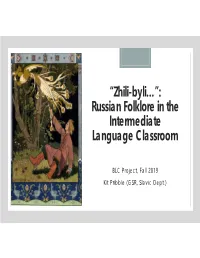
“Zhili-byli…”: Russian Folklore in the Intermediate Language Classroom BLC Project, Fall 2019 Kit Pribble (GSR, Slavic Dept.) Textual features of the fairytale ◦ Formulaic, often cyclical narrative structure ◦ Combination of vivid imagery + concrete plot ◦ Repetition and the rule of 3 ◦ Orality (alliteration, rhyme, & mnemonic devices) Project Goals 1) To gradually build students’ comfort level with reading narrative texts in Russian 2) To introduce students to a foundational aspect of Russian culture, while also engaging students in a critical consideration of how national cultures are conceived or constructed Focus: Traditional Magic Tales and their 20th Century Adaptations 1) Recorded textual variants • Alexander Afanasyev’s collection of Russian fairytales, 1860s 2) 20th century revisions and adaptations • Ballets (Modernist and Soviet) • Modernist paintings and illustrations • Soviet rock music • Animated films (Soviet and Post-Soviet) • Advertisements • Political emblems and political cartoons Project Goals 1) To gradually build students’ comfort level with reading narrative texts in Russian 2) To introduce students to a foundational aspect of Russian culture, while also engaging students in a critical consideration of how national cultures are conceived or constructed Cluster 1: The 3 Bogatyrs Learning goals: 1) Introduce students to the genre of the bylina (East Slavic heroic epic), as well as later re-castings of the bogatyrs (Slavic epic heroes) in Modernist and Post-Soviet art 2) Increase students’ sensitivity to register and -

Download Article
Advances in Social Science, Education and Humanities Research (ASSEHR), volume 312 International Conference "Topical Problems of Philology and Didactics: Interdisciplinary Approach in Humanities and Social Sciences" (TPHD 2018) Between Folklore and Literature: Mastery of A.N. Tolstoy-Storyteller (on the 135th anniversary of the writer) Varvara A. Golovko Evgenia A. Zhirkova Dept. of History of the Russian literature, theory of Dept. of History of the Russian literature, theory of literature and criticism literature and criticism Kuban State University Kuban State University Krasnodar, Russia Krasnodar, Russia zest_90@mail.ru zhirkova@mail.ru Natalya V. Svitenko Dept. of History of the Russian literature, theory of literature and criticism Kuban State University Krasnodar, Russia svitenko@list.ru Abstract–The study of the interaction of traditional folk unfortunately incomplete project of the author, set of folk culture and professional art, folklore and literature for more tales. After the publication of the lyric collections, readers than a century is considered to be one of the main directions of became acquainted with the cycle “Magpie’s Tales”, first humanitarian knowledge. The article is devoted to the analysis of published by the St. Petersburg Publishing House “Public the author’s transformations of Russian folklore in the “fairy- Benefit” in 1910. tale” works of Alexei Nikolaevich Tolstoy (1883-1945). The relevance of the research is determined by the special role of Many times for different literary collections, the author has folklore images, motifs and plot patterns in the writer's works. rewritten the cycle “Magpie’s Tales”. In the Complete Works, The folklore-mythological aspect of the works of the “third” the authors of the comments note that “in 1923, when the State Tolstoy is less studied by scholars, although in a number of works Publishing house published a collection of fairy tales and about the writer there are judgments about the general influence poems by A. -

Pagan Beliefs in Ancient Russia. by Luceta Di Cosimo, Barony Marche of the Debatable Lands, Aethelmearc
1 Pagan Beliefs in Ancient Russia. By Luceta di Cosimo, Barony Marche of the Debatable Lands, Aethelmearc. lucetadicosimo@yahoo.com ©2006-2017 Slavic mythology is a difficult subject. The historical evidence is fragmented, with many conflicting sources and multiple later literary inventions. This is a brief reconstruction of ancient Russian mythology. The first archaeological findings that can be attributed to Slavs date to approximately 6th c. AD. The origins of Slavs are still debated. The pagan Slavic society was an oral society. Christianity, which introduced writing, was more concerned with eradication rather than preservation of pagan beliefs. No one really tried to preserve and record whatever remained, until late period. Then, there is some evidence recorded from the Germans who visited Russia in 18th c., but a lot of it is based on the written 15thc. sources, rather than eyewitness accounts. The 19th c. Europe saw renewed interest in folklore, and combined with rise of nationalism and need for developed mythos, a lot of what was left was recorded, but a lot was altered to make it more palatable, and questionable things (especially with fertility rituals) were edited out as not to besmirch the emerging national character. During the Soviet time, the study of any religion was problematic, due to mandatory atheism. Eventually, the study of the early Slavic traditions was permitted, and even encouraged, but, everything had to pass stringent censorship rules, and could not contradict Marxist-Leninist philosophy. So, people who had the material (in the USSR) could not publish, and people who actually could publish (in the West) did not have access to the materials. -

Slavic Pagan World
Slavic Pagan World 1 Slavic Pagan World Compilation by Garry Green Welcome to Slavic Pagan World: Slavic Pagan Beliefs, Gods, Myths, Recipes, Magic, Spells, Divinations, Remedies, Songs. 2 Table of Content Slavic Pagan Beliefs 5 Slavic neighbors. 5 Dualism & The Origins of Slavic Belief 6 The Elements 6 Totems 7 Creation Myths 8 The World Tree. 10 Origin of Witchcraft - a story 11 Slavic pagan calendar and festivals 11 A small dictionary of slavic pagan gods & goddesses 15 Slavic Ritual Recipes 20 An Ancient Slavic Herbal 23 Slavic Magick & Folk Medicine 29 Divinations 34 Remedies 39 Slavic Pagan Holidays 45 Slavic Gods & Goddesses 58 Slavic Pagan Songs 82 Organised pagan cult in Kievan Rus' 89 Introduction 89 Selected deities and concepts in slavic religion 92 Personification and anthropomorphisation 108 "Core" concepts and gods in slavonic cosmology 110 3 Evolution of the eastern slavic beliefs 111 Foreign influence on slavic religion 112 Conclusion 119 Pagan ages in Poland 120 Polish Supernatural Spirits 120 Polish Folk Magic 125 Polish Pagan Pantheon 131 4 Slavic Pagan Beliefs The Slavic peoples are not a "race". Like the Romance and Germanic peoples, they are related by area and culture, not so much by blood. Today there are thirteen different Slavic groups divided into three blocs, Eastern, Southern and Western. These include the Russians, Poles, Czechs, Ukrainians, Byelorussians, Serbians,Croatians, Macedonians, Slovenians, Bulgarians, Kashubians, Albanians and Slovakians. Although the Lithuanians, Estonians and Latvians are of Baltic tribes, we are including some of their customs as they are similar to those of their Slavic neighbors. Slavic Runes were called "Runitsa", "Cherty y Rezy" ("Strokes and Cuts") and later, "Vlesovitsa". -

Kelliwig Ke Akua
Ke Akua Kelliwig It takes eight men above and eight this black warrior, with one leg Kekri2 Baltic below to pull his eyelids apart so that and one eye in the middle of his a Finnish festival in honour of the he can see. forehead, guarded the property of the god Kekri Ke Akua (see Akua) Black Knight and put those seeking kekri3 Baltic Keagyihl Depguesk North American adventure on the road to meeting the a Finnish ghost or spirit a whirlpool Black Knight in combat. kekritar Baltic This whirlpool had claimed the lives Keevan (see Ciabhan) masks, or the people wearing them, in of many young men so the tree-spirit, Keh Egyptian the Kekri festival Hanging Hair, called a meeting in a primordial god portrayed as having Kekrops (see Cecrops) Festival House of all the river-spirits the head of a frog Keku (see Kekui) who agreed to curb its power. The Kehama Hindu Kekui Egyptian storm-spirit blew part of a cliff into a prince [Emen.Kek(u).Kuk] the river, so diverting the flow of He drank some amrita but failed to a primaeval god water and reducing the whirlpool to a achieve immortality. Instead, he found consort of Kekuit gentle eddy. himself acting as one of the four With Kekuit he represented the Keats, John English supporting the throne of Yama, the darkness of the primordial chaos. (1795–1821) god of the dead. He is depicted sometimes with a a poet Kehtahn North American frog’s head, sometimes as a baboon. He was author of several works an offering to the gods of the Navajo, Kekuit Egyptian on mythological themes including a reed filled with tobacco etc. -
Otherness and Intertextuality in the Witcher. the Duality of Experiencing
Anna Michalska 6875769 Otherness and Intertextuality in The Witcher. The Duality of Experiencing Andrzej Sapkowski’s Universe Utrecht University Literature Today: English and Comparative Literature Supervisor: Frank Brandsma Second evaluator: Jeroen Salman July 2020, Utrecht Michalska 2 Table of Contents Abstract................................................................................................................. 4 Introduction..........................................................................................................5 I. A Hero, an Anti-hero, a No-hero. The Witcher As a Misfit.......................14 Misfit, or Description of a Witcher..........................................15 Literary Background..................................................................16 Hero, or Description of Geralt.................................................19 Monstrum, or Description of a Witcher.................................23 The Professional, or Description of Geralt............................26 II. Slavic-ness and Intertextuality in The Witcher..........................................30 Cultural Background: The Mythology Which Is Not.............31 Literary Background: Polish Ghosts of The Past..................32 The Witcher’s Slavic Demonology, Legends and Customs..35 Author’s View: Trifling Slavic-ness..........................................37 Western Fairy Tales vs Anti-Fairy Tales..................................39 The Implied Author, the Storyteller, the Erudite. Three Levels of Reading.......................................................................44 -

Program Notes
Program Notes Program Notes by April L. Racana Sun. October 22, The 897th Orchard Hall Subscription Concert Mon. October 23, The 898th Suntory Hall Subscription Concert Mikhail Glinka (1804-1857) Kamarinskaya Waltz-fantasia Krakoviak from "A Life for the Czar (Ivan Susanin)" Glinka is considered by many to be the father of Russian music given that his operas and orchestral works were based on Russian themes and ultimately became models for other compatriots to incorporate Russian folk music and folk tales into their works. Tchaikovsky even commented that "all of the Russian school of symphonic works is contained in Glinka's Kamarinskaya, just as the whole oak tree is in an acorn." Oct 22 Kamarinskaya incorporates two folks songs which Glinka had encountered separately -- one a wedding song and the other a traditional dance tune. The composer himself described Oct how he came to combine the two for this work: "By chance I discovered a relationship with 23 the wedding song 'From behind the mountains', which I had heard in the country, and the folk dance tune 'Kamarinskaya', which everyone knows. And suddenly my fantasy ran high; instead of a piano piece I wrote an orchestral piece called 'Wedding Tune and Dance Tune'." The wedding song called Izza-gor opens the work as a kind of introduction which is then repeated and varied before leading into the dance tune. These two tunes alternate throughout the short work, with the dance tune repeated many dozens of times, each time a new variation, highlighting Glinka's creative abilities with orchestral timbres in various combinations and with shifting harmonies throughout. -

RUT 3514: Russian Fairy Tales Prof
Prince Ivan and the Firebird (Ivan Bilibin, 1899) RUT 3514: Russian Fairy Tales Prof. M. Gorham • UF Russian Studies • Dept. of Languages, Literatures and Cultures Section 088A • 3 credits • GenEd H & N MWF 3 (Leigh 207 [MW], Matherly 18 [F]) Dept. of Languages, Literatures, and Cultures Spring 2018 Contact Information: Office: 261 Dauer Hall Phone: 273-3786 Email: mgorham@ufl.edu Office Hours: Wednesdays 1–3 PM (or by appointment) Russian Fairy Tales (RUT 3514), page 2 Course Description and Goals Folk beliefs are a rich and enduring component of Russian culture. This course will introduce you to a wide selection of Russian folklore and fairy tales, and will examine the aesthetic, social, historical, and psychological values that they reflect. You will develop or enhance your understanding of the continuing influence of fairy tales and folk beliefs in Russian literature, music, film, popular culture, and everyday life. The course also provides a general introduction to the study of folklore and fairy tales from a variety of theoretical and comparative perspectives, including the Western fairy tale tradition (the Grimms, Perrault, Disney, etc.). Upon successful completion of the course, you should be able to discuss several approaches to the study of fairy tales, especially as they apply to the body of texts contained in Afanasiev's Russian Fairy Tales. In particular, you will be able to: • Interpret the symbolic meaning of Russian pagan and Christian customs and rituals; • Classify Russian fairy tale narratives according to thematic -

The Russian Literary Fairy Tale 163
SNEAK PREVIEW For additional information on adopting this title for your class, please contact us at 800.200.3908 x501 or info@cognella.com Revised First Edition Edited by Th omas J. Garza University of Texas, Austin Bassim Hamadeh, CEO and Publisher Michael Simpson, Vice President of Acquisitions Jamie Giganti, Managing Editor Jess Busch, Graphic Design Supervisor Marissa Applegate, Acquisitions Editor Jessica Knott, Project Editor Luiz Ferreira, Licensing Associate Copyright © 2014 by Cognella, Inc. All rights reserved. No part of this publication may be reprinted, reproduced, transmitted, or utilized in any form or by any electronic, mechanical, or other means, now known or hereaft er invented, including photocopying, microfi lming, and recording, or in any informa- tion retrieval system without the written permission of Cognella, Inc. First published in the United States of America in 2014 by Cognella, Inc. Trademark Notice: Product or corporate names may be trademarks or registered trademarks, and are used only for identifi cation and explanation without intent to infringe. Cover: Viktor M. Vasnetsov, Copyright in the Public Domain. Ivan Yakovlevich Bilibin, Copyright in the Public Domain. Viktor M. Vasnetsov, Copyright in the Public Domain. Printed in the United States of America ISBN: 978-1-62661-362-1 (pbk)/ 978-1-62661-363-8 (br) Contents Preface vii By Thomas J. Garza INTRODUCTION: ORIGINS OF THE RUSSIAN FOLKTALE 1 Th e Russian Magical World 3 By Cherry Gilchrist STRUCTURAL APPROACHES: THE FORM OF THE FOLKTALE 13 Folklore as a Special Form of Creativity 15 By Peter Bogatyrëv and Roman Jakobson On the Boundary Between Studies of Folklore and Literature 25 By Peter Bogatyrëv and Roman Jakobson Fairy Tale Transformations 27 By Vladimir Propp PSYCHOLOGICAL APPROACHES: MEANING AND MIND IN THE TALES 43 A Method of Psychological Interpretation 45 By Marie-Louise von Franz FEMINIST APPROACHES: THE ROLES OF FEMALE FIGURES IN THE TALES 49 Feminist Approaches to the Interpretation of Fairy Tales 51 By Kay F. -

Political Animals: Representing Dogs in Modern Russian Culture Studies in Slavic Literature and Poetics
Political Animals: Representing Dogs in Modern Russian Culture Studies in Slavic Literature and Poetics Editors O.F. Boele S. Brouwer J.M. Stelleman Founding Editors J.J. van Baak R. Grübel A.G.F. van Holk W.G. Weststeijn VOLUME 59 The titles published in this series are listed at brill.com/sslp Political Animals: Representing Dogs in Modern Russian Culture By Henrietta Mondry LEIDEN | BOSTON Cover illustration: the monument to Pavlov’s dog in St Petersburg (1935), photographed by Peter Campbell. On the initiative of Pavlov a monument to a dog was installed near the department of Physiology, in the garden of the Institute of experimental medicine, to pay a tribute to the dog’s unselfish service to biological science. Sculptor: Bespalov. Library of Congress Control Number: 2015930710 issn 0169-0175 isbn 978-90-42-03902-5 (paperback) isbn 978-94-01-21184-0 (e-book) Copyright 2015 by Koninklijke Brill nv, Leiden, The Netherlands. Koninklijke Brill nv incorporates the imprints Brill, Brill Hes & De Graaf, Brill Nijhoff, Brill Rodopi and Hotei Publishing. All rights reserved. No part of this publication may be reproduced, translated, stored in a retrieval system, or transmitted in any form or by any means, electronic, mechanical, photocopying, recording or otherwise, without prior written permission from the publisher. Authorization to photocopy items for internal or personal use is granted by Koninklijke Brill nv provided that the appropriate fees are paid directly to The Copyright Clearance Center, 222 Rosewood Drive, Suite 910, Danvers, ma 01923, usa. Fees are subject to change. This book is printed on acid-free paper. -

“History of Ukrainian Culture”. Part One
МІНІСТЕРСТВО ОХОРОНИ ЗДОРОВ’Я УКРАЇНИ Харківський національний медичний університет N. M. Martynenko, H.L. Demochko Н. М. Мартиненко, Г.Л. Демочко History of Ukrainian Culture Історія української культури Workbook for English-speaking students Робочий зошит для англомовних студентів Kharkiv 2015 УДК 316.722(091)477(076.6)=111 ББК 63.3 М 29 Затверджено вченою радою ХНМУ. Протокол № 3 від 19 березня 2015 р. Martynenko N. M., Demochko H.L. History of Ukrainian Culture : Workbook for English- speaking students / N. M. Martynenko, G.L. Demochko. – Kharkiv : KNMU, 2015. - 97 p. Мартиненко Н.М., Демочко Г.Л. Історія української культури: Робочий зошит для англомов. студентів / Н.М. Мартиненко, Г.Л. Демочко – Харків : ХНМУ, 2015.- 97 с. © Харківський національний медичний університет, 2015 © Мартиненко Н.М., Демочко Г.Л., 2015 C O N T E N T Unit 1 Part Introduction to “History of Ukrainian culture” 4 one Part Archaic cultures at the territory of Ukraine. 11 two Sources of Ukrainian culture Unit 2 Part Culture of Kyivan Rus‟ (9-12th centuries) 25 one Part Culture of Galiсia-Volhynia Principality 31 two Unit 3 Part Ukrainian Culture of Lithuanian Period (14th-16th c.) 38 one Part Ukrainian Culture of Polish Period 41 two (16th-the first half of 17th centuries) Part Ukraine and West-European cultural influences 45 three (late 17th - 18th centuries). Enlightenment Unit 4 Part Ukrainian cultural revival (late 18th –early 20th c.). 51 one First period Part Ukrainian cultural revival (late 18th –early 20th c.). 59 two Second period Part Ukrainian cultural revival (late 18th –early 20th c.). 69 three Third period Unit 5 Part Ukrainian cultural development of the newest period 75 one (20th –early 21st centuries) Part Social and political processes after disintegration 88 two of the USSR and their influence on the development of culture in Ukraine References 96 Unit 1.Introduction to “History of Ukrainian culture”.