Anaiolo Mazzoni: Geometry. Materiality and Motion in the Fascist City
Total Page:16
File Type:pdf, Size:1020Kb
Load more
Recommended publications
-

Between Modernization and Preservation: the Changing Identity of the Vernacular in Italian Colonial Libya
Between Modernization and Preservation: The Changing Identity of the Vernacular in Italian Colonial Libya BRIAN MCLAREN Harvard University This paper concerns the changing identity of the vernacular The architecture of this tourist system balanced a need to project architecture of the Italian colony of Libya in architectural discourse, an image of a modern and efficient network of travel, with the desire and the related appropriation of this re-configured vernacular by to preserve and even accentuate the characteristic qualities of the architects working in thls region. In this effort, I will describe the indigenous culture of each region. In the first instance, the tourist system difference between an abstract assimilation of these influences in the in Libya offered an experience of the colonial context that was early 1930s and a more scientific interest in the indlgenous culture of fundamentally modern-facilities like the dining room at the Albergo Libya in the latter part of this decade. In the first case, the work of "alle Gazzelle" in Zliten conveying an image of metropolitan comfort. architects like Sebastiano Larco and Carlo Enrico Rava subsumed In the second, a conscious effort was made to organize indigenous cultural references to vernacular constructions into modern aesthetic practices. manifestations that would enhance the tourist experience. One In the second, archtects llke Florestano Di Fausto evinced the material prominent example were the musical and dance performances in the qualities of these buildings in works that often directly re-enacted CaffeArabo at the Suq al-Mushr, which were made in a setting that was traditional forms. However, rather than dlscuss the transformation of intended to enact the mysteries of the East. -
Openagenda: Trento Bets on the Open Data
OPENAGENDA: TRENTO BETS ON THE OPEN DATA Chiara Di Meo, Linguistic and Cultural Mediation for Tourism Business University of Trento, Via Tomaso Gar 14, 38123 Trento, Italy chiara.dimeo@alumni.unitn.it Abstract – The work intends to investigate the pattern that Trento Smart City is following in terms of Open Data and Open Government. Among the several projects dealing with such subject, we consider OpenAgenda an ambitious project aiming at the digitization and integration of all relevant information about the cultural and events agenda spread all over the provincial soil. This specific program is to ascribe to the macro-frame of Trento Smart City, as an example of the city’s ongoing technological commitment. OpenAgenda represents an example of how the Province of Trento is betting on technological improvement and advancement by developing and boosting synergies with local partners and surrounding municipalities. Keywords: Trento smart city, open data, open government, ICT, digital agenda, community innovation. I. INTRODUCTION described. Section IV investigates the consequent advantages and challenges deriving from such Nowadays the digital support for the integration and innovative digital turnover and points out the main share of data has reached the primary importance as far rising opportunities. Finally, some conclusions are drawn. as government and governance patterns are concerned. In fact, the implementation of new technologies can II. THE NATIONAL AND THE LOCAL CONTEXTS improve the way the local community access the information and data as well as the way the local The Smart City initiative, based on the use of technology government bodies run their own assignments. This for the improvement of the life-quality standards, is discourse happens to fit particularly well all those framed and included in the 2020 European innovation “minor” municipalities where a change in perspective strategies regarding the “smart” development of urban has already been made: Trento is an example of those contexts in for a sustainable economic and occupational realities. -
The Differences of Slovenian and Italian Daily Practices Experienced in the First Wave of Covid-19 Pandemic
The Differences of Slovenian and Italian Daily Practices Experienced in the First Wave of Covid-19 Pandemic Saša Pišot ( sasa.pisot@zrs-kp.si ) Science and Research Centre Koper Boštjan Šimunič Science and Research Centre Koper Ambra Gentile Università degli Studi di Palermo Antonino Bianco Università degli Studi di Palermo Gianluca Lo Coco Università degli Studi di Palermo Rado Pišot Science and Research Centre Koper Patrik Dird Faculty of Sport and Physical Education, University of Novi Sad, Serbia Ivana Milovanović Faculty of Sport and Physical Education, University of Novi Sad, Serbia Research Article Keywords: Physical activity and inactivity behavior, dietary/eating habits, well-being, home connement, COVID-19 pandemic measures Posted Date: June 9th, 2021 DOI: https://doi.org/10.21203/rs.3.rs-537321/v1 License: This work is licensed under a Creative Commons Attribution 4.0 International License. Read Full License Page 1/18 Abstract Background: The COVID-19 pandemic situation with the lockdown of public life caused serious changes in people's everyday practices. The study evaluates the differences between Slovenia and Italy in health- related everyday practices induced by the restrictive measures during rst wave of the COVID-19 pandemic. Methods: The study examined changes through an online survey conducted in nine European countries from April 15-28, 2020. The survey included questions from a simple activity inventory questionnaire (SIMPAQ), the European Health Interview Survey, and some other questions. To compare changes between countries with low and high incidence of COVID-19 epidemic, we examine 956 valid responses from Italy (N=511; 50% males) and Slovenia (N=445; 26% males). -
The Architectural Style of Bay Pines VAMC
The Architectural Style of Bay Pines VAMC Lauren Webb July 2011 The architectural style of the original buildings at Bay Pines VA Medical Center is most often described as “Mediterranean Revival,” “Neo-Baroque,” or—somewhat rarely—“Churrigueresque.” However, with the shortage of similar buildings in the surrounding area and the chronological distance between the facility’s 1933 construction and Baroque’s popularity in the 17th and 18th centuries, it is often wondered how such a style came to be chosen for Bay Pines. This paper is an attempt to first, briefly explain the Baroque and Churrigueresque styles in Spain and Spanish America, second, outline the renewal of Spanish-inspired architecture in North American during the early 20th century, and finally, indicate some of the characteristics in the original buildings which mark Bay Pines as a Spanish Baroque- inspired building. The Spanish Baroque and Churrigueresque The Baroque style can be succinctly defined as “a style of artistic expression prevalent especially in the 17th century that is marked by use of complex forms, bold ornamentation, and the juxtaposition of contrasting elements.” But the beauty of these contrasting elements can be traced over centuries, particularly for the Spanish Baroque, through the evolution of design and the input of various cultures living in and interacting with Spain over that time. Much of the ornamentation of the Spanish Baroque can be traced as far back as the twelfth century, when Moorish and Arabesque design dominated the architectural scene, often referred to as the Mudéjar style. During the time of relative peace between Muslims, Christians, and Jews in Spain— the Convivencia—these Arabic designs were incorporated into synagogues and cathedrals, along with mosques. -
Italian Futurism, 1909–1944: Reconstructing the Universe Published on Iitaly.Org (
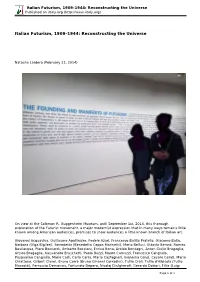
Italian Futurism, 1909–1944: Reconstructing the Universe Published on iItaly.org (http://www.iitaly.org) Italian Futurism, 1909–1944: Reconstructing the Universe Natasha Lardera (February 21, 2014) On view at the Solomon R. Guggenheim Museum, until September 1st, 2014, this thorough exploration of the Futurist movement, a major modernist expression that in many ways remains little known among American audiences, promises to show audiences a little known branch of Italian art. Giovanni Acquaviva, Guillaume Apollinaire, Fedele Azari, Francesco Balilla Pratella, Giacomo Balla, Barbara (Olga Biglieri), Benedetta (Benedetta Cappa Marinetti), Mario Bellusi, Ottavio Berard, Romeo Bevilacqua, Piero Boccardi, Umberto Boccioni, Enrico Bona, Aroldo Bonzagni, Anton Giulio Bragaglia, Arturo Bragaglia, Alessandro Bruschetti, Paolo Buzzi, Mauro Camuzzi, Francesco Cangiullo, Pasqualino Cangiullo, Mario Carli, Carlo Carra, Mario Castagneri, Giannina Censi, Cesare Cerati, Mario Chiattone, Gilbert Clavel, Bruno Corra (Bruno Ginanni Corradini), Tullio Crali, Tullio d’Albisola (Tullio Mazzotti), Ferruccio Demanins, Fortunato Depero, Nicolaj Diulgheroff, Gerardo Dottori, Fillia (Luigi Page 1 of 3 Italian Futurism, 1909–1944: Reconstructing the Universe Published on iItaly.org (http://www.iitaly.org) Colombo), Luciano Folgore (Omero Vecchi), Corrado Govoni, Virgilio Marchi, Filippo Tommaso Marinetti, Alberto Martini, Pino Masnata, Filippo Masoero, Angiolo Mazzoni, Torido Mazzotti, Alberto Montacchini, Nelson Morpurgo, Bruno Munari, N. Nicciani, Vinicio Paladini -

Trento, Bilbao, Finnish Region and Novi Sad Environment V1
Ref. Ares(2016)7134000 - 22/12/2016 A neW concept of pubLic administration based on citizen co-created mobile urban services Grant Agreement: 645845 D3.5 – TRENTO, BILBAO, FINNISH REGION AND NOVI SAD ENVIRONMENT V1 DOC. REFERENCE: WeLive-WP3-D35-REP-211206-v10 RESPONSIBLE: FBK AUTHOR(S): ENG, TECNALIA, UDEUSTO, FBK, CNS, INF, DNET, TRENTO, LAUREA, EUROHELP DATE OF ISSUE: 21/12/16 STATUS: FINAL DISSEMINATION LEVEL: PUBLIC VERSION DATE DESCRIPTION v0.1 11/08/2016 Definition of the Table of Contents and distribution of tasks v0.2 08/11/2016 Contributions from all partners v0.3 29/11/2016 Final version ready to be externally reviewed by BILBAO and TRENTO v1.0 21/12/2016 Reviewers´ comments processed and accepted version submission. INDEX 1. EXECUTIVE SUMMARY............................................................................................................................................. 6 2. INTRODUCTION ....................................................................................................................................................... 7 3. COMMON ENVIRONMENT FOR ALL WELIVE PILOTS ................................................................................................ 9 4. TRENTO ENVIRONMENT ........................................................................................................................................ 10 4.1. PROCESS FOLLOWED IN TRENTO FOR PLATFORM POPULATION ......................................................................... 10 4.1.1. Phase 1 - Stakeholders Consultation Process -
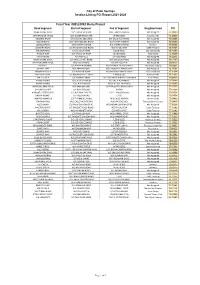
5 Year Slurry Outlook As of 2021.Xlsx
City of Palm Springs Section Listing PCI Report 2021-2026 Fiscal Year 2021/2022 Slurry Project Road Segment Start of Segment End of Segment Neighborhood PCI DINAH SHORE DRIVE W/S CROSSLEY ROAD WEST END OF BRIDGE Not Assigned 75.10000 SNAPDRAGON CIRCLE W/S GOLDENROD LANE W END (CDS) Andreas Hills 75.10000 ANDREAS ROAD E/S CALLE EL SEGUNDO E/S CALLE ALVARADO Not Assigned 75.52638 DILLON ROAD 321'' W/O MELISSA ROAD W/S KAREN AVENUE Not Assigned 75.63230 LOUELLA ROAD S/S LIVMOR AVENUE N/S ANDREAS ROAD Sunmor 75.66065 LEONARD ROAD S/S RACQUET CLUB ROAD N/S VIA OLIVERA Little Tuscany 75.70727 SONORA ROAD E/S EL CIELO ROAD E END (CDS) Los Compadres 75.71757 AMELIA WAY W/S PASEO DE ANZA W END (CDS) Vista Norte 75.78306 TIPTON ROAD N/S HWY 111 S/S RAILROAD Not Assigned 76.32931 DINAH SHORE DRIVE E/S SAN LUIS REY ROAD W/S CROSSLEY ROAD Not Assigned 76.57559 AVENIDA CABALLEROS N/S VISTA CHINO N/S VIA ESCUELA Not Assigned 76.60579 VIA EYTEL E/S AVENIDA PALMAS W/S AVENDA PALOS VERDES The Movie Colony 76.68892 SUNRISE WAY N/S ARENAS ROAD S/S TAHQUITZ CANYON WAY Not Assigned 76.74161 HERMOSA PLACE E/S MISSION ROAD W/S N PALM CANYON DRIVE Old Las Palmas 76.75654 HILLVIEW COVE E/S ANDREAS HILLS DRIVE E END (CSD) Andreas Hills 76.77835 VIA ESCUELA E/S FARRELL DRIVE 130'' E/O WHITEWATER CLUB DRIVE Gene Autry 76.80916 AMADO ROAD E/S CALLE SEGUNDO E/S CALLE ALVARADO Not Assigned 77.54599 AMADO ROAD E/S CALLE ENCILIA W/S CALLE EL SEGUNDO Not Assigned 77.54599 AVENIDA CABALLEROS N/S RAMON ROAD S/S TAHQUITZ CANYON WAY Not Assigned 77.57757 DOLORES COURT LOS -

The Crust (239) 244-8488
8004 TRAIL BLVD THECRUSTPIZZA.NET NAPLES, FL 34108 THE CRUST (239) 244-8488 At The Crust we are committed to providing our guests with delicious food in a clean and friendly environment. Our food is MADE FROM SCRATCH for every order from ingredients that we prepare FRESH in our kitchen EACH DAY. PIZZA Prepared Using Our SIGNATURE HOUSE-MADE Dough – Thin, Crispy, and LIGHTLY SAUCED BUILD YOUR OWN 10 INCH 13 INCH 16 INCH * 12 INCH GLUTEN FREE Cheese .................................. 12.95 Cheese .................................. 16.95 Cheese ................................. 21.75 Cheese .................................. 17.95 Add Topping ......................... 1.10 Add Topping ......................... 2.20 Add Topping ......................... 2.80 Add Topping ......................... 2.20 TOPPINGS SAUCE CHEESE MEAT VEGGIES Marinara Provolone Pepperoni Mushrooms Black Olives Artichokes BBQ Feta Sausage Red Onions Green Olives Garlic Olive Oil Smoked Gouda Meatballs Tomatoes Kalamata Olives Spinach Pesto Gorgonzola Ham Green Peppers Pineapple Cilantro Bacon Banana Peppers Pickled Jalapeños Basil Grilled Chicken Caramelized Onions Anchovies SPECIALTIES 10 INCH ......13 INCH ......16 INCH .........*GF PALERMO .................................................................................................................................................................... 14.95 .......... 19.95 ........ 27.25 ........ 22.95 Olive Oil, Fresh Garlic, Provolone, Parmesan, Gorgonzola, Caramelized Onions BBQ .............................................................................................................................................................................. -

Martin Huber
Martin Huber Department of Economics, University of Fribourg, Bd. de Pérolles 90, CH-1700 Fribourg, Switzerland Telephone: +41 26 300 82 74 E-mail: martin.huber@unifr.ch Fax: +41 26 300 96 78 Date and place of birth: May 06 1980 in Innsbruck, Austria; nationality: Austrian Research interests Policy/treatment effect evaluation in labor, health, and education economics, semi- and nonparametric microeconometric methods for causal inference, machine learning. Academic positions Since 09/2014 University of Fribourg Professor, Chair of Applied Econometrics - Evaluation of Public Policies 02/2010-08/2014 University of St. Gallen Assistant professor of quantitative methods in economics 09/2011-05/2012 Harvard University Visiting researcher (scientific sponsor: Prof. Guido Imbens) 04/2006 -01/2010 Swiss Institute for Empirical Economic Research, University of St. Gallen Research assistant to Prof. Michael Lechner Further work experience 04/2004-03/2006 Employed in private sector companies: Swarovski Crystal Components (strategic marketing) and Transped International (transport logistics) Education 04/2006-01/2010 Ph.D. in Economics and Finance; University of St. Gallen, Switzerland Summa cum laude/with distinction. Specialization: Econometrics; thesis: "Microeconometric Estima- tors and Tests based on Nonparametric Methods, Quantile Regression, and Resampling"; referees: Profs. Michael Lechner, Enno Mammen, and Francesco Audrino 10/1999-02/2004 M.A.s in Economics and in International Business Studies (Mag.rer.soc.oec.); University of Inns- bruck, Austria 09/2001 - 04/2002 Ecole Supérieure de Commerce, Grenoble, France : Erasmus study abroad program Awards and grants 04/2018 Economicus 2017 prize by the foundation “Nadácia VÚB” (Slovakia) for economists below 40 awarded for the joint paper with Lukáš Lafférs and Giovanni Mellace “Sharp IV Bounds on Average Treatment Effects on the Treated and other Populations under Endogeneity and Noncompliance”. -

Thank You All
Thank You All Bernard van Leer Foundation Bertelsmann Vodafone Greece Big Heart Foundation Bestseller Vorwerk We can only accomplish what we do for children, young Canada Feminist Fund British Telecom Western Union Foundation people and families thanks to the generosity, creativity and Dutch Postcode Lottery CEWE White & Case commitment of partners. Partners, both international and Edith & Gotfred Kirk Clarins local, support our ongoing running costs and many of our Fondation de France Deutsche Post DHL Group OTHER PARTNERSHIPS innovative projects. We say thank you to those listed here Fondation de Luxembourg Dr. August Oetker and to the many thousands of other partners who make Grieg Foundation Dufry Group Accountable Now our work possible. Hellenic American Leadership Council Ecoembes Better Care Network Hempel Foundation Fleckenstein Jeanswear Child Rights Connect Institute Circle Foundation 4Life Children’s Rights Action Group Intesa Bank Charity Fund Gekås Ullared Civil Society in Development (CISU) Maestro Cares Foundation GodEl / GoodCause CONCORD INTERGOVERNMENTAL & Government of Germany National Lottery Community Fund Hasbro European Council on Refugees and GOVERNMENTAL PARTNERS Ministry of Foreign Affairs (AA) Novo Nordisk Foundation Herbalife Nutrition Foundation Exiles (ECRE) Federal Ministry for Economic OAK Foundation Hilti EDUCO (International NGO Cooperation Government of Austria Cooperation and Development (BMZ) Obel Family Foundation HSBC for Children) Austrian Development Agency (ADA) Government of Iceland Stiftelsen -

Italian Villas and Their Gardens
Italian Villas and Their Gardens By Edith Wharton INTRODUCTION ITALIAN GARDEN-MAGIC Though it is an exaggeration to say that there are no flowers in Italian gardens, yet to enjoy and appreciate the Italian garden-craft one must always bear in mind that it is independent of floriculture. The Italian garden does not exist for its flowers; its flowers exist for it: they are a late and infrequent adjunct to its beauties, a parenthetical grace counting only as one more touch in the general effect of enchantment. This is no doubt partly explained by the difficulty of cultivating any but spring flowers in so hot and dry a climate, and the result has been a wonderful development of the more permanent effects to be obtained from the three other factors in garden-composition—marble, water and perennial verdure—and the achievement, by their skilful blending, of a charm independent of the seasons. It is hard to explain to the modern garden-lover, whose whole conception of the charm of gardens is formed of successive pictures of flower-loveliness, how this effect of enchantment can be produced by anything so dull and monotonous as a mere combination of clipped green and stonework. The traveller returning from Italy, with his eyes and imagination full of the ineffable Italian garden-magic, knows vaguely that the enchantment exists; that he has been under its spell, and that it is more potent, more enduring, more intoxicating to every sense than the most elaborate and glowing effects of modern horticulture; but he may not have found the key to the mystery. -

From Settler Colonies to Black Utopias: the Dialectics of American Architecture in Black and White
University at Buffalo, SUNY | School of Architecture and Planning ACSA DIVERSITY ACHIEVEMENT AWARD From Settler Colonies to Black Utopias: The Dialectics of American Architecture in Black and White Statement: The attached dossier outlines the range of activities the candidate (Charles L. Davis II) engaged during the 2019-20 academic year to promote racial equity and social justice within the discipline of architecture. These activities include publishing two academic books on race and architecture, hosting a symposium on the whiteness of American architectural history, serving on the advisory board of the Society of Architectural Historians to foster an affiliate group for people of color, and teaching new courses on race and architecture within a professional architecture program. Davis’ academic research is propelled by the dialectic established between the critique of whiteness in the disciplinary norms of Euroamerican architecture and a recovery of blackness in the historical contributions of people of color to modern architecture culture. In a general sense, Davis explores the former in academically peer-reviewed studies and the latter in experimental design courses and architectural criticism. Davis specializes in the historical integrations of race and style theory established within the paradigm of architectural organicism, or the philosophy of making that purported to translate the generative laws of nature into a rational process of design. During the nineteenth century, the notion that buildings possessed character provided architects with a lens for relating the buildings they designed to the populations they served. Davis argues that the exclusively white racial character of many canonical “American architecture” movements constitutes a material form of white cultural nationalism that rhetorically policed the boundaries of the American body politic.