Southwestern Cienegas: Rare Habitats For
Total Page:16
File Type:pdf, Size:1020Kb
Load more
Recommended publications
-

"National List of Vascular Plant Species That Occur in Wetlands: 1996 National Summary."
Intro 1996 National List of Vascular Plant Species That Occur in Wetlands The Fish and Wildlife Service has prepared a National List of Vascular Plant Species That Occur in Wetlands: 1996 National Summary (1996 National List). The 1996 National List is a draft revision of the National List of Plant Species That Occur in Wetlands: 1988 National Summary (Reed 1988) (1988 National List). The 1996 National List is provided to encourage additional public review and comments on the draft regional wetland indicator assignments. The 1996 National List reflects a significant amount of new information that has become available since 1988 on the wetland affinity of vascular plants. This new information has resulted from the extensive use of the 1988 National List in the field by individuals involved in wetland and other resource inventories, wetland identification and delineation, and wetland research. Interim Regional Interagency Review Panel (Regional Panel) changes in indicator status as well as additions and deletions to the 1988 National List were documented in Regional supplements. The National List was originally developed as an appendix to the Classification of Wetlands and Deepwater Habitats of the United States (Cowardin et al.1979) to aid in the consistent application of this classification system for wetlands in the field.. The 1996 National List also was developed to aid in determining the presence of hydrophytic vegetation in the Clean Water Act Section 404 wetland regulatory program and in the implementation of the swampbuster provisions of the Food Security Act. While not required by law or regulation, the Fish and Wildlife Service is making the 1996 National List available for review and comment. -

The Vascular Plants of Massachusetts
The Vascular Plants of Massachusetts: The Vascular Plants of Massachusetts: A County Checklist • First Revision Melissa Dow Cullina, Bryan Connolly, Bruce Sorrie and Paul Somers Somers Bruce Sorrie and Paul Connolly, Bryan Cullina, Melissa Dow Revision • First A County Checklist Plants of Massachusetts: Vascular The A County Checklist First Revision Melissa Dow Cullina, Bryan Connolly, Bruce Sorrie and Paul Somers Massachusetts Natural Heritage & Endangered Species Program Massachusetts Division of Fisheries and Wildlife Natural Heritage & Endangered Species Program The Natural Heritage & Endangered Species Program (NHESP), part of the Massachusetts Division of Fisheries and Wildlife, is one of the programs forming the Natural Heritage network. NHESP is responsible for the conservation and protection of hundreds of species that are not hunted, fished, trapped, or commercially harvested in the state. The Program's highest priority is protecting the 176 species of vertebrate and invertebrate animals and 259 species of native plants that are officially listed as Endangered, Threatened or of Special Concern in Massachusetts. Endangered species conservation in Massachusetts depends on you! A major source of funding for the protection of rare and endangered species comes from voluntary donations on state income tax forms. Contributions go to the Natural Heritage & Endangered Species Fund, which provides a portion of the operating budget for the Natural Heritage & Endangered Species Program. NHESP protects rare species through biological inventory, -

Bulletin / New York State Museum
Juncaceae (Rush Family) of New York State Steven E. Clemants New York Natural Heritage Program LIBRARY JUL 2 3 1990 NEW YORK BOTANICAL GARDEN Contributions to a Flora of New York State VII Richard S. Mitchell, Editor Bulletin No. 475 New York State Museum The University of the State of New York THE STATE EDUCATION DEPARTMENT Albany, New York 12230 NEW YORK THE STATE OF LEARNING Digitized by the Internet Archive in 2017 with funding from IMLS LG-70-15-0138-15 https://archive.org/details/bulletinnewyorks4751 newy Juncaceae (Rush Family) of New York State Steven E. Clemants New York Natural Heritage Program Contributions to a Flora of New York State VII Richard S. Mitchell, Editor 1990 Bulletin No. 475 New York State Museum The University of the State of New York THE STATE EDUCATION DEPARTMENT Albany, New York 12230 THE UNIVERSITY OF THE STATE OF NEW YORK Regents of The University Martin C. Barell, Chancellor, B.A., I. A., LL.B Muttontown R. Carlos Carballada, Vice Chancellor , B.S Rochester Willard A. Genrich, LL.B Buffalo Emlyn 1. Griffith, A. B., J.D Rome Jorge L. Batista, B. A., J.D Bronx Laura Bradley Chodos, B.A., M.A Vischer Ferry Louise P. Matteoni, B.A., M.A., Ph.D Bayside J. Edward Meyer, B.A., LL.B Chappaqua Floyd S. Linton, A.B., M.A., M.P.A Miller Place Mimi Levin Lieber, B.A., M.A Manhattan Shirley C. Brown, B.A., M.A., Ph.D Albany Norma Gluck, B.A., M.S.W Manhattan James W. -

Conocimiento Tradicional De Plantas Silvestres En Una Comunidad De Los Valles Centrales De Oaxaca1
Artículo de revisión ISSN: 2007-9559 Revista Mexicana de Agroecosistemas Vol. 5(1): 55-78, 2018 CONOCIMIENTO TRADICIONAL DE PLANTAS SILVESTRES EN UNA COMUNIDAD DE LOS VALLES CENTRALES DE OAXACA1 [TRADITIONAL KNOWLEDGE OF WILD PLANTS IN A TOWN FROM CENTRAL VALLEYS OF OAXACA] Angel Alfonso Arrazola-Guendulay1§, Ernesto Hernández-Santiago2, Gerardo Rodríguez-Ortiz2 1Licenciatura en Biología-Instituto Tecnológico del Valle de Oaxaca (ITVO). Ex Hacienda de Nazareno, Xoxocotlán. Oaxaca. C.P. 71233. 2Profesor-Investigador, ITVO. §Autor para correspondencia: (arrazola.03@gmail.com) RESUMEN El conocimiento del uso de las plantas es el resultado de la interacción de una sociedad con la naturaleza a través de los años que ha sido transmitido por generaciones. Durante 2016-2017 se realizó un estudio etnobotánico en Ayoquezco de Aldama, Oaxaca, con el objetivo de documentar los saberes y manejo de la flora silvestre. Para registrar la información se aplicaron entrevistas semiestructuradas (n = 50, dirigido a curanderos, personas de la tercera edad, cocineras, últimos mayordomos, comerciantes y conocedores del bosque). Los datos fueron clasificados en nueve categorías de uso y analizados con estadística no paramétrica. Se proporciona además revisión bibliográfica exahustiva del conocimiento tradicional de la flora. El uso más frecuente en número de especies fue el medicinal (29.1%) y con mayor mención el alimenticio (21.2%). Se identificó un total de 200 plantas de las 209 con algún registro etnobotánico, agrupadas en 62 familias y 145 géneros. La familia con mayor frecuencia fue Asteraceae con el 15.5%. Se encontraron cuatro especies incluidas en alguna categoría de riesgo según la NOM-059-SEMARNAT-2010; Brahea nitida (Protección especial), Tillandsia carlos- hankii (Amenazada), Juglans major var glabrata (Amenazada) y Litsea glaucescens (Peligro de extinción). -
Pima County Plant List (2020) Common Name Exotic? Source
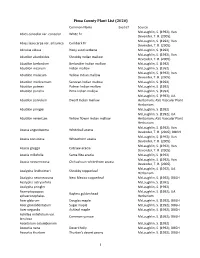
Pima County Plant List (2020) Common Name Exotic? Source McLaughlin, S. (1992); Van Abies concolor var. concolor White fir Devender, T. R. (2005) McLaughlin, S. (1992); Van Abies lasiocarpa var. arizonica Corkbark fir Devender, T. R. (2005) Abronia villosa Hariy sand verbena McLaughlin, S. (1992) McLaughlin, S. (1992); Van Abutilon abutiloides Shrubby Indian mallow Devender, T. R. (2005) Abutilon berlandieri Berlandier Indian mallow McLaughlin, S. (1992) Abutilon incanum Indian mallow McLaughlin, S. (1992) McLaughlin, S. (1992); Van Abutilon malacum Yellow Indian mallow Devender, T. R. (2005) Abutilon mollicomum Sonoran Indian mallow McLaughlin, S. (1992) Abutilon palmeri Palmer Indian mallow McLaughlin, S. (1992) Abutilon parishii Pima Indian mallow McLaughlin, S. (1992) McLaughlin, S. (1992); UA Abutilon parvulum Dwarf Indian mallow Herbarium; ASU Vascular Plant Herbarium Abutilon pringlei McLaughlin, S. (1992) McLaughlin, S. (1992); UA Abutilon reventum Yellow flower Indian mallow Herbarium; ASU Vascular Plant Herbarium McLaughlin, S. (1992); Van Acacia angustissima Whiteball acacia Devender, T. R. (2005); DBGH McLaughlin, S. (1992); Van Acacia constricta Whitethorn acacia Devender, T. R. (2005) McLaughlin, S. (1992); Van Acacia greggii Catclaw acacia Devender, T. R. (2005) Acacia millefolia Santa Rita acacia McLaughlin, S. (1992) McLaughlin, S. (1992); Van Acacia neovernicosa Chihuahuan whitethorn acacia Devender, T. R. (2005) McLaughlin, S. (1992); UA Acalypha lindheimeri Shrubby copperleaf Herbarium Acalypha neomexicana New Mexico copperleaf McLaughlin, S. (1992); DBGH Acalypha ostryaefolia McLaughlin, S. (1992) Acalypha pringlei McLaughlin, S. (1992) Acamptopappus McLaughlin, S. (1992); UA Rayless goldenhead sphaerocephalus Herbarium Acer glabrum Douglas maple McLaughlin, S. (1992); DBGH Acer grandidentatum Sugar maple McLaughlin, S. (1992); DBGH Acer negundo Ashleaf maple McLaughlin, S. -

State of Colorado 2016 Wetland Plant List
5/12/16 State of Colorado 2016 Wetland Plant List Lichvar, R.W., D.L. Banks, W.N. Kirchner, and N.C. Melvin. 2016. The National Wetland Plant List: 2016 wetland ratings. Phytoneuron 2016-30: 1-17. Published 28 April 2016. ISSN 2153 733X http://wetland-plants.usace.army.mil/ Aquilegia caerulea James (Colorado Blue Columbine) Photo: William Gray List Counts: Wetland AW GP WMVC Total UPL 83 120 101 304 FACU 440 393 430 1263 FAC 333 292 355 980 FACW 342 329 333 1004 OBL 279 285 285 849 Rating 1477 1419 1504 1511 User Notes: 1) Plant species not listed are considered UPL for wetland delineation purposes. 2) A few UPL species are listed because they are rated FACU or wetter in at least one Corps Region. 3) Some state boundaries lie within two or more Corps Regions. If a species occurs in one region but not the other, its rating will be shown in one column and the other column will be BLANK. Approved for public release; distribution is unlimited. 1/22 5/12/16 Scientific Name Authorship AW GP WMVC Common Name Abies bifolia A. Murr. FACU FACU Rocky Mountain Alpine Fir Abutilon theophrasti Medik. UPL UPL FACU Velvetleaf Acalypha rhomboidea Raf. FACU FACU Common Three-Seed-Mercury Acer glabrum Torr. FAC FAC FACU Rocky Mountain Maple Acer grandidentatum Nutt. FACU FAC FACU Canyon Maple Acer negundo L. FACW FAC FAC Ash-Leaf Maple Acer platanoides L. UPL UPL FACU Norw ay Maple Acer saccharinum L. FAC FAC FAC Silver Maple Achillea millefolium L. FACU FACU FACU Common Yarrow Achillea ptarmica L. -
SFRC T-593 Phenology of Flowering and Fruiting
Report T-593 Phenology of Flowering an Fruiting In Pia t Com unities of Everglades NP and Biscayne N , orida RESOURCE MANAGEMENT EVERGLi\DES NATIONAL PARK BOX 279 NOMESTEAD, FLORIDA 33030 Everglades National Park, South Florida Research Center, P.O. Box 279, Homestead, Florida 33030 PHENOLOGY OF FLOWERING AND FRUITING IN PLANT COMMUNITIES OF EVERGLADES NATIONAL PARK AND BISCAYNE NATIONAL MONUMENT, FLORIDA Report T - 593 Lloyd L. Loope U.S. National P ark Service South Florida Research Center Everglades National Park Homestead, Florida 33030 June 1980 Loope, Lloyd L. 1980. Phenology of Flowering and Fruiting in Plant Communities of Everglades National Park and Biscayne National Monument, Florida. South Florida Research Center Report T - 593. 50 pp. TABLE OF CONTENTS LIST OF TABLES • ii LIST OF FIGU RES iv INTRODUCTION • 1 ACKNOWLEDGEMENTS. • 1 METHODS. • • • • • • • 1 CLIMATE AND WATER LEVELS FOR 1978 •• . 3 RESULTS ••• 3 DISCUSSION. 3 The need and mechanisms for synchronization of reproductive activity . 3 Tropical hardwood forest. • • 5 Freshwater wetlands 5 Mangrove vegetation 6 Successional vegetation on abandoned farmland. • 6 Miami Rock Ridge pineland. 7 SUMMARY ••••• 7 LITERATURE CITED 8 i LIST OF TABLES Table 1. Climatic data for Homestead Experiment Station, 1978 . • . • . • . • . • . • . 10 Table 2. Climatic data for Tamiami Trail at 40-Mile Bend, 1978 11 Table 3. Climatic data for Flamingo, 1978. • • • • • • • • • 12 Table 4. Flowering and fruiting phenology, tropical hardwood hammock, area of Elliott Key Marina, Biscayne National Monument, 1978 • • • • • • • • • • • • • • • • • • 14 Table 5. Flowering and fruiting phenology, tropical hardwood hammock, Bear Lake Trail, Everglades National Park (ENP), 1978 • . • . • . 17 Table 6. Flowering and fruiting phenology, tropical hardwood hammock, Mahogany Hammock, ENP, 1978. -

Richard Chinn Environmental Training, Inc. Info
Scientific Name Common Name Region 6 Habit Scientific Name Common Name Region 6 Habit Abies balsamea FIR,BALSAM FACW NT Amaranthus californicus AMARANTH,CALIFORNIA NI ANF Abutilon theophrasti VELVET-LEAF NI AIF Amaranthus crassipes AMARANTH,TROPICAL FAC+ AIF Acacia greggii ACACIA,CATCLAW UPL NST Amaranthus greggii AMARANTH,GREGGIS FAC ANF Acacia smallii HUISACHE FACU NTS Amaranthus obcordatus AMARANTH,TRANS PECOS NI ANF Acalypha rhomboidea COPPER-LEAF,COMMON UPL* ANF Amaranthus palmeri AMARANTH,PALMER'S FACU- ANF Acalypha virginica MERCURY,THREE-SEEDED UPL* ANF Amaranthus retroflexus AMARANTH,RED-ROOT FACU- ANF Acer negundo BOX-ELDER FACW- NT Amaranthus rudis AMARANTH,TALL FAC ANF Acer rubrum MAPLE,DRUMMOND RED FACW NT Amaranthus spinosus AMARANTH,SPINY FACU- ANF Acer rubrum MAPLE,TRIDENT RED NI NT Amaranthus tuberculatus AMARANTH,ROUGH-FRUIT NI ANF Acer rubrum MAPLE,RED FAC NT Ambrosia artemisiifolia RAGWEED,ANNUAL FACU- ANF Acer saccharinum MAPLE,SILVER FAC NT Ambrosia grayi BURSAGE,WOOLLY-LEAF FACW PNF Acer saccharum MAPLE,SUGAR UPL NT Ambrosia psilostachya RAGWEED,NAKED-SPIKE FAC- PNF Achillea millefolium YARROW,COMMON FACU PNF Ambrosia trifida RAGWEED,GREAT FAC ANF Acorus calamus SWEETFLAG OBL PIEF Amelanchier alnifolia SERVICE-BERRY,SASKATOON FAC- NS Adiantum capillus-veneris FERN,SOUTHERN MAIDEN-HAIR FACW+ PNF3 Amelanchier arborea SERVICE-BERRY,DOWNY FACU NT Adiantum pedatum FERN,NORTHERN MAIDEN-HAIR FAC PNF3 Amianthium muscaetoxicum FLYPOISON FAC PNF Adiantum tricholepis FERN,HAIRY MAIDEN-HAIR FAC PNF3 Ammannia auriculata AMMANNIA,RED-STEM -
Chromosome Numbers in Compositae, XII: Heliantheae
SMITHSONIAN CONTRIBUTIONS TO BOTANY 0 NCTMBER 52 Chromosome Numbers in Compositae, XII: Heliantheae Harold Robinson, A. Michael Powell, Robert M. King, andJames F. Weedin SMITHSONIAN INSTITUTION PRESS City of Washington 1981 ABSTRACT Robinson, Harold, A. Michael Powell, Robert M. King, and James F. Weedin. Chromosome Numbers in Compositae, XII: Heliantheae. Smithsonian Contri- butions to Botany, number 52, 28 pages, 3 tables, 1981.-Chromosome reports are provided for 145 populations, including first reports for 33 species and three genera, Garcilassa, Riencourtia, and Helianthopsis. Chromosome numbers are arranged according to Robinson’s recently broadened concept of the Heliantheae, with citations for 212 of the ca. 265 genera and 32 of the 35 subtribes. Diverse elements, including the Ambrosieae, typical Heliantheae, most Helenieae, the Tegeteae, and genera such as Arnica from the Senecioneae, are seen to share a specialized cytological history involving polyploid ancestry. The authors disagree with one another regarding the point at which such polyploidy occurred and on whether subtribes lacking higher numbers, such as the Galinsoginae, share the polyploid ancestry. Numerous examples of aneuploid decrease, secondary polyploidy, and some secondary aneuploid decreases are cited. The Marshalliinae are considered remote from other subtribes and close to the Inuleae. Evidence from related tribes favors an ultimate base of X = 10 for the Heliantheae and at least the subfamily As teroideae. OFFICIALPUBLICATION DATE is handstamped in a limited number of initial copies and is recorded in the Institution’s annual report, Smithsonian Year. SERIESCOVER DESIGN: Leaf clearing from the katsura tree Cercidiphyllumjaponicum Siebold and Zuccarini. Library of Congress Cataloging in Publication Data Main entry under title: Chromosome numbers in Compositae, XII. -

C6 Noncarice Sedge
CYPERACEAE etal Got Sedge? Part Two revised 24 May 2015. Draft from Designs On Nature; Up Your C 25 SEDGES, FOINS COUPANTS, LAÎCHES, ROUCHES, ROUCHETTES, & some mostly wet things in the sedge family. Because Bill Gates has been shown to eat footnotes (burp!, & enjoy it), footnotes are (italicized in the body of the text) for their protection. Someone who can spell caespitose only won way has know imagination. Much of the following is taken verbatim from other works, & often not credited. There is often not a way to paraphrase or rewrite habitat or descriptive information without changing the meaning. I am responsible for any mistakes in quoting or otherwise. This is a learning tool, & a continuation of an idea of my friend & former employer, Jock Ingels, LaFayette Home Nursery, who hoped to present more available information about a plant in one easily accessible place, instead of scattered though numerous sources. This is a work in perpetual progress, a personal learning tool, full uv misstakes, & written as a personal means instead of a public end. Redundant, repetitive, superfluous, & contradictory information is present. It is being consolidated. CYPERACEAE Sauergrasgewächse SEDGES, aka BIESIES, SEGGEN Formally described in 1789 by De Jussieu. The family name is derived from the genus name Cyperus, from the Greek kupeiros, meaning sedge. Many species are grass-like, being tufted, with long, thin, narrow leaves, jointed stems, & branched inflorescence of small flowers, & are horticulturally lumped with grasses as graminoids. Archer (2005) suggests the term graminoid be used for true grasses, & cyperoid be used for sedges. (If physical anthropologists have hominoids & hominids, why don’t we have graminoids & graminids?) There are approximately 104 genera, 4 subfamilies, 14 tribes, & about 5000 species worldwide, with 27 genera & 843 species in North America (Ball et al 2002). -

National Wetlands Inventory Map Report for Quinault Indian Nation
National Wetlands Inventory Map Report for Quinault Indian Nation Project ID(s): R01Y19P01: Quinault Indian Nation, fiscal year 2019 Project area The project area (Figure 1) is restricted to the Quinault Indian Nation, bounded by Grays Harbor Co. Jefferson Co. and the Olympic National Park. Appendix A: USGS 7.5-minute Quadrangles: Queets, Salmon River West, Salmon River East, Matheny Ridge, Tunnel Island, O’Took Prairie, Thimble Mountain, Lake Quinault West, Lake Quinault East, Taholah, Shale Slough, Macafee Hill, Stevens Creek, Moclips, Carlisle. • < 0. Figure 1. QIN NWI+ 2019 project area (red outline). Source Imagery: Citation: For all quads listed above: See Appendix A Citation Information: Originator: USDA-FSA-APFO Aerial Photography Field Office Publication Date: 2017 Publication place: Salt Lake City, Utah Title: Digital Orthoimagery Series of Washington Geospatial_Data_Presentation_Form: raster digital data Other_Citation_Details: 1-meter and 1-foot, Natural Color and NIR-False Color Collateral Data: . USGS 1:24,000 topographic quadrangles . USGS – NHD – National Hydrography Dataset . USGS Topographic maps, 2013 . QIN LiDAR DEM (3 meter) and synthetic stream layer, 2015 . Previous National Wetlands Inventories for the project area . Soil Surveys, All Hydric Soils: Weyerhaeuser soil survey 1976, NRCS soil survey 2013 . QIN WET tables, field photos, and site descriptions, 2016 to 2019, Janice Martin, and Greg Eide Inventory Method: Wetland identification and interpretation was done “heads-up” using ArcMap versions 10.6.1. US Fish & Wildlife Service (USFWS) National Wetlands Inventory (NWI) mapping contractors in Portland, Oregon completed the original aerial photo interpretation and wetland mapping. Primary authors: Nicholas Jones of SWCA Environmental Consulting. 100% Quality Control (QC) during the NWI mapping was provided by Michael Holscher of SWCA Environmental Consulting. -

Illinois Bundleflower (Desmanthus Illinoensis) Story by Alan Shadow, Manager USDA-NRCS East Texas Plant Materials Center Nacogdoches, Texas
Helping People Help The Land September/October 2011 Issue No. 11 The Reverchon Naturalist Recognizing the work of French botanist Julien Reverchon, who began collecting throughout the North Central Texas area in 1876, and all the botanists/naturalists who have followed ... Drought, Heat and Native Trees ranging from simple things like more extensive root systems, to more drastic measures like pre- Story by Bruce Kreitler mature defoliation, what they actually have little Abilene, Texas defense against is a very prolonged period of no appreciable water supply. nybody that has traveled in Texas this year A will have noticed that not only most of the By the way, even though they are usually the land browned out, but also if you look at the trees same species, there is a difference in landscape in the fields and beside the roads, they aren't trees and native trees, which are untended plants looking so good either. It doesn't take a rocket that have to fend for themselves. While they are scientist to realize that extreme high temperatures indeed the same basic trees, the differences be- combined with, and partially caused by, drought tween the environments that they live in are huge are hard on trees. and thus overall general environmental factors such as drought, temperature, and insect infesta- Since I'm pretty sure that most of the people read- tions act on them differently. For the purposes of ing this article understand very well that drought this article, I'm referring to trees that are on their is a problem for trees, the question isn't is the pre- own, untended for their entire lives in fields, pas- sent drought going to have an effect on trees, but tures, forests, or just wherever nature has placed rather, what are the present effects of the drought them and refer to them as native trees.