Catalogue of Palearctic Hydrophiloidea (Coleoptera)
Total Page:16
File Type:pdf, Size:1020Kb
Load more
Recommended publications
-
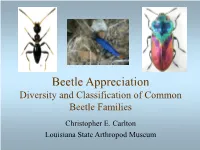
Beetle Appreciation Diversity and Classification of Common Beetle Families Christopher E
Beetle Appreciation Diversity and Classification of Common Beetle Families Christopher E. Carlton Louisiana State Arthropod Museum Coleoptera Families Everyone Should Know (Checklist) Suborder Adephaga Suborder Polyphaga, cont. •Carabidae Superfamily Scarabaeoidea •Dytiscidae •Lucanidae •Gyrinidae •Passalidae Suborder Polyphaga •Scarabaeidae Superfamily Staphylinoidea Superfamily Buprestoidea •Ptiliidae •Buprestidae •Silphidae Superfamily Byrroidea •Staphylinidae •Heteroceridae Superfamily Hydrophiloidea •Dryopidae •Hydrophilidae •Elmidae •Histeridae Superfamily Elateroidea •Elateridae Coleoptera Families Everyone Should Know (Checklist, cont.) Suborder Polyphaga, cont. Suborder Polyphaga, cont. Superfamily Cantharoidea Superfamily Cucujoidea •Lycidae •Nitidulidae •Cantharidae •Silvanidae •Lampyridae •Cucujidae Superfamily Bostrichoidea •Erotylidae •Dermestidae •Coccinellidae Bostrichidae Superfamily Tenebrionoidea •Anobiidae •Tenebrionidae Superfamily Cleroidea •Mordellidae •Cleridae •Meloidae •Anthicidae Coleoptera Families Everyone Should Know (Checklist, cont.) Suborder Polyphaga, cont. Superfamily Chrysomeloidea •Chrysomelidae •Cerambycidae Superfamily Curculionoidea •Brentidae •Curculionidae Total: 35 families of 131 in the U.S. Suborder Adephaga Family Carabidae “Ground and Tiger Beetles” Terrestrial predators or herbivores (few). 2600 N. A. spp. Suborder Adephaga Family Dytiscidae “Predacious diving beetles” Adults and larvae aquatic predators. 500 N. A. spp. Suborder Adephaga Family Gyrindae “Whirligig beetles” Aquatic, on water -

Thorne Moors :A Palaeoecological Study of A
T...o"..e MO<J "S " "",Ae Oe COlOOIC'" S T<.OY OF A e"ONZE AGE slTE - .. "c euc~ , A"O a • n ,• THORNE MOORS :A PALAEOECOLOGICAL STUDY OF A BRONZE AGE SITE A contribution to the history of the British Insect fauna P.c. Buckland, Department of Geography, University of Birmingham. © Authors Copyright ISBN ~o. 0 7044 0359 5 List of Contents Page Introduction 3 Previous research 6 The archaeological evidence 10 The geological sequence 19 The samples 22 Table 1 : Insect remains from Thorne Moors 25 Environmental interpretation 41 Table 2 : Thorne Moors : Trackway site - pollen and spores from sediments beneath peat and from basal peat sample 42 Table 3 Tho~ne Moors Plants indicated by the insect record 51 Table 4 Thorne Moors pollen from upper four samples in Sphagnum peat (to current cutting surface) 64 Discussion : the flooding mechanism 65 The insect fauna : notes on particular species 73 Discussion : man, climate and the British insect fauna 134 Acknowledgements 156 Bibliography 157 List of Figures Frontispiece Pelta grossum from pupal chamber in small birch, Thorne Moors (1972). Age of specimen c. 2,500 B.P. 1. The Humberhead Levels, showing Thorne and Hatfield Moors and the principal rivers. 2 2. Thorne Moors the surface before peat extraction (1975). 5 3. Thorne Moors the same locality after peat cutting (1975). 5 4. Thorne Moors location of sites examined. 9 5. Thorne Moors plan of trackway (1972). 12 6. Thorne Moors trackway timbers exposed in new dyke section (1972) • 15 7. Thorne Moors the trackway and peat succession (1977). -

First Record of a Minute Mud-Loving Beetle of the Family Georissidae (Insecta: Coleoptera: Hydrophiloidea) in Thailand
NAT. HIST. BULL. SIAM SOC. 61(2): 131–133, 2016 First Record of a Minute Mud-loving Beetle of the Family Georissidae (Insecta: Coleoptera: Hydrophiloidea) in Thailand William D. Shepard1 and Robert W. Sites2* The family Georissidae (minute mud-loving beetles) is represented by a single genus, Georissus, which occurs on all continents except Antarctica. However, country records of species of Georissus are scattered. The genus comprises three subgenera (Georissus [Georissus], Georissus [Neogeorissus], and Georissus [Nipponogeorissus]), 80 species, and 2 subspecies (+$16(1/,729.,1 ),.Éÿ(. 2011). Various authors have considered the family as a subfamily within Hydrophilidae; however, current opinion retains family status (6+257 ),.Éÿ(. 2013). Larval, pupal, and adult Georissus are found on damp, sandy shores of lakes and rivers (SHEPARD, 6RPHDGXOWVFDPRXÁDJHWKHPVHOYHVZLWKDFRYHULQJ of sand grains glued to their dorsum (BAMEUL, 1989). Most descriptions of adults are of the external morphology and only a few included a description or illustration of the aedeagus. Larvae have been described by VAN EMDEN (1956), BERTRAND (1972), SPANGLER (1991) and $5&+$1*(/6.< (1997); pupae have been described by BERTRAND (1972) and SHEPARD (2003). The chromosomal karyotype of Georissus crenulatus (Rossi) has been described and illustrated by SHAARAWI & ANGUS (1992), and the life cycle of Georissus californicus LeConte) has been described by SHEPARD (2003). This family is little known because of their small size (many less than 2 mm) and the adults of some taxa conceal themselves with sand and remain still upon disturbance. Although most species are described from a limited number of adults, if a collector takes the time to closely examine sandy shores, the adults can be found. -

Water Beetles
Ireland Red List No. 1 Water beetles Ireland Red List No. 1: Water beetles G.N. Foster1, B.H. Nelson2 & Á. O Connor3 1 3 Eglinton Terrace, Ayr KA7 1JJ 2 Department of Natural Sciences, National Museums Northern Ireland 3 National Parks & Wildlife Service, Department of Environment, Heritage & Local Government Citation: Foster, G. N., Nelson, B. H. & O Connor, Á. (2009) Ireland Red List No. 1 – Water beetles. National Parks and Wildlife Service, Department of Environment, Heritage and Local Government, Dublin, Ireland. Cover images from top: Dryops similaris (© Roy Anderson); Gyrinus urinator, Hygrotus decoratus, Berosus signaticollis & Platambus maculatus (all © Jonty Denton) Ireland Red List Series Editors: N. Kingston & F. Marnell © National Parks and Wildlife Service 2009 ISSN 2009‐2016 Red list of Irish Water beetles 2009 ____________________________ CONTENTS ACKNOWLEDGEMENTS .................................................................................................................................... 1 EXECUTIVE SUMMARY...................................................................................................................................... 2 INTRODUCTION................................................................................................................................................ 3 NOMENCLATURE AND THE IRISH CHECKLIST................................................................................................ 3 COVERAGE ....................................................................................................................................................... -

ACTA ENTOMOLOGICA 59(1): 253–272 MUSEI NATIONALIS PRAGAE Doi: 10.2478/Aemnp-2019-0021
2019 ACTA ENTOMOLOGICA 59(1): 253–272 MUSEI NATIONALIS PRAGAE doi: 10.2478/aemnp-2019-0021 ISSN 1804-6487 (online) – 0374-1036 (print) www.aemnp.eu RESEARCH PAPER Aquatic Coleoptera of North Oman, with description of new species of Hydraenidae and Hydrophilidae Ignacio RIBERA1), Carles HERNANDO2) & Alexandra CIESLAK1) 1) Institute of Evolutionary Biology (CSIC-Universitat Pompeu Fabra), Passeig Maritim de la Barceloneta 37, E-08003 Barcelona, Spain; e-mails: Ignacio.Ribera@ibe.upf-csic.es, a.cieslak@gmx.net 2) P.O. box 118, E-08911 Badalona, Catalonia, Spain; e-mail: leptotyphlus@gmail.com Accepted: Abstract. We report the aquatic Coleoptera (families Dryopidae, Dytiscidae, Georissidae, 10th June 2019 Gyrinidae, Heteroceridae, Hydraenidae, Hydrophilidae and Limnichidae) from North Oman, Published online: mostly based on the captures of fourteen localities sampled by the authors in 2010. Four 24th June 2019 species are described as new, all from the Al Hajar mountains, three in family Hydraenidae, Hydraena (Hydraena) naja sp. nov., Ochthebius (Ochthebius) alhajarensis sp. nov. (O. punc- tatus species group) and O. (O.) bernard sp. nov. (O. metallescens species group); and one in family Hydrophilidae, Agraphydrus elongatus sp. nov. Three of the recorded species are new to the Arabian Peninsula, Hydroglyphus farquharensis (Scott, 1912) (Dytiscidae), Hydraena (Hydraenopsis) quadricollis Wollaston, 1864 (Hydraenidae) and Enochrus (Lumetus) cf. quadrinotatus (Guillebeau, 1896) (Hydrophilidae). Ten species already known from the Arabian Peninsula are newly recorded from Oman: Cybister tripunctatus lateralis (Fabricius, 1798) (Dytiscidae), Hydraena (Hydraena) gattolliati Jäch & Delgado, 2010, Ochthebius (Ochthebius) monseti Jä ch & Delgado 2010, Ochthebius (Ochthebius) wurayah Jäch & Delgado, 2010 (all Hydraenidae), Georissus (Neogeorissus) chameleo Fikáč ek & Trávní č ek, 2009 (Georissidae), Enochrus (Methydrus) cf. -

Taxonomic Status of Enoshrus Vilis (Sharp) and E. Uniformis (Sharp) (Coleoptera, Hydrophilidae)
Title Taxonomic status of Enoshrus vilis (Sharp) and E. uniformis (Sharp) (Coleoptera, Hydrophilidae) Author(s) Minoshima, Yûsuke N. Insecta matsumurana. New series : journal of the Faculty of Agriculture Hokkaido University, series entomology, 75, 1- Citation 18 Issue Date 2019-11 Doc URL http://hdl.handle.net/2115/76254 Type bulletin (article) File Information 01_Minoshima_IM75.pdf Instructions for use Hokkaido University Collection of Scholarly and Academic Papers : HUSCAP INSECTA MATSUMURANA NEW SERIES 75: 1–18 OCTOBER 2019 TAXONOMIC STATUS OF ENOCHRUS VILIS (SHARP) AND E. UNIFORMIS (SHARP) (COLEOPTERA, HYDROPHILIDAE) By YÛSUKE N. MINOSHIMA Abstract MInosHIMA, Y. N. 2019. Taxonomic status of Enochrus vilis (Sharp) and E. uniformis (Sharp) (Coleoptera, Hydrophilidae). Ins. matsum. n. s. 75: 1–18, 5 figs. The status of two taxonomically problematic species, Enochrus (Methydrus) uniformis (Sharp, 1884) and E. (M.) vilis (Sharp, 1884), are studied. Enochrus vilis is affirmed as a distinct species and restored from synonymy of E. (M.) affinis (Thunberg, 1794). The lectotype of E. uniformis is designated. Enochrus uniformis and E. vilis are redescribed. Enochrus vilis exhibits geographical variation in body size and the shape of the median lobe of the aedeagus. Two morphologically differentiated populations of E. vilis (northern and southern populations) were detected in Japan. Genetic distance of the COI gene between the specimens collected from Hokkaido (northern population) and Yamaguchi Prefecture (southern population) is 1.67%. Occurrence of E. affinis in Japan is confirmed and diagnostic information of the species is provided. Author’s address. Minoshima, Y.: Natural History Division, Kitakyushu Museum of Natural History and Human History, 2-4-1 Higashida, Yahatahigashi-ku, Kitakyushu-shi, Fukuoka, 805-0071 Japan (minoshima@kmnh.jp). -

A New Species of the Genus Cyrtonion (Coleoptera: Hydrophilidae: Megasternini) from the Democratic Republic of the Congo
ACTA ENTOMOLOGICA MUSEI NATIONALIS PRAGAE Published 15.viii.2008 Volume 48(1), pp. 27-35 ISSN 0374-1036 A new species of the genus Cyrtonion (Coleoptera: Hydrophilidae: Megasternini) from the Democratic Republic of the Congo Martin FIKÁČEK Department of Entomology, National Museum, Kunratice 1, CZ-148 00 Praha 4, Czech Republic & Charles University in Prague, Faculty of Science, Department of Zoology, Viničná 7, CZ-128 44 Praha 2, Czech Republic; e-mail: mfi kacek@seznam.cz Abstract. Cyrtonion moto sp. nov. is described from northeastern part of the Democratic Republic of the Congo. The species is compared with the remaining two representatives of the genus, C. ghanense Hansen, 1989 and C. sculpticolle (Régimbart, 1907). Distributions of all three species of the genus Cyrtonion Han- sen, 1989 are mapped and discussed. Key words. Coleoptera, Hydrophilidae, Sphaeridiinae, Megasternini, Cyrtonion, new species, taxonomy, distribution, Afrotropical region Introduction Within the mainland part of the Afrotropical region (i.e. excluding Madagascar, Mascarenes, Seychelles and Cape Verde Islands), the tribe Megasternini is represented by 17 genera conta- ining more than 90 described species (HANSEN 1999, HEBAUER 2006, FIKÁČEK 2007). Among these taxa, the Megasternum group of genera, i.e. the group of genera characterized by large antennal grooves of prosternum reaching laterally pronotal margins, is especially diverse in tropical Africa. This diversity especially concerns the external morphology, which is quite unusual within the otherwise largely externally-uniform representatives of the tribe. Eight genera are presently recognized in Afrotropical region, of which the last three are endemic: Emmidolium Orchymont, 1937, Tectosternum Balfour-Browne, 1958, Megasternum Mulsant, 1844, Pachysternum Motschulsky, 1863, Cryptopleurum Mulsant, 1844, Cyrtonion Hansen, 1989, Cercillum Knisch, 1921, and Pyretus Balfour-Browne, 1950. -

Clade Age and Diversification Rate Variation Explain Disparity in Species Richness Among Water Scavenger Beetle (Hydrophilidae) Lineages
Clade Age and Diversification Rate Variation Explain Disparity in Species Richness among Water Scavenger Beetle (Hydrophilidae) Lineages Devin D. Bloom1,2, Martin Fika´cˇek3,4, Andrew E. Z. Short1,2* 1 Department of Ecology & Evolutionary Biology, University of Kansas, Lawrence, Kansas, United States of America, 2 Division of Entomology, Biodiversity Institute, University of Kansas, Lawrence, Kansas, United States of America, 3 Department of Entomology, National Museum, Prague, Czech Republic, 4 Department of Zoology, Faculty of Sciences, Charles University, Prague, Czech Republic Abstract Explaining the disparity of species richness across the tree of life is one of the great challenges in evolutionary biology. Some lineages are exceptionally species rich, while others are relatively species poor. One explanation for heterogeneity among clade richness is that older clades are more species rich because they have had more time to accrue diversity than younger clades. Alternatively, disparity in species richness may be due to among-lineage diversification rate variation. Here we investigate diversification in water scavenger beetles (Hydrophilidae), which vary in species richness among major lineages by as much as 20 fold. Using a time-calibrated phylogeny and comparative methods, we test for a relationship between clade age and species richness and for shifts in diversification rate in hydrophilids. We detected a single diversification rate increase in Megasternini, a relatively young and species rich clade whose diversity might be explained by the stunning diversity of ecological niches occupied by this clade. We find that Amphiopini, an old clade, is significantly more species poor than expected, possibly due to its restricted geographic range. The remaining lineages show a correlation between species richness and clade age, suggesting that both clade age and variation in diversification rates explain the disparity in species richness in hydrophilids. -
The Evolution and Genomic Basis of Beetle Diversity
The evolution and genomic basis of beetle diversity Duane D. McKennaa,b,1,2, Seunggwan Shina,b,2, Dirk Ahrensc, Michael Balked, Cristian Beza-Bezaa,b, Dave J. Clarkea,b, Alexander Donathe, Hermes E. Escalonae,f,g, Frank Friedrichh, Harald Letschi, Shanlin Liuj, David Maddisonk, Christoph Mayere, Bernhard Misofe, Peyton J. Murina, Oliver Niehuisg, Ralph S. Petersc, Lars Podsiadlowskie, l m l,n o f l Hans Pohl , Erin D. Scully , Evgeny V. Yan , Xin Zhou , Adam Slipinski , and Rolf G. Beutel aDepartment of Biological Sciences, University of Memphis, Memphis, TN 38152; bCenter for Biodiversity Research, University of Memphis, Memphis, TN 38152; cCenter for Taxonomy and Evolutionary Research, Arthropoda Department, Zoologisches Forschungsmuseum Alexander Koenig, 53113 Bonn, Germany; dBavarian State Collection of Zoology, Bavarian Natural History Collections, 81247 Munich, Germany; eCenter for Molecular Biodiversity Research, Zoological Research Museum Alexander Koenig, 53113 Bonn, Germany; fAustralian National Insect Collection, Commonwealth Scientific and Industrial Research Organisation, Canberra, ACT 2601, Australia; gDepartment of Evolutionary Biology and Ecology, Institute for Biology I (Zoology), University of Freiburg, 79104 Freiburg, Germany; hInstitute of Zoology, University of Hamburg, D-20146 Hamburg, Germany; iDepartment of Botany and Biodiversity Research, University of Wien, Wien 1030, Austria; jChina National GeneBank, BGI-Shenzhen, 518083 Guangdong, People’s Republic of China; kDepartment of Integrative Biology, Oregon State -

Stow Cum Quy Fen Pond Survey
Stow Cum Quy Fen pond survey A report for the Freshwater Habitats Trust July 2017 (Version 2) 1. Introduction Stow-cum-Quy Fen Site of Special Scientific Interest (SSSI) covers 29.6 hectares and is located 7.5 km north-east of the centre of Cambridge. It features a number of ponds, the largest being a coprolite pit from which phosphate-rich deposits were excavated in the mid to late 19th century for fertiliser (O’Connor, 2001 & 2011). Originally believed to be fossilised dinosaur dung, the ‘coprolite’ seams were in fact phosphatic nodules derived from the remains of marine molluscs, cephalopods and other organisms deposited during the Jurassic (Cambridgeshire Archaeology Field Group, 2015). The elongate shape of some smaller ponds suggests that these too originated as coprolite pits but others are likely to be stock watering ponds. This survey was commissioned by the Freshwater Habitats Trust as part of the Flagship Ponds project. Fieldwork for was undertaken by Jonathan Graham (botanical survey) and Martin Hammond (invertebrates) on 17th May 2017. This was followed by a second visit on 21st June 2017 to seek out additional species. 2. Survey methods Eight ponds (refer to location map below) were surveyed using PSYM (Predictive System for Multimetrics), the standard methodology for evaluating the ecological quality of ponds and small lakes (Environment Agency, 2002). A PSYM survey involves: Obtaining environmental data such as pond area, altitude, grid reference, substrate composition, cover of emergent vegetation, degree of shade, accessibility to livestock and water pH Collecting a sample of aquatic macro-invertebrates using a standard protocol (three minutes’ netting divided equally between each ‘meso-habitat’ within the pond basin, plus one minute searching the water surface and submerged debris) Recording wetland plants PSYM generates six ‘metrics’ (measurements) representing important indicators of ecological quality. -
Metacommunities and Biodiversity Patterns in Mediterranean Temporary Ponds: the Role of Pond Size, Network Connectivity and Dispersal Mode
METACOMMUNITIES AND BIODIVERSITY PATTERNS IN MEDITERRANEAN TEMPORARY PONDS: THE ROLE OF POND SIZE, NETWORK CONNECTIVITY AND DISPERSAL MODE Irene Tornero Pinilla Per citar o enllaçar aquest document: Para citar o enlazar este documento: Use this url to cite or link to this publication: http://www.tdx.cat/handle/10803/670096 http://creativecommons.org/licenses/by-nc/4.0/deed.ca Aquesta obra està subjecta a una llicència Creative Commons Reconeixement- NoComercial Esta obra está bajo una licencia Creative Commons Reconocimiento-NoComercial This work is licensed under a Creative Commons Attribution-NonCommercial licence DOCTORAL THESIS Metacommunities and biodiversity patterns in Mediterranean temporary ponds: the role of pond size, network connectivity and dispersal mode Irene Tornero Pinilla 2020 DOCTORAL THESIS Metacommunities and biodiversity patterns in Mediterranean temporary ponds: the role of pond size, network connectivity and dispersal mode IRENE TORNERO PINILLA 2020 DOCTORAL PROGRAMME IN WATER SCIENCE AND TECHNOLOGY SUPERVISED BY DR DANI BOIX MASAFRET DR STÉPHANIE GASCÓN GARCIA Thesis submitted in fulfilment of the requirements to obtain the Degree of Doctor at the University of Girona Dr Dani Boix Masafret and Dr Stéphanie Gascón Garcia, from the University of Girona, DECLARE: That the thesis entitled Metacommunities and biodiversity patterns in Mediterranean temporary ponds: the role of pond size, network connectivity and dispersal mode submitted by Irene Tornero Pinilla to obtain a doctoral degree has been completed under our supervision. In witness thereof, we hereby sign this document. Dr Dani Boix Masafret Dr Stéphanie Gascón Garcia Girona, 22nd November 2019 A mi familia Caminante, son tus huellas el camino y nada más; Caminante, no hay camino, se hace camino al andar. -
Nabs 2004 Final
CURRENT AND SELECTED BIBLIOGRAPHIES ON BENTHIC BIOLOGY 2004 Published August, 2005 North American Benthological Society 2 FOREWORD “Current and Selected Bibliographies on Benthic Biology” is published annu- ally for the members of the North American Benthological Society, and summarizes titles of articles published during the previous year. Pertinent titles prior to that year are also included if they have not been cited in previous reviews. I wish to thank each of the members of the NABS Literature Review Committee for providing bibliographic information for the 2004 NABS BIBLIOGRAPHY. I would also like to thank Elizabeth Wohlgemuth, INHS Librarian, and library assis- tants Anna FitzSimmons, Jessica Beverly, and Elizabeth Day, for their assistance in putting the 2004 bibliography together. Membership in the North American Benthological Society may be obtained by contacting Ms. Lucinda B. Johnson, Natural Resources Research Institute, Uni- versity of Minnesota, 5013 Miller Trunk Highway, Duluth, MN 55811. Phone: 218/720-4251. email:ljohnson@sage.nrri.umn.edu. Dr. Donald W. Webb, Editor NABS Bibliography Illinois Natural History Survey Center for Biodiversity 607 East Peabody Drive Champaign, IL 61820 217/333-6846 e-mail: dwebb@inhs.uiuc.edu 3 CONTENTS PERIPHYTON: Christine L. Weilhoefer, Environmental Science and Resources, Portland State University, Portland, O97207.................................5 ANNELIDA (Oligochaeta, etc.): Mark J. Wetzel, Center for Biodiversity, Illinois Natural History Survey, 607 East Peabody Drive, Champaign, IL 61820.................................................................................................................6 ANNELIDA (Hirudinea): Donald J. Klemm, Ecosystems Research Branch (MS-642), Ecological Exposure Research Division, National Exposure Re- search Laboratory, Office of Research & Development, U.S. Environmental Protection Agency, 26 W. Martin Luther King Dr., Cincinnati, OH 45268- 0001 and William E.