Dr. VAHRAM L. SHEMMASSIAN June 2019 Office Phone: (818)
Total Page:16
File Type:pdf, Size:1020Kb
Load more
Recommended publications
-

No. 151-October-2020
California State University, Fresno Armenian Studies Program Non-Profit and Armenian Students Organization U.S. Postage 5245 N. Backer Ave. M/S PB 4 PAID Fresno, CA 93740-8001 Permit No. 262 Change Service Requested FRESNO, CA HYE SHARZHOOM Armenian Action nd ՀԱՅ ՇԱՐԺՈՒՄ 42 Year October 2020 Vol. 42, No. 1 (151) Ethnic Supplement to The Collegian Dr. Joseph I. Castro Chosen as Artsakh Attacked by Azerbaijan on Sept. 27 Eighth Chancellor of the CSU Azerbaijan Targets Civilians and Churches native and first Mexican American to be appointed to oversee the 23-campus system. Castro will succeed Timothy P. White who is retiring after leading the university since late 2012. “The California State University provides unprecedented and transformational opportunities for students from all backgrounds to earn a high-quality college degree and to better their families, their Dr. Joseph I. Castro communities and the industries in Photo: ASP Archive which they become leaders. There CSU PUBLIC AFFAIRS is no other institution that makes DEPARTMENT AND NEWS SOURCES this great of an impact on the entire state – the CSU is key to a The California State University growing and thriving California,” (CSU) Board of Trustees has said Castro. “I am truly grateful appointed Joseph I. Castro, Ph.D., for and excited about this unique to serve as the eight Chancellor and wonderful opportunity, and of the California State University I look forward to working with system. Castro has served as the the talented faculty, staff and The 19th century Holy Savior (Ghazanchetsots) Cathedral in Shushi was damaged in an eighth president of California presidents of the 23 campuses Azeri attack on October 8. -
Jousour Bridges and Return
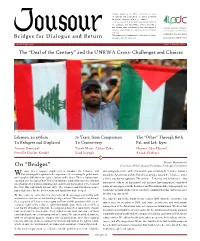
Jousour, issued by the LPDC represents an array of opinions and perspectives on issues pertaining Palestinian refugees affairs in Lebanon. It aims to expand the realm of rational dialogue between the Lebanese and Palestinians beyond stereotypes and dogmas while contributing to the development of common relationships in a positive and constructive manner. This supplement is distributed for free with An-Nahar, Al-Liwa’a, and The Daily Star. Special Supplement Issue 1, October 2018 The “Deal of the Century” and the UNRWA Crisis: Challenges and Choices Photo by: Haitham Mousawi Lebanon, an asylum 70 Years, from Compassion The “Other” Through Both To Refugees and Displaced To Controversy Pal. and Leb. Eyes Amine Gemayel Tarek Mitri, Abbas Zaki, Husein Abu Elnaml Pernille Dahler Kardel Ziad Sayegh Asaad Shaftari Hasan Mneymneh On “Bridges” Chairman of the Lebanese Palestinian Dialogue Committee e issue this newspaper supplement to introduce the Lebanese and attempting to break free of the chains of the past, including the Lebanese attitudes WPalestinian public opinion to the importance of examining the problematic toward the Palestinians and the Palestinian attitudes toward the Lebanese, under and complex difficulties the joint relations suffer from. These relations have a direct and honest approach. The writers – Lebanese and Palestinian – that extended over the span of this 70-year-old asylum, marked by much serenity and participated with us on this project rely on those fixed principles, considered overshadowed by misunderstanding and controversy that peaked in the years of the Civil War and bloody internal strife. The Lebanese and Palestinian people points of convergence for the Lebanese and Palestinians alike. -
Constructions and Instrumentalization of the Past: a Comparative Study on Memory Management in the Region
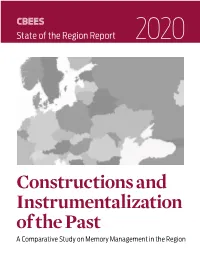
CBEES State of the Region Report 2020 Constructions and Instrumentalization of the Past A Comparative Study on Memory Management in the Region Published with support from the Foundation for Baltic and East European Studies (Östersjstiftelsen) Constructions and Instrumentalization of the Past A Comparative Study on Memory Management in the Region December 2020 Publisher Centre for Baltic and East European Studies, CBEES, Sdertrn University © CBEES, Sdertrn University and the authors Editor Ninna Mrner Editorial Board Joakim Ekman, Florence Frhlig, David Gaunt, Tora Lane, Per Anders Rudling, Irina Sandomirskaja Layout Lena Fredriksson, Serpentin Media Proofreading Bridget Schaefer, Semantix Print Elanders Sverige AB ISBN 978-91-85139-12-5 4 Contents 7 Preface. A New Annual CBEES Publication, Ulla Manns and Joakim Ekman 9 Introduction. Constructions and Instrumentalization of the Past, David Gaunt and Tora Lane 15 Background. Eastern and Central Europe as a Region of Memory. Some Common Traits, Barbara Trnquist-Plewa ESSAYS 23 Victimhood and Building Identities on Past Suffering, Florence Frhlig 29 Image, Afterimage, Counter-Image: Communist Visuality without Communism, Irina Sandomirskaja 37 The Toxic Memory Politics in the Post-Soviet Caucasus, Thomas de Waal 45 The Flag Revolution. Understanding the Political Symbols of Belarus, Andrej Kotljarchuk 55 Institutes of Trauma Re-production in a Borderland: Poland, Ukraine, and Lithuania, Per Anders Rudling COUNTRY BY COUNTRY 69 Germany. The Multi-Level Governance of Memory as a Policy Field, Jenny Wstenberg 80 Lithuania. Fractured and Contested Memory Regimes, Violeta Davoliūtė 87 Belarus. The Politics of Memory in Belarus: Narratives and Institutions, Aliaksei Lastouski 94 Ukraine. Memory Nodes Loaded with Potential to Mobilize People, Yuliya Yurchuk 106 Czech Republic. -

The Cost of Memorializing: Analyzing Armenian Genocide Memorials and Commemorations in the Republic of Armenia and in the Diaspora
INTERNATIONAL JOURNAL FOR HISTORY, CULTURE AND MODERNITY www.history-culture-modernity.org Published by: Uopen Journals Copyright: © The Author(s). Content is licensed under a Creative Commons Attribution 4.0 International Licence eISSN: 2213-0624 The Cost of Memorializing: Analyzing Armenian Genocide Memorials and Commemorations in the Republic of Armenia and in the Diaspora Sabrina Papazian HCM 7: 55–86 DOI: 10.18352/hcm.534 Abstract In April of 1965 thousands of Armenians gathered in Yerevan and Los Angeles, demanding global recognition of and remembrance for the Armenian Genocide after fifty years of silence. Since then, over 200 memorials have been built around the world commemorating the vic- tims of the Genocide and have been the centre of hundreds of marches, vigils and commemorative events. This article analyzes the visual forms and semiotic natures of three Armenian Genocide memorials in Armenia, France and the United States and the commemoration prac- tices that surround them to compare and contrast how the Genocide is being memorialized in different Armenian communities. In doing so, this article questions the long-term effects commemorations have on an overall transnational Armenian community. Ultimately, it appears that calls for Armenian Genocide recognition unwittingly categorize the global Armenian community as eternal victims, impeding the develop- ment of both the Republic of Armenia and the Armenian diaspora. Keywords: Armenian Genocide, commemoration, cultural heritage, diaspora, identity, memorials HCM 2019, VOL. 7 Downloaded from Brill.com10/05/202155 12:33:22PM via free access PAPAZIAN Introduction On 24 April 2015, the hundredth anniversary of the commencement of the Armenian Genocide, Armenians around the world collectively mourned for and remembered their ancestors who had lost their lives in the massacres and deportations of 1915.1 These commemorations took place in many forms, including marches, candlelight vigils, ceremo- nial speeches and cultural performances. -

Annual Report of the Armenian Evangelical 'Bethel' Church In
1 ARMENIAN EVANGELICAL BETHEL CHURCH MINISTER: REV. HAROUTUNE SELIMIAN JANUARY 2017 OFFICE OF THE MINISTER ALEPPO-SYRIA Christmas Musical Concert at Bethel Church Under the auspices of Rev. Haroutune Selimian, President of the Armenian Evangelical Community in Syria, a musical concert was held on Sunday 1st of January 2017, at the Armenian Evangelical Bethel Church. Attending it were the President of the Armenian Evangelical Community, the representative and the head of the Armenian Orthodox and Catholic Churches, pastors, clergy and lay-men of the churches, directors of schools, representatives of cultural centers and foundations, as well as a large number of other guests. The concert began with Mrs. Shoghig Shahinian Giragosian’s words of welcome who proceeded to introduce the evening's performers, Mrs. Shoghagat Selimian (Musical Conductor & Pianist), Zani Pambukian (Flutist) and Armani Hera Selimian (Singer) who presented Christmas music and songs, arranged by Shoghagat Apartian- Selimian. It was to be an evening that could only be rivalled by the angels themselves singing at the birth of our Lord Jesus Christ. Once more the traditional Christmas hymns gave the audience the joy of the Lord. At the end of the Concert Rev. Haroutune Selimian took the opportunity to thank the talented musicians and expressed his heartfelt gratitude. He said. “We live in a world of violence, not peace. It’s all we’ve ever been familiar with. For almost as long as human beings have been around and have had to live together, our planet has been characterized by conflict, chaos, disharmony, and violence. 2 It is important to understand that peace is more than just the absence of conflict. -

The HOMENETMEN LEADER's GUIDE
The HOMENETMEN LEADER’S GUIDE Հ.Մ.Ը.Մ.ական ՂԵԿԱՎԱՐԻ ՈՒՂԵՑՈՅՑ English Version Second Edition 2.1 February 2019 Prepared by: Dr. Shahe Yeni-Komshian Commissioned by: Homenetmen Western USA Regional Executive Board Sponsored by: Homenetmen Central Executive Board The content of the Homenetmen Leader’s Guide includes original writings by SY, as well as edited past documents and/or reproduction of already prepared documents. The Guide is available on-line as an e-document, at: www. Homenetmen.net The Homenetmen Leader’s Guide was Developed on the Occasion of the 100th Anniversary of HOMENETMEN As a Tribute to its Remarkable Contribution to Armenian Society, In the Hopes of Educating Future Generations of Leaders to Carry on the Torch. SY 2 PREFACE Homenetmen has bylaws, rules and regulations, but no formal leadership development program. Governing bodies also do not have a comprehensive orientation guide for new board members. Hence this guidebook. This Guide is primarily written for the leadership of Western USA Region. However, the entire Homenetmen family with all of its Regions and Chapters could use this guidebook, with minor adjustments of region specific information. WHY Do We Need to HAVE a GUIDE for LEADERS? Every nonprofit organization needs a board development process. Homenetmen has to give tools to those leaders who are expected to lead our youth, to better explain to them their role and responsibilities, educate them about their position and functions and help improve their performance. Quality leaders are better mentors. This Guide may be utilized for two purposes: 1. As a reference handbook, adopted by any Homenetmen leader, or 2. -

Amaanews-Aug-Sept-Oct2002
Publication of the Armenian Missionary Association of America AUG/SEPT/OCT 2002 - Vol. XXXVI No. 4 (ISSN 1097-0924) The Rev. Jirair Sogomian Editor Retiring Haigazian University President, the Rev. Dr. John Khanjian Welcomes the New President, the Rev. Dr. Paul Haidostian (see story on pages 10-11) E D I T O R I A L M E S S A G E “A Test of Our Stewardship” Rev. Jirair M. Sogomian These, indeed, are unusual times for us all! As we approach the first anniversary of that infamous 11th day of September in the history of the United States of America, we share the lingering grief and pain of the families and friends of those thousands of innocent victims who perished in such tragic circumstances. However, deeply aware of our shrinking world, often described as a global village, we also share the grief and pain of the least of God’s children around the world who are daily victimized by irrational and inhuman violence, and by the deeply encrusted human injustice and greed that hold our world hostage to unrighteousness and senseless suffering. eedless to say, our world has been affected in not be hoarded and stored up for the future. These are Nmore than one way by the escalation of unbridled times that test the mettle of our faith, the genuineness hatred, boundless brutality and insatiable human of our Christian stewardship, and the honesty of our greed. The economic downturn in our country, caused motives in giving and sharing that others may sur- by these and other conditions, has seriously affected vive times harsher than we have ever experienced! not only the pocketbooks of millions of people, but These are times that call us to new standards of giv- has also seriously curtailed our ability to reach out to ing that are truly sacrificial and self-denying. -

Der Hakob Celebrating Badarak at the Tomb of Christ
Սուրբ Երրորդութիւն Հայաստանեայց Առաքելական Եկեղեցի Holy Trinity Armenian Apostolic Church LOOYS Cheltenham, PA Rev. Fr. Hakob Gevorgyan, Pastor Spring 2018-02 Der Hakob Celebrating Badarak at the Tomb of Christ Upcoming Events Hours of Worship - Morning Service: 10:00 AM Read what’s been happening at our - Divine Liturgy: 10:30 AM church and be a part of what’s Church School coming up! - Language Instruction: 10:15-11:15 - Christian Education: 11:20-12:15 Pray Until Something Happens www.holytrinity-pa.org Contact Information Holy Trinity Armenian Church 101 Ashmead Road, Cheltenham, PA 19012 www.holytrinity-pa.org Items for inclusion in the Sunday Messenger or requests for Requiem Services or Special Prayers should be sent to the church office by Wednesday for the upcoming Sunday. For all emergencies, please contact Rev. Fr. Hakob Gevorgyan at the church 215-663-1600 (cell 917-213-8658). CHURCH INFORMATION Office Telephone: 215-663-1600 ACYOA Jrs. Kitchen: 267-282-4594 Ella Hanamirian (Co-Chair) Pastor: Rev. Fr. Hakob Gevorgyan Christine Grigoryan (Co-Chair) frhakob@holytrinity-pa.org Mariana Majian (Parent Advisor) 215-758-2664 Church Secretary: Maggie Miller LADIES of HOLY TRINITY office@holytrinity-pa.org Elizabeth Barone (Coordinator) 610-449-2236 REGULAR SUNDAY HOURS OF WORSHIP Lorraine Damerjian (Treasurer) 215-572-8465 Morning Service: 10:00 AM INTERCOMMUNAL Divine Liturgy (Soorp Badarak): 10:30 AM Ara Shakarjian 215-886-1904 Church School: 10:15 AM Tanya Paretchan 215-947-4394 PARISH COUNCIL MEMBERS Emily Movsesian 734-277-2753 John Hanamirian (Chair) 215-431-0589 COFFEE HOUR COORDINATOR Larry D. -

International Armenian Cultural Education As a Strategy for Language Maintenance
Journal of Language and Cultural Education, 2(2) ISSN 1339-4045 (print), ISSN 1339-4584 (online) Copyright © 2014 SlovakEdu “It’s not important where you are, it’s important what you are”: International Armenian Cultural Education as a Strategy for Language Maintenance Anke al-Bataineh, INALCO Paris, France throughthemediumof@gmail.com Abstract This article draws on ethnographic and interview data to document a case of transnational cultural education in a diasporan context. The activities of the cultural and educational arm of an Armenian political party are described in terms of their curricular, extracurricular and social variety, and in terms of their transnational organizational structure. The author regards two important theories, Fishman’s (1965, 1991, 2001) domains model and Ethnolinguistic Vitality Theory (Allard & Landry, 1986, 1992; Giles, Bourhis & Taylor, 1977) as complementary in their contributions to the understanding of language maintenance as opposed to language shift. These frameworks are applied to analyze the language maintenance value of the organization’s programming, and to identify weaknesses in the current model. Challenges for the organization itself and for other communities who may wish to implement such a model for language maintenance or revitalization are discussed, and areas for further research are identified. While the model’s strength lies in its immersive teaching, especially of extracurricular subjects, a significant weakness is found in the application of a maintenance model of cultural education to situations where language revitalization is needed. Keywords Ethnolinguistic vitality, domains of language use, language maintenance, revitalization, Armenian diaspora Introduction The increasing global problem of language endangerment has created an urgent need for language maintenance and revitalization programs, and for research into the efficacy of various models for these programs. -

A History of Armenian Immigration to Southern California Daniel Fittante
But Why Glendale? But Why Glendale? A History of Armenian Immigration to Southern California Daniel Fittante Abstract: Despite its many contributions to Los Angeles, the internally complex community of Armenian Angelenos remains enigmatically absent from academic print. As a result, its history remains untold. While Armenians live throughout Southern California, the greatest concentration exists in Glendale, where Armenians make up a demographic majority (approximately 40 percent of the population) and have done much to reconfigure this homogenous, sleepy, sundown town of the 1950s into an ethnically diverse and economically booming urban center. This article presents a brief history of Armenian immigration to Southern California and attempts to explain why Glendale has become the world’s most demographically concentrated Armenian diasporic hub. It does so by situating the history of Glendale’s Armenian community in a complex matrix of international, national, and local events. Keywords: California history, Glendale, Armenian diaspora, immigration, U.S. ethnic history Introduction Los Angeles contains the most visible Armenian diaspora worldwide; however yet it has received virtually no scholarly attention. The following pages begin to shed light on this community by providing a prefatory account of Armenians’ historical immigration to and settlement of Southern California. The following begins with a short history of Armenian migration to the United States. The article then hones in on Los Angeles, where the densest concentration of Armenians in the United States resides; within the greater Los Angeles area, Armenians make up an ethnic majority in Glendale. To date, the reasons for Armenians’ sudden and accelerated settlement of Glendale remains unclear. While many Angelenos and Armenian diasporans recognize Glendale as the epicenter of Armenian American habitation, no one has yet clarified why or how this came about. -

Non-Arab Women in the Arab World
File Intro File Intro Ross-Nazzal and Aglaia Viviani have provided an historical provides a bridge to the last section of this issue, dealing vantage point from which to understand the way American with mixed marriages and the thorny topic of patrilineal cul- and British women viewed Palestine and Egypt in the mid tural and citizenship rights. 19th century. Sharon Nagy has aptly juxtaposed the historical and current Some of the weaknesses of this issue’s first section are experience of Western and South East Asian women who made up for through the inclusion of powerfully individual have married into upper, middle and lower-middle class testimonials by both indigenous minority women and families in the Arabian peninsula during the last several Western women with a wealth of personal experience in decades. Rima Habib and Lina Abou-Habib provide an the Arab world. Diane King reflects on her work research- activist’s insight into the struggle to find local support for ing the ethnic and gendered oppression of the women of the human rights of Arab women who have married non- Iraqi Kurdistan during the dark days at the end of the nationals and thus seemingly forfeited their children’s cul- Non-Arab Women regime of Saddam Hussein. In her view, Kurdish women are tural identity. far from being the “helpless victims” they are often por- trayed as by well meaning Western NGOs. A good friend The articles in this issue have opened the debate on who from my native Austria, Ingrid Jaradat Gassner describes the decides the nature of ethnic and gender identity in the process of becoming Palestinian over a period of almost region. -

Syrian-Armenian Archive: Individual Research Exploration
preservation . education . justice Syrian-Armenian Archive: Individual Research Exploration Note to Teachers: This is an assignment outline for students in a social studies, history, or research class who are interested in getting exposure to introductory archival use and research. The assignment should ideally be a long-weekend or a vacation assignment in order to give students adequate time to explore the archive and answer their chosen question thoughtfully, but the length of the written response assignment can be adjusted to fit your curriculum needs. This assignment might be a good addition to your pre-established lessons or curriculum covering any of the following: • Research Methods • Primary and Secondary Sources • Archives • Social Awareness and Refugees • Contemporary Middle Eastern studies • Ottoman Empire History Content warning: Please note that this archive contains personal descriptions of violence and disturbing events in the context of genocide, displacement, and conflict. Primary Objective: Students will practice learning from an archive in order to write their own essays in response to introductory research questions. Additional objectives: Students will be able to: • Explain a bit about Armenians and the Syrian Armenian experience --------------------------------------------------------------------------------------------- Introduction of Assignment Duration: Approx. 10 minutes In order to introduce the assignment, introduce the following information: Ask: Does anyone know about Armenia, or Armenian people? Look for answers that cover the following, or give the following information as an answer: • Armenians are a group of people, just like Ghanaian people, German people, or Korean people, for example. • Over 100 years ago, they were the victims of a Genocide, which means lots of them were killed because of who they were, in this case, it was because they were Armenians.