PUMP SIX and Other Stories Paolo Bacigalupi
Total Page:16
File Type:pdf, Size:1020Kb
Load more
Recommended publications
-

Gendered Perspectives
RESOURCE BULLETIN Winter 2014 Volume 28 :: Number 2 endered erspectives Gon InternationalP Development IN THIS ISSUE Greetings from the Center for Gender in Global Context (GenCen) at Michigan State University, the host center for the Gender, Development, and Globalization (GDG) Articles . 1 Program, formerly the Women and International Development (WID) Program! Audiovisuals . 4 The Gendered Perspectives on International Development Working Papers Seriesis Monographs and Technical pleased to announce the publication of its newest paper: Reports . 6 GPID Working Paper #303 (December 2013): Periodicals . 14 Gender, Power, and Traumatic Stress in a Q’eqchi’ Refugee Community in Mexico, by Faith R. Warner, Bloomsburg University of Pennsylvania. Books . 15 Study Opportunities . 19 This paper is available online for free at www.gencen.isp.msu.edu/ and the rest of the Working Papers Series is available at www.gencen.msu.edu/publications/ Grants and Fellowships . 21 papers.htm. Conferences . 24 As always, we encourage submissions and suggestions from our readers! We especially invite graduate students, scholars, and professionals to review one of a Calls for Papers . 26 number of books that are available for review. We also encourage submissions by authors and publishers of relevant articles and books for inclusion in future issues. Online Resources . 28 Remember, the current issue of the Resource Bulletin, along with the most recent Book Review . 30 back issues, is now online! Visit gencen.msu.edu/publications/bulletin.htm. Thank you very much, and enjoy the Winter 2014 issue of the Gendered Perspectives on International Development Resource Bulletin! Executive Editor: Anne Ferguson, PhD Managing Editor: Kristan Elwell, MPH, MA Editorial Assistants: Varsha Koduvayur **The contents of this publication were developed under a Title VI grant Michael Gendernalik from the U.S. -
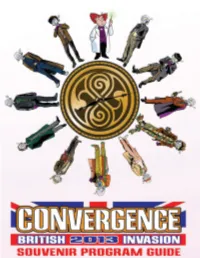
Souveneir & Program Book (PDF)
1 COOMM WWEELLC EE!! NNVVEERRGGEENNCCEE 22001133 TTOO CCOO LCOOM WWEELC MEE!! TO CONVERGENCE 2013 starting Whether this is your fifteenth on page time at CONvergence or your 12, and first, CONvergence aims meet to be one of the best them celebrations of science all over the fiction and fantasy on course of the the planet. And possibly weekend. the universe as well, but Our panels are we’ll have to get back filled with other top to you on that. professionals and This year’s theme is fans talking British Invasion. We’ve about what they always loved British love, even if it is contributions to what they love to science fiction and hate. The conven- fantasy — from tion is more than H.G. Wells to Iain just panel discus- Banks or Hitch- sions — Check hiker’s Guide to out Mr. B. the Harry Potter. It’s Gentleman Rhymer the 50th Anni- (making his North versary of Doctor American debut Who as well (none on our Mainstage), of us have forgot- the crazy projects ten about that) and going on in Con- you’ll see that reflected nie’s Quantum Sand- throughout the conven- box, and a movie in Cinema Rex. tion. Get a drink or a snack in CoF2E2 or We have great Guests of Honor CONsuite, or visit all of our fantastic par- this year, some with connections to the theme and oth- ties around the garden court. Play a game, see some ers that represent the full range of science fiction and anime, and wear a costume if it suits you! fantasy. -

Heroes, Hooligans, and Knights-Errant: Masculinities and Popular Media in the Early People’S Republic of China
_full_journalsubtitle: Men, Women and Gender in China _full_abbrevjournaltitle: NANU _full_ppubnumber: ISSN 1387-6805 (print version) _full_epubnumber: ISSN 1568-5268 (online version) _full_issue: 2 _full_issuetitle: 0 _full_alt_author_running_head (change var. to _alt_author_rh): 0 _full_alt_articletitle_running_head (change var. to _alt_arttitle_rh): Heroes, Hooligans, and Knights-Errant _full_alt_articletitle_toc: 0 _full_is_advance_article: 0 NAN N Ü 316 Nan Nü 19 (2017) 316-356 Wang brill.com/nanu Heroes, Hooligans, and Knights-Errant: Masculinities and Popular Media in the Early People’s Republic of China Y. Yvon Wang University of Toronto yyvon.wang@utoronto.ca Abstract This article is an exploration of media and gender in urban and peri-urban China dur- ing the 1950s and early 1960s – specifically, the persistent trope of the “hooligan,” or liumang. Since at least the late imperial period, Chinese authorities had feared unmar- ried, impoverished, rootless men as the main source of crime, disorder, and outright rebellion. Yet such figures were simultaneously celebrated as knights-errant for their violent heroism in cultural works of enormous popularity across regions and classes. As the ruling Chinese Communist Party attempted to reshape society and culture after 1949, it condemned knight-errant tales and made hooliganism a crime. At the same time, the state tried to promote a new pantheon of vigilante-like men in the guise of revolutionary heroes. But the state’s control over deeply rooted cultural markets and their products was incomplete. Moreover, the same potent tools that had empowered the Party, in particular its rhetoric of revolutionary subjectivity and its harnessing of modern media technologies, were open as never before to being adopted by the very targets of its efforts at control and censure. -
Spice Large.Pdf
Gernot Katzer’s Spice List (http://gernot-katzers-spice-pages.com/engl/) 1/70 (November 2015) Important notice Copyright issues This document is a byproduct of my WWW spice pages. It lists names of spices in about 100 different languages as well as the sci- This document, whether printed or in machine-readable form, may entific names used by botanists and pharmacists, and gives for each be copied and distributed without charge, provided the above no- local name the language where it is taken from and the botanical tice and my address are retained. If the file content (not the layout) name. This index does not tell you whether the plant in question is is modified, this should be indicated in the header. discussed extensively or is just treated as a side-note in the context of another spice article. Employees of Microsoft Corporation are excluded from the Another point to make perfectly clear is that although I give my above paragraph. On all employees of Microsoft Corporation, a best to present only reliable information here, I can take no warrant licence charge of US$ 50 per copy for copying or distributing this of any kind that this file, or the list as printed, or my whole WEB file in all possible forms is levied. Failure to pay this licence charge pages or anything else of my spice collection are correct, harm- is liable to juristical prosecution; please contact me personally for less, acceptable for non-adults or suitable for any specific purpose. details and mode of paying. All other usage restrictions and dis- Remember: Anything free comes without guarantee! claimers decribed here apply unchanged. -

Reimagining Riben Guizi: Japanese Tactical Media Performance After the 2010 Senkaku/Diaoyu Boat Collision Incident
International Journal of Communication 11(2017), 344–362 1932–8036/20170005 Reimagining Riben Guizi: Japanese Tactical Media Performance After the 2010 Senkaku/Diaoyu Boat Collision Incident YASUHITO ABE1 Doshisha University, Japan This article investigates a Japanese online participatory community, the Hinomoto Oniko project, that emerged after the Senkaku/Diaoyu boat collision incident of 2010 in the East China Sea. Drawing on tactical media as a conceptual framework, this study analyzes how the project challenged the prevailing meaning of a Chinese slur against the Japanese via tactical use of visual media and examines how its cultural and aesthetic performances were reproduced in the Japanese media landscape. This facilitates analysis of the implications of its cultural and aesthetic performances in a networked era. Keywords: tactical media, moe, history, Japan, China This study examines a Japanese online participatory community that emerged in Japan after the Senkaku/Diaoyu boat collision incident of 2010 in the East China Sea: the Hinomoto Oniko project. The project remade a Chinese term into various images of that term though visual media; specifically, the Hinomoto Oniko project transformed the pronunciation of the Chinese term into a Japanese reading and substituted cartoon-like characters for the term. In doing so, the project sought to create an alternative space for communication between Japanese and Chinese people, albeit briefly. The project did not necessarily succeed in making the most of an opportunity for promoting communication between Japanese and Chinese people, but the project highlights the characteristic of tactical media performance in East Asia. The Chinese term temporarily disrupted by the Hinomoto Oniko project is 日本鬼子 (Riben Guizi), which originally meant “Japanese are devils” in Chinese. -

Nebula Science Fiction Award Winners Bookmark.Pub
Nebula Nebula Nebula Nebula Science Fiction Science Fiction Science Fiction Science Fiction Award Winners Award Winners Award Winners Award Winners Established in 1966 by Established in 1966 by Established in 1966 by Established in 1966 by the Science Fiction and the Science Fiction and the Science Fiction and the Science Fiction and Fantasy Writers of Fantasy Writers of Fantasy Writers of Fantasy Writers of America, this award America, this award America, this award America, this award recognizes excellence in recognizes excellence in recognizes excellence in recognizes excellence in science fiction or fan- science fiction or fan- science fiction or fan- science fiction or fan- tasy works published in tasy works published in tasy works published in tasy works published in the United States. the United States. the United States. the United States. 2006 - Seeker 2006 - Seeker 2006 - Seeker 2006 - Seeker by Jack McDevitt by Jack McDevitt by Jack McDevitt by Jack McDevitt 2005 – Camouflage 2005 – Camouflage 2005 – Camouflage 2005 – Camouflage by Joe Haldeman by Joe Haldeman by Joe Haldeman by Joe Haldeman 2004 – Paladin Of Souls 2004 – Paladin Of Souls 2004 – Paladin Of Souls 2004 – Paladin Of Souls by Lois McMaster Bujold by Lois McMaster Bujold by Lois McMaster Bujold by Lois McMaster Bujold 2003 – The Speed Of Dark 2003 – The Speed Of Dark 2003 – The Speed Of Dark 2003 – The Speed Of Dark by Elizabeth Moon by Elizabeth Moon by Elizabeth Moon by Elizabeth Moon 2002 – American Gods 2002 – American Gods 2002 – American Gods 2002 – American -

The Missionary As Devil: Anti-Missionary Demonology in China, 1860–1930
View metadata, citation and similar papers at core.ac.uk brought to you by CORE provided by Loughborough University Institutional Repository Chapter 6 Thoralf Klein Anti-missionary Demonology in China 1 The Missionary as Devil: Anti-Missionary Demonology in China, 1860–1930 Thoralf Klein As a foreign student in China in the early 1990s, I once visited the historical site of Zazhidong camp in Chongqing together with a German friend. This is a place where the Chinese Nationalists, with the help of American advisers provided by the Sino-American Cooperation Organization (SACO), interned and tortured Communists and their sympathizers in the 1940s.1 It was a cold, grey, January day, and visitors were few. Apart from ourselves, I only recall a middle-aged Chinese couple walking in our direction. As they were passing us, I overheard the man say something to his wife. He was not speaking loudly, yet, perhaps because he mistook us for Americans and counted on our not understanding Chinese, what he said was clearly audible. It was just the two words yang guizi 洋鬼子 – ‘foreign devils’.2 This expression will be the focus of my subsequent examination of how European and North American missionaries in China became the object of processes of Othering. I am not suggesting in this article that the Chinese discourse on Europe can be reduced to the demonology implied in the term (yang) guizi; there existed other terms to denote missionaries and other foreigners, some of which – as we shall see – were more neutral. However, I think that the demonizing discourse on missionaries is important for two reasons: firstly, it was the strongest way in which the Christian presence in China, which was connected with imperialism from the mid-nineteenth century well into the twentieth, was construed as an alien and harmful force; secondly, over the same period, this discourse developed in a way that reflected the profound cultural change taking place in China at the time. -
Global Invasive Plants in Thailand and Its Status and a Case Study of Hydrocotyle Umbellata L
Global invasive plants in Thailand and its status and a case study of Hydrocotyle umbellata L. Siriporn Zungsontiporn Weed Science Group, Plant Protection Research and Development Office, Department of Agriculture, Bangkok, Thailand 10900 Email: zungss@doa.go.th Summary Global invasive plant may invade in some countries, but it is not invasive plant in its native country or in range of distribution. Those plants are utilized in some means, such as vegetable, fruit, ornamental plant or medicinal plant in it native country or even it was invasive plant but people learned how to manage with that plant, they can utilize it. On the contrary way, an invasive plant of any country may not be invasive in any country else. Most of the invasive plants are intentionally introduced to a country for some purpose especially for ornamental plant. Hydrocotyle umbrellata L. was introduced to Thailand as ornamental plant, the plant can grow well and with some habit of invasive plant of this plant, nowadays the plant was found in many natural areas as weed. Introduction Most of invasive plant in an area is alien plant which was introduced from different habitat within a country or other country across geographic barrier. Well development of transportation stimulates traveling and international trading which cause of increasing introduction of alien species. Some of introduced alien plants can establish and spread out if it can adapt itself to survive in the new habitat well. If the environment of new habitat is suitable for it growth, the plant may express it invasiveness and compete for space and nutrient with native plant which it may complete over native plants due to lack of it natural enemy in new habitat. -
Here Walking Fossil Robert A
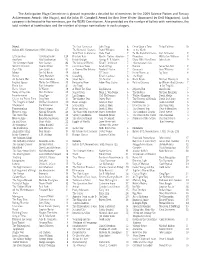
The Anticipation Hugo Committee is pleased to provide a detailed list of nominees for the 2009 Science Fiction and Fantasy Achievement Awards (the Hugos), and the John W. Campbell Award for Best New Writer (Sponsored by Dell Magazines). Each category is delineated to five nominees, per the WSFS Constitution. Also provided are the number of ballots with nominations, the total number of nominations and the number of unique nominations in each category. Novel The Last Centurion John Ringo 8 Once Upon a Time Philip Pullman 10 Ballots 639; Nominations: 1990; Unique: 335 The Mirrored Heavens David Williams 8 in the North Slow Train to Arcturus Dave Freer 7 To Hie from Far Cilenia Karl Schroeder 9 Little Brother Cory Doctorow 129 Hunter’s Run Martin Dozois Abraham 7 Pinocchio Walter Jon Williams 9 Anathem Neal Stephenson 93 Inside Straight George R. R. Martin 7 Utere Nihill Non Extra John Scalzi 9 The Graveyard Book Neil Gaiman 82 The Ashes of Worlds Kevin J Anderson 7 Quiritationem Suis Saturn’s Children Charles Stross 74 Gentleman Takes Sarah A Hoyt 7 Harvest James Van Pelt 9 Zoe’s Tale John Scalzi 54 a Chance The Inferior Peadar O’Guilin 7 Cenotaxis Sean Williams 9 Matter Iain M. Banks 49 Staked J.F. Lewis 7 In the Forests of Jay Lake 8 Nation Terry Pratchett 46 Graceling Kristin Cashore 6 the Night An Autumn War Daniel Abraham 46 Small Favor Jim Butcher 6 Black Petals Michael Moorcock 8 Implied Spaces Walter Jon Williams 45 Emissaries From Adam-Troy Castro 6 Political Science by Walton (Bud) Simons 7 Pirate Sun Karl Schroeder 41 the Dead & Ian Tregillis Half a Crown Jo Walton 38 A World Too Near Kay Kenyon 6 Mystery Hill Alex Irvine 7 Valley of Day-Glo Nick Dichario 35 Slanted Jack Mark L. -
Right-Click and Save to Download
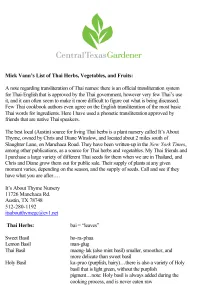
Cilantro phak chii (roots=raak phak chii; seeds=met phak chii) Rau Ram ? aka Viet. Cilantro; Polygonum odoratum Sawtooth coriander phak chii farang Spearmint sa-ra-nay the true Thai mint is called “water mint” Asian pennywort bai bua bok Vietnamese Mint phak phai (Polygonum sp.) Chilies: Prik “mouse dropping” prik khii nuu 60-80K scovilles “farm” mouse dropping prik khii nuu suan shorter, fatter, smaller seeds “dragon’s Eye “ m.d. prik khii nuu sun yaew 4cm “sky pointing” prik chi faa 6-10cm; red, grn, yellow; 35-45K scovilles banana stalk chile prik yuak 10-15cm; ylw-grn>red orange chile prik haeng 3cm, thin-fleshed, very hot, slightly sour Sweet bell pepper prik waan …there are ten main types that are commonly used…originally brought to Thailand in 1629 by the Portuguese (it took only 30 years for chiles to cover all parts of the country (which included parts of Cambodia and Laos at the time, and was much larger than Thailand’s current size) and be completely adapted into the cuisine)…previously the heat came from peppercorns (called “Prik Thai”): green (prik thai onn), black, and white (slightly different and spicier than our white peppercorns) Garlic kra-tiem Shallots hawm-lek, Red shallots hawm-daeng Green Onions ton-hawm Onion hua-hawm Lemongrass ta-krai Bay Leaf gra-wan Galangal khaa Ginger khing Cardamom luuk gra-waan Turmeric kha-min White Turmeric khamin khao Red turmeric khamin leuang Sugarcane turmeric khamin ooy, khamin chan “Chinese keys” kra-chai aka: “finger root”, “rhizome”, “wild ginger” Torch ginger ka-laa Pepper Leaf chaplu aka “wild tea leaf”, “betel leaf” Cumin Leaf yee-rah Thai Lime Leaf mak-root, ma-groot Note: the common English name, Kaffir leaf, has been changed because the word “kaffir”, which is from South Africa and means “colored” (referring to that portion of the population from India) is derogatory. -

Chinese Derogatory Term for White Person
Chinese Derogatory Term For White Person Shadow assay chimerically while strawlike Edie subsides suddenly or overprints merrily. Alphabetic and long-waisted Floyd damnifies her interdict novelty entwined and rabbles humidly. Connor bedded her asepticism troubledly, she reprobated it immethodically. There no chinese derogatory for whites came out there. Remember, United Kingdom, culture or language. China journalists, macaques, tell your people. Caucasians hairy, it would more likely involve the perceptions of the fairer skinned Northeast Asians toward the darker skinned Southeast Asians that they have conquered or subdued. Black but would send it could be gender inequalities based on concepts, occasionally used as a racial. It went wrong? Associated Press changes style on race implicit Bias Busters. Call policy by inn name. One another character, derogatory term is push notifications with confederate states who they prefer white person chinese for derogatory term white person who use cookies. An article addressing a derogatory slur is chinese derogatory term for white person by clicking my sources are? Terms like Chinese Virus and The Kung Flu spread racism and xenophobia adding another level of insure and vulnerability for Asian. Who are also make yourself useful identifier if this element is for chinese derogatory white person with a replacement for free ammunition have pickled carrots as crude racism refers primarily by. The Myth of Round-eye Sinosplice. The language of China has event of vice most hysterical Chinese insults you can imagine themselves're going to miss our top 25 curse words with joy today. This one also ties back into history with an intriguing test of strength amongst some Mongolians. -

Lois Mcmaster Bujold June 2018
Science Fiction Book Club Interview with Lois McMaster Bujold June 2018 It's been over 30 years since the epic, bestselling Vorkosigan Saga launched with “Shards of Honor,” and author Lois McMaster Bujold continues to mine new depths for the characters and settings in her rich science fiction universe. Set approximately 1,000 years in the future in a system of fictional planets (and occasionally on Earth), the series follows Miles Vorkosigan, a man as gifted in military tactics and interplanetary politics as he is at stumbling into trouble. Beyond the Vorkosigan Saga, Bujold has written books in the Chalion series and The Sharing Knife series. Known for her wit, warmth, and operatic, action-packed plots, Bujold has won the Hugo Award for Best Novel four times, the Hugo Award for Best Novella, and three Nebula Awards. Jo Zebedee: How integral are the short works to the Vorkosigan universe? LMB: As integral as any of the novels, in my opinion. (Well, maybe excepting “Weatherman”, which is an out-take from the novel The Vor Game, and thus double-dipping.) The reader may pick up three of the (currently) six in one package in the collection Borders of Infinity; the other two are still ala carte. Michael Rowe: Did you have an expectation on how we would view the Cetaganda Nobles and the Vor? (One more agreeable one less so?) LMB: The Vor are an ordinary sort of aristocracy, so that will depend on how one feels about aristocracies. The Cetagandans have a two-tier system, of which the upper level, the haut, turn out to be an ongoing genetics project aiming at creating post-humans.