Exterior Mouldings and Trim Board
Total Page:16
File Type:pdf, Size:1020Kb
Load more
Recommended publications
-
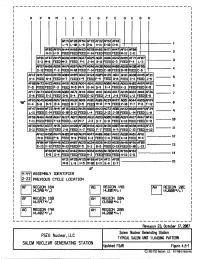
Salem Generating Station, Units 1 & 2, Revision 29 to Updated Final Safety Analysis Report, Chapter 4, Figures 4.5-1 to 4.5
r------------------------------------------- 1 I p M J B I R N L K H G F E D c A I I I I I Af'Jq AF20 AF54 AF72 32 AF52 AF18 I L-q L-10 L-15 D-6 -11 E-10 D-8 l I AF03 Af't;qAH44 AH60 AH63 AG70 AH65 AH7l AH47 AFS4 AF08 I N-ll H-3 FEED FEED FEED H-14 FEED FEED FEED M-12 C-11 2 I AF67 AH4q AH04 AG27 AG2<i' AG21 AG16 AG42 AF71 AF07 AF01 AG36 AH!5!5 3 I E-3 M-6 FEED M-3 FEED P-1 J-14 B-11 FEED D-3 FEED F-4 L-3 I AF67 AH5S AG56 Atflq AGsq AH2<1' AG48 AH30 AG68 AH08 AG60 AH30 AF55 I D-12 FEED F-2 FEED N-11 FEED F-14 FEED C-11 FEED B-11 FEED C-8 4 I AF12 AH57 AG43 AH38 AHtiJq AG12 AH24 AGfR AH25 AGil AG31 AH45 AF21 AGlM AH21 5 I H~4 FEED N-4 FEED H-7 FEED K~q FEED F-q FEED G-8 FEED C-4 FEED J-15 I AF50 AH72 AH22 AGS6 AH15 AGll.lAG64 AG41 AG52 AG88 AH18 AG65 AHIJ2 AH5q AF51 I F-5 FEED FEED F-3 FEED M-5 r+q G-14 o-q E-4 FEED K-3 FEED FEED K-5 6 I f:Fl7 AH73 AG24 AH28 AG82 AG71 AH14 AG18 AHil AG46 AG17 AH35 AG22 AH61 AF26 7 I E-8 FEED E-2 FEED G-6 G-4 FEED E-12 FEED J-4 J-6 FEED L-2 FEED E-5 I Af&q I qeo AF65 AG45 AtM0 AG57 AH33 AG32 AG16 AH01 AGI6 AG3<1' AH27 AG51 AG44 AG55 K-4 B-8 e-q B-6 FEED B-7 P-5 FEEC M-11 P-q FEED P-11 P-7 P-8 F-12 8 I AF47 AH68 AF23 AH41 AF1!5 AG62 AH26 AG03 AH23 AH32 AG28 AHsq AF3<1' q I L-U FEED E-14 FEED G-10 G-12 FEED L-4 FEED FEED L-14 FEED L-8 I ~~ AF66 AH66 AH10 AG67 AH37 AGJq AG68 AG3l AG63 AG05 AH08 AG5q AH17 AH67 AF41 I F-11 FEED FEED F-13 FEED L-12 M-7 J-2 D-7 D-11 FEED K-13 FEED FEED K-11 10 I AE33 AH!52 AG37 AH31 AG14 AH20 AF20 AH34 AG13 AH36 AG07 AH40 AG38 AH!53 AF27 I G-ll FEED N-12 FEED J-8 FEED K-7 FEED -

1St IRF Asia Regional Congress & Exhibition
1st IRF Asia Regional Congress & Exhibition Bali, Indonesia November 17–19 , 2014 For Professionals. By Professionals. "Building the Trans-Asia Highway" Bali’s Mandara toll road Executive Summary International Road Federation Better Roads. Better World. 1 International Road Federation | Washington, D.C. ogether with the Ministry of Public Works Indonesia, we chose the theme “Building the Trans-Asia Highway” to bring new emphasis to a visionary project Tthat traces its roots back to 1959. This Congress brought the region’s stakeholders together to identify new and innovative resources to bridge the current financing gap, while also sharing case studies, best practices and new technologies that can all contribute to making the Trans-Asia Highway a reality. This Congress was a direct result of the IRF’s strategic vision to become the world’s leading industry knowledge platform to help countries everywhere progress towards safer, cleaner, more resilient and better connected transportation systems. The Congress was also a reflection of Indonesia’s rising global stature. Already the largest economy in Southeast Asia, Indonesia aims to be one of world’s leading economies, an achievement that will require the continued development of not just its own transportation network, but also that of its neighbors. Thank you for joining us in Bali for this landmark regional event. H.E. Eng. Abdullah A. Al-Mogbel IRF Chairman Minister of Transport, Kingdom of Saudi Arabia Indonesia Hosts the Region’s Premier Transportation Meeting Indonesia was the proud host to the 1st IRF Asia Regional Congress & Exhibition, a regional gathering of more than 700 transportation professionals from 52 countries — including Ministers, senior national and local government officials, academics, civil society organizations and industry leaders. -
The World's Colonisation and Trade Routes Formation As Imitated By
The World's Colonisation and Trade Routes Formation as Imitated by Slime Mould Andrew Adamatzky University of the West of England, Bristol, United Kingdom This is unedited preprint with low-resolution photographs. Final and edited version of this paper is published in Int. J. Bifurcation Chaos, 22, 1230028 (2012) [26 pages] DOI: 10.1142/S0218127412300285 Abstract The plasmodium of Physarum polycephalum is renowned for spanning sources of nutrients with networks of protoplasmic tubes. The networks transport nutrients and metabolites across the plas- modium's body. To imitate a hypothetical colonisation of the world and formation of major trans- portation routes we cut continents from agar plates arranged in Petri dishes or on the surface of a three-dimensional globe, represent positions of selected metropolitan areas with oat flakes and inoculate the plasmodium in one of the metropolitan areas. The plasmodium propagates towards the sources of nutrients, spans them with its network of protoplasmic tubes and even crosses bare substrate between the continents. From the laboratory experiments we derive weighted Physarum graphs, analyse their structure, compare them with the basic proximity graphs and generalised graphs derived from the Silk Road and the Asia Highway networks. Keywords: biological transport networks, unconventional computing, slime mould 1 Introduction Nature-inspired computing paradigms and experimental laboratory prototypes are demonstrated reason- able success in approximation of shortest, and often collision-free, paths between two given points in an arXiv:1209.3958v1 [nlin.AO] 18 Sep 2012 Euclidean space or a graph. Examples include ant-based optimisation of communication networks [15], approximation of a shortest path in experimental reaction-diffusion chemical systems [1], gas-discharge analog systems [35], spatially extended crystallisation systems [5], fungi mycelia networks [22], and maze solving by Physarum polycephalum [29]. -
Hardware Withdrawal: Select IBM Flashsystem A9000R, Flashsystem 900, SAN Volume Controller, and Flashsystem 7000 Features - No Replacements Available
IBM Europe Withdrawal Announcement ZG21-0091, dated August 24, 2021 Hardware withdrawal: Select IBM FlashSystem A9000R, FlashSystem 900, SAN Volume Controller, and FlashSystem 7000 features - No replacements available Table of contents 1 Overview 12 Replacement product information 1 Withdrawn products 12 Announcement countries Overview Effective August 24, 2021, and January 8, 2022, IBM(R) will withdraw from marketing the following products. On or after the effective dates of withdrawal, you can no longer order these products directly from IBM. For new orders, the client-requested arrival date (CRAD) can be no later than January 28, 2022, for products withdrawn effective January 8, 2022. You can obtain the products on an as-available basis through IBM Business Partners. If you have a continuing need for this machine/model type, go to the IBM Certified Pre-owned Equipment website to check on availability or utilize the request a quote to communicate your specific requirements. IBM Certified Pre-owned Equipment has the largest inventory of used IBM systems that are refurbished, tested, and warranted for a minimum of 90 days. Withdrawn products Effective August 24, 2021, the following features will be withdrawn: Description Machine number Model numbers Feature number CLUSTER UNIT 1 2076 624, U7A 1201 INDICATOR CLUSTER UNIT 2 2076 624, U7A 1202 INDICATOR CLUSTER UNIT 3 2076 624, U7A 1203 INDICATOR CLUSTER UNIT 4 2076 624, U7A 1204 INDICATOR OEM 2076 312 1760 DESIGNATION FLAG 10GBE OPTICAL 2076 312, 324 5711 SW SFP PAIR Storage 2076 12G, 24G, -

Auction 14A Final Draft.Vp
OUR STAFF Stephen Album Paul Montz Director of Islamic & Early Indian Numismatics Director of World Coins Steve has been serving the Paul joined the staff in January numismatic community since 2011. He attended UC Davis 1960. In 1976 he began dealing from 1975-80, earning bachelor's nearly exclusively in Islamic and and master's degrees in Indian coins. He has authored Agricultural Science & several books including the Management and Agronomy, Catalogue of California Trade respectively. He began working Tokens, Volumes I & II in 1972 in the numismatic field in the and 1974 respectively. 1977 saw 1970's. In 1981, he founded the release of his complete rewrite of Marsden's Olde World Numismatics in Chico, CA, a business he Numismata Orientalia Illustrata, a guide to Islamic ran for 30 years, focusing on A-Z world coins, before and Oriental coins with values. In 1993 he published merging with Stephen Album Rare Coins. He has put A Checklist of Islamic Coins, which now in its second out price lists for many years and has been a fixture edition is the standard for collectors of Islamic coins. at major shows since the 1980's. Paul is a life Mr. Album is currently a senior fellow at the member of the American Numismatic Association Worcester College, Oxford, England, and in this and is a member of other organizations. He has been position has authored three of the ten volumes of the a contributing editor for the Standard Catalog of Sylloge of Islamic Coins in the Ashmolean (Museum) World Coins since 1998. Paul brings experience in beginning in 1999. -

Pin Information for the Intel® Stratix®10 1SG250 Device Version: 2020-10-27
Pin Information for the Intel® Stratix®10 1SG250 Device Version: 2020-10-27 TYPE BANK HF55 Package NF43 Package UF50 Package Transceiver I/O 1C 28 28 28 Transceiver I/O 1D 28 28 28 Transceiver I/O 1E 28 28 28 Transceiver I/O 1F 28 28 28 Transceiver I/O 1K - 28 28 Transceiver I/O 1L - 28 28 Transceiver I/O 1M - 28 28 Transceiver I/O 1N - 28 28 LVDS I/O 2A 48 48 48 LVDS I/O 2B 48 48 48 LVDS I/O 2C 48 48 48 LVDS I/O 2F 48 - 48 LVDS I/O 2G 48 - - LVDS I/O 2H 48 - - LVDS I/O 2I 48 - - LVDS I/O 2J 48 - - LVDS I/O 2K 48 - - LVDS I/O 2L 48 48 48 LVDS I/O 2M 48 48 48 LVDS I/O 2N 48 48 48 LVDS I/O 3A 48 48 48 LVDS I/O 3B 48 48 48 LVDS I/O 3C 48 48 48 LVDS I/O 3D 48 48 - LVDS I/O 3E 48 - - LVDS I/O 3F 48 - - LVDS I/O 3G 48 - - LVDS I/O 3H 48 - - LVDS I/O 3I 48 48 48 LVDS I/O 3J 48 48 48 LVDS I/O 3K 48 48 48 LVDS I/O 3L 48 48 48 Transceiver I/O 4C - - 28 Transceiver I/O 4D - - 28 Transceiver I/O 4E - - 28 Transceiver I/O 4F - - 28 Transceiver I/O 4K - - 28 Transceiver I/O 4L - - 28 Transceiver I/O 4M - - 28 Transceiver I/O 4N - - 28 3V I/O 6A 8 8 8 3V I/O 6C - 8 8 3V I/O 7A - - 8 3V I/O 7C - - 8 SDM shared LVDS I/O SDM 29 29 29 i. -

The Effect of Road Upgrading to Overland Trade in Asian Highway Network Ziyodullo PARPIEV ∗ Jamshid SODIKOV **
Eurasian Journal of Business and Economics 2008, 1 (2), 85-101. The Effect of Road Upgrading to Overland Trade in Asian Highway Network Ziyodullo PARPIEV ∗ Jamshid SODIKOV ** Abstract This paper investigates an impact of road upgrading and improvement on overland trade in 18 out of 32 Asian Highway Network member countries. A regression based cost model was developed. The results indicate that approximately 6.5 billion US dollars is required to upgrade and improve surface condition of the selected roads with total length of 15,842 km. The gravity model approach was adopted to quantitatively evaluate overland trade expansion assuming pessimistic and optimistic scenarios: improvements in road quality indices up to 50 and up to 75, respectively. The results suggests that in the first scenario total intra-regional trade will increase by about 20 percent or 48.7 billion US dollars annually, while second scenario predicts that trade will increase by about 35 percent or 89.5 billion US dollars annually. Keywords: Asian Highway Network, road transport, gravity model. Jel Classification: F12, F15, F17. ∗ Advisor-Economist, UNDP Uzbekistan Country Office, Email: ziyodullo.parpiev@undp.org ** Chief Engineer, Road Research Institute, Tashkent, Uzbekistan The views expressed in this paper are those of the author(s) and do not necessarily represent those of organizations the authors are associated with. Ziyodullo PARPIEV & Jamshid SODIKOV 1. Introduction In 1992, the United Nations Economic and Social Commission for Asia and the Pacific (ESCAP) endorsed the Asian Land Transport Infrastructure Development (ALTID) project comprising of the Asian Highway and the Trans-Asian Railway network. The formalization of the Asian Highway, through the Intergovernmental Agreement on Asian Highway Network (AHN), was adopted in November 2003. -
Growing Together Articulates a Number of Proposals That Can Help the Region Exploit Its Huge Untapped Potential for Regional Economic Integration
i Photo by Warren Field ii FOREWORD For the global economy, these are difficult times. The world is emerging from a crisis whose aftershocks continue to resonate – trapping some of the richest economies in recession and shaking the foundations of one of the world’s major currencies. Here at ESCAP, there are historical echoes. What is now the Economic and Social Commission for Asia and the Pacific was founded more than 60 years ago – also in the aftermath of a global crisis. The countries of Asia and the Pacific established their new Commission partly to assist them in rebuilding their economies as they came out of the yoke of colonialism and the Second World War. The newly established ECAFE, as ESCAP was called then, held a ministerial conference on regional economic cooperation in 1963 that resolved to set up the Asian Development Bank with the aim of assisting the countries in the region in rebuilding their economies. Fifty years later, the Asia-Pacific region is again at a crossroads, on this occasion seeking ways and means to sustain its dynamism in a dramatically changed global context in the aftermath of a global financial and economic crisis. An important change is the fact that, burdened by huge debts and global imbalances, the advanced economies of the West are no longer able to play the role of engines of growth for the Asia-Pacific region that they played in the past. Hence, the Asia-Pacific region has to look for new engines of growth. The secretariat of ESCAP has argued over the past few years that regional developmental challenges, such as poverty and wide disparities in social and physical infrastructure, can be turned into opportunities for sustaining growth in the future. -

1 EAPRS SCORING CODEBOOK Full P1
1 EAPRS SCORING CODEBOOK Full p1, Abbreviated p45, Mini p57 Full scoring Section A1-6 – Paved trails Item Description Scoring Aa13 Trail condition 1=poor 2=fair 3=excellent Aa15 Trail cleanliness 1=not at all 2=somewhat 3=mostly to extremely Saa11 Trail presence 0=no 1=yes Saa62 Trail length, trichotomized and weighted 1= 0-0.5 miles 3=0.6-1 mile 5=1.1-highest Aa14 Trail width 1=<2ft 2=2-5ft 3=>5ft Aa16 Trail flatness 1=significant incline/decline 2=some incline/decline 3=completely flat Aa17 Trail continuity 0=no 1=yes Aa18 Trail clear from obstruction 1=not at all 2=somewhat 3=mostly to extremely Aa19 Trail coverage/shade 1=poor 2=fair 3=excellent Aa110 Trail dividing-line stripe 0=no 1=yes Scorea1, paved Max score 44. Condition and cleanliness multiplied by length, then summed with trail existence width, flatness, continuity, clear, coverage, dividing line. and surface scoresa1=sum(((aa13+aa15)*(saa11*saa62),aa14,aa16,aa17,aa18,aa19,aa110) Aa22 Signage visibility 1=not at all 2=somewhat 2 3=mostly to extremely Aa23 Signage condition 1=poor 2=fair 3=excellent Aa24 Signage content - uses 0=no 1=yes Aa25 Signage content – warnings 0=no 1=yes Aa26 Signage content – distances 0=no 1=yes Aa27 Signage content – trail name 0=no 1=yes Aa28 Signage colorful 0=no 1=yes Aa29 Signage trail map 0=no 1=yes Aa210 Signage distance markings 0=no 1=yes Aa211 Signage convergence 0=no 1=yes Scorea2, paved Sum of above items. -

Asian Highway Handbook
ECONOMIC AND SOCIAL COMMISSION FOR ASIA AND THE PACIFIC ASIAN HIGHWAY HANDBOOK UNITED NATIONS New York, 2003 ST/ESCAP/2303 The Asian Highway Handbook was prepared under the direction of the Transport and Tourism Division of the United Nations Economic and Social Commission for Asia and the Pacific. The team of staff members of the Transport and Tourism Division who prepared the Handbook comprised: Fuyo Jenny Yamamoto, Tetsuo Miyairi, Madan B. Regmi, John R. Moon and Barry Cable. Inputs for the tourism- related parts were provided by an external consultant: Imtiaz Muqbil. The designations employed and the presentation of the material in this publication do not imply the expression of any opinion whatsoever on the part of the Secretariat of the United Nations concerning the legal status of any country, territory, city or area or of its authorities, or concerning the delimitation of its frontiers or boundaries. This publication has been issued without formal editing. CONTENTS I. INTRODUCTION TO THE ASIAN HIGHWAY………………. 1 1. Concept of the Asian Highway Network……………………………… 1 2. Identifying the Network………………………………………………. 2 3. Current status of the Asian Highway………………………………….. 3 4. Formalization of the Asian Highway Network……………………….. 7 5. Promotion of the Asian Highway……………………………………... 9 6. A Vision of the Future………………………………………………… 10 II. ASIAN HIGHWAY ROUTES IN MEMBER COUNTRIES…... 16 1. Afghanistan……………………………………………………………. 16 2. Armenia……………………………………………………………….. 19 3. Azerbaijan……………………………………………………………... 21 4. Bangladesh……………………………………………………………. 23 5. Bhutan…………………………………………………………………. 27 6. Cambodia……………………………………………………………… 29 7. China…………………………………………………………………... 32 8. Democratic People’s Republic of Korea……………………………… 36 9. Georgia………………………………………………………………... 38 10. India…………………………………………………………………… 41 11. Indonesia………………………………………………………………. 45 12. Islamic Republic of Iran………………………………………………. 49 13 Japan………………………………………………………………….. -

ASIAN HIGHWAY ROUTE MAP 500 Km
40° E 60° E 80° E 100° E 120° E 140° E 500 Km. Vyborg Torpynovka 60° N St. Petersburg ASIAN HIGHWAY ROUTE MAP 500 Km. 60° N RUSSIAN FEDERATION AH8 Yekaterinburg AH7 AH6 Moscow AH6 AH6 Krasnoyarsk AH6 Ufa Petuhovo AH6 Chelyabinsk E30 Chistoe Isilkul AH6 Omsk Novosibirsk E30 AH60 Krasnoe Petropavlovsk Karakuga E30 AH4 AH8 Troisk AH6 Samara Cherlak E119 Kaerak AH7 AH62 Pnirtyshskoe E30 Kostanai AH64 Barnaul AH30 E123 Kokshetau AH60 AH30 E125 AH63 E127 Tambov E121 Pavlodar AH64 Irkutsk Ulan-Ude Borysoglebsk Saratov Kurlin AH7 AH64 Chita Kursk AH61 Pogodaevo AH60 AH6 Ozinki AH64 (AH64) AH6 E38 Shiderty (AH67) AH3 AH61 Voronezh Ural'sk AH62 Astana E127 Veseloyarskyj AH4 AH6 Krupets Kamenka AH7 (AH67) Belogorsk E38 AH8 Zhaisan E123 Krasny Aul E119 E125 Kyahta AH61 Arkalyk AH67 Semipalatinsk Heihe AH63 Altanbulag Zabaykalsk Blagoveshchensk E38 Aktobe Karabutak Karaganda AH60 E121 Tashanta (AH67) Ulaanbaishint Darkhan Georgievka AH3 Manzhouli AH30 Volgograd AH61 AH4 AH6 Donetsk AH70 E38 AH67 Khabarovsk AH32 E40 E40 AH60 (AH67) Ulaanbaatar Nalayh AH8 AH7 Hovd AH32 Sumber Arshan E119 Zhezkazgan AH32 Qiqihar AH31 Tongjiang (AH70) Atyrau AH63 E125 Taskesken Choybalsan (AH70) KAZAKHSTAN Uliastay Kotyaevka AH70 E105 Numrug Port of Odessa E40 Aralsk Baketu Ondorhaan AH62 Bakhty AH35 AH33 Astrakhan E121 E123 AH67 Takeshkan Choir Ucharal AH3 AH32 E40 AH68 MONGOLIA Yarantai Harbin AH30 Beyneu E014 Dostyk Bichigt E119 Kyzylorda AH60 AH8 Burubaital Alatawshankou AH4 E40 AH35 Daut-ota Saynshand AH6 AH60 AH5 AH31 Pogranichny AH70 AH5 Port of Constantza 500 -
Pub 2424 Fulltext 0.Pdf
ESCAP is the regional development arm of the United Nations and serves as the main economic and social development centre for the United Nations in Asia and the Pacific. Its mandate is to foster cooperation between its 53 members and 9 associate members. ESCAP provides the strategic link between global and country-level programmes and issues. It supports Governments of the region in consolidating regional positions and advocates regional approaches to meeting the region’s unique socio-economic challenges in a globalizing world. The ESCAP office is located in Bangkok, Thailand. Please visit our website at www.unescap.org for further information. The shaded areas of the map indicate ESCAP members and associate members. ECONOMIC AND SOCIAL COMMISSION FOR ASIA AND THE PACIFIC Priority Investment Needs for the Development of the Asian Highway Network United Nations New York, 2006 ST/ESCAP/2424 This publication was prepared under the direction of the Transport and Tourism Division of the Economic and Social Commission for Asia and the Pacific. Inputs related to priority investment needs and projects were provided by national experts and representatives of member countries at three subregional expert group meetings. The designations employed and the presentation of the material in this publication do not imply the expression of any opinion whatsoever on the part of the Secretariat of the United Nations concerning the legal status of any country, territory, city or area, or of its authorities, or the delineation of its frontiers or boundaries. This publication has been issued without formal editing. ii CONTENTS Page INTRODUCTION ................................................................................................................................... 1 I. STATUS OF THE ASIAN HIGHWAY NETWORK .................................................................