BYJU's IAS Comprehensive News Analysis
Total Page:16
File Type:pdf, Size:1020Kb
Load more
Recommended publications
-
Configurations of the Indic States System
Comparative Civilizations Review Volume 34 Number 34 Spring 1996 Article 6 4-1-1996 Configurations of the Indic States System David Wilkinson University of California, Los Angeles Follow this and additional works at: https://scholarsarchive.byu.edu/ccr Recommended Citation Wilkinson, David (1996) "Configurations of the Indic States System," Comparative Civilizations Review: Vol. 34 : No. 34 , Article 6. Available at: https://scholarsarchive.byu.edu/ccr/vol34/iss34/6 This Article is brought to you for free and open access by the Journals at BYU ScholarsArchive. It has been accepted for inclusion in Comparative Civilizations Review by an authorized editor of BYU ScholarsArchive. For more information, please contact scholarsarchive@byu.edu, ellen_amatangelo@byu.edu. Wilkinson: Configurations of the Indic States System 63 CONFIGURATIONS OF THE INDIC STATES SYSTEM David Wilkinson In his essay "De systematibus civitatum," Martin Wight sought to clari- fy Pufendorfs concept of states-systems, and in doing so "to formulate some of the questions or propositions which a comparative study of states-systems would examine." (1977:22) "States system" is variously defined, with variation especially as to the degrees of common purpose, unity of action, and mutually recognized legitima- cy thought to be properly entailed by that concept. As cited by Wight (1977:21-23), Heeren's concept is federal, Pufendorfs confederal, Wight's own one rather of mutuality of recognized legitimate independence. Montague Bernard's minimal definition—"a group of states having relations more or less permanent with one another"—begs no questions, and is adopted in this article. Wight's essay poses a rich menu of questions for the comparative study of states systems. -

Gupta Empire and Their Rulers – History Notes
Gupta Empire and Their Rulers – History Notes Posted On April 28, 2020 By Cgpsc.Info Home » CGPSC Notes » History Notes » Gupta Empire and Their Rulers Gupta Empire and Their Rulers – The Gupta period marks the important phase in the history of ancient India. The long and e¸cient rule of the Guptas made a huge impact on the political, social and cultural sphere. Though the Gupta dynasty was not widespread as the Maurya Empire, but it was successful in creating an empire that is signiÛcant in the history of India. The Gupta period is also known as the “classical age” or “golden age” because of progress in literature and culture. After the downfall of Kushans, Guptas emerged and kept North India politically united for more than a century. Early Rulers of Gupta dynasty (Gupta Empire) :- Srigupta – I (270 – 300 C.E.): He was the Ûrst ruler of Magadha (modern Bihar) who established Gupta dynasty (Gupta Empire) with Pataliputra as its capital. Ghatotkacha Gupta (300 – 319 C.E): Both were not sovereign, they were subordinates of Kushana Rulers Chandragupta I (319 C.E. to 335 C.E.): Laid the foundation of Gupta rule in India. He assumed the title “Maharajadhiraja”. He issued gold coins for the Ûrst time. One of the important events in his period was his marriage with a Lichchavi (Kshatriyas) Princess. The marriage alliance with Kshatriyas gave social prestige to the Guptas who were Vaishyas. He started the Gupta Era in 319-320C.E. Chandragupta I was able to establish his authority over Magadha, Prayaga,and Saketa. Calendars in India 58 B.C. -

Gadre 1943.Pdf
- Sri Pratapasimha Maharaja Rajyabhisheka Grantha-maia MEMOIR No. II. IMPORTANT INSCRIPTIONS FROM THE BARODA STATE. * Vol. I. Price Rs. 5-7-0 A. S. GADRE INTRODUCTION I have ranch pleasure in writing a short introduction to Memoir No, II in 'Sri Pratapsinh Maharaja Rajyabhisheka Grantharnala Series', Mr, Gadre has edited 12 of the most important epigraphs relating to this part of India some of which are now placed before the public for the first time. of its These throw much light on the history Western India and social and economic institutions, It is hoped that a volume containing the Persian inscriptions will be published shortly. ' ' Dilaram V. T, KRISHNAMACHARI, | Baroda, 5th July 1943. j Dewan. ii FOREWORD The importance of the parts of Gujarat and Kathiawad under the rule of His Highness the Gaekwad of Baroda has been recognised by antiquarians for a the of long time past. The antiquities of Dabhoi and architecture Northern the Archaeo- Gujarat have formed subjects of special monographs published by of India. The Government of Baroda did not however realise the logical Survey of until a necessity of establishing an Archaeological Department the State nearly decade ago. It is hoped that this Department, which has been conducting very useful work in all branches of archaeology, will continue to flourish under the the of enlightened rule of His Highness Maharaja Gaekwad Baroda. , There is limitless scope for the activities of the Archaeological Department in Baroda. The work of the first Gujarat Prehistoric Research Expedition in of the cold weather of 1941-42 has brought to light numerous remains stone age and man in the Vijapuf and Karhi tracts in the North and in Sankheda basin. -
Harshavardhana [NCERT Notes on Ancient Indian History for UPSC]
UPSC Civil Services Examination UPSC Notes [GS-I] Topic: Harshavardhana [NCERT Notes on Ancient Indian History for UPSC] King Harshavardhana was also known as Harsha. He built a huge empire that extended from north & northwestern India till the Narmada in the South. His capital was Kannauj. His reforms and policies were generous and were always aimed at boosting the peace and prosperity of his people. King Harshavardhana deeds were praised by Chinese Buddhist traveller Xuanzang in his writings. Facts about King Harshavardhana (Reign: 606 A.D to 647 A.D.) Harshavardhana was born in 590 AD to King Prabhakaravardhana of Sthaneshvara (Thanesar, Haryana). He belonged to the Pushyabhuti also called Vardhana dynasty. He was a Hindu who later embraced Mahayana Buddhism. He was married to Durgavati. He had a daughter and two sons. His daughter married a king of Vallabhi whereas his sons were killed by his own minister. King Harshavardhana Ascension After Prabhakaravardhana died, his elder son Rajyavardhana ascended to the throne of Thanesar. Harsha had a sister, Rajyashri who was married to king Grahavarman of Kannauj. Sasanka, the Gauda king killed Grahavarman and kept Rajyashri prisoner. This prompted Rajyavardhana to fight against Sasanka. But Sasanka killed Rajyavardhana. This led the 16-year old Harshavardhana to ascend the throne of Thanesar in 606 AD. He vowed to avenge his brother’s murder and also rescue his sister. For this, he forged an alliance with Bhaskaravarman, the Kamarupa king. Harsha and Bhaskaravarman marched against Sasanka. Ultimately, Sasanka left for Bengal and Harsha became the king of Kannauj also. Empire of King Harshavardhana On acquiring Kannauj, Harsha united the two kingdoms of Thanesar and Kannauj. -
Harshavardhana NOTES
Winmeen Tnpsc Group 1 & 2 Self Preparation Course 2018 History Part - 11 11] Harshavardhana NOTES Harshavardhana (606 – 647 AD) After Gupta’s decline, Harshavardhana, a ruler of Thanesar, Haryana extended his authority over all fiduciaries Harshavardhana made Kannauj his capital & seat of power & became last great Hindu ruler of North India. In his early life, Harsha was devoted to Shiva but later he became an ardent Mahayana Buddhist under the influence of Chinese pilgrim Huan Tsang. Prabhakaravardhana is the founder of vardhana dynasty. Harsha supported scholars like Haridatta and Jeyasena. Bhaskaravarman helped harsha to fight long with Sasangan who killed harsha brother. Harsha initiall followe d Bhraminism. Hieun- Tsang and Rajyasri influenced harsha to follow Buddhism Pushyabhuti Dynasty It’s founder was Pushyabhuti. They became independent after the Hun invasion. Their capital was Thaneshwar, to the north of Delhi. 1 www.winmeen.com | Learning Leads to Ruling Winmeen Tnpsc Group 1 & 2 Self Preparation Course 2018 An important king of Vardhan Dynasty was Prabhakaravardhan. After his death, his elder son Rajyavardhan assumed the throne. He was treacherously murdered by Sasanka, the ruler of Bengal. Thereafter, Harshavardhan succeeded his brother. Extent of Harshavardhan’s Empire: Harsha ruled over a vast territory consisting of eastern Punjab, Uttar Pradesh, West Bengal, Bihar, Orissa under their control. Nepal had accepted his overlordship. Harsha defeated the ruler of Kannauj and made Kannauj his new capital. Most important battle fought by Harshavardhan was against Chalukyan ruler Pulakeshin II with the ambition to extend his empire beyond Narmada. Aihole inscription of Pulakeshin mentions that Harsha was defeated. -

History of India
HISTORY OF INDIA VOLUME - 2 History of India Edited by A. V. Williams Jackson, Ph.D., LL.D., Professor of Indo-Iranian Languages in Columbia University Volume 2 – From the Sixth Century B.C. to the Mohammedan Conquest, Including the Invasion of Alexander the Great By: Vincent A. Smith, M.A., M.R.A.S., F.R.N.S. Late of the Indian Civil Service, Author of “Asoka, the Buddhist Emperor of India” 1906 Reproduced by Sani H. Panhwar (2018) Preface by the Editor This volume covers the interesting period from the century in which Buddha appeared down to the first centuries after the Mohammedans entered India, or, roughly speaking, from 600 B.C. to 1200 A.D. During this long era India, now Aryanized, was brought into closer contact with the outer world. The invasion of Alexander the Great gave her at least a touch of the West; the spread of Buddhism and the growth of trade created new relations with China and Central Asia; and, toward the close of the period, the great movements which had their origin in Arabia brought her under the influences which affected the East historically after the rise of Islam. In no previous work will the reader find so thorough and so comprehensive a description as Mr. Vincent Smith has given of Alexander’s inroad into India and of his exploits which stirred, even if they did not deeply move, the soul of India; nor has there existed hitherto so full an account of the great rulers, Chandragupta, Asoka, and Harsha, each of whom made famous the age in which he lived. -
History Notes Sources of Ancient History
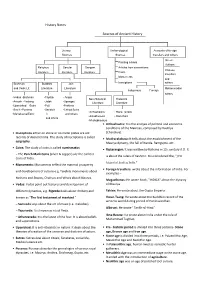
History Notes Sources of Ancient History Literary Archaeological Accounts of foreign Sources Sources travellers and writers Greek Painting & Idols Authors Religious Secular Sangam Articles from excavations Chinese literature literature literature Coins travellers Monuments and Inscriptions writers Brahman Buddhist Jain and Vedic Lit. Literature Literature Mohammadan Indigenous Foreign writers •Vedas •Brahman •Tripitak • Angas Non-Historical Historical •Arnyak •Vedang •Jatak •Upangas Literature Literature •Upanishad •Sutra •Pali •Prakirna •Smriti •Puranas •Sanskrit •Chhed Sutra •Arthashastra • Rajta rangini •Mahakavya(Epic) lit. and others •Astadhyayee • Ramcharit and others •M ahabhashya • Arthashastra: It is the analysis of political and economic conditions of the Mauryas, composed by Kautilya • Inscriptions either on stone or on metal plates are old (Chanakya). records of Ancient India. The study of inscriptions is called • Mudrarakshasa: It tells about the establishment of the epigraphy. Maurya dynasty, the fall of Nanda, Ramgupta, etc. • Coins: The study of coins is called numismatics. • Rajtarangini: It was written by Kalhana in 12th century A.D. It – The Punch Mark Coins (silver & copper) are the earliest is about the rulers of Kashmir. It is considered the, “first coins of India. historical book of India.” • Monuments: Monuments reflect the material prosperity • Foreign travellers: wrote about the information of India. For and development of culture e.g. Taxshila monuments about examples – Kushans and Stupas, Chaityas and Vihars about Maurya. Megasthenes: He wrote book, “INDICA” about the dynasty • Vedas: Vedas point out features and development of of Maurya. different dynasties, e.g. Rigveda deals about Archery and Fahien: He wrote about the Gupta Emperor. known as “The first testament of mankind.” Hieun-Tsang: He wrote about the Buddhist record of the western world during period of Harshavardhan. -

Central University of Punjab, Bathinda, Punjab
Central University of Punjab, Bathinda, Punjab Course Scheme For M.A. (History) 1 CENTRE FOR SOUTH AND CENTRAL ASIAN STUDIES (Including Historical Studies) Course structure-M.A. IN HISTORY % Weightage Semester I Marks Paper Course Title L T P Cr A B C D E Code HST. 501 Research F 4 0 0 4 25 25 25 25 100 Methodology HST. 503 Indian Political C 4 0 0 4 25 25 25 25 100 Thought HST. 504 Pre-History and C 4 0 0 4 25 25 25 25 100 Proto-History of India HST. 505 Ancient India C 4 0 0 4 25 25 25 25 100 (600BCE-300CE) HST. XXX Elective Course I E* 4 0 0 4 25 25 25 25 100 IDC. XXX Inter- E 2 0 0 2 15 10 10 15 50 Disciplinary/Open (O)** Elective HST. 599 Seminar C 0 0 0 2 15 10 10 15 50 TOTAL SEM I - 24 24 - 600 Elective Courses (Opt any one courses within the department) HST. 511 Art and Architecture E* 4 0 0 4 25 25 25 25 100 of Ancient India HST. 512 Early State and E* 4 0 0 4 25 25 25 25 100 Society in Ancient India Interdisciplinary Course/Open Elective Offered (For other Centers) HST. 521 Harrappan E 2 0 0 2 15 10 10 15 50 Civilization (O)** HST. 522 Religion in Ancient E 2 0 0 2 15 10 10 15 50 India (O)** 2 Semester II % Weightage Marks Paper Course Title L T P Cr A B C D E Code HST. -
ANCIENT INDIA All Bights Reserved ANCIENT INDIA
CORNELL UNIVERSITY LIBRARY Date ANCIENT INDIA All Bights reserved ANCIENT INDIA BY S. KRISHNASWAMI AIYANGAE, M.A. Member of the Royal Asiatic Society of Oreal Britain and Ireland Fellow of the Roijal Bistorical Society, London. Member ol the Board of Studies, and Examiner in History and Economics. Vnirersity of Madras Mysore Education Serria: WITH AN INTRODUCTION BY VINCENT A. SMITH, M.A., I.C.S. (retired) ' Author of the ' Early History of India LONDON: LUZAC & Co., IC great kussell isteeet MADEAS: S.P.C.K. DEPOSITORY, VEPBEY 1911 1)5 4-04- /\fl 6 ^,©XKg^ PRINTED AT THE :. PKESS, VEPBKY, MADRAS 1911 "^QXYS^ ) INSCRIBED TO THE :ME:M0RY OP JOHN WEIE [Inspector-General op Education in JIybore] ( November 1, 1909—July 31, 1911 Cornell University Library The original of tliis book is in tine Cornell University Library. There are no known copyright restrictions in the United States on the use of the text. http://www.archive.org/details/cu31924022968840 PEEFACE The first chapter deals with the early portion of Indian History, and so the title ' Ancient India ' has been given to the book. The other chapters deal with a variety ot subjects, and are based on lectures given on different occa- sions. One was originally prepared as my thesis for the M.A. Degree Examination of the University of Madras. The favourable reception given to my early work by historical and oriental scholars encouraged me to put my researches into a more permanent form, which a liberal grant from the Madras School Book and Literature Society has enabled me to do. -
Unit 10 Emergence of Rashtrakutas*
History of India from C. 300 C.E. to 1206 UNIT 10 EMERGENCE OF RASHTRAKUTAS* Structure 10.0 Objectives 10.1 Introduction 10.2 Historical Backgrounds of the Empire 10.3 The Rashtrakuta Empire 10.4 Disintegration of the Empire 10.5 Administration 10.6 Polity, Society, Religion, Literature 10.7 Summary 10.8 Key Words 10.9 Answers to Check Your Progress Exercises 10.10 Suggested Readings 10.0 OBJECTIVES In this Unit, we will discuss about the origin and emergence of the Rashtrakutas and the formation of Rashtrakuta empire. Later, we will also explore the organization and nature of Rashtrakuta state with social, religious, educational, cultural achievements during the Rashtrakutas. After studying the Unit, you will be able to learn about: major and minor kingdoms that were ruling over different territories of south India between 8th and 11th centuries; emergence of the Rashtrakutas as a dominant power in Deccan; the process of the formation of Rashtrakuta empire and contributions of different kings; the nature of early medieval polity and administration in the Deccan; significant components of the feudal political structure such as ideological bases, bureaucracy, military, control mechanism, villages etc.; and social, religious, educational, architectural and cultural developments within the Rashtrakuta empire. 10.1 INTRODUCTION India witnessed three powerful kingdoms between c. 750 and 1000 CE: Pala empire, Pratihara empire and Rashtrakuta empire in south India. These kingdoms fought each other to establish their respective hegemony which was the trend of early medieval India. Historian Noboru Karashima treats the empire as a new type of state, i.e. -
Unit 3 the Pushyabhutis and the Rise of Harsha*
History of India from C. 300 C.E. to 1206 UNIT 3 THE PUSHYABHUTIS AND THE RISE OF HARSHA* Structure 3.0 Objectives 3.1 Introduction 3.2 The Changing Political Scenario in North India 3.2.1 New Type of Political Centres: the Jayaskandhavaras 3.2.2 Kanauj as the New Political Centre 3.2.3 Decline of Pataliputra 3.3 The Pushyabhutis 3.4 The Political Activities of Harsha 3.4.1 Sources 3.4.2 Political Activities of Harsha: An Overview 3.4.3 The Extent of Harsha’s Kingdom 3.4.4 Xuan Zang’s Account 3.4.5 Harsha Era 3.4.6 End of Harsha’s Reign 3.5 The Changing Structure of Polity 3.5.1 Titles of Kings 3.5.2 Administration 3.5.3 Political Structure 3.6 Aftermath: The Tripartite Struggle for Kanauj 3.7 Summary 3.8 Key Words 3.9 Answers to Check Your Progress Exercises 3.10 Suggested Readings 3.0 OBJECTIVES After reading this Unit, you will be able to learn: how the political scenario of north India changed in the 5th-6th century CE; the emergence of new types of political centres – the Jayaskandhavaras; why Kanauj became the new political centre of North India; Harsha’s political activities; the extent of Harsha’s ‘empire’; the changing political structure of north India; and impact of the rise of Kanauj: the Tripartite struggle. 3.1 INTRODUCTION The political scenario in post-Gupta north India was characterised by the emergence of numerous ruling families like the Maukharis of Kanyakubja, later 34 *Dr. -

I. Some Problems of Ancient Indian History: No. III: the Gurjara Clans
JOURNAL THE ROYAL ASIATIC SOCIETY. i. SOME PROBLEMS OF ANCIENT INDIAN HISTORY. No. Ill: THE GURJARA CLANS. BY A. F. RUDOLF HOERNXE, PH.D., C.I.E. (Concluded from p. 662, October, 1904.) T HAVE already expressed my agreement with General Sir A. Cunningham's theory that the emperors of Kanauj were Tomaras. For the evidence, such as it is, I must refer to his Arch. Sun. Reports, vol. i, p. 132 ff. From this theory, in combination with that of Mr. Bhandarkar, it follows, of course, that the Tomaras were a clan of the Gurjara tribe. It is curious that the Tomaras are hardly ever mentioned in older records. There are, so far as I am aware, only two old inscriptions that name them. One is the Pehewa inscription (E.I. i, 244) of the time of Mahendrapala (c. 885-910 A.D.), and the other is the Harsha inscription (E.I. ii, 116) of the Chohan Vigraharaja, dated 973 A.D., which would fall into the reign of Vijayapala (c. 950 - 975 A.D.). Vigraharaja's great - grandfather Chandana is said to have defeated or slain (hatvd) a Tomara J.R.A.S. 1905. 1 Downloaded from https://www.cambridge.org/core. INSEAD, on 12 Oct 2018 at 17:18:34, subject to the Cambridge Core terms of use, available at https://www.cambridge.org/core/terms. https://doi.org/10.1017/S0035869X00032676 2 SOME PROBLEMS OF ANCIENT INDIAN HISTORY. lord (isa and bhupa) named Rudrena, and to have been a cause of terror (bhaija-da) to the sovereign (Ksitipati).