The Four Seasons + Gil Shaham
Total Page:16
File Type:pdf, Size:1020Kb
Load more
Recommended publications
-
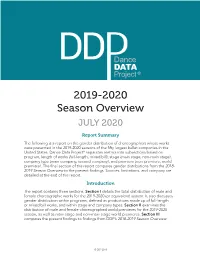
2019-2020 Season Overview JULY 2020
® 2019-2020 Season Overview JULY 2020 Report Summary The following is a report on the gender distribution of choreographers whose works were presented in the 2019-2020 seasons of the fifty largest ballet companies in the United States. Dance Data Project® separates metrics into subsections based on program, length of works (full-length, mixed bill), stage (main stage, non-main stage), company type (main company, second company), and premiere (non-premiere, world premiere). The final section of the report compares gender distributions from the 2018- 2019 Season Overview to the present findings. Sources, limitations, and company are detailed at the end of the report. Introduction The report contains three sections. Section I details the total distribution of male and female choreographic works for the 2019-2020 (or equivalent) season. It also discusses gender distribution within programs, defined as productions made up of full-length or mixed bill works, and within stage and company types. Section II examines the distribution of male and female-choreographed world premieres for the 2019-2020 season, as well as main stage and non-main stage world premieres. Section III compares the present findings to findings from DDP’s 2018-2019 Season Overview. © DDP 2019 Dance DATA 2019 - 2020 Season Overview Project] Primary Findings 2018-2019 2019-2020 Male Female n/a Male Female Both Programs 70% 4% 26% 62% 8% 30% All Works 81% 17% 2% 72% 26% 2% Full-Length Works 88% 8% 4% 83% 12% 5% Mixed Bill Works 79% 19% 2% 69% 30% 1% World Premieres 65% 34% 1% 55% 44% 1% Please note: This figure appears inSection III of the report. -

Grieg & Musical Life in England
Grieg & Musical Life in England LIONEL CARLEY There were, I would prop ose, four cornerstones in Grieg's relationship with English musicallife. The first had been laid long before his work had become familiar to English audiences, and the last was only set in place shortly before his death. My cornerstones are a metaphor for four very diverse and, you might well say, ve ry un-English people: a Bohemian viol inist, a Russian violinist, a composer of German parentage, and an Australian pianist. Were we to take a snapshot of May 1906, when Grieg was last in England, we would find Wilma Neruda, Adolf Brodsky and Percy Grainger all established as significant figures in English musicallife. Frederick Delius, on the other hand, the only one of thi s foursome who had actually been born in England, had long since left the country. These, then, were the four major musical personalities, each having his or her individual and intimate connexion with England, with whom Grieg established lasting friendships. There were, of course, others who com prised - if I may continue and then finally lay to rest my architectural metaphor - major building blocks in the Grieg/England edifice. But this secondary group, people like Francesco Berger, George Augener, Stop ford Augustus Brooke, for all their undoubted human charms, were firs t and foremost representatives of British institutions which in their own turn played an important role in Grieg's life: the musical establishment, publishing, and, perhaps unexpectedly religion. Francesco Berger (1834-1933) was Secretary of the Philharmonic Soci ety between 1884 and 1911, and it was the Philharmonic that had first prevailed upon the mature Grieg to come to London - in May 1888 - and to perform some of his own works in the capital. -

ANNUAL REPORT 2019/20 Fadi Kheir Fadi LETTERS from the LEADERSHIP
ANNUAL REPORT 2019/20 Fadi Kheir Fadi LETTERS FROM THE LEADERSHIP The New York Philharmonic’s 2019–20 season certainly saw it all. We recall the remarkable performances ranging from Berlioz to Beethoven, with special pride in the launch of Project 19 — the single largest commissioning program ever created for women composers — honoring the ratification of the 19th Amendment. Together with Lincoln Center we unveiled specific plans for the renovation and re-opening of David Geffen Hall, which will have both great acoustics and also public spaces that can welcome the community. In March came the shock of a worldwide pandemic hurtling down the tracks at us, and on the 10th we played what was to be our final concert of the season. Like all New Yorkers, we tried to come to grips with the life-changing ramifications The Philharmonic responded quickly and in one week created NY Phil Plays On, a portal to hundreds of hours of past performances, to offer joy, pleasure, solace, and comfort in the only way we could. In August we launched NY Phil Bandwagon, bringing live music back to New York. Bandwagon presented 81 concerts from Chris Lee midtown to the far reaches of every one of the five boroughs. In the wake of the Erin Baiano horrific deaths of Black men and women, and the realization that we must all participate to change society, we began the hard work of self-evaluation to create a Philharmonic that is truly equitable, diverse, and inclusive. The severe financial challenge caused by cancelling fully a third of our 2019–20 concerts resulting in the loss of $10 million is obvious. -

Lionel Bringuier
Lionel Bringuier Conductor French conductor Lionel Bringuier is one of the most engaging conductors of his generation, heralded for his artistic maturity, emotional insight, and insightful programming. He appears frequently with the world’s preeminent orchestras, and regularly collaborates with top solo artists both in concert and on critically lauded recordings. During the 2017/2018 season, Mr. Bringuier will make two appearances with the Orchestre National de Lyon, in November 2017 and May 2018. The season also includes engagements with the Leipzig Gewandhaus Orchestra, Chicago Symphony Orchestra, Orchestre Philharmonique de Radio France, Montreal Symphony Orchestra, Finnish & Swedish Radio Symphony Orchestras, Gothenburg Symphony Orchestra, Orquesta Sinfonica de Castilla y León, Gulbenkian Symphony Orchestra, and Malaysian Philharmonic, among others. Bringuier makes his seasonal return to the Los Angeles Philharmonic in March 2018, with a programme featuring Dvorak, Symphony No.8. Mr. Bringuier’s other programmes this season feature a vast range of repertoire; additional highlights include Dutilleux’ Symphony No. 1, Lutosławski’s Les espaces de sommeil, and Brett Dean’s Amphitheatre, alongside works by Shostakovich, Ravel, Salonen, Gruber, Varèse, Berlioz, and more. Bringuier has appeared as a guest conductor with the New York Philharmonic, Cleveland Orchestra, Munich Philharmonic, Simón Bolívar Symphony Orchestra of Venezuela, Philharmonia Orchestra, and Israel Philharmonic Orchestra. Named Chief Conductor and Music Director of the Tonhalle Orchestra Zurich in 2012, he now enters his seventh season working with the ensemble. Mr. Bringuier and the TOZ will embark on a multi- city tour throughout Europe in April 2018, with pianist Igor Levit as soloist. Following the landmark inauguration of the Creative Chair Initiative for the Tonhalle Orchestra Zurich in his first season, Lionel Bringuier will collaborate with the composer Brett Dean this year. -
What Handel Taught the Viennese About the Trombone
291 What Handel Taught the Viennese about the Trombone David M. Guion Vienna became the musical capital of the world in the late eighteenth century, largely because its composers so successfully adapted and blended the best of the various national styles: German, Italian, French, and, yes, English. Handel’s oratorios were well known to the Viennese and very influential.1 His influence extended even to the way most of the greatest of them wrote trombone parts. It is well known that Viennese composers used the trombone extensively at a time when it was little used elsewhere in the world. While Fux, Caldara, and their contemporaries were using the trombone not only routinely to double the chorus in their liturgical music and sacred dramas, but also frequently as a solo instrument, composers elsewhere used it sparingly if at all. The trombone was virtually unknown in France. It had disappeared from German courts and was no longer automatically used by composers working in German towns. J.S. Bach used the trombone in only fifteen of his more than 200 extant cantatas. Trombonists were on the payroll of San Petronio in Bologna as late as 1729, apparently longer than in most major Italian churches, and in the town band (Concerto Palatino) until 1779. But they were available in England only between about 1738 and 1741. Handel called for them in Saul and Israel in Egypt. It is my contention that the influence of these two oratorios on Gluck and Haydn changed the way Viennese composers wrote trombone parts. Fux, Caldara, and the generations that followed used trombones only in church music and oratorios. -

2020-21 Season Brochure
2020 SEA- This year. This season. This orchestra. This music director. Our This performance. This artist. World This moment. This breath. This breath. 2021 SON This breath. Don’t blink. ThePhiladelphiaOrchestra MUSIC DIRECTOR YANNICK NÉZET-SÉGUIN our world Ours is a world divided. And yet, night after night, live music brings audiences together, gifting them with a shared experience. This season, Music Director Yannick Nézet-Séguin and The Philadelphia Orchestra invite you to experience the transformative power of fellowship through a bold exploration of sound. 2 2020–21 Season 3 “For me, music is more than an art form. It’s an artistic force connecting us to each other and to the world around us. I love that our concerts create a space for people to gather as a community—to explore and experience an incredible spectrum of music. Sometimes, we spend an evening in the concert hall together, and it’s simply some hours of joy and beauty. Other times there may be an additional purpose, music in dialogue with an issue or an idea, maybe historic or current, or even a thought that is still not fully formed in our minds and hearts. What’s wonderful is that music gives voice to ideas and feelings that words alone do not; it touches all aspects of our being. Music inspires us to reflect deeply, and music brings us great joy, and so much more. In the end, music connects us more deeply to Our World NOW.” —Yannick Nézet-Séguin 4 2020–21 Season 5 philorch.org / 215.893.1955 6A Thursday Yannick Leads Return to Brahms and Ravel Favorites the Academy Garrick Ohlsson Thursday, October 1 / 7:30 PM Thursday, January 21 / 7:30 PM Thursday, March 25 / 7:30 PM Academy of Music, Philadelphia Yannick Nézet-Séguin Conductor Michael Tilson Thomas Conductor Lisa Batiashvili Violin Yannick Nézet-Séguin Conductor Garrick Ohlsson Piano Hai-Ye Ni Cello Westminster Symphonic Choir Ravel Le Tombeau de Couperin Joe Miller Director Szymanowski Violin Concerto No. -
Beyond the Storm
Pamela J. Marshall Beyond the Storm oboe collection of Poetry-Inspired Solos PREVIEWSpindrift Music Company www.spindrift.com Publishing contemporary classical music and promoting its performance and appreciation collection of Poetry-Inspired Solos Beyond the Storm by Pamela J. Marshall for oboe La Mer by Oscar Wilde (1854-1900) From Poems, 1881 A white mist drifts across the shrouds, A wild moon in this wintry sky Gleams like an angry lion's eye Out of a mane of tawny clouds. The muffled steersman at the wheel Is but a shadow in the gloom;-- And in the throbbing engine-room Leap the long rods of polished steel. The shattered storm has left its trace Upon this huge and heaving dome, For the thin threads of yellow foam Float on the waves like ravelled lace. PREVIEWSpindrift Music Company www.spindrift.com aer "La Mer" by Oscar Wilde Beyond the Storm Pamela J. Marshall Andante misterioso, con licenza q = 86 Oboe p p mp pp mp pp 2 p pp mp 4 (like a throbbing engine) 5 (as if two voices, staccato notes extremely clipped) 11 mp pp 15 18 mp pp pp 21 pp mp 26 mp 27 PREVIEW Copyright © 2007 Pamela J. Marshall 28 mf 29 f 33 mf 38 p mp 43 mf 48 mp 51 pp 54 mp p 57 p mf 61 PREVIEWmp 64 p ppp 2 Spindrift Music Company Publishing contemporary classical music and promoting its performance and appreciation 38 Dexter Road Lexington MA 02420-3304 USA 781-862-0884 info@spindrift.com www.spindrift.com Selected Music by Pamela J. -

Ballet? Y First the Ballerina Glides Across the Stage, Her Arms M Making Lovely Lines in the Air
My First alle B Album t What is Ballet? Firs The ballerina glides across the stage, her arms My t making lovely lines in the air. A beautiful tune comes from the strings of the large orchestra. She is the Sleeping Beauty: she was put into a allet deep magic sleep by the wicked witch. But she B lbum has now been woken by her handsome prince, A and he dances joyfully with her, athletic and strong. Another time, she is Princess Odette from Swan Lake, and around her the other dancers – swans in white chiffon – weave patterns in time to the music. And yet another time, she is the Sugar Plum Fairy celebrating the joy of Christmas in The Nutcracker. This is ballet, the classical dance that, once seen, is never forgotten. Even though today we have film and video games, ballet is still a powerful vision of beauty and excitement. The dancers use the strength of an athlete, the balance of a gymnast and the sensitivity of a violinist to tell stories through their dancing. Here is some of the best music which has propelled dancers for hundreds of years. 2 Tchaikovsky Swan Lake Stravinsky The Firebird 1 Scene 2:37 3 Scene I. The Firebird’s Dance 1:19 Keyword: Oboe Keyword: Fire Swan Lake is a ballet from Russia about a prince called Siegfried. In the forest he finds A firebird is a brightly coloured magical bird that comes a mysterious lake where swans are swimming, led by a beautiful but sad swan wearing out of the fire. -

Adapting Piano Music for Ballet: Tchaikovsky's Children's Album, Op
Adapting Piano Music for Ballet: Tchaikovsky's Children's Album, Op. 39 Item Type text; Electronic Dissertation Authors Stavrianou, Eleni Persefoni Citation Stavrianou, Eleni Persefoni. (2021). Adapting Piano Music for Ballet: Tchaikovsky's Children's Album, Op. 39 (Doctoral dissertation, University of Arizona, Tucson, USA). Publisher The University of Arizona. Rights Copyright © is held by the author. Digital access to this material is made possible by the University Libraries, University of Arizona. Further transmission, reproduction, presentation (such as public display or performance) of protected items is prohibited except with permission of the author. Download date 06/10/2021 04:39:03 Item License http://rightsstatements.org/vocab/InC/1.0/ Link to Item http://hdl.handle.net/10150/660266 ADAPTING PIANO MUSIC FOR BALLET: TCHAIKOVSKY’S CHILDREN’S ALBUM, OP. 39 by Eleni Persefoni Stavrianou ____________________________________ Copyright © Eleni Persefoni Stavrianou 2021 A DMA Critical Essay Submitted to the Faculty of the FRED FOX SCHOOL OF MUSIC In Partial Fulfillment of the Requirements For the Degree of DOCTOR OF MUSICAL ARTS In the Graduate College THE UNIVERSITY OF ARIZONA 2021 2 THE UNIVERSITY OF ARIZONA GRADUATE COLLEGE As members of the Doctor of Musical Arts Creative Project and Lecture-Recital Committee, we certify that we have read the Critical Essay prepared by: titled: and recommend that it be accepted as fulfilling the Critical Essay requirement for the Degree of Doctor of Musical Arts. _________________________________________________________________ Date: ____________ _________________________________________________________________ Date: ____________ _________________________________________________________________ Date: ____________ submission of the final copies of the essay to the Graduate College. I hereby certify that I have read this Critical Essay prepared under my direction and recommend that it be accepted as fulfilling the Critical Essay requirement. -

Christianialiv
Christianialiv Works from Norway’s Golden Age of wind music Christianialiv The Staff Band of the Norwegian Armed Forces The second half of the 19th century is often called the “Golden Age” of Norwegian music. The reason lies partly in the international reputations established by Johan Svendsen and Edvard Grieg, but it also lies in the fact that musical life in Norway, at a time of population growth and economic expansion, enjoyed a period of huge vitality and creativity, responding to a growing demand for music in every genre. The Staff Band of the Norwegian Armed Forces (to use its modern name) played a key role in this burgeoning musical life not just by performing music for all sections of society, but also by discovering and fostering musical talent in performers and composers. Johan Svendsen, Adolf Hansen, Ole Olsen and Alfred Evensen, whose music we hear on this album, can therefore be called part of the band’s history. Siste del av 1800-tallet er ofte blitt kalt «gullalderen» i norsk musikk. Det skyldes ikke bare Svendsens og Griegs internasjonale posisjon, men også det faktum at musikklivet i takt med befolkningsøkning og økonomiske oppgangstider gikk inn i en glansperiode med et sterkt behov for musikk i alle sjangre. I denne utviklingen spilte Forsvarets stabsmusikkorps en sentral rolle, ikke bare som formidler av musikkopplevelser til alle lag av befolkningen, men også som talentskole for utøvere og komponister. Johan Svendsen, Adolf Hansen, Ole Olsen og Alfred Evensen er derfor en del av korpsets egen musikkhistorie. The Staff Band of the Norwegian Armed Forces / Ole Kristian Ruud Recorded in DXD 24bit/352.8kHz 5.1 DTS HD MA 24/192kHz 2.0 LPCM 24/192kHz + MP3 and FLAC EAN13: 7041888519027 q e 101 2L-101-SABD made in Norway 20©14 Lindberg Lyd AS 7 041888 519027 Johan Svendsen (1840-1911) Symfoni nr. -

Indianapolis Symphony Orchestra Announces 2016-2017 Season
Tuesday, March 1, 2016 Contact: Lisa Vielee, media@indianapolissymphony.org Indianapolis Symphony Orchestra announces 2016-2017 season Music Director Krzysztof Urbański programs major works by Beethoven, Brahms, Mozart, Bartók plus a midwinter ”Music of the Earth” festival Distinguished guest conductors include Bernard Labadie, Edo de Waart, Roberto Abbado, Jun Märkl and Matthias Pintscher; renowned soloists include Hilary Hahn, André Watts, the Labèque Sisters and Gil Shaham ISO commissions and premieres Dejan Lazić’s symphonic poem, Mozart and Salieri, in a concert devoted to the one of the greatest rivalries in classical music Former ISO music directors John Nelson and Raymond Leppard make return appearances ISO Principal Pops Conductor Jack Everly’s Pops Series includes Indiana Jones: Raiders of the Lost Ark Film + Orchestra, trumpeter Chris Botti and the world premiere of The Doo Wop Project Jack Everly conducts the ISO’s Opening Night Gala and pays tribute to the Hilbert Circle Theatre’s 100th anniversary and Indiana’s bicentennial INDIANAPOLIS – The Indianapolis Symphony Orchestra today announced its 87th season of classical and pops concerts at the ISO’s historic home venue, the Hilbert Circle Theatre. The 2016-2017 season runs from September 15-June 10 and features an array of repertoire, programs, world premieres and a special tribute to the theater’s 100th anniversary. In his sixth season with the ISO, Music Director Krzysztof Urbański has programmed large-scale masterworks, including Beethoven’s Seventh Symphony, Brahms’ German Requiem, Mahler’s First Symphony (“Titan”) and Bartók’s Concerto for Orchestra, and will collaborate with several admired soloists, including violinist Hilary Hahn and pianist André Watts. -

Vivaldi's Four Seasons
Vivaldi's Four Seasons Paul Dyer AO Artistic Director 2019 Australian Brandenburg Orchestra SYDNEY PROGRAM City Recital Hall Telemann Concerto for 4 Violins in G major, TWV 40:201 Friday 1 November 7:00PM Directed by Matthew Bruce, Baroque violin Saturday 2 November 2:00PM Telemann Ouverture-Suite in C major, Water Music, TWV 55:C3 (Matinee) Directed by Ben Dollman, Baroque violin Saturday 2 November 7:00PM i Ouverture Wednesday 6 November 7:00PM ii Sarabande. Die schlafende Thetis (The sleeping Thetis) Wednesday 13 November 7:00PM iii Bourée. Die erwachende Thetis (Thetis awakening) Friday 15 November 7:00PM iv Loure. Der verliebte Neptunus (Neptune in love) Parramatta (Riverside Theatres) v Gavotte. Die spielenden Najaden (Playing Naiads) Monday 4 November 7:00pm vi Harlequinade. Der scherzenden Tritonen (The joking Triton) vii Der stürmende Aeolus (The stormy Aeolus) MELBOURNE viii Menuet. Der angenehme Zephir (The pleasant Zephir) Melbourne Recital Centre ix Gigue. Ebbe und Fluth (Ebb and Flow) Saturday 9 November 7:00PM x Canarie. Die lustigen Bots Leute (The merry Boat People) Sunday 10 November 5:00PM Interval Vivaldi Le Quattro Stagioni (The Four Seasons), Op. 8 No. 1-4 Solo Baroque violin, Shaun Lee-Chen Concerto No. 1 La primavera (Spring), RV 269 i Allegro ii Largo iii Allegro Concerto No. 2 L’estate (Summer), RV 315 i Allegro non molto–Allegro ii Adagio–Presto–Adagio iii Presto Concerto No. 3 L’autunno (Autumn), RV 293 i Allegro ii Adagio molto iii Allegro Concerto No. 4 L’inverno (Winter), RV 297 i Allegro non molto ii Largo iii Allegro CHAIRMAN’S 11 Proudly supporting our guest artists.