Zootaxa, a New Species of Toad
Total Page:16
File Type:pdf, Size:1020Kb
Load more
Recommended publications
-

A Collection of Amphibians from Río San Juan, Southeastern Nicaragua
See discussions, stats, and author profiles for this publication at: https://www.researchgate.net/publication/264789493 A collection of amphibians from Río San Juan, southeastern Nicaragua Article in Herpetology Notes · January 2009 CITATIONS READS 12 188 4 authors, including: Javier Sunyer Matthias Dehling University of Canterbury 89 PUBLICATIONS 209 CITATIONS 54 PUBLICATIONS 967 CITATIONS SEE PROFILE SEE PROFILE Gunther Köhler Senckenberg Research Institute 222 PUBLICATIONS 1,617 CITATIONS SEE PROFILE Some of the authors of this publication are also working on these related projects: Zoological Research in Strict Forest Reserves in Hesse, Germany View project Diploma Thesis View project All content following this page was uploaded by Javier Sunyer on 16 August 2018. The user has requested enhancement of the downloaded file. Herpetology Notes, volume 2: 189-202 (2009) (published online on 29 October 2009) A collection of amphibians from Río San Juan, southeastern Nicaragua Javier Sunyer1,2,3*, Guillermo Páiz4, David Matthias Dehling1, Gunther Köhler1 Abstract. We report upon the amphibians collected during seven expeditions carried out between the years 2000–2006 to thirteen localities in both Refugio de Vida Silvestre Río San Juan and Reserva Biológica Indio-Maíz, southeastern Nicaragua. We include morphometric data of around one-half of the adult specimens in the collection, and provide a brief general overview and discuss zoogeographic and conservation considerations of the amphibians known to occur in the Río San Juan area. Keywords. Amphibia, conservation, ecology, morphometry, zoogeography. Introduction potential of holding America’s first interoceanic channel and also because it was part of the sea route to travel The San Juan River is an approximately 200 km slow- from eastern to western United States. -

Myxozoan and Helminth Parasites of the Dwarf American Toad, Anaxyrus Americanus Charlesmithi (Anura: Bufonidae), from Arkansas and Oklahoma Chris T
51 Myxozoan and Helminth Parasites of the Dwarf American Toad, Anaxyrus americanus charlesmithi (Anura: Bufonidae), from Arkansas and Oklahoma Chris T. McAllister Science and Mathematics Division, Eastern Oklahoma State College, Idabel, OK 74745 Charles R. Bursey Department of Biology, Pennsylvania State University-Shenango Campus, Sharon, PA 16146 Matthew B. Connior Health and Natural Sciences, South Arkansas Community College, El Dorado, AR 71730 Stanley E. Trauth Department of Biological Sciences, Arkansas State University, State University, AR 72467 Abstract: We examined 69 dwarf American toads, Anaxyrus americanus charlesmithi, from McCurtain County, Oklahoma (n = 37) and Miller, Nevada and Union counties, Arkansas (n = 32) for myxozoan and helminth parasites. The following endoparasites were found: a myxozoan, Cystodiscus sp., a trematode, Clinostomum marginatum, two tapeworms, Cylindrotaenia americana (Oklahoma only) and Distoichometra bufonis, five nematodes, acuariid larvae, Cosmocercoides variabilis, Oswaldocruzia pipiens, larval Physaloptera sp. (Arkansas only), and Rhabdias americanus (Arkansas only), and acanthocephalans (Oklahoma only). We document six new host and four new geographic distribution records for these select parasites.©2014 Oklahoma Academy of Science Introduction (McAllister et al. 2008), Cosmocercoides The dwarf American toad, Anaxyrus variabilis (McAllister and Bursey 2012a) and americanus charlesmithi, is a small anuran tetrathyridia of Mesocestoides sp. (McAllister that ranges from southwestern Indiana and et al. 2014c) from A. a. charlesmithi from southern Illinois south through central Arkansas, and Clinostomum marginatum from Missouri, western Kentucky and Tennessee, dwarf American toads from Oklahoma (Cross and all of Arkansas, to eastern Oklahoma and and Hranitz 2000). In addition, Langford and northeastern Texas (Conant and Collins 1998). Janovy (2013) reported Rhabdias americanus It occurs in various habitats, from suburban from A. -

Amphibian Alliance for Zero Extinction Sites in Chiapas and Oaxaca
Amphibian Alliance for Zero Extinction Sites in Chiapas and Oaxaca John F. Lamoreux, Meghan W. McKnight, and Rodolfo Cabrera Hernandez Occasional Paper of the IUCN Species Survival Commission No. 53 Amphibian Alliance for Zero Extinction Sites in Chiapas and Oaxaca John F. Lamoreux, Meghan W. McKnight, and Rodolfo Cabrera Hernandez Occasional Paper of the IUCN Species Survival Commission No. 53 The designation of geographical entities in this book, and the presentation of the material, do not imply the expression of any opinion whatsoever on the part of IUCN concerning the legal status of any country, territory, or area, or of its authorities, or concerning the delimitation of its frontiers or boundaries. The views expressed in this publication do not necessarily reflect those of IUCN or other participating organizations. Published by: IUCN, Gland, Switzerland Copyright: © 2015 International Union for Conservation of Nature and Natural Resources Reproduction of this publication for educational or other non-commercial purposes is authorized without prior written permission from the copyright holder provided the source is fully acknowledged. Reproduction of this publication for resale or other commercial purposes is prohibited without prior written permission of the copyright holder. Citation: Lamoreux, J. F., McKnight, M. W., and R. Cabrera Hernandez (2015). Amphibian Alliance for Zero Extinction Sites in Chiapas and Oaxaca. Gland, Switzerland: IUCN. xxiv + 320pp. ISBN: 978-2-8317-1717-3 DOI: 10.2305/IUCN.CH.2015.SSC-OP.53.en Cover photographs: Totontepec landscape; new Plectrohyla species, Ixalotriton niger, Concepción Pápalo, Thorius minutissimus, Craugastor pozo (panels, left to right) Back cover photograph: Collecting in Chamula, Chiapas Photo credits: The cover photographs were taken by the authors under grant agreements with the two main project funders: NGS and CEPF. -
Multi-National Conservation of Alligator Lizards
MULTI-NATIONAL CONSERVATION OF ALLIGATOR LIZARDS: APPLIED SOCIOECOLOGICAL LESSONS FROM A FLAGSHIP GROUP by ADAM G. CLAUSE (Under the Direction of John Maerz) ABSTRACT The Anthropocene is defined by unprecedented human influence on the biosphere. Integrative conservation recognizes this inextricable coupling of human and natural systems, and mobilizes multiple epistemologies to seek equitable, enduring solutions to complex socioecological issues. Although a central motivation of global conservation practice is to protect at-risk species, such organisms may be the subject of competing social perspectives that can impede robust interventions. Furthermore, imperiled species are often chronically understudied, which prevents the immediate application of data-driven quantitative modeling approaches in conservation decision making. Instead, real-world management goals are regularly prioritized on the basis of expert opinion. Here, I explore how an organismal natural history perspective, when grounded in a critique of established human judgements, can help resolve socioecological conflicts and contextualize perceived threats related to threatened species conservation and policy development. To achieve this, I leverage a multi-national system anchored by a diverse, enigmatic, and often endangered New World clade: alligator lizards. Using a threat analysis and status assessment, I show that one recent petition to list a California alligator lizard, Elgaria panamintina, under the US Endangered Species Act often contradicts the best available science. -
For Review Only
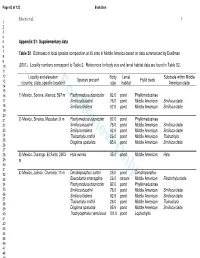
Page 63 of 123 Evolution Moen et al. 1 1 2 3 4 5 Appendix S1: Supplementary data 6 7 Table S1 . Estimates of local species composition at 39 sites in Middle America based on data summarized by Duellman 8 9 10 (2001). Locality numbers correspond to Table 2. References for body size and larval habitat data are found in Table S2. 11 12 Locality and elevation Body Larval Subclade within Middle Species present Hylid clade 13 (country, state, specific location)For Reviewsize Only habitat American clade 14 15 16 1) Mexico, Sonora, Alamos; 597 m Pachymedusa dacnicolor 82.6 pond Phyllomedusinae 17 Smilisca baudinii 76.0 pond Middle American Smilisca clade 18 Smilisca fodiens 62.6 pond Middle American Smilisca clade 19 20 21 2) Mexico, Sinaloa, Mazatlan; 9 m Pachymedusa dacnicolor 82.6 pond Phyllomedusinae 22 Smilisca baudinii 76.0 pond Middle American Smilisca clade 23 Smilisca fodiens 62.6 pond Middle American Smilisca clade 24 Tlalocohyla smithii 26.0 pond Middle American Tlalocohyla 25 Diaglena spatulata 85.9 pond Middle American Smilisca clade 26 27 28 3) Mexico, Durango, El Salto; 2603 Hyla eximia 35.0 pond Middle American Hyla 29 m 30 31 32 4) Mexico, Jalisco, Chamela; 11 m Dendropsophus sartori 26.0 pond Dendropsophus 33 Exerodonta smaragdina 26.0 stream Middle American Plectrohyla clade 34 Pachymedusa dacnicolor 82.6 pond Phyllomedusinae 35 Smilisca baudinii 76.0 pond Middle American Smilisca clade 36 Smilisca fodiens 62.6 pond Middle American Smilisca clade 37 38 Tlalocohyla smithii 26.0 pond Middle American Tlalocohyla 39 Diaglena spatulata 85.9 pond Middle American Smilisca clade 40 Trachycephalus venulosus 101.0 pond Lophiohylini 41 42 43 44 45 46 47 48 49 50 51 52 53 54 55 56 57 58 59 60 Evolution Page 64 of 123 Moen et al. -

The Most Frog-Diverse Place in Middle America, with Notes on The
Offcial journal website: Amphibian & Reptile Conservation amphibian-reptile-conservation.org 13(2) [Special Section]: 304–322 (e215). The most frog-diverse place in Middle America, with notes on the conservation status of eight threatened species of amphibians 1,2,*José Andrés Salazar-Zúñiga, 1,2,3Wagner Chaves-Acuña, 2Gerardo Chaves, 1Alejandro Acuña, 1,2Juan Ignacio Abarca-Odio, 1,4Javier Lobon-Rovira, 1,2Edwin Gómez-Méndez, 1,2Ana Cecilia Gutiérrez-Vannucchi, and 2Federico Bolaños 1Veragua Foundation for Rainforest Research, Limón, COSTA RICA 2Escuela de Biología, Universidad de Costa Rica, San Pedro, 11501-2060 San José, COSTA RICA 3División Herpetología, Museo Argentino de Ciencias Naturales ‘‘Bernardino Rivadavia’’-CONICET, C1405DJR, Buenos Aires, ARGENTINA 4CIBIO Research Centre in Biodiversity and Genetic Resources, InBIO, Universidade do Porto, Campus Agrário de Vairão, Rua Padre Armando Quintas 7, 4485-661 Vairão, Vila do Conde, PORTUGAL Abstract.—Regarding amphibians, Costa Rica exhibits the greatest species richness per unit area in Middle America, with a total of 215 species reported to date. However, this number is likely an underestimate due to the presence of many unexplored areas that are diffcult to access. Between 2012 and 2017, a monitoring survey of amphibians was conducted in the Central Caribbean of Costa Rica, on the northern edge of the Matama mountains in the Talamanca mountain range, to study the distribution patterns and natural history of species across this region, particularly those considered as endangered by the International Union for Conservation of Nature. The results show the highest amphibian species richness among Middle America lowland evergreen forests, with a notable anuran representation of 64 species. -

FEMALE PERSPECTIVES on BREEDING PHENOLOGY in EASTERN ONTARIO GRAY TREEFROGS by HAYLEY JENNIFER ROBERTS a Thesis Submitted To
FEMALE PERSPECTIVES ON BREEDING PHENOLOGY IN EASTERN ONTARIO GRAY TREEFROGS by HAYLEY JENNIFER ROBERTS A thesis submitted to the Department of Biology in conformity with the requirements for the degree of Master of Science Queen’s University Kingston, Ontario, Canada (September 2015) Copyright © Hayley Jennifer Roberts, 2015 This work is licensed under a Creative Commons Attribution 4.0 International License Abstract Studies of the forces that shape local adaptation contribute to our understanding of origins of range-wide variation, speciation, and potential responses to changing environments. Phenology is an important component of such local adaptation. Phenological research is central to studies of geographical range limits and species distributions, migration, speciation, response to climate change and ex situ conservation and re-introduction programs. Despite over 22,000 phenological studies published thus far, there is a lack of phenological information on reproductive patterns of temperate anurans, particularly for females. My thesis therefore focuses on gaining insights into temperate frog phenology primarily of females, and patterns of female choice. I focus on Hyla versicolor (Gray Treefrogs), an Eastern North American temperate frog. My data come from perimeter transect surveys done at two wetlands at the Queen’s University Biological Station over the entire 2014 breeding season. I compared male and female peak abundance using an N- mixture model. Both males and females peaked on Julian Day 154 (June 3rd 2014). Females arrived three days after males in my focal wetlands, and left three days before. Timing of arrival is most likely based on a combination of females responding to male advertisement calls, and both sexes responding to abiotic factors (e.g. -

Rapid Pace of Species Extinctions Mounts to a 'Crisis'
Rapid Pace of Species Extinctions Mounts to a 'Crisis' GLAND, Switzerland, November 3, 2009 (ENS) - Nearly one-third of all known species of plants and animals are threatened with extinction, finds the International Union for the Conservation of Nature, IUCN, in the most recent update of its authoritative Red List of Threatened Species� issued today. The updated assessment shows that 17,291 species out of the 47,677 assessed species are threatened with extinction. "The scientific evidence of a serious extinction crisis is mounting," warns Jane Smart, director of IUCN's Biodiversity Conservation Group. The IUCN finds that 21 percent of all known mammals, 30 percent of all known amphibians, 12 percent of all known birds, and 28 percent of reptiles, 37 percent of freshwater fishes, 70 percent of plants, 35 percent of invertebrates assessed so far are at risk. "This year's IUCN Red List makes for sobering reading," says Craig Hilton-Taylor, manager of the IUCN Red List Unit. "These results are just the tip of the iceberg. We have only managed to assess 47,663 species so far; there are many more millions out there which could be under serious threat." "We do, however, know from experience that conservation action works so let's not wait until it's too late and start saving our species now," urged Hilton- Taylor. Threatened by climate change, the hooded grebe, Podiceps gallardoi, of Argentina, was "January sees the launch of the International Year of uplisted from Near Threatened to Biodiversity, said Smart. "The latest analysis of the Endangered in 2009. -

Rhinella Marina and Incilius Valliceps (Anura: Bufonidae)
Available online at www.sciencedirect.com Revista Mexicana de Biodiversidad Revista Mexicana de Biodiversidad 88 (2017) 365–371 www.ib.unam.mx/revista/ Ecology Helminth diversity of two anurans: Rhinella marina and Incilius valliceps (Anura: Bufonidae) from lagunas de Yalahau, Yucatán, Mexico Diversidad de helmintos de dos anuros: Rhinella marina e Incilius valliceps (Anura: Bufonidae) de las lagunas de Yalahau, Yucatán, México a b,∗ b Juan F. Espínola-Novelo , Sergio Guillén-Hernández , Carlos F. González-Salas , c Azucena Canto a Programa de Doctorado en Ciencias Aplicadas, Mención Sistemas Marinos Costeros, Facultad de Ciencias del Mar y Recursos Biológicos, Universidad de Antofagasta, Antofagasta, Casilla 170, Chile b Departamento de Biología Marina, Facultad de Medicina Veterinaria y Zootecnia, Universidad Autónoma de Yucatán, Carretera Mérida-Xmatkuil, Km 15.5, Apartado Postal 4-116, 97100 Itzimná, Mérida, Yucatán, Mexico c Centro de Investigación Científica de Yucatán, A.C. Calle 43 Núm. 130 Chuburná de Hidalgo, 97200 Mérida, Yucatán, Mexico Received 3 August 2016; accepted 8 February 2017 Available online 3 May 2017 Abstract Helminth communities in amphibians in Mexico have received little attention. During 2005 and 2006, we collected a total of 52 individuals of the marine toad (Rhinella marina) and 54 of the southern Gulf Coast toad (Incilius valliceps) in the Lagunas de Yalahau (Yucatán, Mexico), in order to study their helminth communities. We produced rarefaction and extrapolation sample-size-based and coverage-based curves to provide asymptotic diversity estimators based on Hill numbers to compare the communities. We calculated the first 3 Hill numbers, which are associated with estimators of species richness and species dominance. -

Taxonomic Checklist of Amphibian Species Listed in the CITES
CoP17 Doc. 81.1 Annex 5 (English only / Únicamente en inglés / Seulement en anglais) Taxonomic Checklist of Amphibian Species listed in the CITES Appendices and the Annexes of EC Regulation 338/97 Species information extracted from FROST, D. R. (2015) "Amphibian Species of the World, an online Reference" V. 6.0 (as of May 2015) Copyright © 1998-2015, Darrel Frost and TheAmericanMuseum of Natural History. All Rights Reserved. Additional comments included by the Nomenclature Specialist of the CITES Animals Committee (indicated by "NC comment") Reproduction for commercial purposes prohibited. CoP17 Doc. 81.1 Annex 5 - p. 1 Amphibian Species covered by this Checklist listed by listed by CITES EC- as well as Family Species Regulation EC 338/97 Regulation only 338/97 ANURA Aromobatidae Allobates femoralis X Aromobatidae Allobates hodli X Aromobatidae Allobates myersi X Aromobatidae Allobates zaparo X Aromobatidae Anomaloglossus rufulus X Bufonidae Altiphrynoides malcolmi X Bufonidae Altiphrynoides osgoodi X Bufonidae Amietophrynus channingi X Bufonidae Amietophrynus superciliaris X Bufonidae Atelopus zeteki X Bufonidae Incilius periglenes X Bufonidae Nectophrynoides asperginis X Bufonidae Nectophrynoides cryptus X Bufonidae Nectophrynoides frontierei X Bufonidae Nectophrynoides laevis X Bufonidae Nectophrynoides laticeps X Bufonidae Nectophrynoides minutus X Bufonidae Nectophrynoides paulae X Bufonidae Nectophrynoides poyntoni X Bufonidae Nectophrynoides pseudotornieri X Bufonidae Nectophrynoides tornieri X Bufonidae Nectophrynoides vestergaardi -

Chris Harper Private Lands Biologist U.S
Chris Harper Private Lands Biologist U.S. Fish & Wildlife Service Austin Texas Ecological Services Office 512-490-0057 x 245 chris_harper@fws.gov http://www.fws.gov/partners/ U.S. Fish & Wildlife Service The Partners for Fish and Wildlife Program in Texas Voluntary Habitat Restoration on Private Lands • The Mission of the U.S. Fish & Wildlife Service: working with others to conserve, protect and enhance fish, wildlife, and plants and their habitats for the continuing benefit of the American people Federal Trust Species • The term “Federal trust species” means migratory birds, threatened species, endangered species, interjurisdictional fish, marine mammals, and other species of concern. • “Partners for Fish and Wildlife Act” (2006) • To authorize the Secretary of the Interior to provide technical and financial assistance to private landowners to restore, enhance, and manage private land to improve fish and wildlife habitats through the Partners for Fish and Wildlife Program. Habitat Restoration & Enhancement • Prescribed fire • Brush thinning • Grazing management • Tree planting • Native seed planting • Invasive species control • In-stream restoration • “Fish passage” • Wetlands Fire as a Driver of Vegetation Change • Climate X Fire Interactions • Climate X Grazing Interactions • Climate X Grazing X Fire • Historic effects • Time lags • Time functions • Climate-fuels-fire relationships • Fire regimes • Restoring fire-adapted ecosystems Woody encroachment Austin PFW • Houston Toad – Pine/oak savanna/woodlands • Southern Edwards Plateau -

Spindly Leg Syndrome, a Review by Ed Kowalski Photos © Ed Kowalski
Director’s Welcome The Magazine of Tree Walkers International Road to Stewardship There is a peculiar human drive to RON SKYLSTAD organize and categorize, and in the Editor conservation world it is no different. © Jason Brown When we first aligned ourselves organizationally with our goals at ED KOWALSKI TWI, we examined the individuals and organizations involved in NATHANIEL PAULL our corner of the amphibian conservation effort and looked for a Assistant Editors structure that would reflect the organization’s ethos. Eventually, we settled on “stewards” working as part of an amphibian “network.” And so, our loose grouping of captive amphibian keepers became the MARCOS OSORNO Amphibian Steward Network (ASN). Executive Director As we move forward, I ask for your help in the stewardship of two wonderful, interrelated things. First and foremost, in the continued BRENT L. BROCK care and conservation of amphibians and their habitat. In TWI, we Program Director all share a connection to our natural world through amphibians. Those who keep amphibians in captivity maintain a window into a natural habitat under immense pressures. This connection to nature MISSION STATEMENT is vital to maintaining a conservation ethos, and I am proud to be Tree Walkers International supports the part of a community through a wonderful hobby that is steeped protection, conservation, and restoration of in ethical traditions and perennially introspective in regards to its wild amphibian populations through hands-on future. action both locally and internationally. Next, I ask for your help in stewardship of the network itself. We foster personal relationships between people and nature by providing opportunities TWI and ASN are volunteer driven projects.