Internal Displaced Persons and Their Information Needs
Total Page:16
File Type:pdf, Size:1020Kb
Load more
Recommended publications
-

Lessons from Colombia for Curtailing the Boko Haram Insurgency in Nigeria
Lessons From Colombia For Curtailing The Boko Haram Insurgency In Nigeria BY AFEIKHENA JEROME igeria is a highly complex and ethnically diverse country, with over 400 ethnic groups. This diversity is played out in the way the country is bifurcated along the lines of reli- Ngion, language, culture, ethnicity and regional identity. The population of about 178.5 million people in 2014 is made up of Christians and Muslims in equal measures of about 50 percent each, but including many who embrace traditional religions as well. The country has continued to experience serious and violent ethno-communal conflicts since independence in 1960, including the bloody and deadly thirty month fratricidal Civil War (also known as the Nigerian-Biafran war, 1967-70) when the eastern region of Biafra declared its seces- sion and which claimed more than one million lives. The most prominent of these conflicts recently pitch Muslims against Christians in a dangerous convergence of religion, ethnicity and politics. The first and most dramatic eruption in a series of recent religious disturbances was the Maitatsine uprising in Kano in December 1980, in which about 4,177 died. While the exact number of conflicts in Nigeria is unknown, because of a lack of reliable sta- tistical data, it is estimated that about 40 percent of all conflicts have taken place since the coun- try’s return to civilian rule in 1999.1 The increasing wave of violent conflicts across Nigeria under the current democratic regime is no doubt partly a direct consequence of the activities of ethno- communal groups seeking self-determination in their “homelands,” and of their surrogate ethnic militias that have assumed prominence since the last quarter of 2000. -
A Geographically Disaggregated Analysis of Boko Haram Terrorism
ESTIMATING POPULATIONS AT RISK IN DATA-POOR ENVIRONMENTS: A GEOGRAPHICALLY DISAGGREGATED ANALYSIS OF BOKO HARAM TERRORISM 2009-2014 by Adrianna D. Valenti A Thesis Presented to the FACULTY OF THE USC GRADUATE SCHOOL UNIVERSITY OF SOUTHERN CALIFORNIA In Partial Fulfillment of the Requirements for the Degree MASTER OF SCIENCE (GEOGRAPHIC INFORMATION SCIENCE AND TECHNOLOGY) May 2015 Copyright 2015 Adrianna D. Valenti DEDICATION This study is dedicated to the countless refugees and IDPs that wish to live free of war, oppression, and persecution. ii ACKNOWLEDGMENTS I would like to express my gratitude to my committee chair Dr. Daniel Warshawsky for his guidance, direction, and interest during my study. In addition, many thanks to my former teachers Dr. Karen Kemp as well as committee members Dr. Katsuhiko Oda and Dr. Su Jin Lee for supporting me throughout my time at USC. You all are inspiring with your passion for solving complex problems and utilizing GIS. A thank you is not enough, but special thanks to my family Dawn, Joe, Brenden, and Becky for always supporting me throughout my many endeavors; my coworkers Alex, Matt, Jeremy, Aaron, and Jeff for inspiring me to push to new innovative heights and allowing me to be creative in solving complex problems; my friends Sandra, John, and James for your continuous motivation through the long nights; and last but not least, Elijah for sticking with me through the ups and the downs and being my compass through the rough terrain. iii TABLE OF CONTENTS DEDICATION ii ACKNOWLEDGMENTS iii LIST OF TABLES -

NORTH-EAST NIGERIA HUMANITARIAN SITUATION UPDATE Progress on Key Activities from the 2019-2021 Humanitarian Response Strategy
AID WORKERS ARE #NOTATARGET NORTH-EAST NIGERIA HUMANITARIAN SITUATION UPDATE Progress on key activities from the 2019-2021 Humanitarian Response Strategy JANUARY 2020 EDITION (covering 1 November - 31 December 2019) NORTH-EAST NIGERIA: HUMANITARIAN SITUATION UPDATE | 1 November - 31 December 2019 North-East Nigeria Humanitarian Situation Update, January 2020 Edition - Update on key activities from the 2019-2021 Humanitarian Response Strategy. Reporting period: 1 November - 31 December 2019 Publication date: 14 February 2020 The mission of the United Nations Office for the Coordination of Humanitarian Affairs (OCHA) is to coordinate the global emergency response to save lives and protect people in humanitarian crises. We advocate for effective and principled humanitarian action by all, for all. OCHA produces these reports in collaboration with humanitarian partners. This report covers mainly activities that are part of the 2019-2021 Humanitarian Response Strategy (HRP) for Borno, Adamawa and Yobe states in north-east Nigeria. Please note that humanitarian partners monitor their activities through dozens of key performance indicators (KPIs) in addition to those presented here. The KPIs tracked in this report were selected for their significance out of the overall 2019 HRS monitoring framework. For more information, please visit unocha.org/nigeria and reliefweb.int/country/nga. To sign up for our mailing list: bit.ly/NigeriaUpdates. Contacts: Edem Wosornu Peter Ekayu Head of Office, OCHA Nigeria, Abuja Deputy Head of Office, OCHA Nigeria, Maiduguri wosornu@un.org ekayu@un.org +2349037810140 +2349037810095 2 NORTH-EAST NIGERIA: HUMANITARIAN SITUATION UPDATE | 1 November - 31 December 2019 ACCESS BY INTERNATIONAL HUMANITARIAN ORGANISATIONS 3 NORTH-EAST NIGERIA: HUMANITARIAN SITUATION UPDATE | 1 November - 31 December 2019 OPERATIONAL OVERVIEW In the months of November and December, rising insecurity to locations along the Maiduguri – Monguno and Maiduguri – Damaturu road continued to impede the delivery of life-saving aid. -
Adamawa and Borno - COVID-19 Risk Related Indicators
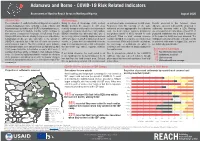
Adamawa and Borno - COVID-19 Risk Related Indicators Assessment of Hard-to-Reach Areas in Northeast Nigeria August 2020 Introduction Methodology The continuation of conflict in Northeast Nigeria has created a Using its Area of Knowledge (AoK) method, on settlement-wide circumstances in H2R areas. Results presented in this factsheet, unless complex humanitarian crisis, rendering sections of Borno and REACH monitors the situation in H2R areas Responses from KIs reporting on the same otherwise specified, represent the proportion of Adamawa states as hard to reach (H2R) for humanitarian actors. remotely through monthly multisector interviews in settlement are then aggregated to the settlement settlements assessed within a LGA. Findings Previous assessments illustrate how the conflict continues to accessible Local Government Area (LGA) capitals. level. The most common response provided by are only reported on LGAs where at least 5% of have severe consequences for people in H2R areas. People REACH interviews key informants (KIs) who 1) the greatest number of KIs is reported for each populated settlements and at least 5 settlements living in H2R areas, who are already facing severe and extreme are recently arrived internally displaced persons settlement. When no most common response in the respective LGA have been assessed. The humanitarian needs, are also vulnerable to the spread of (IDPs) who have left a H2R settlement in the last 3 could be identified, the response is considered as findings presented are indicative of broader trends COVID-19, especially due to the lack of health care services months, or 2) have been in contact with someone ‘no consensus’. While included in the calculations, in assessed settlements in August 2020, and are and information sources. -

How Boko Haram Became the Islamic State's West Africa
HOW BOKO HARAM BECAME THE ISLAMIC STATE’S WEST AFRICA PROVINCE J. Peter Pham ven before it burst into the headlines with its brazen April 2014 abduction of nearly three hundred schoolgirls from the town of Chibok in Nigeria’s northeast- Eern Borno State, sparking an unprecedented amount of social media communica- tion in the process, the Nigerian militant group Boko Haram had already distinguished itself as one of the fastest evolving of its kind, undergoing several major transformations in just over half a decade. In a very short period of time, the group went from being a small militant band focused on localized concerns and using relatively low levels of violence to a significant terrorist organization with a clearer jihadist ideology to a major insurgency seizing and holding large swathes of territory that was dubbed “the most deadly terrorist group in the world” by the Institute for Economics and Peace, based on the sheer number of deaths it caused in 2014.1 More recently, Boko Haram underwent another evolution with its early 2015 pledge of allegiance to the Islamic State and its subsequent rebranding as the “Islamic State West Africa Province” (ISWAP). The ideological, rhetorical, and operational choices made by Boko shifted consider- ably in each of these iterations, as did its tactics. Indeed the nexus between these three elements—ideology, rhetoric, and operations—is the key to correctly interpreting Boko Haram’s strategic objectives at each stage in its evolution, and to eventually countering its pursuit of these goals. Boko Haram 1.0 The emergence of the militant group that would become known as Boko Haram cannot be understood without reference to the social, religious, economic, and political milieu of J. -
FEWS NET Special Report: a Famine Likely Occurred in Bama LGA and May Be Ongoing in Inaccessible Areas of Borno State
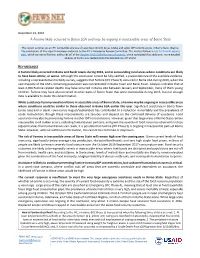
December 13, 2016 A Famine likely occurred in Bama LGA and may be ongoing in inaccessible areas of Borno State This report summarizes an IPC-compatible analysis of Local Government Areas (LGAs) and select IDP concentrations in Borno State, Nigeria. The conclusions of this report have been endorsed by the IPC’s Emergency Review Committee. This analysis follows a July 2016 multi-agency alert, which warned of Famine, and builds off of the October 2016 Cadre Harmonisé analysis, which concluded that additional, more detailed analysis of Borno was needed given the elevated risk of Famine. KEY MESSAGES A Famine likely occurred in Bama and Banki towns during 2016, and in surrounding rural areas where conditions are likely to have been similar, or worse. Although this conclusion cannot be fully verified, a preponderance of the available evidence, including a representative mortality survey, suggests that Famine (IPC Phase 5) occurred in Bama LGA during 2016, when the vast majority of the LGA’s remaining population was concentrated in Bama Town and Banki Town. Analysis indicates that at least 2,000 Famine-related deaths may have occurred in Bama LGA between January and September, many of them young children. Famine may have also occurred in other parts of Borno State that were inaccessible during 2016, but not enough data is available to make this determination. While assistance has improved conditions in accessible areas of Borno State, a Famine may be ongoing in inaccessible areas where conditions could be similar to those observed in Bama LGA earlier this year. Significant assistance in Bama Town (since July) and in Banki Town (since August/September) has contributed to a reduction in mortality and the prevalence of acute malnutrition, though these improvements are tenuous and depend on the continued delivery of assistance. -

Nigeria Update to the IMB Nigeria
Progress in Polio Eradication Initiative in Nigeria: Challenges and Mitigation Strategies 16th Independent Monitoring Board Meeting 1 November 2017 London 0 Outline 1. Epidemiology 2. Challenges and Mitigation strategies SIAs Surveillance Routine Immunization 3. Summary and way forward 1 Epidemiology 2 Polio Viruses in Nigeria, 2015-2017 Past 24 months Past 12 months 3 Nigeria has gone 13 months without Wild Polio Virus and 11 months without cVDPV2 13 months without WPV 11 months – cVDPV2 4 Challenges and Mitigation strategies 5 SIAs 6 Before the onset of the Wild Polio Virus Outbreak in July 2016, there were several unreached settlements in Borno Borno Accessibility Status by Ward, March 2016 # of Wards in % Partially LGAs % Fully Accessible % Inaccessible LGA Accessible Abadam 10 0% 0% 100% Askira-Uba 13 100% 0% 0% Bama 14 14% 0% 86% Bayo 10 100% 0% 0% Biu 11 91% 9% 0% Chibok 11 100% 0% 0% Damboa 10 20% 0% 80% Dikwa 10 10% 0% 90% Gubio 10 50% 10% 40% Guzamala 10 0% 0% 100% Gwoza 13 8% 8% 85% Hawul 12 83% 17% 0% Jere 12 50% 50% 0% Kaga 15 0% 7% 93% Kala-Balge 10 0% 0% 100% Konduga 11 0% 64% 36% Kukawa 10 20% 0% 80% Kwaya Kusar 10 100% 0% 0% Mafa 12 8% 0% 92% Magumeri 13 100% 0% 0% Maiduguri 15 100% 0% 0% Marte 13 0% 0% 100% Mobbar 10 0% 0% 100% Monguno 12 8% 0% 92% Ngala 11 0% 0% 100% Nganzai 12 17% 0% 83% Shani 11 100% 0% 0% State 311 41% 6% 53% 7 Source: Borno EOC Data team analysis Four Strategies were deployed to expand polio vaccination reach and increase population immunity in Borno state SIAs RES2 RIC4 Special interventions 12 -

Chibok Girls/ #Bringbackourgirls/ Stolen
TRANSFORMING FEMALE ABDUCTION VICTIMS TO MENTORS USING SURVIVOR CENTERED APPROACH: DISCUSSING "CHIBOK GIRLS/ #BRINGBACKOURGIRLS/ STOLEN DAUGHTERS" AS A CASE STUDY by ENEKOLE ATABO A THESIS Presented to the Conflict and Dispute Resolution Program and the Graduate School of the University of Oregon in partial fulfillment of the requirements for the degree of Master of Science June 2019 THESIS APPROVAL PAGE Student: Enekole Atabo Title: Transforming Female Abduction Victims to Mentors using Survivor Centered Approach: Discussing "Chibok Girls/ #BringBackOurGirls/ Stolen Daughters" as a case study This thesis has been accepted and approved in partial fulfillment of the requirements for the Master of Science degree in the Conflict and Dispute Resolution Program by: Prof. Merle Weiner Chairperson Prof. Ibrahim Gassama Member Dr. Christina O’Bryan Member and Janet Woodruff-Borden Vice Provost and Dean of the Graduate School Original approval signatures are on file with the University of Oregon Graduate School. Degree awarded June 2019 ii © 2019 Enekole Atabo iii THESIS ABSTRACT Enekole Atabo Master of Science Conflict and Dispute Resolution June 2019 Title: Transforming Female Abduction Victims to Mentors using Survivor Centered Approach: Discussing "Chibok Girls/ #BringBackOurGirls/ Stolen Daughters" as a case study Generally, women and girls are discriminated against based on gender, education, religion, or culture. Some of these characteristics are either ascribed or achieved. Life chances or the ability to improve one’s quality of life depends on the intersectionality of the different forms of oppression. Education which is one important means to improve life chances has often been targeted by religious and cultural ideology to the extent that girls are severely punished for defying restrictions on women’s education. -

Nigeria's Boko Haram
Nigeria’s Boko Haram: Frequently Asked Questions Lauren Ploch Blanchard Specialist in African Affairs March 29, 2016 Congressional Research Service 7-5700 www.crs.gov R43558 Nigeria’s Boko Haram: Frequently Asked Questions Summary Boko Haram, a violent Nigerian Islamist movement, has grown increasingly active and deadly in its attacks against state and civilian targets in recent years, drawing on a narrative of victimization and vengeance for state abuses to elicit recruits and sympathizers. The group’s April 2014 abduction of almost 300 schoolgirls drew particular international attention, including from the Obama Administration and Members of Congress. Its high death toll and its pledge of allegiance to the Islamic State (IS, also known as ISIL or ISIS) in March 2015 have further raised the concern of U.S. policy makers. The group has sought to rebrand itself as the Islamic State’s West Africa Province (ISWAP), though it remains more popularly known by its original nickname. The State Department has named several individuals linked to Boko Haram, including its leader, Abubakar Shekau, as Specially Designated Global Terrorists, and the group was designated as a Foreign Terrorist Organization (FTO) by the State Department in November 2013. More than 15,000 people are estimated to have been killed by Boko Haram, including more than 6,000 in 2015 alone, making it one of world’s deadliest terrorist groups. By U.N. estimates, roughly 2.8 million people have been displaced by Boko Haram-related violence in the Lake Chad Basin region, where approximately 5.6 million are in need of emergency food aid. -

IOM Nigeria DTM Emergency Tracking Tool (ETT)
DISPLACEMENT TRACKING MATRIX - Nigeria DTM Nigeria EMERGENCY TRACKING TOOL (ETT) DTM Emergency Tracking Tool (ETT) is deployed to track and provide up-to-date information on sudden displacement and other population movements IOM OIM ETT Report: No. 52 | 30 January – 5 February 2018 MOVEMENT Arrivals: 4,150 individuals Abadam SUMMARY Totals Departures: 590 individuals Mobbar Kukawa Guzamala Within the period of 30 January to 5 February 2018, a total of 4,150 arrivals, 740 316 and 590 departures were recorded at loca�ons in Askira/Uba, Bama, 152 Gubio Chibok, Damboa, Dikwa, Fufore, Girei, Gubio, Guzamala, Gwoza, Hawul, 10 Monguno Nganzai 199 Hong, Jere, Kaga, Kala/Balge, Konduga, Kukawa, Madagali, Mafa, Magumeri, 423 Magumeri Marte Maiha, Michika, Mobbar, Monguno, Mubi-North, Mubi-South, Ngala, Ngala 133 206 Kala/Balge Nganzai, Yola-North, and Yola-South LGAs in Borno and Adamawa States. Mafa 61 Jere 116 323 110 Dikwa The main triggers were poor living condi�ons (27%), voluntary reloca�on Maiduguri (27%), ongoing conflict (24%), improved security (20%) and military Kaga Borno 106 Konduga Bama 22 12 opera�ons (2%). 161 Movement triggers Gwoza Damboa 49 515 Poor Living Condi�ons Chibok Madagali 24 Biu 39 Voluntary Reloca�on 280 Askira/Uba 104 68 25 Michika Hawul 56 Kwaya Kusar Ongoing Conflicts Bayo 53 41 Hong Mubi North 45 38 Improved Security Shani Gombi 52 Mubi South 56 Maiha Military Opera�ons Shelleng Guyuk 54 Song 8 Military Improved Ongoing Voluntary Poor Living Opera�ons Security Conflicts Reloca�on Condi�ons Number of individuals 105 -
ETT Report No.107
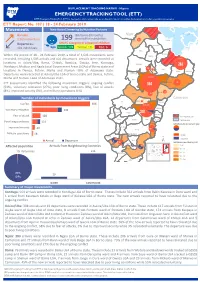
DISPLACEMENT TRACKING MATRIX - Nigeria DTM Nigeria EMERGENCY TRACKING TOOL (ETT) DTM Emergency Tracking Tool (ETT) is deployed to track and provide up-to-date information on sudden displacement and other population movements ETT Report: No. 107 | 18 - 24 February 2019 Movements New Arrival Screening by Nutri�on Partners Abadam Arrivals: Children (6-59 months) Niger Lake Chad 1,505 individuals screened for malnutri�on 23 Kukawa 199 Mobbar MUAC category of screened children Departures: Guzamala 101 individuals Green: 174 Yellow: 19 Red: 6 Gubio Monguno Within the period of 18 - 24 February 2019, a total of 1,606 movements were Nganzai recorded, including 1,505 arrivals and 101 departures. Arrivals were recorded at Marte Ngala loca�ons in Askira/Uba, Bama, Chibok, Damboa, Gwoza, Jere, Konduga, Magumeri Maiduguri 283 Maiduguri, Mobbar and Ngala Local Government Areas (LGAs) of Borno state and 36 9 Jere Mafa loca�ons in Demsa, Fufore, Maiha and Numan LGAs of Adamawa state. Dikwa Kala/Balge Departures were recorded at Askira/Uba LGA of Borno state and Demsa, Fufore, Borno Konduga Maiha and Numan LGAs of Adamawa state. Kaga ETT assessments iden�fied the following movement triggers: ongoing conflict 564 Bama 76 (53%), voluntary reloca�on (27%), poor living condi�ons (8%), fear of a�acks (8%), improved security (3%), and military opera�ons (1%) Gwoza 23 Damboa 39 Number of individuals by movement triggers Cameroon Chibok 7 Biu Madagali Conflict 856 Askira/Uba Michika Voluntary reloca�on 439 Kwaya Kusar 19 Bayo Hawul 308 Mubi North Fear of a�ack 128 -

Nigeria – Complex Emergency JUNE 7, 2021
Fact Sheet #3 Fiscal Year (FY) 2021 Nigeria – Complex Emergency JUNE 7, 2021 SITUATION AT A GLANCE 206 8.7 2.9 308,000 12.8 MILLION MILLION MILLION MILLION Estimated Estimated Number of Estimated Estimated Projected Acutely Population People in Need in Number of IDPs Number of Food-Insecure w of Nigeria Northeast Nigeria in Nigeria Nigerian Refugees Population for 2021 in West Africa Lean Season UN – December 2020 UN – February 2021 UNHCR – February 2021 UNHCR – April 2021 CH – March 2021 Major OAG attacks on population centers in northeastern Nigeria—including Borno State’s Damasak town and Yobe State’s Geidam town—have displaced hundreds of thousands of people since late March. Intercommunal violence and OCG activity continue to drive displacement and exacerbate needs in northwest Nigeria. Approximately 12.8 million people will require emergency food assistance during the June-to-August lean season, representing a significant deterioration of food security in Nigeria compared with 2020. 1 TOTAL U.S. GOVERNMENT HUMANITARIAN FUNDING USAID/BHA $230,973,400 For the Nigeria Response in FY 2021 State/PRM2 $13,500,000 For complete funding breakdown with partners, see detailed chart on page 7 Total $244,473,400 1 USAID’s Bureau for Humanitarian Assistance (USAID/BHA) 2 U.S. Department of State Bureau for Population, Refugees, and Migration (State/PRM) 1 KEY DEVELOPMENTS Violence Drives Displacement and Constrains Access in the Northeast Organized armed group (OAG) attacks in Adamawa, Borno, and Yobe states have displaced more than 200,000 people since March and continue to exacerbate humanitarian needs and limit relief efforts, according to the UN.