"Subject," "Citizen," "National," and "Permanent Allegiance"
Total Page:16
File Type:pdf, Size:1020Kb
Load more
Recommended publications
-
MODIFICATIONS and WAIVERS to TAKING the OATH of ALLEGIANCE Practice Advisory
Practice Advisory | May 2018 MODIFICATIONS AND WAIVERS TO TAKING THE OATH OF ALLEGIANCE Practice Advisory By Sharon Hing I. Introduction The final step in the naturalization process is the oath of allegiance to the United States. The oath demonstrates loyalty to the United States and the Constitution. All applicants must demonstrate that they are “attached to the principles of the Constitution of the United States and well disposed to the good order and happiness of the United States.”1 The oath also includes statements that the applicant is willing to “bear arms on behalf of the United States,” and “perform noncombatant service in the Armed Forces” when required by law.2 Although the text of the oath is included in the naturalization application form, and a United States Citizenship and Immigration Services (USCIS) officer reviews the text of the oath with the applicant at the naturalization interview, a person is not a United States citizen until they have taken the oath. Applicants may request modifications to the oath of allegiance in select circumstances. In other instances, applicants may request to waive taking the oath altogether. In this practice advisory, we outline the requirements for each. A. Waivers to the Oath Requirement USCIS may waive taking the oath of allegiance in two instances: (1) when the applicant is a child; or (2) when the applicant has a physical or development disability or mental impairment. 1. Children In the main, a person cannot naturalize unless they are 18 years of age or older. However, there are several ways that a child can become a U.S. -

2013 Thomson Reuters. No Claim to Original US
Marr, Abbey 1/6/2013 For Educational Use Only BIRTHRIGHT JUSTICE: THE ATTACK ON BIRTHRIGHT..., 36 N.Y.U. Rev. L. &... 36 N.Y.U. Rev. L. & Soc. Change 57 New York University Review of Law and Social Change 2012 Article BIRTHRIGHT JUSTICE: THE ATTACK ON BIRTHRIGHTCITIZENSHIP AND IMMIGRANTWOMEN OF COLOR Allison S. Hartry d1 a1 Copyright (c) 2012 New York University Review of Law and Social Change; Allison S. Hartry Abstract: Anti-immigrant sentiment in the United States is increasingly focused on restricting women of color's access to reproductive justice. Rhetoric surrounding “anchor babies” and an “invasion by birth canal” shows how the debate over immigration plays out on the bodies of immigrantwomen of color. This Article begins by describing the history of exclusion inherent in this country's immigration laws and the modern political assault on birthrightcitizenship, both of which are grounded in nativism, sexism, and racism. Using the experiences of individual women and conditions in immigration detention centers as examples, the Article then demonstrates that Immigration and Customs Enforcement appears to be targeting pregnant women for removal with the aim of preventing them from giving birth in this country. I. Introduction 58 II. The History of Exclusion in U.S. Immigration Law & Policy 64 A. The Historical and Legal Underpinnings of BirthrightCitizenship 64 1. Wong Kim Ark and the Extension of BirthrightCitizenship 66 2. The Meaning of “[B]orn . in the United States.” 68 3. Citizenship for the Children of Undocumented Immigrants 71 B. Modern Conservative Attempts to Eliminate BirthrightCitizenship 72 C. Racism, Nativism, and Attacks on BirthrightCitizenship 77 III. -
A More Meaningful Citizenship Test? Unmasking the Construction of a Universalist, Principle-Based Citizenship Ideology
A More Meaningful Citizenship Test? Unmasking the Construction of a Universalist, Principle-Based Citizenship Ideology Julian Wonjung Parkt INTRODUCTION In September 2007, the United States Office of Citizenship and Immigration Services (USCIS 1) unveiled the final one hundred questions to the new citizenship test, created by USCIS to be "more standardized, fair, and meaningful '2 than the current naturalization exam.3 The new exam is the result of USCIS's seven-year test development project, costing a reported 6.5 million dollars.4 Focusing on American civic values, the new test includes one hundred Copyright 0 2008 California Law Review, Inc. California Law Review, Inc. (CLR) is a California nonprofit corporation. CLR and the authors are solely responsible for the content of their publications. t J.D., UC Berkeley School of Law, 2008; PH.D., Yale University, 2005; M.A., Stanford University, 1998; B.A., Stanford University, 1997. 1 would first like to thank Victor Hwang for teaching the course "Asian Americans and the Law" in the spring of 2007 and for providing me with the forum to develop this topic. His patience and generosity was much appreciated. I would also like to thank Professor Leti Volpp for looking at drafts of this Comment and providing me with timely feedback. I would further like to thank all the members of the California Law Review for their assistance throughout the various stages of this Comment. In particular, I would like to thank Angela Hollowell-Fuentes for her expert reading of the first draft of this Comment; Mayte Santacruz Benavidez for her thoroughness in checking sources; and Aaron Gershbock for his meticulous attention to details during the final read. -

I Pledge Allegiance: the Naturalization Oath and Dual Citizenship
The Insightful Immigration Blog Commentaries on Immigration Policy, Cases and Trends http://blog.cyrusmehta.com I PLEDGE ALLEGIANCE: THE NATURALIZATION OATH AND DUAL CITIZENSHIP Author : Cyrus Mehta By Gary Endelman and Cyrus D. Mehta The oath ceremony is often one of the most significant and profound in an immigrant’s journey towards American citizenship. It signifies the end of the immigrant experience and is the final threshold before one’s acceptance as a citizen. It is also a happy moment, and the ceremony is generally accompanied by a stirring speech from a judge or well-known public official. Still, the oath, as prescribed by section 337 of the Immigration and Nationality Act (INA), requires a serious commitment from the immigrant to forever renounce former allegiances, and also insists that the naturalization applicant take the oath without mental reservation or evasion. People may still wish to keep their former citizenship even while becoming American citizens for a number of reasons, such as ease of travel to the country to conduct business or to continue to access the country’s social security and healthcare system. Our blog examines the impact of the oath on the immigrant’s desire to retain his or her citizenship of the former country. At journey’s end, we suggest that, contrary to popular assumption or common understanding, American law is much more tolerant towards and accepting of dual citizenship than most of us, lay and lawyer alike, have ever believed. The current format of the oath of allegiance is as follows: “I hereby -

Respectability & the Quest for Citizenship
Brooklyn Law Review Volume 83 | Issue 1 Article 12 12-12-2017 Respectability & the Quest for Citizenship Angela M. Banks Follow this and additional works at: https://brooklynworks.brooklaw.edu/blr Recommended Citation Angela M. Banks, Respectability & the Quest for Citizenship, 83 Brook. L. Rev. (2017). Available at: https://brooklynworks.brooklaw.edu/blr/vol83/iss1/12 This Article is brought to you for free and open access by the Law Journals at BrooklynWorks. It has been accepted for inclusion in Brooklyn Law Review by an authorized editor of BrooklynWorks. Respectability & the Quest for Citizenship Angela M. Banks† INTRODUCTION Historically, immigration and citizenship law and policy in the United States has been shaped by the idea that certain immigrant populations present a threat to American society. Such ideas justified the Alien and Sedition Acts,1 the Chinese Exclusion Act,2 the enactment of new deportation grounds in 1917,3 and the adoption of national origin quotas in 1924.4 These ideas continue to operate today and influence law and policy. For example, on January 27, 2017, President Donald J. Trump declared that the entry of Iranian, Iraqi, Libyan, Somalian, Sudanese, Syrian, and Yemeni citizens along with Syrian refugees to the United States is “detrimental to the interests of the United States.”5 Two days † Charles J. Merriam Distinguished Professor of Law, Sandra Day O’Connor College of Law, Arizona State University. I would like to thank the participants in the 2015 Global Migration, Structural Inclusion and Citizenship Education Across Nations Conference, 2015 Law & Society Annual Meeting, 2014 Immigration Law Teachers Workshop, and the University of Richmond Emroch Faculty Colloquy for comments, advice, and discussion. -
From Exclusion to Inclusion
From Exclusion to Inclusion 1941–1992 Around 9 :00 in the morning on April 21, 1945, Daniel K. Inouye, a 20-year-old army lieutenant from Honolulu, Hawaii, was shot in the stomach on the side of a mountain in northwestern Italy. The German bullet went clean out his back and missed his spine by a fraction of an inch. “It felt like someone punched me,” he remembered years later. “But the pain was almost non-existent. A little ache, that’s all and since the bleeding was not much I said well, I’ll keep on going.”1 Later that morning, Inouye, a pre-med student who had been getting ready for church when Japan bombed Pearl Harbor on December 7, 1941, was hit again. This time a rifle grenade nearly blew off his entire right arm. After picking up his tommy gun with his left hand, he continued to charge up the hill, firing at German soldiers as he went. Eventually shot in the leg, Inouye waited until his men seized control of the mountain before being evacuated.2 The war in Europe ended 17 days later. Inouye lived in military hospitals for the next two years to rebuild his strength and learn to do everyday tasks with one arm. The war forced him to adapt, and over the next two decades, the country he nearly died for began to adapt to the war’s consequences as well. For the most marginalized people—women and minorities, especially—World War II had profound implications for what it meant to be American. -
HOUSE OF. REPRESENTATIVES Resolution 198
2898 CONGRESSIONAL RECORD-HOUSE APRIL 5 REPORTS OF COMMI'ITEES ON PUBLIC MEMORIALS 400. By the SPEAKER: Petition of the BILLS AND RESOLUTIONS American Bar Association petitioning con Under clause 3 of rule XXII, memori sideration of their resolution with reference to Under clause 2 of rule XIII, reports of als were presented and referred as fol House bill 1025; to the Committee on the committees were delivered to the Clerk lows: Civll Service. for printing and reference to the proper By the SPEAKER: Memorial of the Legisla calendar, as follows: ture of the State of North Dakota, memorial izing the President and the Congress of the Mr. CLARK: Committee on Rules. House United States to continue and provide for HOUSE OF. REPRESENTATIVES Resolution 198. Resolution for the consider- the continuation of the program of incentive . ation of House Joint Resolution 14 authoriz payments to farmers who increase their pro MoNDAY, APRIL 5, 1943 ing the execution of certain obligations under duction in 1943; to the Committee on Appro the treaties of 1903 and 1936 with Panama, priations. The House met at 12 o'clock noon. and other commitments; without amend Also, memorial of the Legislature of the The Chaplain, Rev. James Shera ment (Rept. No. 340). Referred to the House State of Washington, memorializing the Pres Montgomery, D. D., offered the following Calendar. ident and the Congress of the United States prayer: Mr. DIES: Committee on Rules. House to take action relative to the purchase, main Resolution 199. Resolution for the consider tenance, and operation of bridges across the Glory be to Thy name, 0 Lord Most ation of H. -

U.S. Citizenship in Puerto Rico: One Hundred Years After the Jones Act Contents
CENTRO: Journal of the Center for Puerto Rican Studies SPECIAL ISSUE: VOL. 29, NO. 1 – 2017 U.S. CITIZENSHIP IN PUERTO RICO: ONE HUNDRED YEARS AFTER THE JONES ACT CONTENTS CENTRO: Journal of the Center for Puerto Rican Studies vol. 29, no. 1 – 2017 U.S. CITIZENSHIP IN PUERTO RICO: One Hundred Years After the Jones Act Guest Editors: Charles R. Venator-Santiago and Edgardo Meléndez Preface: U.S. Citizenship in Puerto Rico: Dual Consciousness About Law And Justice: One Hundred Years After the Jones Act Puerto Ricans’ Battle For U.S. Citizenship In Hawai‘i —Edwin Meléndez —Susan K. Serrano Introduction: U.S. Citizenship in Puerto Rico: “…Acting Like an American Citizen”: Discursive and One Hundred Years After the Jones Act Political Resistance to Puerto Rican U.S. Citizenship —Charles R. Venator-Santiago and Edgardo Meléndez Anomalies in the 1930s —Daniel Acosta Elkan Mapping the Contours of the History of the Extension of U.S. Citizenship to Puerto Rico, 1898–Present A Note on the Puerto Rican De-Naturalization —Charles R. Venator-Santiago Exception of 1948 —Charles R. Venator-Santiago The Unresolved Constitutional Issues of Puerto Rican Citizenship Puerto Ricans as Contingent Citizens: Shifting —Rogers M. Smith Mandated Identities and Imperial Disjunctures —Pedro Cabán Citizenship and Equality in an Age of Diversity: Reflections on Balzac and the Indian Civil Rights Act Puerto Ricans and U.S. Citizenship in 1917: —Sanford Levinson Imperatives of Security —Bartholomew Sparrow and Jennifer Lamm To Be or Not to Be: Puerto Ricans and Their Illusory U.S. Citizenship Comments on the Jones Act and the Grant of U.S. -

SECTION 404(C) of the NATIONALITY ACT of 1940: RESIDENCE ABROAD AS AUTOMATIC EXPATRIATION of the NATURALIZED AMERICAN*
NOTES SECTION 404(c) OF THE NATIONALITY ACT OF 1940: RESIDENCE ABROAD AS AUTOMATIC EXPATRIATION OF THE NATURALIZED AMERICAN* CONGRESSIONAL power to differentiate between the naturalized and native- born American citizen has never been dearly defined by the Supreme Court. Although the Court has upheld two statutes providing for loss of naturalized citizenship, neither created a significant distinction between the naturalized and native-born American. The first, providing for denaturalization because of fraud or illegality in the naturalization proceedings, acted on the rationale that the person affected had not become a citizen in the first place.' The sec- ond statute created a presumption of loss of naturalized citizenship upon resi- dence in a foreign state.2 Because this presumption was easily overcome by * Lapides v. Clark, 176 F-2d 619 (D.C. Cir. 1949). 1. Nationality Act of 1906 §§ 15, 23, 34 STAT. 601, 603 (1906). These provisions were substantially reenacted in the Nationality Act of 1940 § 338, 54 STAT. 1158 (1940), 8 U.S.C. § 738 (1946). They provide for cancellation of a certificate of citizenship on grounds of fraud or illegal procurement. Additional provision is made for cancellation of the certifi- cate of a naturalized American who, within five years after his naturalization, returns to the country of his habitation or goes to another foreign country and takes permanent residence there. This is considered "prima fade evidence of a lack of intention on the part of such person to become a permanent citizen .... and, in the absence of counter- vailing evidence, it.. [is] . sufficient in the proper proceeding to authorize the rev- ocation.., of the order admitting such person to citizenship and the cancellation of the certificate of naturalization as having been obtained through fraud." For the Court's view that the statute was not discriminatory, see Luria v. -
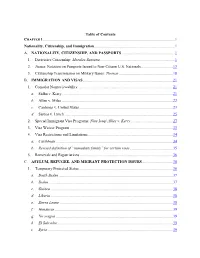
2016-Digest-Chapter-1.Pdf
Table of Contents CHAPTER 1 .................................................................................................................................1 Nationality, Citizenship, and Immigration...............................................................................1 A. NATIONALITY, CITIZENSHIP, AND PASSPORTS ....................................................1 1. Derivative Citizenship: Morales-Santana .........................................................................1 2. Tuaua: Notation on Passports Issued to Non-Citizen U.S. Nationals ............................... 13 3. Citizenship Transmission on Military Bases: Thomas ..................................................... 18 B. IMMIGRATION AND VISAS ........................................................................................ 21 1. Consular Nonreviewability ............................................................................................. 21 a. Sidhu v. Kerry ............................................................................................................. 21 b. Allen v. Milas ............................................................................................................. 22 c. Cardenas v. United States ............................................................................................ 23 d. Santos v. Lynch .......................................................................................................... 25 2. Special Immigrant Visa Programs: Nine Iraqi Allies v. Kerry ........................................ -

The Fight to Be American: Military Naturalization and Asian Citizenship
W&M ScholarWorks Arts & Sciences Articles Arts and Sciences 1-2010 The Fight to be American: Military Naturalization and Asian Citizenship Deenesh Sohoni College of William and Mary, dssoho@wm.edu Follow this and additional works at: https://scholarworks.wm.edu/aspubs Part of the Immigration Law Commons Recommended Citation Sohoni, Deenesh and Amin Vafa. 2010. “The Fight to be American: Military Naturalization and Asian Citizenship.” Asian American Law Journal. Vol. 17: 119-151. This Article is brought to you for free and open access by the Arts and Sciences at W&M ScholarWorks. It has been accepted for inclusion in Arts & Sciences Articles by an authorized administrator of W&M ScholarWorks. For more information, please contact scholarworks@wm.edu. The Fight to Be American: Military Naturalization and Asian Citizenship Deenesh Sohonit & Amin Vafa ABSTRACT In 1862, Congress passed legislation granting foreigners serving in the U.S. military the right to expedited naturalization. Although driven by pragmatic concerns, "military naturalization" served as a powerful symbolic message: those willing to fight for the United States are worthy of its citizenship. At the same time, military naturalization conflicted with existing laws that limited naturalization to whites and blacks. In this Article, we analyze how courts weighed the competing ideologies of citizenship by examining court cases brought by Asian aliens seeking military naturalization between 1900 and 1952. Our research demonstrates the importance of instrumental and ideological pressures in shaping the legal understanding of U.S. citizenship, as well as the contradictions that emerged as the judiciary sought to bring coherence to conflicting legislative acts regarding naturalization. -

NEW! Lesson Plan: Naturalization & Citizenship
LESSON PLAN: NATURALIZATION AND CITIZENSHIP This page intentionally left blank 1 INTRODUCTION The United States District Court for the Southern District of Indiana is pleased to present this educational lesson plan on naturalization and citizenship. The lesson plan is designed to help teachers engage students in learning about the naturalization process in the United States and the role of the federal courts in that process. Students will also participate in meaningful conversation about the rights and responsibilities of citizenship. Teaching students about citizenship gives them the foundation to understand and participate in this country's democratic society. Democracies require engaged, informed, and responsible citizens in order to thrive. Teaching students about naturalization helps them to value their status as citizens and involves them in critical thinking about the benefits and duties that come with citizenship. GRADE LEVELS: This lesson plan can be adapted for middle school or high school use. INDIANA ACADEMIC STANDARDS: Middle School 8.2 Civics and Government High School United States Government (USG) Standard 2: Foundations of Government in the United States United States Government (USG) Standard 3: Purposes, Principles and Institutions of Government in the United States United States Government (USG) Standard 5: Roles of Citizens in the United States OBJECTIVES: After completing this lesson, a student should be able to: Discuss the rights and responsibilities of citizenship Know the meaning of key vocabulary terms Understand