TAXI DRIVER Gala TAXI DRIVER TAXI DRIVER
Total Page:16
File Type:pdf, Size:1020Kb
Load more
Recommended publications
-
Café Society
Presents CAFÉ SOCIETY A film by Woody Allen (96 min., USA, 2016) Language: English Distribution Publicity Bonne Smith Star PR 1352 Dundas St. West Tel: 416-488-4436 Toronto, Ontario, Canada, M6J 1Y2 Fax: 416-488-8438 Tel: 416-516-9775 Fax: 416-516-0651 E-mail: starpr@sympatico.ca E-mail: info@mongrelmedia.com www.mongrelmedia.com @MongrelMedia MongrelMedia CAFÉ SOCIETY Starring (in alphabetical order) Rose JEANNIE BERLIN Phil STEVE CARELL Bobby JESSE EISENBERG Veronica BLAKE LIVELY Rad PARKER POSEY Vonnie KRISTEN STEWART Ben COREY STOLL Marty KEN STOTT Co-starring (in alphabetical order) Candy ANNA CAMP Leonard STEPHEN KUNKEN Evelyn SARI LENNICK Steve PAUL SCHNEIDER Filmmakers Writer/Director WOODY ALLEN Producers LETTY ARONSON, p.g.a. STEPHEN TENENBAUM, p.g.a. EDWARD WALSON, p.g.a. Co-Producer HELEN ROBIN Executive Producers ADAM B. STERN MARC I. STERN Executive Producer RONALD L. CHEZ Cinematographer VITTORIO STORARO AIC, ASC Production Designer SANTO LOQUASTO Editor ALISA LEPSELTER ACE Costume Design SUZY BENZINGER Casting JULIET TAYLOR PATRICIA DiCERTO 2 CAFÉ SOCIETY Synopsis Set in the 1930s, Woody Allen’s bittersweet romance CAFÉ SOCIETY follows Bronx-born Bobby Dorfman (Jesse Eisenberg) to Hollywood, where he falls in love, and back to New York, where he is swept up in the vibrant world of high society nightclub life. Centering on events in the lives of Bobby’s colorful Bronx family, the film is a glittering valentine to the movie stars, socialites, playboys, debutantes, politicians, and gangsters who epitomized the excitement and glamour of the age. Bobby’s family features his relentlessly bickering parents Rose (Jeannie Berlin) and Marty (Ken Stott), his casually amoral gangster brother Ben (Corey Stoll); his good-hearted teacher sister Evelyn (Sari Lennick), and her egghead husband Leonard (Stephen Kunken). -

Death, Medicine, and Religious Solidarity in Martin Scorsese's Bringing out the Dead
Death, Medicine, and Religious Solidarity in Martin Scorsese's Bringing Out the Dead David M. Hammond, Beverly J. Smith Logos: A Journal of Catholic Thought and Culture, Volume 7, Number 3, Summer 2004, pp. 109-123 (Article) Published by Logos: A Journal of Catholic Thought and Culture DOI: https://doi.org/10.1353/log.2004.0027 For additional information about this article https://muse.jhu.edu/article/170325 [ This content has been declared free to read by the pubisher during the COVID-19 pandemic. ] 06-logos-hammond2-pp109-123 5/25/04 9:37 AM Page 109 David M. Hammond and Beverly J. Smith Death, Medicine, and Religious Solidarity in Martin Scorsese’s Bringing Out the Dead In this paper, we will discuss the portrait of medicine in Martin Scorsese’s film, Bringing Out the Dead. Medicine is frequently represented in films as a metaphor for religion, developing a rela- tionship anthropologists have explored for over a century. In a cul- ture of technology and secularization, it might seem this relationship would have necessarily faded. However, despite today’s unprece- dented attempts to frustrate death,1 medicine still must surrender to human mortality. Informed by a religious critique, Bringing Out the Dead suggests that medicine, ideally, is “less about saving lives than about bearing witness,” as Frank Pierce, the central character in the movie, puts it. To put this suggestion into context, we will describe the relationship between religion and medicine evident in the movie as seen from anthropological and theological perspectives. The essential claim of Scorsese’s film is that redemption is avail- able only by bearing witness to a common human solidarity. -
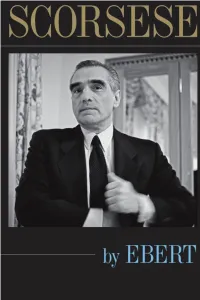
Scorses by Ebert
Scorsese by Ebert other books by An Illini Century roger ebert A Kiss Is Still a Kiss Two Weeks in the Midday Sun: A Cannes Notebook Behind the Phantom’s Mask Roger Ebert’s Little Movie Glossary Roger Ebert’s Movie Home Companion annually 1986–1993 Roger Ebert’s Video Companion annually 1994–1998 Roger Ebert’s Movie Yearbook annually 1999– Questions for the Movie Answer Man Roger Ebert’s Book of Film: An Anthology Ebert’s Bigger Little Movie Glossary I Hated, Hated, Hated This Movie The Great Movies The Great Movies II Awake in the Dark: The Best of Roger Ebert Your Movie Sucks Roger Ebert’s Four-Star Reviews 1967–2007 With Daniel Curley The Perfect London Walk With Gene Siskel The Future of the Movies: Interviews with Martin Scorsese, Steven Spielberg, and George Lucas DVD Commentary Tracks Beyond the Valley of the Dolls Casablanca Citizen Kane Crumb Dark City Floating Weeds Roger Ebert Scorsese by Ebert foreword by Martin Scorsese the university of chicago press Chicago and London Roger Ebert is the Pulitzer The University of Chicago Press, Chicago 60637 Prize–winning film critic of the Chicago The University of Chicago Press, Ltd., London Sun-Times. Starting in 1975, he cohosted © 2008 by The Ebert Company, Ltd. a long-running weekly movie-review Foreword © 2008 by The University of Chicago Press program on television, first with Gene All rights reserved. Published 2008 Siskel and then with Richard Roeper. He Printed in the United States of America is the author of numerous books on film, including The Great Movies, The Great 17 16 15 14 13 12 11 10 09 08 1 2 3 4 5 Movies II, and Awake in the Dark: The Best of Roger Ebert, the last published by the ISBN-13: 978-0-226-18202-5 (cloth) University of Chicago Press. -

Martin Scorsese
MARTIN SCORSESE TEACHES FILMMAKING INTRODUCTION ABOUT THIS WORKBOOK MASTERCLASS COMMUNITY SUPPLIES AND MATERIALS The MasterClass team has Throughout, we’ll encourage To be an active participant in created this workbook as a you to share work and Martin’s MasterClass, you’ll supplement to Martin’s class. discuss course materials need a notebook to jot down Each chapter is supported here with your classmates in ideas that are sparked as you with a review, resources to The Hub to give and receive watch the lessons. learn more, and assignments. constructive feedback. You can The exercises in this workbook also connect with your peers build on each other, with the in the discussion section ultimate goal of equipping you beneath each lesson video. to direct a short film. MARTIN SCORSESE 2 ABOUT MARTIN SCORSESE Martin Scorsese was born in 1942 in New York In 2003, PBS broadcast the seven-film City, and was raised in the neighborhood of documentary series Martin Scorsese Little Italy, which later provided the inspiration Presents: The Blues. The Aviator was released in for several of his films. Scorsese earned a BS December of 2004 and earned five degree in film communications in 1964, followed Academy Awards in addition to the Golden by an MA in the same field in 1966 at New York Globe and BAFTA awards for Best Picture. In University’s School of Film. During this time, 2005, “No Direction Home: Bob Dylan” was he made numerous prize-winning short films broadcast as part of the American including The Big Shave. In 1968, Scorsese Masters series on PBS. -

ROBERT GREENHUT Producer
ROBERT GREENHUT Producer TRUST - Millennium - David Schwimmer, director PICASSO & BRAQUE GO TO THE MOVIES - Independent - Arne Glimcher, director BROOKLYN’S FINEST - Warner Bros. - Antoine Fuqua, director AUGUST RUSH - Warner Bros. - Kirsten Sheridan, director FIND ME GUILTY - Yari Film Group - Sidney Lumet, director STATESIDE - First Look Films - Reverge Anselmo, director THE BLACK KNIGHT - 20th Century Fox - Gil Junger, director WHITE RIVER KID - Independent - Arne Glimcher, director WITH FRIENDS LIKE THESE - Independent - Phillip Frank Messina, director THE PREACHER’S WIFE - Buena Vista - Penny Marshall, director EVERYONE SAYS I LOVE YOU - Miramax - Woody Allen, director MIGHTY APHRODITE - Miramax - Woody Allen, director BULLETS OVER BROADWAY - Miramax - Woody Allen, director RENAISSANCE MAN - Buena Vista - Penny Marshall, director WOLF (Executive) - Columbia - Mike Nichols, director MANHATTAN MURDER MYSTERY - TriStar - Woody Allen, director HUSBANDS AND WIVES - TriStar - Woody Allen, director SHADOWS AND FOG - Orion - Woody Allen, director A LEAGUE OF THEIR OWN - Columbia - Penny Marshall, director REGARDING HENRY (Executive) - Paramount - Mike Nichols, director ALICE - Orion - Woody Allen, director QUICK CHANGE - Warner Bros. - Howard Franklin, Bill Murray, directors POSTCARDS FROM THE EDGE (Executive) - Columbia - Mike Nichols, director CRIMES AND MISDEMEANORS - Orion - Woody Allen, director NEW YORK STORIES - Touchstone - Woody Allen, director WORKING GIRL - 20th Century Fox - Mike Nichols, director BIG - 20th Century Fox - Penny -

RETROSPECTIVA SCORSESE 24 De Janeiro a 20 De Fevereiro De 2020 Programação 24/01 SEX 15H CURTAS | 57'| What's a Nice Girl L
RETROSPECTIVA SCORSESE 24 de janeiro a 20 de fevereiro de 2020 Programação 24/01 SEX 15h CURTAS | 57’| What's a Nice Girl Like You Doing in a Place Like This?, de Martin Scorsese (EUA, 1963) | | 9’ It's Not Just You, Murray!, de Martin Scorsese (EUA, 1964) | 15’ The Big Shave, de Martin Scorsese (EUA, 1968) | 6’ Michael Jackson: Bad, de Martin Scorsese (EUA, 1987) | 17’ The Key to Reserva, de Martin Scorsese (EUA, 2007) | 10’ 16h15 Quem Bate à Minha Porta?, de Martin Scorsese (I Call First, EUA, 1967) | 16 anos | 90’ 18h Sexy e Marginal, de Martin Scorsese (Boxcar Bertha, EUA, 1972) | 14 anos | 88’ 20h Caminhos Perigosos, de Martin Scorsese (Mean Streets, EUA, 1973) | 112’ 25/01 SÁB 15h Alice Não Mora Mais Aqui, de Martin Scorsese (Alice Doesn't Live Here Anymore, EUA, 1974) | 14 anos | 112’ 17h15 Taxi Driver, de Martin Scorsese (EUA, 1976) | 16 anos | 113’ 19h30 New York, New York, de Martin Scorsese (EUA, 1977) | 10 anos | 155’ 26/01 DOM 18h O Último Concerto de Rock, de Martin Scorsese (The Last Waltz, EUA, 1978) | Livre | 117’ 20h15 Touro Indomável, de Martin Scorsese (Raging Bull, EUA, 1980) | 16 anos| 129’ 27/01 SEG 15h A Cor do Dinheiro, de Martin Scorsese (The Color of Money, EUA, 1986) | 12 anos | 119’ 17h15 O Rei da Comédia, de Martin Scorsese (The King of Comedy, EUA, 1982) | 12 anos | 109’ 19h15 Depois de Horas, de Martin Scorsese (After Hours, EUA, 1985) | 16 anos | 97’ 21h Contos de Nova York, de Martin Scorsese; Francis Ford Coppola; Woody Allen (New York Stories, EUA, 1989) | 14 anos | 124’ 28/01 TER 15h A Última Tentação -

New York Stories De Martin Scorsese, Francis Ford Coppola Et Woody Allen Michel Beauchamp
Document generated on 09/27/2021 5:31 p.m. 24 images New York vu par… New York Stories de Martin Scorsese, Francis Ford Coppola et Woody Allen Michel Beauchamp Cinéma d’animation Number 43, Summer 1989 URI: https://id.erudit.org/iderudit/22936ac See table of contents Publisher(s) 24/30 I/S ISSN 0707-9389 (print) 1923-5097 (digital) Explore this journal Cite this review Beauchamp, M. (1989). Review of [New York vu par… / New York Stories de Martin Scorsese, Francis Ford Coppola et Woody Allen]. 24 images, (43), 76–77. Tous droits réservés © 24 images inc., 1989 This document is protected by copyright law. Use of the services of Érudit (including reproduction) is subject to its terms and conditions, which can be viewed online. https://apropos.erudit.org/en/users/policy-on-use/ This article is disseminated and preserved by Érudit. Érudit is a non-profit inter-university consortium of the Université de Montréal, Université Laval, and the Université du Québec à Montréal. Its mission is to promote and disseminate research. https://www.erudit.org/en/ NEW YORK STORIES DE MARTIN SCORSESE, FRANCIS FORD COPPOLA ET WOODY ALLEN Le peintre Lionel Dobie (Nick Nolte) en compagnie de son assistante /amante Paulette (Rosanna Arquette). NEW YORK VII PAR.. par Michel Beauchamp ew York, Scorsese, Coppola et tème et en renverser les valeurs. Il pousse d'un orchestre qui accompagne le célé- Allen. C'est l'affiche la plus presti à son terme la logique du désir qui lui est brissime flûtiste. Seule échappée dans le N gieuse que pouvait offrir le cinéma chère et se rend aux confins du rêve, là où réel, un clochard enfoui sous un amas de américain pour donner toutes ses chances disparaît le désir. -

Celebrity and Authorial Integrity in the Films of Woody Men %Y
CELEBRITY AND AUTHORIAL INTEGRITY IN THE FILMS OF WOODY ALLEN BY FAYE MCINTYRE A Thesis Submitted to the Facul@ of Graduate Studies in Partial Fulfillment of the Requirements for the Degree of DOCTOR OF PHILOSOPHY Department of English University of Manitoba Winnipeg, Manitoba (c) January, 200 1 National Library BibIiothèque nationale du Canada Acquisitions and Acquisitions et Bibliographic Services services bibliographiques 395 Wellington Street 395. rue Wellington Ottawa ON Ki A ON4 Ottawa ON KI A ON4 Canada Canada rour rïk vom rbw~ Our fi& Notre rtifBrence The author has granted a non- L'auteur a accordé une licence non exclusive licence allowing the exclusive permettant à la National Lïbrary of Canada to Bibliothèque nationale du Canada de reproduce, loan, distribute or seU reproduire, prêter, distribuer ou copies of this thesis in microform, vendre des copies de cette thèse sous paper or electronic formats. la forme de microfiche/film, de reproduction sur papier ou sur format électronique. The author retains ownership of the L'auteur conserve la propriété du copyright in this thesis. Neither the droit d'auteur qui protège cette thèse. thesis nor substantid extracts fÏom it Ni la thèse ni des extraits substantiels may be printed or othemise de celle-ci ne doivent être imprimés reproduced without the author's ou autrement reproduits sans son permission. autorisation. THE UNIVERSITY OF MANITOBA FACULTY OF GRADUATE STUDIES *f *f * COPYRIGHT PERMISSION PAGE Celebrity and Authorial Integrity in the Films of Woody Men %Y Faye McIntyre A Thesis/Practicum submitted to the Faculty of Graduate Studies of The University of Manitoba in partial fulNlment of the requirements of the degree of Doctor of Philosophy FAYE MCINTYRE O 2001 Permission has been granted to the Library of The University of Manitoba to Iend or seU copies of this thesis/practicum, to the National Library of Canada to microfilm this thesis/practicum and to lend or sell copies of the film, and to Dissertations Abstracts International to publish an abstract of this thesis/practicum. -
Introduction."
O’Brien, Catherine. "Introduction." : . London: Bloomsbury Academic, 2018. 1–12. Bloomsbury Collections. Web. 1 Oct. 2021. <http://dx.doi.org/10.5040/9781350003309.0005>. Downloaded from Bloomsbury Collections, www.bloomsburycollections.com, 1 October 2021, 12:51 UTC. Copyright © O’Brien 2018. You may share this work for non-commercial purposes only, provided you give attribution to the copyright holder and the publisher, and provide a link to the Creative Commons licence. Introduction A statue of a Madonna and Child in a New York kitchen appears in the opening shot of Martin Scorsese’s Who’s That Knocking at My Door (1967–9); and the final image ofSilence (2016) is of a handmade crucifix glowing in the flames of a crematory fire in seventeenth-century Japan. It is inarguable that there is a Catholic dimension to Scorsese’s filmography that can be traced from the Marian icon in his first full-length feature right through to his movie about Jesuit priests that was released around fifty years later. With due respect paid to the scale of the task, the following chapters engage with that particular cinematic trajectory and take seriously the oft-quoted words of the director himself: ‘My whole life has been movies and religion. That’s it. Nothing else.’ Scorsese was born in 1942, educated by the Sisters of Charity and received his religious instruction before the mood of aggiornamento that was heralded by Pope John XXIII’s instigation of Vatican II (the Second Vatican Council of 1962– 5), which was an effort to modernize the Catholic Church. Indeed, religion(s) played a role in the young boy’s life, even down to the fact that his father Charles earned pragmatic money by lighting the stoves for his Jewish neighbours on the Sabbath. -
1 Evolving Authorship, Developing Contexts: 'Life Lessons'
Notes 1 Evolving Authorship, Developing Contexts: ‘Life Lessons’ 1. This trajectory finds its seminal outlining in Caughie (1981a), being variously replicated in, for example, Lapsley and Westlake (1988: 105–28), Stoddart (1995), Crofts (1998), Gerstner (2003), Staiger (2003) and Wexman (2003). 2. Compare the oft-quoted words of Sarris: ‘The art of the cinema … is not so much what as how …. Auteur criticism is a reaction against sociological criticism that enthroned the what against the how …. The whole point of a meaningful style is that it unifies the what and the how into a personal state- ment’ (1968: 36). 3. For a fuller discussion of the conception of film authorship here described, see Grist (2000: 1–9). 4. While for this book New Hollywood Cinema properly refers only to this phase of filmmaking, the term has been used by some to designate ‘either something diametrically opposed to’ such filmmaking, ‘or some- thing inclusive of but much larger than it’ (Smith, M. 1998: 11). For the most influential alternative position regarding what he calls ‘the New Hollywood’, see Schatz (1993). For further discussion of the debates sur- rounding New Hollywood Cinema, see Kramer (1998), King (2002), Neale (2006) and King (2007). 5. ‘Star image’ is a concept coined by Richard Dyer in relation to film stars, but it can be extended to other filmmaking personnel. To wit: ‘A star image is made out of media texts that can be grouped together as promotion, publicity, films and commentaries/criticism’ (1979: 68). 6. See, for example, Grant (2000), or the conception of ‘post-auteurism’ out- lined and critically demonstrated in Verhoeven (2009). -

CSE 142 Final Exam
Sample midterm extra questions 1. HTML/CSS Coding Write the XHTML and CSS code necessary to recreate the following appearance on-screen. (Adapted from the WA.B.L page of the Washington Beer Commision website, washingtonbeer.com .) Most of the XHTML code is given to you; the code given may not be modified. The only change you may make to the provided XHTML code is that you may add any number of div and/or span elements, possibly with id and/or class attributes, as targets for CSS styling. Write valid code that would pass the W3C validators. Assume that the given XHTML code would appear inside the body of the page. • Text on the page uses a sans-serif font. The area around the outside of the page has a yellowish color of #FFB131. • The overall central page area has a white background, and a 5px-thick solid black border on its bottom edge only. It is centered within the page and is 950px wide. • The list of links appears without bullets, displayed all in one line, centered on the page. Each link's text is bold, not underlined, colored #FFB131, has a line height of 2em, and has 1.5em of horizontal spacing on either side of it. (Between two adjacent links there is a total of 3em space.) • The main content area (beneath the navigation links) has 1.5em of horizontal space on the left and right. All the headers inside of it are underlined. • The “Join WA.B.L” section is located on the right side of the main content area, with text flowing around it. -

Preparing for Your Trek Fundraising Ideas
Preparing for the National Forest Trek – A to Z of fundraising PREPARING FOR YOUR TREK FUNDRAISING IDEAS Thank you for signing up to take part in the inaugural National Forest Trek, taking place from 17th to 19th September 2021. Your fundraising starts here. We’ve put together an A to Z guide that will help you to raise the funds necessary to participate in The National Forest Trek. Please ensure that any planned activity is undertaken in a responsible manner and is fully compliant with any COVID-19 guidance that is applicable at the time. FOR FURTHER INFORMATION, PLEASE CONTACT US AS FOLLOWS: www.nationalforesttrek.co.uk / info@nationalforesttrek.co.uk Preparing for the National Forest Trek – A to Z of fundraising A • Auction / Auction of promises – Those old vinyl records or CDs might be worth a few bob on eBay and they could be worth a few bob for your fund-raising too. Perhaps you have the contacts to get your hands on some sought-after sports memorabilia? Then an auction could be the charity fundraising activity for you. How about auctioning off your own skill-set? Don’t be shy now! Could a couple of hours gardening for friends help you raise funds? • Afternoon tea – Time to put the kettle on and maybe show off your baking skills. Everyone loves a cuppa and you can encourage donations for all attendees be it at the workplace or at home. Another cuppa anyone? B • Bake sale – Make like Mary and bake like Berry on your way to fundraising success. Whether you run the event at work, school or your home be sure to find out about any specialist diets (or perhaps just favourites) first to maximise sales! • Bingo – If the phrase "2 little ducks" brings a smile to your face then bingo could be the activity for you! Our advice: keep it fun and adapt the game for your audience.