Saint Joan Shaw, George Bernard
Total Page:16
File Type:pdf, Size:1020Kb
Load more
Recommended publications
-

Mary the Blessed Virgin
January 1 – Mary the Blessed Virgin Mary is venerated with a special cult, called by St. Thomas Aquinas, hyperdulia, as the holiest of all creatures. The main events of her life are celebrated as liturgical feasts of the universal Church. Traditionally, she was declared the daughter of Sts. Joachim and Anne. Born in Jerusalem, Mary was presented in the Temple and took a vow of virginity. Living in Nazareth, Mary was visited by the archangel Gabriel, who announced to her that she would become the Mother of Jesus, by the Holy Spirit. She became betrothed to St. Joseph and went to visit her cousin, Elizabeth, who was bearing St. John the Baptist. Acknowledged by Elizabeth as the Mother of God, Mary intoned the Magnificat. When Emperor Augustus declared a census throughout the vast Roman Empire, Mary and St. Joseph went to Bethlehem where he was born, as he belonged to the House of David. There Mary gave birth to Jesus and was visited by the Three Kings. Mary and Joseph presented Jesus in the Temple, where St. Simeon rejoiced and Mary received word of sorrows to come later. Warned to flee, St. Joseph and Mary went to Egypt to escape the wrath of King Herod. They remained in Egypt until King Herod died and then returned to Nazareth. Nothing is known of Mary's life during the next years except for a visit to the Temple of Jerusalem, at which time Mary and Joseph sought the young Jesus, who was in the Temple with the learned elders. The first recorded miracle of Jesus was performed at a wedding in Cana, and Mary was instrumental in calling Christ's attention to the need. -

Wielding the Spiritual Sword Again: Some Considerations on Neo
IPT0010.1177/1755088214559926Journal of International Political TheoryKalpokas 559926research-article2014 Article Journal of International Political Theory 2015, Vol. 11(3) 296 –312 Wielding the spiritual sword © The Author(s) 2014 Reprints and permissions: again: Some considerations on sagepub.co.uk/journalsPermissions.nav DOI: 10.1177/1755088214559926 neo-medievalism in modern ipt.sagepub.com international order Ignas Kalpokas University of Nottingham, UK Abstract This article traces the paradoxes within the modern international system, which is guided by liberal norms and values, in particular pertaining to human rights. This system is seen here as being ruled by an empty norm: power is present, but it is disembodied. Therefore, the entire international order is open to uses and abuses by the most powerful actors in the international sphere, especially the power states. Furthermore, when combined with the fact that the modern world has been completely appropriated by humanity as a universal integrated whole, whoever falls outside the dominant normative structure is, in effect, no longer even part of humanity. To analyse the means and effects of such tension between the universal and the particular, this article draws analogies with the medieval struggle between the secular and the religious authorities. It is argued that currently one can observe a return of the Respublica Christiana in the form of a rights-centred ‘international community’. And yet, contrary to earlier scholarly attempts to draw analogies with the Middle Ages, this return is seen here as a dangerous employment of political theology. Keywords Humanitarian intervention, human rights, political theology, sovereignty Introduction This article explores the contemporary tendencies in international relations through recourse to the medieval theories of the interrelationship between the religious and secular powers. -

Toward an Ecological Conversion: Ecospiritual Literacy for Developing Roman Catholic Ecological Education
Toward an Ecological Conversion: Ecospiritual Literacy for Developing Roman Catholic Ecological Education by Youngmin Song A Thesis submitted to the Faculty of Theology of the University of St. Michael’s College and the Graduate Centre for Theological Studies of the Toronto School of Theology. In partial fulfilment of the requirements for the degree of Doctor of Philosophy in Theology awarded by the University of St. Michael’s College. © Copyright by Youngmin Song 2018 Toward an Ecological Conversion: Ecospiritual Literacy for Developing Roman Catholic Ecological Education Youngmin Song Doctor of Philosophy in Theology University of St. Michael’s College 2018 Abstract The root of the current ecological crisis is a spiritual one and demands a genuine ecological conversion. In response to this call, the dissertation attempts to develop a model of Roman Catholic ecological education which seeks an integral development of thoughts, feelings, and actions. For this purpose, the study proposes ecospiritual literacy as a conceptual foundation of Roman Catholic ecological education and develops its basic principles which collectively inspire ecological conversion. Based on an evolutionary cosmology which is concerned with both the physical and spiritual dimensions of the larger reality, the concept of ecospiritual literacy encourages learners to understand how they are deeply embedded within the larger world, to sense the divine sacredness which all of creation reveals, and to participate in their role for enhancing the sacred community of creation. With its emphasis on seeing the whole aspect of the larger reality, ecospiritual literacy enables Roman Catholic ecological education to highlight Earth as an active subject (i.e., as our primary teacher) that reveals ecological and spiritual messages. -

Historical Painting Techniques, Materials, and Studio Practice
Historical Painting Techniques, Materials, and Studio Practice PUBLICATIONS COORDINATION: Dinah Berland EDITING & PRODUCTION COORDINATION: Corinne Lightweaver EDITORIAL CONSULTATION: Jo Hill COVER DESIGN: Jackie Gallagher-Lange PRODUCTION & PRINTING: Allen Press, Inc., Lawrence, Kansas SYMPOSIUM ORGANIZERS: Erma Hermens, Art History Institute of the University of Leiden Marja Peek, Central Research Laboratory for Objects of Art and Science, Amsterdam © 1995 by The J. Paul Getty Trust All rights reserved Printed in the United States of America ISBN 0-89236-322-3 The Getty Conservation Institute is committed to the preservation of cultural heritage worldwide. The Institute seeks to advance scientiRc knowledge and professional practice and to raise public awareness of conservation. Through research, training, documentation, exchange of information, and ReId projects, the Institute addresses issues related to the conservation of museum objects and archival collections, archaeological monuments and sites, and historic bUildings and cities. The Institute is an operating program of the J. Paul Getty Trust. COVER ILLUSTRATION Gherardo Cibo, "Colchico," folio 17r of Herbarium, ca. 1570. Courtesy of the British Library. FRONTISPIECE Detail from Jan Baptiste Collaert, Color Olivi, 1566-1628. After Johannes Stradanus. Courtesy of the Rijksmuseum-Stichting, Amsterdam. Library of Congress Cataloguing-in-Publication Data Historical painting techniques, materials, and studio practice : preprints of a symposium [held at] University of Leiden, the Netherlands, 26-29 June 1995/ edited by Arie Wallert, Erma Hermens, and Marja Peek. p. cm. Includes bibliographical references. ISBN 0-89236-322-3 (pbk.) 1. Painting-Techniques-Congresses. 2. Artists' materials- -Congresses. 3. Polychromy-Congresses. I. Wallert, Arie, 1950- II. Hermens, Erma, 1958- . III. Peek, Marja, 1961- ND1500.H57 1995 751' .09-dc20 95-9805 CIP Second printing 1996 iv Contents vii Foreword viii Preface 1 Leslie A. -

February 24, 2019
Good Shepherd Parish 2021 Decherd Blvd Phone (931) 967-0961 Website: goodshepherdtn.com Decherd, TN 37324 gsoffice1@bellsouth.net Emergency Contact Number—931-636-2742 Fr. Anthony Mutuku, Pastor Sat 9:00 am Mass Deacon Philip Johnson, DRE 5:00 pm Mass Caroline Woods, Dir. Admin. Services Sun 8:00 am St. Margaret Mary Patty Davidson, Religious Ed Coordinator/ 10:30 am Mass Youth Minister, Safe Environment Coordinator 2:00 pm Spanish Mass David Gallagher, Bookkeeper Mon 9:00 am Communion Service Karen Herget, Volunteer Secretary Tue 9:00 am Mass Wed 9:00 am Communion Service Marie Habbick, Volunteer Secretary All daily Masses and Communion Services are Thu 9:00 am Mass Parish Council Finance Board held in the St. Anthony 7:00 pm Spanish Mass of Padua Chapel in the Parish Center Fri 9:00 am Mass Ron Fernandez Deacon Philip Johnson Mercy Hall John Nauseef Holy Day Masses at Good Shepherd 10:00 am & 7:00 pm Linda Holcomb Bob Knies Subject to change. Please check Upcoming Events/Page 1 Deacon Philip Johnson Linda Holcomb Caroline Woods Bruce Rawson Sacraments John Casey Baptism: Please contact the Church Office to determine Ex-Officio Marie Robey how to begin the process of planning a baptism. David Gallagher Pam Wiedemer First Communion: Please contact our DRE, Deacon Mike Wiedemer Philip Johnson at the Church Office, for more information. Bruce Rawson Reconciliation: Confessions are heard at 4:00 p.m. on Angel Amador RCIA Saturday or by appointment. Patty Davidson Please contact Confirmation: Please contact our DRE, Deacon Philip Su Fernandez Deacon Philip Johnson Johnson, at the Church Office for more information. -
Saint Joan Timeline Compiled by Richard Rossi
1 Saint Joan Timeline Compiled by Richard Rossi A certain understanding of the historical background to Saint Joan is necessary to fully understand the various intricacies of the play. As an ocean of ink has been spilled by historians on Joan herself, I shall not delve too deeply into her history, keeping closely to what is relevant to the script. My dates, which may not necessarily match those that Shaw used, are the historically accepted dates; where there is discrepancy, I have notated. In some cases, I have also notated which characters refer to certain events in the timeline. There is a great deal of history attached to this script; the Hundred Years War was neither clean nor simple, and Joan was, as The Inquisitor says, “...crushed between these mighty forces, the Church and the Law.” 1st Century: Saint Peter founds the Catholic Church of Rome. (Warwick mentions St. Peter) 622: Establishment of Mohammad’s political and religious authority in Medina. (Cauchon mentions the prophet) 1215: The Waldensian movement, founded by Peter Waldo around 1170, is declared heretical at the Fourth Lateran Council. The movement had previously been declared heretical in 1184 at the Synod of Verona, and in 1211 80+ Waldensians were burned at the stake at Strausbourg. This was one of the earliest proto-Protestant groups and was very nearly destroyed. 1230’s: Establishment of the Papal Inquisition, which would later prosecute the trial against Joan of Arc. (Mentioned by Warwick. This is the same inquisition mentioned throughout the script) 1328: Charles IV of France dies without a male heir, ending the Capetian Dynasty and raising some very serious questions regarding the right of inheritance. -
Charles A. Owen, Jr. Medieval Studies Library Catalog (Update in Progress)
Charles A. Owen, Jr. Medieval Studies Library Catalog (Update in Progress) AC 1 E8 1976 Chretien De Troyes. Arthurian Romances. Trans. W.W. Comfort. London: J.M. Dent & Sons, 1976. AC 1 E8 1978 Chretien De Troyes. Arthurian Romances. Trans. W.W. Comfort. London: J.M. Dent & Sons, 1978. AC 1 E8 D3 Dasent, George Webbe, trans. The Story of Burnt Njal. London: Dent, 1949. AC 1 E8 G6 Gordon, R.K., trans. Anglo-Saxon Poetry. London: Dent, 1936. AC 1 G72 St. Augustine. Confessions. Trans. R.S. Pine-Coffin. New York: Penguin,1978. AC 5 V3 v.2 Essays in Honor of Walter Clyde Curry. Vol. 2. Nashville: Vanderbilt UP, 1954. AC 8 B79 Bryce, James. University and Historical Addresses. London: Macmillan, 1913. AC 15 C55 Brannan, P.T., ed. Classica Et Iberica: A Festschrift in Honor of The Reverend Joseph M.-F. Marique. Worcester, MA: Institute for Early Christian Iberian Studies, 1975. AE 2 B3 Anglicus, Bartholomew. Medieval Lore: An Epitome of the Science, Geography, Animal and Plant Folk-lore and Myth of the Middle Age. Ed. Robert Steele. London: Elliot Stock, 1893. AE 2 H83 Hugh of St. Victor. The Didascalion. Trans. Jerome Taylor. New York: Columbia UP, 1991. 2 copies. AE 2 I8313 Lindsay, W.M., ed. Isidori Hispalensis Episcopi: Etymologiarum Sive Originum. Libri I-X. Scriptorum Classicorum Bibliotheca Oxoniensis. London: Oxford UP, 1966. AE 2 I8313 Lindsay, W.M., ed. Isidori Hispalensis Episcopi: Etymologiarum Sive Originum. Libri XI-XX. Scriptorum Classicorum Bibliotheca Oxoniensis. London: Oxford UP, 1966. AS 122 L5 v.32 Edwards, J. Goronwy. -

JOAN of ARC Dy Herself and Her Witnesses 1994 Edition with a New Cover Published by SCARBOROUGH HOUSE Lanham, MD 20706
JOAN OF ARC Dy Herself and Her Witnesses 1994 edition with a new cover published by SCARBOROUGH HOUSE Lanham, MD 20706 REGINE PERNOUD A SCARBOROUGII BOOK REISSUE 1982 First Stein and Day Paperback edition 1969 TranslateJ from the French hy EJwarJ Hyams First published in the United States of America by STEIN AND DAY / Publishers, 1966 This translation copyright Cl Macdonald & Co (Publishers) Ltd., 1964 First published in the French language in 1962 as Jeanne d'Arc par elle-mlme 1'1 par ses temoins Copyright Cl 1962 by Editions du Seuil All rights reserved Printed in the United States of America Library or Con&re!! Catalo.:ln& In Publication nata Pernoud, Regine, 1909· Joan or Arc by herseU and her witnesses. "A Scarborough book." Translation or: Jeanne d'Arc par elle-meme et par ses temoins. Includes index. I. Joan, or Arc, Saint, 1412-1431. 2. Christian saints-France-Biography. I. Title. DC103.P3783 19R2 944'.026'0924 [B] 82-19312 ISBN 0-8128-1260-3 (pbk.) SCARBOROUGH HOUSE Lanham • New York • London ----:1 ~.--.., --~, ---' --'. :=..=J ~ 9 REHABILITATION On October 24, 1430, while Joan was still a prisoner at Beaurevoir, the Duke of Burgundy had been forced to raise the siege of Com picgne, that town having heen relieved by a French army commanded by the Comte de Vcndome and the Marshal de lloussac. The olTensi ve operations which the duke had been able to prepare, thanks to the imprudent truces signed by Charles VII, had not been as profitable as he had hoped. In 143 I there were more French successes, chieOy owin~ 10 lhe ener~y of La Hire, who had been appointed captain-general ill Normandy immediately after the taking of Louviers in December 1429, and of the sire de Barbazan in Champagne. -

Joan of Arc As Prisonnière De Guerre1
1 Joan of Arc as prisonnière de guerre1 Abstract Contrary to what has been previously claimed, the birth of the French term prisonnier de guerre dates back to long before the early seventeenth century. The corpus of documents which form the foundation of this article includes some sixty occurrences of the term (in French or Latin) over a period of more than a century, the earliest dating to 1357. In contrast with previous studies on the status of prisoners of war which have tended to rely on a modern conception of the term, this present investigation focuses on contemporary perceptions of those who were designated prisonniers de guerre in the later middle ages. The significance of this discussion is demonstrated in particular through the case of Joan of Arc, who, perhaps surprisingly, was considered a prisonnière de guerre by the English. In her case – which was by no means an exception to the general rule – the status of prisonnier de guerre derived from the property rights which her ‘master’ (or captor) enjoyed over her. It did not involve any protection of the prisoner her (or him) self. Contemporary debates around the status of prisonniers de guerre, when such questions were raised, were focused on the rights of the master. Perhaps is it more appropriate not to speak of the status prisoner of war but rather the status of the master of the prisoner of war. Keywords: Joan of Arc, Prisoner of war, Ransom, Property right, Combatant status 1 I would like to express my deep gratitude to Professor Anne Curry who provided generous and useful advice throughout the process of building up this argument. -

Matthew Paris's Chronica Majora and Allegations Of
2018 HAWAII UNIVERSITY INTERNATIONAL CONFERENCES ARTS, HUMANITIES, SOCIAL SCIENCES & EDUCATION JANUARY 3 - 6, 2018 PRINCE WAIKIKI HOTEL, HONOLULU, HAWAII MATTHEW PARIS’S CHRONICA MAJORA AND ALLEGATIONS OF JEWISH RITUAL MURDER MEIER, DAVID DEPARTMENT OF SOCIAL SCIENCES DICKINSON STATE UNIVERSITY DICKINSON, NORTH DAKOTA Dr. David Meier Department of Social Sciences Dickinson State University Dickinson, North Dakota Matthew Paris’s Chronica Majora and Allegations of Jewish Ritual Murder Synopsis: Robert Nisbet recognized Matthew Paris as “admittedly one of the greatest historians, if not the greatest in his day.” Matthew provided “the most detailed record of events unparalleled in English medieval history” from 1236-1259. Within the chronicle, allegations of Jewish ritual murder rested alongside classical sources in various languages, including Greek, Latin, Arabic, and Hebrew. Matthew Paris’s Chronica Majora and Allegations of Jewish Ritual Murder David A. Meier, Dickinson State University Allegations of Jewish ritual murder in medieval European chronicles rested alongside classical sources in various languages, including Greek, Latin, Arabic, and Hebrew. Hartmann Schedel’s Weltchronik 1493 (2001) depicted Simon of Trent’s alleged murder by the local Jewish community in 1475 in a manner that mirrored alleged Jewish ritual murders in England in 1144 and 1255.1 Between 1144 and 1493, allegations of Jewish ritual murder spread and flourished. Matthew Paris’s Chronica Majora emerged at historical crossroads where allegations of Jewish ritual murder spread beyond England and into continental Europe. Before the century finished in 1290, England had expelled its Jewish population inspiring many regions on the continent to follow suit in the coming years.2 In offering a written record, chroniclers bridged narrative history from ancient times (largely Biblical) with contemporary culture, history, society, politics and nascent legal systems, employed, in turn, by both church and state in the High Middle Ages. -
Guiderq> Educators
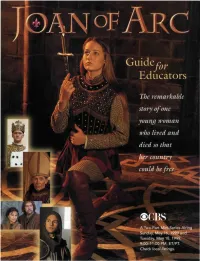
*?i i<\ T Guide rQ> Educators • • The remarkable • • . • -. •. story of one young woman who lived and m^m irtitfir her country eould be free. Two-Part Mini-Series Airim ay, May 16, 1999 an Tuesday, May 18, 1999, 9:00-11:00 PM, ET/PT. Check local \'r* Tips for Using the JOAN OF ARC Educators' Guide and Website There are endless ways to create exciting lessons around the mini- series JOAN OF ARC. Here are some ideas to help you get started. Synopsis Before Viewing: Joan of Arc's humble roots begin in Domremy, in south • Review the SYNOPSES to familiarize ern France, during the Hundred Years' War. Joan's your students with the stories and father almost kills her at birth because he believes a characters in JOAN OF ARC. daughter cannot do the man's work that is needed. • Participate in the interactive ONLINE DISCUSSION with "Joan However, Joan is spared and grows up a clever and of Arc," to develop an understand defiant child, always seeking equal privilege to her ing about her place in history. brothers. Her life—and the fate of her country—begins • Assign JOAN OF ARC for viewing to change when she experiences visions and voices of as enrichment, homework, or extra credit. Saints Catherine, Michael, and Margaret. At 16, Joan After Viewing: leaves her family and village on her divine mission to • Use the DISCUSSION QUESTIONS help the Dauphin Charles gain his crown and, thus, and STUDENT ACTIVITIES in this unite France against its English enemies. guide to direct purposeful viewing and extend student investigation. -
Saint Joan Script Glossary Compiled by Richard Rossi Italicized Definitions Have an Accompanying Picture Scene I
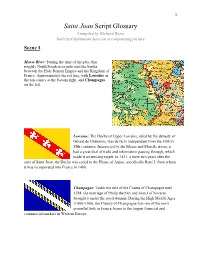
1 Saint Joan Script Glossary Compiled by Richard Rossi Italicized definitions have an accompanying picture Scene I Meuse River: During the time of the play, this roughly North/South river indicated the border between the Holy Roman Empire and the Kingdom of France. Approximately the red line, with Lorraine as the tan county at the bottom right, and Champagne on the left. Lorraine: The Duchy of Upper Lorraine, ruled by the dynasty of Gérard de Châtenois, was de facto independent from the 10th to 15th centuries. Intersected by the Meuse and Moselle rivers, it had a great deal of trade and information passing through, which made it an enticing target. In 1431, a mere two years after the start of Saint Joan, the Duchy was ceded to the House of Anjou, specifically René I, from whom it was incorporated into France in 1480. Champagne: Under the rule of the Counts of Champagne until 1284, the marriage of Philip the Fair and Joan I of Navarre brought it under the royal domain. During the High Middle Ages (1000-1300), the County of Champagne was one of the most powerful fiefs in France, home to the largest financial and commercial markets in Western Europe. 2 Vaucouleurs Castle: The main defense of “the town that armed Joan of Arc” and the residence of Robert de Baudricourt. The unruined structures, including the gothic chapel on the right, were rebuilt during the 18th century. Robert de Baudricourt: (1400-1454) minor French nobility, the son of the chamberlain of the Duke of Bar (Liebald de Baudricourt).