Altamira Año 1960
Total Page:16
File Type:pdf, Size:1020Kb
Load more
Recommended publications
-

L1i Brería Asturiana Llimiara (P
Les collaboraciones de LLETRES ASTURIA- NES empobínense al apartáu 574 d'Uviéu. LTAcademianun ta obligada a tornar los orixi- nales que nun s'asoleyen. Los artículos firmaos son responsabilidá dafechu de los sos autores. ASOLEYA: Academia de la Llingua Asturiana EMPRENTA: Grussi - Uviéu DPTU. LLEGAL: O - 826182 1. S. s. N.: 0212 - 0534 ENTAMU Nun ye d'aconseyar jacuéi? De magar naciere, esta Academia caltúvose na idea de nun s'inxerir nes discusiones con presones que la entamaben escontra la llingua as- turiana. Pa nós ta perafitao que ye posible'l llogru de la so normaliza- ción social asina comu algamar que seya ferramienta amañosa pal tra- bayu lliterariu y comunicativu de tolos díes. Les nueses razones nun se dixebren pa ello de les qu'almiten que son vidables les demás llingües minoritaries espardíes perdayuri. La ventaxa de nueso 'foi siempre que los contrarios a la llingua, en- cirrizaos nes sos llacerioses zunes, nin foron munchos en númberu nin intelixentes nos sos planteamientos. Llueu les sos llagunes informatives fexeron ver a la xente de bona voluntá y xuiciu que se contaben aven- tures ellí onde facia talta encontar con razones. De toes maneres, ye posible que'l nuesu facer nun fora entendíu al dereches por delles presones que col mal conseyu del so oportunismu quixeron ver debilidá u namái se daba prudencia pela nuesa parte. Y ye posible qu'eses presones, desengañaes d'un procesu que nun dio pasu a les sos presonales ambiciones, camentando que'l Gobiernu Asturianu pue dir alantre nel camín recuperador, quemen agora l'últimu cartuchu naguando por torgar lo qu'a estes altures yá-yos resulta imparable, la reconocencia dafechu de la llingua na sociedá asturiana. -

Hispania Written and Illustrated by Ana Rosa Rodriguez and Juan Antonio Perojo for the Creafudge Contest
Demonio Sonriente se enorgullece de presentar: escrito y dibujado por: Jon “Bandido“ Perojo gutierrez ana “miss bennet“ rodriguez gonzalez Open Game License Version 1.0a The following text is the property of Wizards of the Coast, Inc. and is Copyright 2000 Wizards of the Coast, Inc (“Wizards”). All Rights Reserved. 1. Definitions: (a)”Contributors” means the copyright and/or trademark owners who have contributed Open Game Content; (b)”Derivative Material” means copyrighted material including derivative works and translations (including into other computer languages), potation, modification, correction, addition, extension, upgrade, improvement, compilation, abridgment or other form in which an existing work may be recast, transformed or adapted; (c) “Distribute” means to reproduce, license, rent, lease, sell, broadcast, publicly display, transmit or otherwise distribute; (d)”Open Game Content” means the game mechanic and includes the methods, procedures, processes and routines to the extent such content does not embody the Product Identity and is an enhance- ment over the prior art and any additional content clearly identified as Open Game Content by the Contributor, and means any work covered by this License, including translations and derivative works under copyright law, but specifically excludes Product Identity. (e) “Product Identity” means product and product line names, logos and identifying marks including trade dress; artifacts; creatures characters; stories, storylines, plots, thematic elements, dialogue, incidents, language, -

Aspectos De La Romanizacion Segun Las Fuentes Escritas En La Provincia De Palencia
ASPECTOS DE LA ROMANIZACION SEGUN LAS FUENTES ESCRITAS EN LA PROVINCIA DE PALENCIA por Liborio Hernández Guerra ASPECTOS DE LA ROMANIZACION SEGUN LAS FUENTES ESCRITAS . 209 INTRODUCCION En el presente trabajo intentamos resumir nuestra Tesis Doctoral que lleva por título "Las fuentes antiguas escritas en época romana en la provincia de Palencia", leída en la Facultad de Filosofía y Letras de la Universidad de Valladolid. Debido a su amplitud nos hemos centrado principalmente, a la hora de sintetizar dicho trabajo, en cuestiones generales sobre el proceso de romani- zación en la provincia de Palencia. En dicha Tesis, abarcamos lo que es base fundamental de un estudio de Historia Antigua, los "elementos escritos": las Fontes y la Epigrafía, que si bien es verdad que las primeras no se habían recogido, sobre las segundas se habían realizado hasta la fecha algunos estudios que hemos tenido presentes (1). En el presente trabajo desarrollamos, por un lado, el estudio de las fuentes antiguas escritas, las histórico-literarias y las geográficas ; por otro, las fuentes epigráficas . Todas ellas (las "Fontes") nos han proporcionado un material que permite un mejor conocimiento de los pueblos prerromanos : cántabros, vac- ceo y turmogos que ocupaban el solar de la actual provincia de Palencia, así como su transformación bajo la influencia romana. Veamos las noticias de los autores antiguos ("Fontes") que hablan de la provincia de Palencia, así como la aportación de la Epigrafía. 1.- Del estudio de las fuentes clásicas vemos la confluencia de tres pueblos en la privincia palentina : por el norte, el pueblo cántabro ; por el sur, el pueblo vacceo y por el este, los Turmogos, cuyos límites y definición, a veces, son difíciles de establecer por lo que debemos acudir a los epígrafes. -

El Balneario Romano: Aspectos Médicos, Funcionales Y Religiosos
El balneario romano y la Cueva Negra ... Antig. Crist. (Murcia) XIII, 1996, pág. 23-151 EL BALNEARIO ROMANO: ASPECTOS MÉDICOS, FUNCIONALES Y RELIGIOSOS RESUMEN En el artículo se estudian los balnearios en el mundo romano. Se analiza la función medicinal (balneoterapia) en el mundo antiguo. También se estudia su funcionamiento, desde el proceso de construcción hasta un día en la vida normal de un balneario. Por último el ca- rácter religioso de las fuentes medicinales así como los dioses relacionados con el culto a las aguas. Palabras clave: balneario, terma, balneoterapia, aguas minerales, aguas medicinales, culto a las aguas. ABSTRACT In the article the spas are studied in the Roman world. The medicinal function is analyzed (balneotherapy) in the old world. Their operation is also studied, from the construction process until one day in the normal life of a spa. Lastly the religious character of the medicinal sources as well as the gods related with the cult to the waters. Keywords: spa, terma, balneoterapia, mineral waters, medicinal waters, cult to the waters. El objetivo de este trabajo es ofrecer una visión general de la balneoterapia hispana para abordar todas las cuestiones relacionadas con los baños de aguas medicinales. Estas cuestiones son: el estudio general sobre la balneoterapia romana desde el punto de vista de la medicina, el análisis del uso y funcionamiento de los balnearios de aguas minero-medicinales en el mundo romano y el estudio sobre las divinidades relacionadas con los balnearios hispanos y su relación con el mundo de las aguas medicinales1. 1. LA BALNEOTERAPIA EN EL MUNDO ANTIGUO No sólo los romanos, sino casi todos los pueblos de la Antigüedad han tenido conocimiento de las virtudes terapéuticas y curativas de determinadas aguas y de los beneficios que se desprendían del uso regular del baño y del uso del agua como remedio poderoso para los males de la especie humana. -

Anatomy of Melancholy by Democritus Junior
THE ANATOMY OF MELANCHOLY WHAT IT IS WITH ALL THE KINDS, CAUSES, SYMPTOMS, PROGNOSTICS, AND SEVERAL CURES OF IT IN THREE PARTITIONS; WITH THEIR SEVERAL SECTIONS, MEMBERS, AND SUBSECTIONS, PHILOSOPHICALLY, MEDICINALLY, HISTORICALLY OPENED AND CUT UP BY DEMOCRITUS JUNIOR [ROBERT BURTON] WITH A SATIRICAL PREFACE, CONDUCING TO THE FOLLOWING DISCOURSE PART 3 – Love-Melancholy and Religious Melancholy Published by the Ex-classics Project, 2009 http://www.exclassics.com Public Domain ROBERT BURTON CONTENTS The Preface ....................................................................................................................8 Love's Beginning, Object, Definition, Division ..........................................................28 Love of Men, which varies as his Objects, Profitable, Pleasant, Honest.....................33 Love of Men, which varies as his Objects, Profitable, Pleasant, Honest.....................33 Pleasant Objects of Love .............................................................................................36 Pleasant Objects of Love .............................................................................................36 Honest Objects of Love ...............................................................................................38 Honest Objects of Love ...............................................................................................38 Charity composed of all three Kinds, Pleasant, Profitable, Honest .............................42 Charity composed of all three Kinds, Pleasant, -
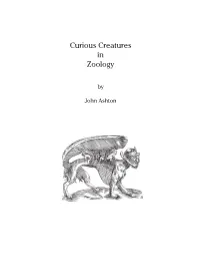
Curious Creatures in Zoology
CuriousCreatures in Zoology by JohnAshton ArmentBiologicalPress ThisElectronicPublicationisareprintofJohnAshton’s CuriousCreaturesinZoology. ThiseditionwasoriginallypublishedbyCassellPublishinginNewYork.TheNewYork editiondoesnotshowacopyrightdate,buttheLondoneditionwaspublishedin1890.The currentpublisherhasattemptedtoretainallpertinenttextandfigures,butformatchanges werenecessary.Becausepaginationhaschanged,textreferenceswillnotnecessarilyreferto specificpagesinthiselectronicdocument.InternallinkshavebeencreatedfortheTable ofContentsandtheIndex.IfyouareviewingthisdocumentwithAdobeAcrobatReader®, justclickonthelinks. Thiselectronicreprintis©2000byArmentBiologicalPress. Theoriginaltextisinthepublicdomain,howeverallchanges,formattingandpresentation ofthispublicationarecopyrightedbythecurrentpublisher. ISBN1-930585-05-5 ArmentBiologicalPress Landisville,PA www.herper.com/ebooks/ Preface “TRAVELLERS see strange things,” more especially when their writing about, or delineation of, them is not put under the microscope of modern scientific examination. Our ancestors were content with what was given them, and being, as a rule, a stay-at- home race, they could not confute the stories they read in books. That age of faith must have had its comforts, for no man could deny the truth of what he was told. But now that modern travel has subdued the globe, and inquisitive strangers have poked their noses into every portion of the world, “the old order changeth, giving place to new,” and, gradually, the old stories are forgotten. It is to rescue some of -

L'africa ROMANA T Rasformazione Dei Paesaggi Del Potere Nell'africa Settentrionale Fino Alla Fine Del Mondo Antico
L'AFRICA ROMANA T rasformazione dei paesaggi del potere nell'Africa settentrionale fino alla fine del mondo antico A cura di Maria Bastiana Cocco, Alberto Gavini, Antonio Ibba Volume primo Carocci Collana del Dipartimento di Storia, Scienze dell’Uomo e della Formazione dell’Università degli Studi di Sassari Serie del Centro di Studi Interdisciplinari sulle Province Romane Direttore: Raimondo Zucca 43* In copertina: Praetorium della Legio III Augusta a Lambaesis (foto di Attilio Mastino). 1a edizione, novembre 2012 © copyright 2012 by Carocci editore S.p.A., Roma Finito di stampare nel novembre 2012 issn 1828-3004 isbn 978-88-430-6287-4 Riproduzione vietata ai sensi di legge (art. 171 della legge 22 aprile 1941, n. 633) Senza regolare autorizzazione, è vietato riprodurre questo volume anche parzialmente e con qualsiasi mezzo, compresa la fotocopia, anche per uso interno o didattico. I lettori che desiderano informazioni sui volumi pubblicati dalla casa editrice possono rivolgersi direttamente a: Carocci editore corso Vittorio Emanuele II 229 - 00186 Roma telefono 06 / 42818417 - fax 06 / 42747931 Visitateci sul nostro sito Internet: http://www.carocci.it Trasformazione dei paesaggi del potere nell’Africa settentrionale fino alla fine del mondo antico Atti del XIX convegno di studio Sassari, 16-19 dicembre 2010 A cura di Maria Bastiana Cocco, Alberto Gavini, Antonio Ibba Volume primo Carocci editore Volume pubblicato con il contributo finanziario di: FONDAZIONE BANCO DI SARDEGNA UNIVERSITÀ DEGLI STUDI DI SASSARI I saggi di questi Atti di convegno sono stati sottoposti a referaggio. Comitato scientifico Presidente: Attilio Mastino Componenti: Aomar Akerraz, Angela Antona, Samir Aounallah, Piero Bartoloni, Nacéra Benseddik, Paolo Bernardini, Azedine Beschaouch, José Mar´ıa Bl´azquez, Antonietta Boninu, Giovanni Brizzi, Francesca Cenerini, Antonio Maria Corda, Lietta De Salvo, Angela Donati, Rubens D’Oriano, Mounir Fantar, Piergiorgio Floris, Emilio Galvagno, Elisabetta Garau, Mansour Ghaki, Julián González, John J. -

Toponyms of Lusitania: a Re-Assessment of Their Origins Autor(Es): Curchin, Leonard A
Toponyms of Lusitania: a re-assessment of their origins Autor(es): Curchin, Leonard A. Publicado por: Faculdade de Letras da Universidade de Coimbra URL persistente: URI:http://hdl.handle.net/10316.2/37749 DOI: DOI:http://dx.doi.org/10.14195/1647-8657_46_7 Accessed : 6-Oct-2021 17:37:31 A navegação consulta e descarregamento dos títulos inseridos nas Bibliotecas Digitais UC Digitalis, UC Pombalina e UC Impactum, pressupõem a aceitação plena e sem reservas dos Termos e Condições de Uso destas Bibliotecas Digitais, disponíveis em https://digitalis.uc.pt/pt-pt/termos. Conforme exposto nos referidos Termos e Condições de Uso, o descarregamento de títulos de acesso restrito requer uma licença válida de autorização devendo o utilizador aceder ao(s) documento(s) a partir de um endereço de IP da instituição detentora da supramencionada licença. Ao utilizador é apenas permitido o descarregamento para uso pessoal, pelo que o emprego do(s) título(s) descarregado(s) para outro fim, designadamente comercial, carece de autorização do respetivo autor ou editor da obra. Na medida em que todas as obras da UC Digitalis se encontram protegidas pelo Código do Direito de Autor e Direitos Conexos e demais legislação aplicável, toda a cópia, parcial ou total, deste documento, nos casos em que é legalmente admitida, deverá conter ou fazer-se acompanhar por este aviso. impactum.uc.pt digitalis.uc.pt LEONARD A. CURCHIN Classical Studies. University of Waterloo (Canada) TOPONYMS OF LUSITANIA: A RE-ASSESSMENT OF THEIR ORIGINS “Conimbriga” XLVI (2007) p. 129-160 ABSTRACT: Recent advances in linguistic theory and methodology have given greater scientific validity to the study of ancient toponyms. -

'Du Lard Ou Du Cochon'? the Testamentum Porcelli As A
CORE Metadata, citation and similar papers at core.ac.uk Published in A Tall Order. Writing the Social History of the Ancient World 216 : 107-141, 2005 1 Provided by RERO DOC Digital Library which should be used for any reference to this work Jean-Jacques Aubert ‘Du lard ou du cochon’? The Testamentum Porcelli as a Jewish Anti-Christian Pamphlet* to the teacher and friend who will know how to read my threefold and trivial dissimulatio A Strange, Mysterious Text At the very beginning of the fifth century A.D., Jerome twice refers to an unusual piece of Latin literature, traditionally entitled Testamentum porcelli or A Piglet’s Will. First in 401/402, ranting about Rufinus of Aquileia in his Apologia Contra Rufinum, he claims that Quasi non cirratorum turba Milesiarum in scholis figmenta decantet et testamentum suis Bessorum cachinno membra concutiat atque inter scurrarum epulas nugae istius modi frequententur. Classes of curly-haired boys are reciting Milesian tales in schools and the pig’s will cracks them up, making them burst into Bessian laughter, as that kind of tomfoolery usually occurs during jesters’ banquets.1 * This paper was initially written for a trial lecture for the professorship in Latin language and literature at the University of Neuchâtel, subsequently enlarged and first published in French in honor of W.V. Harris in J.U. Kalms (ed.), Internationales Josephus-Kolloquium Aarhus 1999 (Münsteraner Judaistische Studien 6, Münster 2000) 302-36, under the title “Du lard ou du cochon? Une lecture à rebrousse-soies du Testamentum porcelli.” The response of some readers induced me to translate it into English (with some minor changes and revisions) for this volume, with the kind permission of Prof. -

Penetración Romana En Los Picos De Europa
PENETRACIÓN ROMANA EN LOS PICOS DE EUROPA Por: Má Josefa Martínez Pereda PENETRACIÓN ROMANA EN LOS PICOS DE EUROPA 17 INTRODUCCIÓN El título de nuestro trabajo es «Penetración romana en los Picos de Europa». Ha sido motivado por una de las partes que se tratan en la asignatura de Lengua Latina de BUP . En el apartado de historia, vida y costumbres romanas intentamos partir en la medida de lo posible del entorno que habitamos, en este caso concreto de la zona de Guardo, en el norte de Palencia. Para recabar noticias sobre el tema, comenzamos buscando noticias de tradi- ción oral, parte de la que se encargaron los alumnos por ser oriundos del lugar, para luego pasar a la documentación escrita y de carácter más científico. Cuando comenzamos a poner en marcha este trabajo nos encontramos con la gran escasez de datos existentes, sólo podíamos contar con un puente derruido y la fuente llamada La Reana en Velilla del Río Carrión. A partir de aquí comenzaron a surgir las preguntas ¿cómo la zona no va a contar con cierta historia si hay un texto literario de bastante extensión que nos habla de la Reana? ¿Por qué se molesto Plinio en hablar de ella (N .H. XXXI, 23-24) siendo una zona en la que, según parece, prácticamente no estuvieron los romanos? ¿Cómo es posible que, habiendo jugado un papel tan importante en las Guerras Cántabras los Picos de Europa, esta zona del norte de Palencia, de situación privilegiada, pues está a pocos kilómetros de los Picos, con fácil acceso natural y lindando con la zona vaccea, aliada de los romanos, no hubiera sufrido la presencia romana? ¿Cómo siendo una zona rica en todo tipo de mineral, los romanos no lo explotaron cuando en otras zonas de la Península práctica- mente lo agotaron? ¿Cómo es posible que haya restos arqueológicos que nos indican presencia romana desde Saldaña hasta Guardo? Estas y otras preguntas nos animaron a buscar documentación sobre el tema, pero, para evitar que la zona se dilatase demasiado, decidimos marcarnos la extensión geográfica que queríamos estudiar . -

Libri Xxxvii
F¥ NOVA SCRIPTOnUM LATINORUM BIBLIOTHECA NOVA SCRIPTORUM LATINORUM BIBLIOTHECA AD OPTIMAS EDITIONES RECENSITA ACCUBAMTIBUS PARISIEITSTS ACADEMIJE PROFESSORIBUS ET COLLIGENTE J. P. CHARPENTIER RHETORICES PROFESSORE EDIDIT C. L. F. PANCROUCRE aizq °^\ PA fefea ^.o Correi ci- / ;] EXCUDIT C. 'Ù^n^O^^SSS^^x/J EQJUES LEGIONI HON^rS^ApsCftiPTB» ( >- M DCCC XXXVIII. C. PUNII SECUNDI HISTORIA NATURALIS C. PLINII SECUNDI HISTORIiE NATURA US LIBRI XXXVII QUIBTJS ACCESSERE NOVUS INDEX ANIMALIUM , MINERALIUM, VEGETABILIUM SYNONYMICUS, NOMIKUMQUE ET RERUM QUO AD GETERA ENODATIO , HABITA ALPHABETICI ORDINIS RATIONE , ' E NOTIS GALLICHE EDITIONIS AJASSON DE GRANDSAGNE QUARUM AUCTORES EXSTIlERE AD ZOOSOPHIAM, UT PLURIMUM, G. OLIVIER PASSIM VERO, ET IN US TJtLÉ ZOOSOPHI.fi NON ERANT, I)OÉ, E. DOLO, FÉE, L. EOUCHE, EL. JOHANNEAU, L. MARCUS, C. L. F. PANCKOUCKE, VAL. PARISOT, ETC. VOLUMEN NONUM. ò\iq PARISIIS EXCUDIT C. L. F. PANCROUCRE EQUES LEGIONI HONORIS ADSCRIPTUS M DCCC XXXVHI. >«%>W»*'»*»> INDEX IIISTORICUS. NOMINA PROPRIA NUMINUM, VIRORUM, FEMIlNAR*Jai. Absyrtus Medea» frater, III, 3o. JEgimius, VII, 4g. Acaslus, VII, 57. -Egineta Gctor, XXXV, 40. Acca Laurentia,XVIII, 2. -ffigisthum ab Oreste interfìci,XXXV, Accius in Praxidico, XVIII, 55.— 40. poeta, XXXIV , io. — Priscus , .ffigle (Socralis), XXXV, 40. XXXV, 37. jE^losthenes, IV, 22. Aciiilles Telephum sanasse dicitur, JEIius C. trib. plebis, XXXIV, i5. XXV, 19; XXXIV, 45. — Sila- — Calus, XXXIII, 5o. — P. cos. nionis,(signum), XXXIV, 19.— XVIII, 46. — Gallus, VI, 32. — Parrhasii (tabula), XXXV, 36. — Stilo , IX , 5g. — Praconiuus, virginis habitù occultatus, XXXV, XXXIII, 7.— Tubero, VII, 53; 40. •— cimi Chirone ( statua ), X, 20. XXXVI, 4. — Acliillis tumulus, JEmilianus Scipio, V, 1; VII, 28; IV, 26.